](https://deep-paper.org/en/paper/2505.13628/images/cover.png)
Introduction: The Tower of Babel Problem in AI
Imagine you are trying to learn a language that is completely foreign to you—perhaps Quechua or Swahili—and you have no dictionary. You do, however, have a photo album. You point to a picture of a dog, and a local speaker says “allqu” (in Quechua). You point to a picture of the sun, and they say “inti.” Eventually, without ever seeing a direct translation to English, you begin to understand the language through the shared reality of the visual world.
This concept, known as visual grounding, is the core inspiration behind a fascinating new paper titled “Cross-Lingual Representation Alignment Through Contrastive Image-Caption Tuning.”
In the field of Natural Language Processing (NLP), we face a significant hurdle known as the “low-resource” problem. Massive language models (like the ones powering ChatGPT or Google Translate) are typically trained on enormous amounts of text. Specifically, they rely heavily on bitexts—pairs of sentences that are direct translations of each other (e.g., a sentence in English paired with its exact translation in French).
For widely spoken languages like Spanish, Chinese, or German, bitexts are abundant. But for thousands of other languages, these resources simply don’t exist in the volumes required to train deep learning models. Collecting high-quality, expert-translated parallel text is expensive, slow, and often impossible for underserved communities.
So, how do we build AI that understands these languages? The researchers in this paper propose a solution that bypasses the need for parallel text entirely: using images as a bridge.
Their hypothesis is elegant in its simplicity: If we can teach a model that the English sentence “A cat sits on a mat” describes Image X, and the Quechua sentence “Michi qatasqa matapi tiyan” also describes Image X, then the model should implicitly learn that the English and Quechua sentences mean the same thing.
In this deep dive, we will explore how the authors utilized contrastive learning to align languages without a single direct translation between them, how they successfully integrated an indigenous language (Quechua) that the model had never seen before, and what this implies for the future of inclusive AI.
Background: The Challenge of Representation Alignment
To understand why this approach is novel, we first need to understand how modern NLP models handle multiple languages.
Encoder Language Models
The backbone of this research is the Encoder Language Model, specifically a model called XLM-R (Cross-lingual Language Model - Roberta). Think of an encoder as a machine that translates text into numbers. It takes a sentence and converts it into a “vector” or “embedding”—a long list of numbers that represents the meaning of that sentence in a multi-dimensional space.
Ideally, in a multilingual model, the vector for “dog” in English should be very close to the vector for “perro” in Spanish. If they are close in this mathematical space, the model understands that they share a semantic meaning.
The Disjointed Space Problem
However, simply showing a model lots of text in different languages doesn’t guarantee this alignment. If a model reads English Wikipedia and Hindi Wikipedia separately, it might create a cluster of English vectors in one corner of the room and a cluster of Hindi vectors in another. They are disjoint.
Traditionally, researchers fix this by feeding the model bitexts (parallel translations) to force the representations together. But as we established, we don’t always have those translations.
Enter Contrastive Learning
The researchers turn to Contrastive Learning, a technique that has revolutionized computer vision (most notably in OpenAI’s CLIP model). The logic of contrastive learning is roughly: “Pull matching things closer together, and push non-matching things far apart.”
By using image-caption pairs, the authors aim to use the image as a “pivot.” If Language A aligns with the Image, and Language B aligns with the same Image, then Language A and B should theoretically align with each other.
The Core Method: Text-Image Contrastive Tuning
The methodology employed in this paper is a clever adaptation of the CLIP architecture, fine-tuned for a multilingual setting. Let’s break down the architecture and the training process.
The Two Towers
The model consists of two main components, often referred to as a “two-tower” architecture:
- The Text Encoder: The authors use XLM-Roberta-Large (XLM-R). This is a massive model pre-trained on 100 languages. It effectively processes the captions.
- The Image Encoder: They use a Vision Transformer (ViT). This model breaks images into patches and processes them to extract visual features.
Because these two models come from different families, their output vectors (the lists of numbers they produce) are different sizes. To fix this, the authors add a linear layer (a simple mathematical transformation) to the end of both models to project their outputs into a shared dimension of 512.
The Mathematical Heart: Contrastive Loss
The magic happens in how these models are trained. The goal is to maximize the similarity between the correct image-caption pairs while minimizing the similarity with incorrect ones.
The authors use a standard contrastive loss function. Let’s look at the mathematical formulation they used:
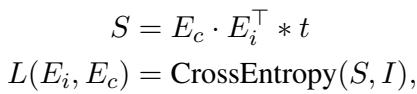
Here is what this equation tells us:
- \(S = E_c \cdot E_i^\top * t\): This calculates the Similarity Score (\(S\)).
- \(E_c\) is the vector representation of the Caption.
- \(E_i\) is the vector representation of the Image.
- The dot (\(\cdot\)) represents a dot product. In vector math, a high dot product means two vectors are pointing in the same direction (they are similar).
- \(t\) is a learned temperature parameter. This scaling factor helps the model distinguish between “very similar” and “somewhat similar” pairs more sharply, preventing the probability distribution from being too flat.
- \(L(E_i, E_c) = \mathrm{CrossEntropy}(S, I)\): This is the Loss Function (\(L\)).
- The model looks at a batch of images and captions (say, 100 pairs).
- For every image, it calculates the similarity score with all 100 captions.
- The goal is to have the highest score on the diagonal (where Image 1 matches Caption 1) and low scores everywhere else.
- CrossEntropy is the standard way to measure the error between the predicted match and the actual match.
The Training Data Strategy
To test their hypothesis, the researchers needed a controlled environment. They utilized the MS-COCO dataset, a famous collection of 118,000 images, each with English captions.
They didn’t just use the English captions, though. Using Google Translate, they created a synthetic multilingual dataset by translating the English captions into:
- Spanish
- Japanese
- Hindi
- Quechua (Crucially, Quechua was included to represent a low-resource language that the base XLM-R model might struggle with).
They then created four distinct experimental setups:
- Eng-Only: Trained only on English captions.
- Eng-Pivot: Trained on parallel text (English paired with Spanish/Japanese/Hindi) without images. This serves as a baseline for “traditional” alignment methods.
- Multilingual: Trained on images paired with captions rotated between English, Spanish, Japanese, and Hindi.
- Multilingual + Quechua: The same as above, but adding Quechua to the mix.
Experiments & Analysis
The authors conducted three major experiments to validate their approach. We will examine the results of each.
Experiment 1: Does Image Alignment Lead to Text Alignment?
The first question is the most fundamental: If I only train the model to match text to images, do the text representations of different languages align with each other?
To test this, they used a task called Bitext Retrieval. They took the Flores-200 dataset (a high-quality translation benchmark) and asked the model: “Here is a sentence in Hindi. Find the matching sentence in English.”
If the representations are aligned, the vector for the Hindi sentence should be mathematically closest to the vector for the English translation.
The Results: The “Multilingual” image-caption model performed impressively. While it didn’t quite match the “Eng-Pivot” model (which was trained directly on text translation pairs), it came very close. This proves the core hypothesis: visual overlap creates semantic text overlap.
To visualize this, the authors used t-SNE, a technique that compresses high-dimensional vectors onto a 2D plane so we can see how they cluster.

Let’s look closely at Figure 1 above:
- XLM-R (Far Left): Notice the distinct blobs. Each color represents a language. They are separated, meaning the model sees “English” and “Spanish” as different concepts. This is poor alignment.
- Eng-Pivot (Middle): The colors are mixed. This is what ideal alignment looks like using traditional parallel text.
- Multilingual (Right panels): Look at the two plots on the right. Even without parallel text, the colors are tightly clustered and overlapping. This visually confirms that the image-caption training forced the languages into the same semantic space.
Experiment 2: The “Zero-Shot” Quechua Test
This is perhaps the most exciting part of the paper. Quechua is an indigenous language of the Andes. It is not included in the pre-training data of XLM-R. This means the model essentially treats Quechua as random noise initially.
The researchers asked: Can we add Quechua to the model just by showing it images and Quechua captions?
This simulates a real-world scenario where a linguist might have a photo book with descriptions in a rare language but no English translations.
The Findings: When they moved from the “Multilingual” dataset to the “Multilingual + Quechua” dataset, the retrieval accuracy for Quechua jumped from 18.0% to 29.2%.
This is a significant finding. It demonstrates that languages unseen during pre-training can be incorporated “post-hoc” (after the fact) into the alignment using visual supervision. The model learned to associate Quechua words with visual concepts, which effectively anchored them to the English, Spanish, and Hindi representations of those same concepts.
Experiment 3: Preserving Downstream Intelligence
One risk of fine-tuning a model on a specific task (like matching images) is “catastrophic forgetting.” The model might get good at matching photos but lose its ability to understand complex logic or grammar.
To test this, the authors evaluated the models on XNLI (Cross-Lingual Natural Language Inference). NLI is a logic task: given a “Premise” and a “Hypothesis,” is the hypothesis true (entailment), false (contradiction), or unrelated (neutral)?
The researchers used a specific feature extraction method for this task, combining the encoded representations of the premise (\(p\)) and hypothesis (\(h\)):

As shown in the equation above, they feed the concatenation (\(\oplus\)) of the vectors, their absolute difference, and their product into a classifier. This standard approach forces the classifier to look at the relationship between the two sentences.
They trained the NLI classifier only on English data and then tested it on other languages. This is a true test of cross-lingual transfer. If the alignment works, an NLI classifier trained on English should work on Hindi.
The Results:
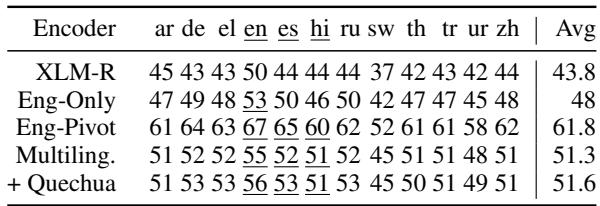
Looking at Table 2, we can draw several conclusions:
- Safety: The “Multilingual” image-tuned models (Avg 51.3) outperformed the baseline XLM-R (Avg 43.8). Tuning on images didn’t break the model; it made it smarter across languages.
- The Quechua Boost: Adding Quechua (the bottom row, “+ Quechua”) didn’t hurt performance on other languages. In fact, it slightly increased the average score (51.6 vs 51.3).
- English Improvement: Interestingly, adding Quechua even improved the score on English (56 vs 55). This suggests that exposing the model to more diverse linguistic structures—even from low-resource languages—can refine its general semantic understanding.
Limitations and Future Outlook
While the results are promising, the authors are transparent about limitations. The image-based alignment does not yet beat the state-of-the-art methods that use bitexts (notice “Eng-Pivot” still has the highest scores in Table 2). Bitexts provide a very dense, precise signal that images (which can be interpreted in many ways) struggle to replicate perfectly.
Additionally, when Quechua was added, the retrieval performance for other languages dipped slightly in some metrics. This was likely due to the researchers balancing the dataset size—to make room for Quechua, they had to show fewer examples of Spanish and Hindi. In a real-world application, one would simply add data without subtracting the others.
Conclusion
This paper provides compelling evidence for a more inclusive future in AI. By validating that visual information can act as a semantic bridge, the authors have opened a door for thousands of low-resource languages.
We no longer strictly need expensive, expert-translated parallel texts to align languages. Instead, we can leverage the universal language of imagery. A picture of a “sunset” looks the same in Fairfax, Tokyo, or Cusco. By grounding our AI models in this shared visual reality, we can bootstrap understanding for languages that have been historically left behind.
For students and researchers, the key takeaway is clear: Multimodality (using text and images together) isn’t just about generating pretty pictures; it’s a powerful structural tool for organizing information and bridging semantic gaps across cultures.