](https://deep-paper.org/en/paper/2505.15174/images/cover.png)
Building Bulletproof AI: The Block Reflector Orthogonal Layer and Logit Annealing
Deep learning models are undeniably powerful, achieving superhuman performance in tasks ranging from medical diagnosis to autonomous driving. Yet, they possess a startling weakness: adversarial attacks. A malicious actor can add imperceptible noise to an image—changes so subtle the human eye cannot detect them—and cause a state-of-the-art AI to misclassify a stop sign as a speed limit sign.
To combat this, researchers have developed “defenses.” Most are empirical—they work until a smarter attacker comes along. However, the gold standard is Certified Robustness. A certifiably robust model comes with a mathematical guarantee: for a given input, no perturbation within a specific range (the “radius”) can change the model’s prediction.
In a recent paper presented at the International Conference on Machine Learning (ICML) 2025, researchers introduced BRONet, a new architecture that pushes the boundaries of certified robustness. They achieved this through two key innovations: the Block Reflector Orthogonal (BRO) layer, a mathematically elegant and computationally efficient way to build robust networks, and Logit Annealing (LA) loss, a smarter way to train them.
This post will deconstruct the paper, explaining how these components work together to create efficient, certifiably robust neural networks.
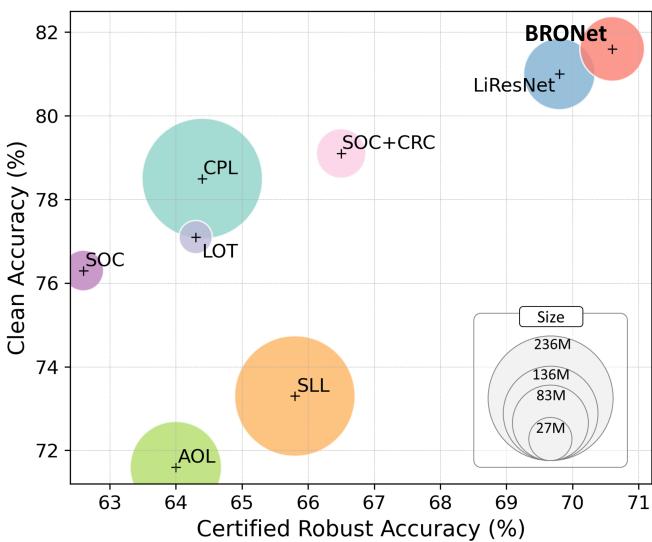
Figure 1: A landscape of certified robustness methods. The proposed BRONet (red bubbles) achieves a superior trade-off between clean accuracy and certified robust accuracy compared to existing baselines.
1. The Challenge: What is a Lipschitz Neural Network?
To understand why BRONet is significant, we must first understand the mechanism used to guarantee robustness: the Lipschitz constant.
In simple terms, a function is Lipschitz continuous if its output doesn’t change too wildly when the input changes. If a neural network \(f\) has a Lipschitz constant \(L\), it means that for any two inputs \(x_1\) and \(x_2\), the distance between their outputs is bounded by \(L\) times the distance between the inputs.

Why does this matter for security? If we know the Lipschitz constant \(L\), we can calculate exactly how much “wiggle room” an attacker has. If the network is 1-Lipschitz (meaning \(L=1\)), the change in the output logits can never be greater than the magnitude of the noise added to the input. This allows us to calculate a “certified radius”—a safety zone around an image where we are mathematically certain the prediction will not flip.
However, calculating the exact Lipschitz constant of a deep neural network is an NP-hard problem. To get around this, researchers use the composition property:

If we ensure that every single layer in the network is 1-Lipschitz (orthogonal), the entire network is 1-Lipschitz.
The Problem with Existing Methods
The theory is sound, but the engineering is difficult. Constructing a neural network where every layer is perfectly orthogonal (preserving the norm of the input) is computationally expensive.
Previous state-of-the-art methods like SOC (Skew-Orthogonal Convolution) and LOT (Layer-wise Orthogonal Training) rely on iterative algorithms. To make a layer orthogonal, they run a loop (like a Taylor expansion or Newton’s method) during every forward pass. This makes training slow, consumes massive amounts of memory, and sometimes results in numerical instability where the layer isn’t actually orthogonal.
We need a way to build orthogonal layers that is fast, memory-efficient, and mathematically exact. Enter the BRO Layer.
2. The Solution Part I: The BRO Layer
The Block Reflector Orthogonal (BRO) layer is designed to solve the efficiency bottleneck. Instead of using iterative approximations, it uses a direct parameterization based on Householder reflections (specifically, block reflectors), a concept from linear algebra used in QR decomposition.
The Math Behind BRO
The core idea is to construct an orthogonal matrix \(W\) from a smaller, unconstrained matrix \(V\). The researchers propose a specific parameterization:
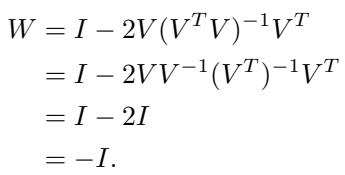
Wait, let’s look at the expanded form to understand the structure better:
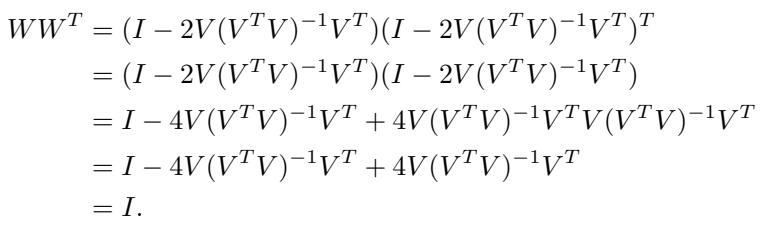
Here, \(W\) is the weight matrix of the layer. \(V\) is a trainable parameter matrix with a low rank (it has fewer columns than rows).
- Orthogonality: As shown in the derivation above, \(W W^T = I\). This proves that the matrix is perfectly orthogonal.
- Efficiency: Because \(V\) is “low-rank” (smaller than \(W\)), the matrix operations are cheaper to compute.
- No Iterations: Unlike SOC or LOT, which loop until they get “close enough” to orthogonal, the BRO formula yields an orthogonal matrix in a single shot.
Convolution via the Fourier Domain
The math above works for standard matrix multiplication (dense layers). But computer vision relies on Convolutional Neural Networks (CNNs). Making a convolution operation orthogonal is tricky.
The researchers leverage the Convolution Theorem: Convolution in the spatial domain is equivalent to point-wise multiplication in the frequency domain.
By using the Fast Fourier Transform (FFT), they convert the input image and the convolutional filters into the frequency domain. In this domain, the convolution operation becomes a sequence of matrix multiplications. They apply the BRO parameterization to these matrices and then use the Inverse FFT to get the result back in the spatial domain.
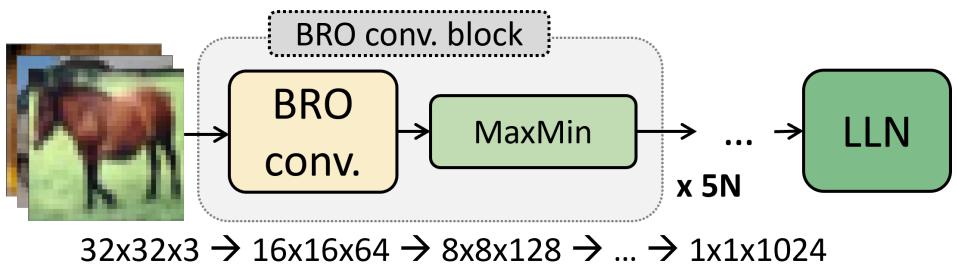
This process ensures the convolution is 1-Lipschitz (distance preserving) while being much faster than computing matrix exponentials (used in SOC) or iterative square roots (used in LOT).
Handling Dimensions
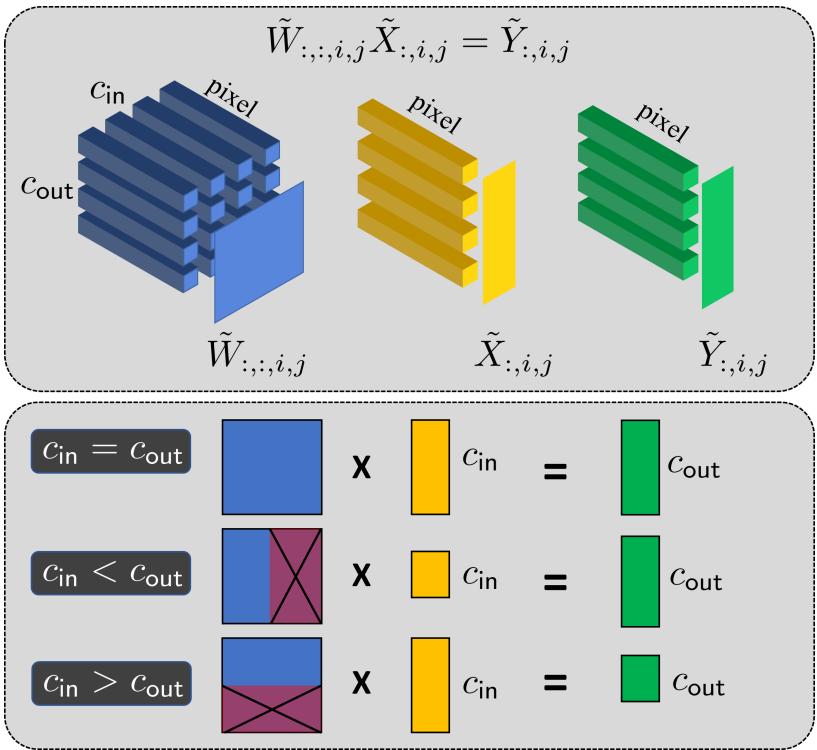
A strict orthogonal matrix must be square (input size equals output size). However, neural networks often change channel dimensions (e.g., going from 64 filters to 128 filters).
The BRO layer handles this gracefully:
- Expanding (Input < Output): The layer preserves the norm.
- reducing (Input > Output): The layer is non-expanding (1-Lipschitz), ensuring the robustness guarantee holds even if information is compressed.
Efficiency Gains
How much faster is it? The comparison is striking. As the number of layers increases, the runtime for iterative methods like LOT explodes. BRO scales much more gently because it avoids the internal loops.
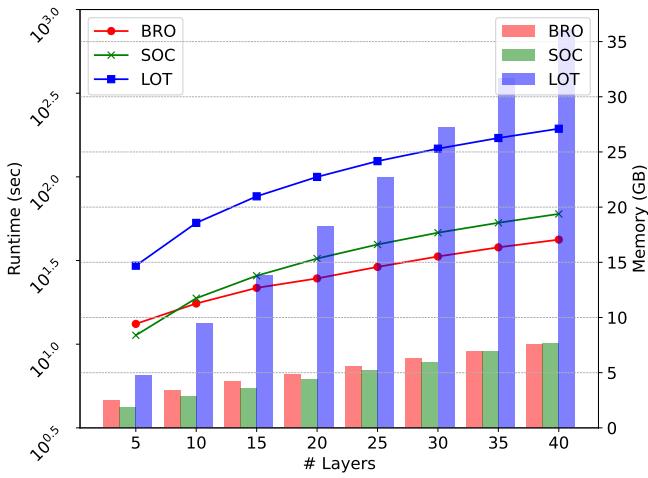
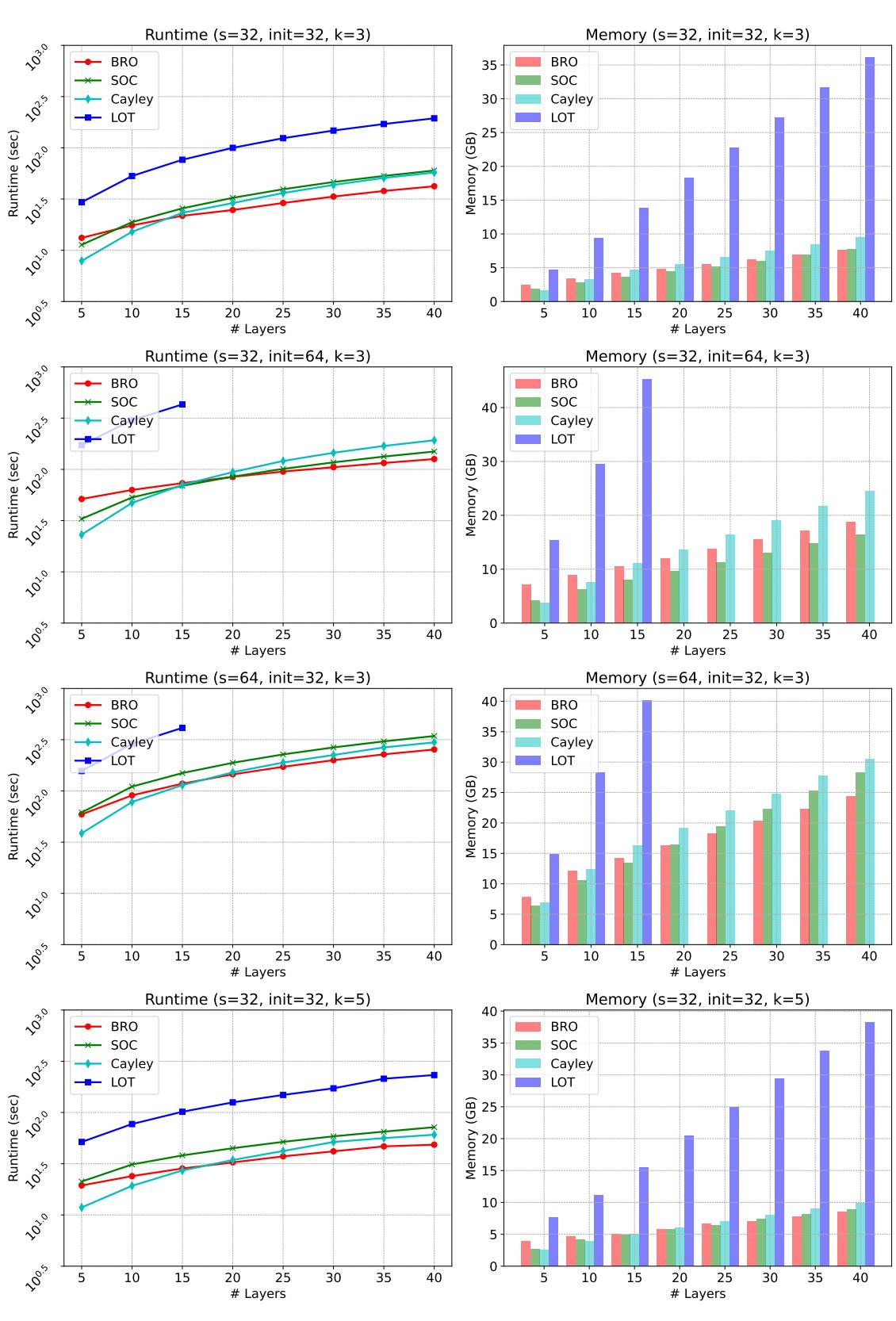
Furthermore, looking at specific configurations, we see that LOT consumes significantly more memory (GB) during training, which limits how deep we can make the network. BRO stays memory-efficient, allowing for deeper, more expressive architectures.
3. The Solution Part II: Logit Annealing (LA) Loss
Building a perfect orthogonal network addresses the architecture, but we still need to train it. This brings us to the second major contribution of the paper: the loss function.
The Limits of Lipschitz Networks
Standard neural networks can be incredibly complex. Lipschitz networks, by definition, are constrained. They are “stiff.” They cannot arbitrarily twist and distort the decision boundary to fit every single data point perfectly.
The authors use Rademacher Complexity to prove a theoretical point: Lipschitz networks have limited capacity.
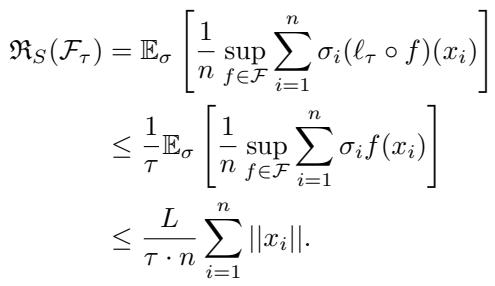
Because the complexity is bounded by \(L\), we cannot force the model to have arbitrarily large “margins” (the gap between the correct class score and the runner-up).
The Problem with Current Training Methods
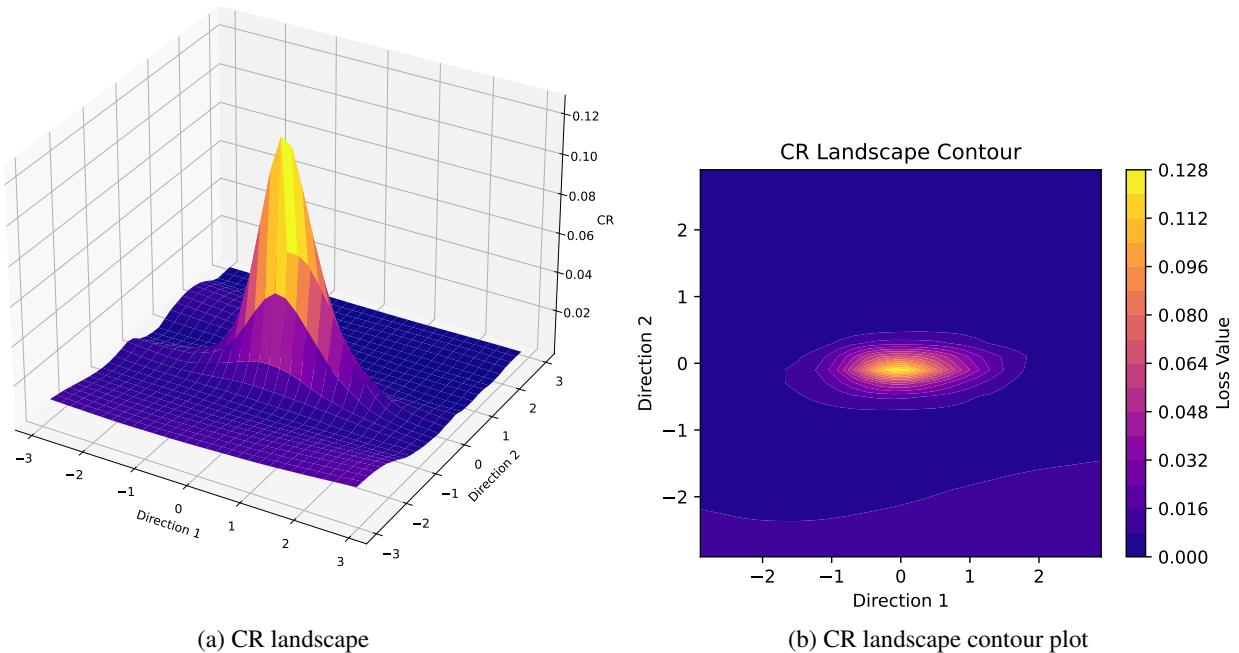
Previous methods used Certificate Regularization (CR). This adds a penalty to the loss function if the margin is small, aggressively pushing the model to increase the safety radius for every image.
The authors identify critical issues with CR:
- Discontinuous Gradients: The derivative jumps abruptly.
- Gradient Domination: As the model gets confident, the gradient explodes towards infinity, causing the training to focus entirely on easy examples rather than learning new ones.
- Impossible Goals: Because of the limited capacity proven above, CR tries to force the model to do something it mathematically cannot do for all data points.
Enter Logit Annealing
To solve this, the researchers propose Logit Annealing (LA) Loss.
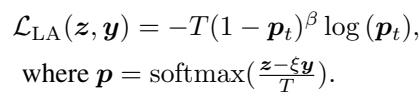
The intuition is brilliant in its simplicity: If the model is already doing “good enough” on a data point, stop worrying about it.
The term \((1 - p_t)^\beta\) acts as an annealing factor.
- When the probability of the true class \(p_t\) is low (the model is wrong), the loss is high, and the gradient is strong.
- As \(p_t\) approaches 1 (the model is confident and correct), the factor decays to zero.
This prevents the model from wasting its limited capacity trying to push the margin of easy images to infinity. Instead, it reallocates that capacity to the harder, boundary-case images.
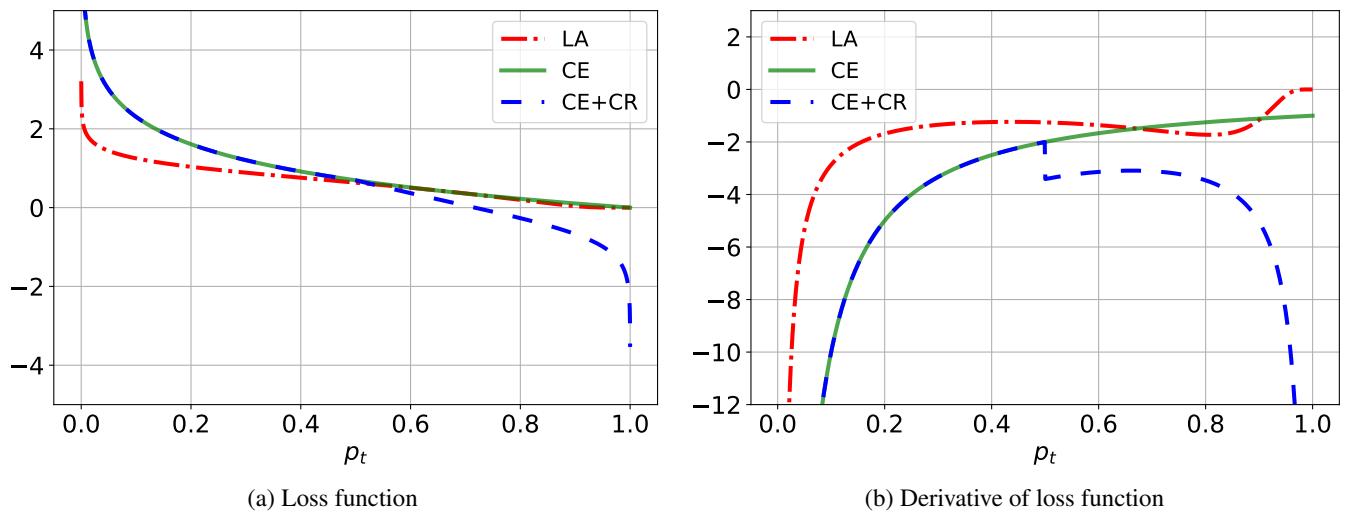
As shown above, the gradient of the LA loss (red dashed line) smoothly drops to zero as the model succeeds. The CR loss (blue), conversely, spikes, destabilizing training.
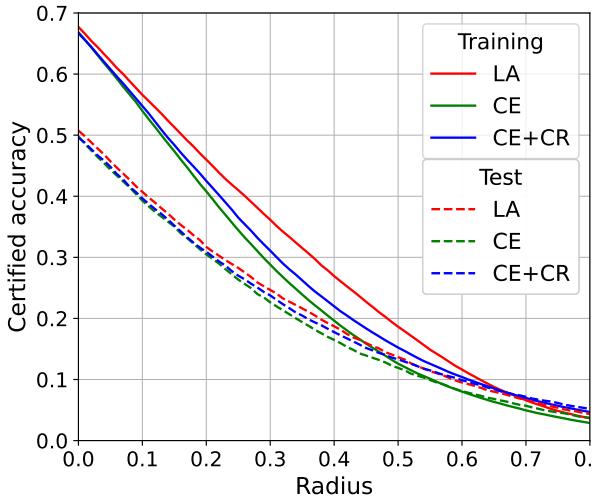
The result is a better distribution of margins. The model learns appropriate safety radii for most points rather than overfitting to a few.
4. Introducing BRONet
Combining the BRO Layer and LA Loss, the authors construct BRONet.
The architecture follows a standard ResNet-like structure but replaces the convolutional layers with BRO layers. It uses “MaxMin” activations (which preserve norms better than ReLU) and careful reparameterization to ensure the entire pipeline remains 1-Lipschitz.
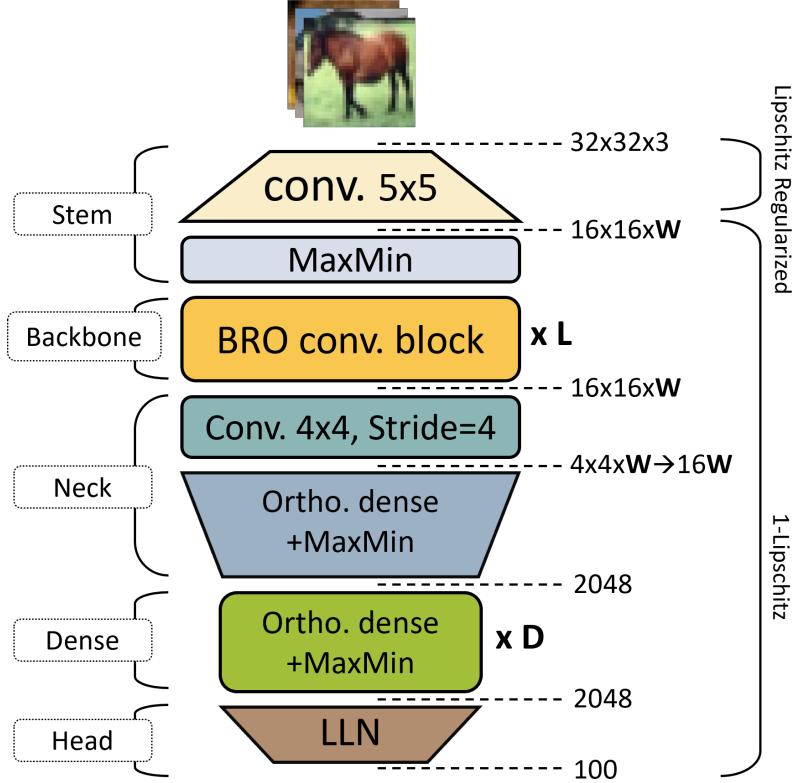
Key components include:
- Stem: Standard convolution (Lipschitz regularized).
- Backbone: Stacks of BRO Convolutional Blocks.
- Neck: Downsampling while maintaining Lipschitz constraints.
- Head: Orthonormal dense layers leading to the final classification.
5. Experimental Results
So, does it work? The results suggest a resounding yes.
State-of-the-Art Robustness
On benchmarks like CIFAR-10 and CIFAR-100, BRONet consistently outperforms existing 1-Lipschitz networks (like Cayley, SOC, and LOT) and other certified defense methods.
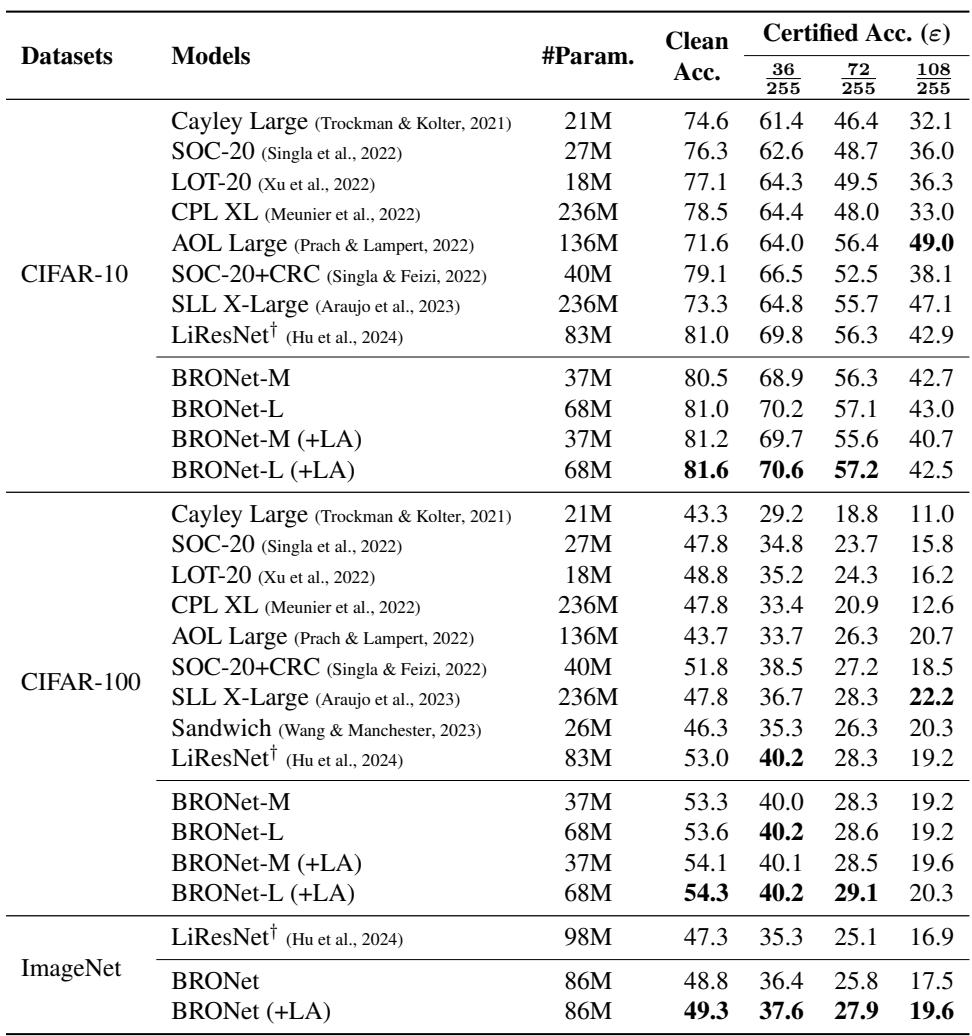
Notice in Table 1 that BRONet (bottom rows) achieves higher Certified Accuracy at various perturbation sizes (\(\epsilon = 36/255\), etc.) compared to models with similar or even larger parameter counts.
Scaling to ImageNet
One of the biggest hurdles for certified robustness is scaling to large datasets like ImageNet. Many previous methods simply run out of memory or take too long to train.
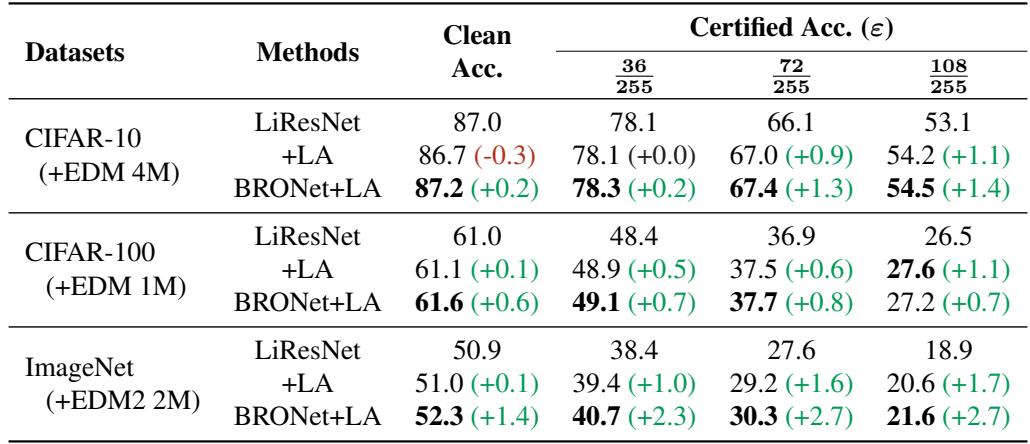
BRONet, thanks to the efficiency of the BRO layer, scales effectively. When combined with diffusion-generated data augmentation (a modern technique to improve robustness), BRONet sets new benchmarks.
Stability vs. LOT
One of the most damning findings in the paper regarding previous methods is the instability of LOT. The authors found that LOT, which relies on Newton’s method iterations to approximate orthogonality, often fails to converge to a true orthogonal matrix when using standard initializations (like Kaiming init).
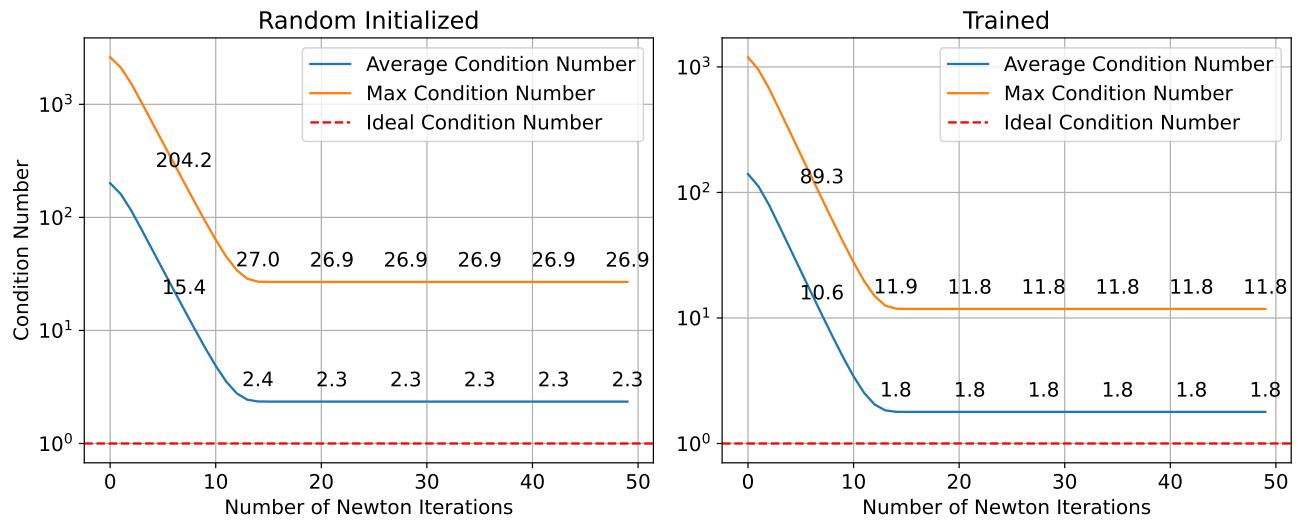
The “Condition Number” of an orthogonal matrix should be 1. As seen in the graphs, BRO (which is exact by design) doesn’t suffer from the convergence issues that iterative methods do.
6. Conclusion and Key Takeaways
The BRONet paper represents a maturing of the field of certified robustness. It moves away from “brute forcing” constraints via expensive iterative algorithms and towards elegant, exact mathematical constructions.
Key Takeaways for Students:
- Efficiency unlocks Depth: You cannot build deep, powerful robust networks if your layers consume too much memory or time. The BRO Layer’s low-rank, iteration-free design solves this.
- Capacity Matters: Constraints (like 1-Lipschitz) limit what a model can learn. Acknowledging this limitation is crucial.
- Smart Loss Functions: The Logit Annealing Loss teaches us that “harder” isn’t always better. By relaxing the penalty on easy examples, we allow the constrained model to focus its limited power where it’s needed most.
As AI systems are deployed in safety-critical environments—from self-driving cars to medical imaging—guarantees like the ones provided by BRONet will shift from being academic curiosities to absolute necessities.