](https://deep-paper.org/en/paper/2505.15694/images/cover.png)
Introduction
In the current landscape of Large Language Model (LLM) development, “alignment” is the North Star. We want models that are not just smart, but also helpful, honest, and harmless. To achieve this, we rely heavily on human feedback—specifically, datasets where humans indicate which of two model responses they prefer. This data powers the two dominant alignment paradigms: Reinforcement Learning from Human Feedback (RLHF) and Direct Preference Optimization (DPO).
But there is a crack in the foundation. Most theoretical work assumes that the preference labels provided by humans are perfect and readily available. In the real world, this is rarely the case. We face two distinct but overlapping threats:
- Privacy Concerns: Human preference data can reveal sensitive information. To protect users, we often need to “privatize” labels (e.g., using Local Differential Privacy), which intentionally adds noise to the data.
- Data Corruption: Whether through malicious data poisoning attacks or simple annotation errors, a fraction of the dataset is often incorrect (corrupted).
Until now, researchers have mostly looked at these problems in isolation—either fixing privacy or fixing robustness. But in practice, they coexist. Furthermore, does the order in which these noises are introduced matter?
In this post, we dive deep into a recent paper by Zhou et al. (2025) that proposes a unified theoretical framework for analyzing these issues. By reducing the complex problems of RLHF and DPO into a classic statistical problem—Logistic Regression—the authors derive powerful new guarantees and uncover a surprising result: the sequence in which privacy protection and adversarial corruption occur fundamentally changes the difficulty of learning.
Background: The Alignment Problem
Before we tackle the noise, let’s establish the baseline. In offline alignment, we start with a pre-trained model (often called the Supervised Fine-Tuning or SFT model) and a dataset of preferences.
The dataset \(\mathcal{D}\) consists of samples \((s_i, a_i^0, a_i^1, y_i)\). Here, \(s_i\) is the prompt, \(a_i^0\) and \(a_i^1\) are two potential responses, and \(y_i \in \{0, 1\}\) is the label indicating which response the human preferred.
The standard way to model this probability is using the Bradley-Terry (BT) model. It assumes there is an underlying “true” reward function \(r^*\) that dictates preferences:

Our goal is to find a policy \(\widehat{\pi}\) (the aligned LLM) that maximizes the expected reward, minimizing the suboptimality gap compared to some ideal comparator policy \(\pi^\dagger\):

The Twin Threats: Privacy and Corruption
The paper investigates what happens when the label \(y_i\) is not the “true” label generated by the BT model, but a noisy version \(z_i\).
1. Local Differential Privacy (LDP)
To protect user privacy, we might process labels through a “local randomizer” \(\mathcal{R}\). The most common method is Randomized Response (RR). Imagine a coin flip: if it’s heads, you tell the truth; if it’s tails, you answer randomly. This gives the user plausible deniability.
Formally, an algorithm satisfies \(\varepsilon\)-LDP if the output distribution is bounded, ensuring that observing the output doesn’t reveal the true input with high certainty:

A smaller \(\varepsilon\) (epsilon) means more privacy but more noise.
2. Adversarial Corruption
On top of privacy, we assume an adversary can inspect the dataset and arbitrarily flip a fraction \(\alpha\) of the labels. This is the “Strong Adversary” model. The adversary is adaptive—they can target the specific samples that will do the most damage to your learning algorithm.
The Order of Operations: CTL vs. LTC
This paper introduces a crucial distinction in how these two noises interact:
- CTL (Corruption-then-LDP): The adversary poisons the data first. Then, the privacy mechanism adds noise to the already corrupted labels.
- LTC (LDP-then-Corruption): The users privatize their data first. Then, the adversary intercepts the privatized stream and corrupts it.
As we will see, this distinction is not just semantic—it changes the mathematical limits of learnability.
The Unified Framework: Reduction to Logistic Regression
The most elegant contribution of this paper is a reduction framework. The authors show that under specific (but standard) assumptions, both RLHF and DPO can be mathematically transformed into a Parameter Estimation problem in Logistic Regression.
This is significant because it allows us to stop thinking about complex Reinforcement Learning dynamics for a moment and focus on a well-understood statistical problem: estimating a vector \(\theta\) given inputs \(x\) and binary labels \(y\).
In standard logistic regression, the probability of a label being 1 is given by the sigmoid function \(\sigma\):

Let’s look at how both alignment methods fit this mold.
1. Reducing RLHF
In RLHF, we typically learn a reward model and then optimize a policy. The authors assume a Linear Reward Model, where the reward is a dot product of a feature map \(\phi(s,a)\) and a parameter vector \(\theta^*\).
Using the BT model (Equation 1), if we define the feature vector \(x_i\) as the difference between the features of the two responses (\(\phi(s, a^1) - \phi(s, a^0)\)), the probability of preference becomes exactly the logistic regression formula.
The authors propose a “Pessimistic” RLHF algorithm. Because we are offline (cannot explore new data), we must be cautious. The algorithm constructs a confidence set \(\Theta(\widehat{\theta}, \lambda)\) around our estimated parameters and optimizes the worst-case reward within that set:
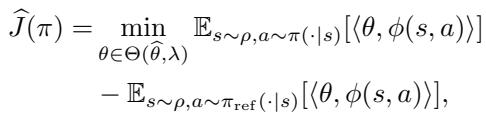
The confidence set is defined by the covariance matrix \(\widehat{\Sigma}\), ensuring we don’t trust the reward model in areas of the feature space where we have little data:

The paper proves that the suboptimality of the learned policy \(\widehat{\pi}\) is directly bounded by the error in estimating the reward parameters \(\theta\):

This confirms: If we can estimate \(\theta\) accurately in logistic regression, we can solve robust RLHF.
2. Reducing DPO
DPO skips the reward modeling step and optimizes the policy directly. The authors assume a Log-Linear Policy Class. This means the optimal policy takes the form of a “softmax” over linear features:

Through some algebraic manipulation involving the DPO loss function, the authors show that the labels in DPO also follow a logistic regression model. In this case, the “true” parameter \(\theta_{\text{true}}\) corresponds to a scaled difference between the optimal policy parameters and the reference policy parameters.
Just like in RLHF, the performance of DPO depends on how well we can estimate this parameter vector. The authors derive a bound showing that DPO suboptimality is controlled by the parameter estimation error:

Here, \(\kappa_{\Pi}\) is a condition number representing the geometry of the policy class—essentially measuring how hard it is to distinguish between different policies.
The Core Algorithm: Private and Robust Estimation
Now that we’ve reduced both RLHF and DPO to “estimate \(\theta\) in logistic regression,” how do we actually do that when the labels \(z_i\) are noisy?
Standard Maximum Likelihood Estimation (minimizing the standard log-loss) fails here because the privacy mechanism and corruption shift the distribution of the labels. The gradient would be biased.
To fix this, the authors introduce a corrected loss function. This new loss uses a scaling factor \(c(\varepsilon)\) to counteract the privacy noise “squashing” the signal.
The standard log-loss looks like this:

The new, robust, private loss function is:

Here, \(c(\varepsilon) = \frac{e^\varepsilon + 1}{e^\varepsilon - 1}\). Notice the term \((z_i + \sigma(\varepsilon) - 1)c(\varepsilon)\). This is an unbiased estimator of the true label \(y_i\) under the Randomized Response mechanism. By plugging this into the loss, the algorithm (Algorithm 1 in the paper) creates a gradient that points in the right direction on average, despite the noise.
Key Theoretical Results
Using this algorithm, the authors derive bounds for the estimation error \(\|\widehat{\theta} - \theta_{\text{true}}\|\). These bounds reveal the interaction between privacy and robustness.
Estimation Error Bounds
The error bounds for the Corruption-then-LDP (CTL) and LDP-then-Corruption (LTC) scenarios are shown below:
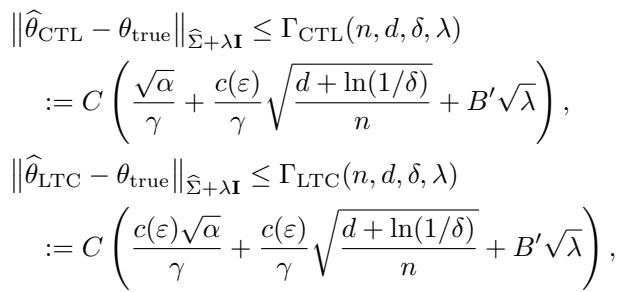
Let’s break down the components of \(\Gamma(n, d, \delta, \lambda)\):
- The Corruption Term: \(\frac{\sqrt{\alpha}}{\gamma}\) for CTL, but \(\frac{c(\varepsilon)\sqrt{\alpha}}{\gamma}\) for LTC.
- The Privacy/Noise Term: \(\frac{c(\varepsilon)}{\sqrt{n}}\). This shows that error decreases with more data (\(n\)), but increases with higher privacy (higher \(c(\varepsilon)\)).
The Separation Result: LTC is Harder
This is the paper’s most critical insight. Look closely at the corruption term (the first term in the brackets).
- CTL: Proportional to \(\sqrt{\alpha}\).
- LTC: Proportional to \(c(\varepsilon)\sqrt{\alpha}\).
In the LTC setting (where privacy happens before corruption), the impact of the adversary (\(\alpha\)) is multiplied by the privacy cost \(c(\varepsilon)\). Since \(c(\varepsilon) > 1\) (and can be very large for high privacy regimes), LTC is strictly harder than CTL.
Why? Intuition suggests that when data is privatized first (LTC), the signal is diluted. The adversary then corrupts this already weak signal. Because the learning algorithm has to “scale up” the data by \(c(\varepsilon)\) to undo the privacy noise, it inadvertently scales up the adversary’s corruption as well.
In CTL, the adversary corrupts the clean data. The privacy mechanism then adds noise to everything. The privacy noise partially “masks” the corruption, preventing the adversary from being as effective as they are in the LTC case.
Suboptimality Bounds
By plugging these estimation errors back into the reduction frameworks, the authors provide the first-ever suboptimality bounds for RLHF and DPO under simultaneous privacy and corruption.
For DPO, the final result looks like this:
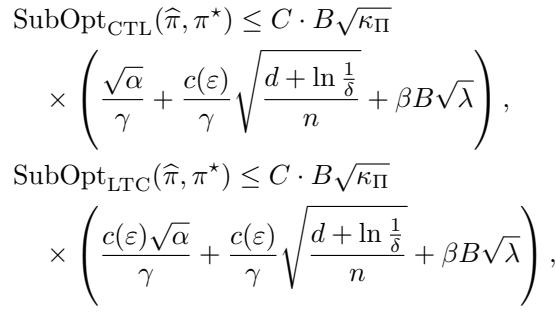
Notice the pattern holds: the LTC bound is looser (worse) due to the \(c(\varepsilon)\) factor attached to \(\sqrt{\alpha}\). This implies that if you are designing a system, it is theoretically safer to apply privacy protection after data collection/cleaning (if possible), rather than collecting private data that might later be corrupted.
Experiments
To validate these theoretical findings, the authors conducted experiments using GPT-2 Large on a synthetic finance dataset. They trained models using Robust DPO (rDPO), which implements their corrected loss function.
1. Does the corrected loss help?
They compared standard DPO against rDPO in a private setting (no corruption).
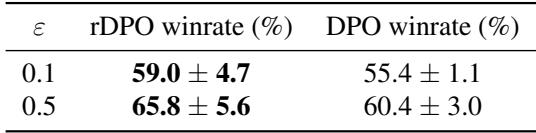
As shown in Table 1, rDPO consistently achieves higher win rates than standard DPO. The corrected loss successfully mitigates the bias introduced by the differential privacy mechanism.
2. Is LTC actually harder than CTL?
They then introduced corruption (\(\alpha = 0.1\)) alongside privacy (\(\varepsilon\) varying).

Table 2 confirms the theory. For the same privacy budget and corruption level, the model trained under the CTL setting achieves a significantly higher win rate (69.6% vs 65.4% at \(\epsilon=1\)). As \(\epsilon\) decreases (privacy increases/noise increases), the gap widens, empirically verifying that LTC is indeed the more challenging environment for alignment.
Conclusion & Implications
This paper provides a crucial stepping stone for making AI alignment robust in the real world. By unifying RLHF and DPO under the umbrella of logistic regression, Zhou et al. simplify the analysis of complex noise scenarios.
Key Takeaways for Students and Practitioners:
- Reductions are Powerful: Complex RL problems can often be analyzed as simpler supervised learning problems (like logistic regression). This simplifies the math and allows us to borrow tools from robust statistics.
- No Free Lunch with Privacy: Adding privacy (\(\varepsilon\)-LDP) inevitably increases the sample complexity. You need more data to achieve the same accuracy.
- Order Matters: The interplay between privacy and robustness is non-commutative. LDP-then-Corruption (LTC) is fundamentally harder than Corruption-then-LDP (CTL) because the privacy-decoding process amplifies the adversarial noise.
As we move toward deploying LLMs trained on decentralized, user-provided data, these theoretical insights will define how we build pipelines that respect user privacy without crumbling under the weight of noisy or malicious data.