](https://deep-paper.org/en/paper/2505.16061/images/cover.png)
Introduction
“Is ACL an AI conference?”
This question, recently posed by opinion leaders in the field, highlights an ongoing identity crisis within Natural Language Processing (NLP). As Large Language Models (LLMs) like GPT-4 and Claude dominate the headlines, the line between computational linguistics and general artificial intelligence has blurred.
But there is a more pressing question than how researchers define themselves: How does the world define NLP?
For students and aspiring researchers entering this field, it is easy to view academia as an “Ivory Tower”—a closed loop where researchers write papers only to be cited by other researchers. However, the reality is far more dynamic. NLP research bleeds into technology patents, influences government policy, and sparks debates in the media.
In a fascinating new scientometric study, Internal and External Impacts of Natural Language Processing Papers, researcher Yu Zhang from Texas A&M University investigates nearly 45 years of publication history. By tracking citations alongside patents, media mentions, and policy documents, the study reveals exactly which topics manage to break out of the academic bubble and shape the real world.
If you are a student deciding on a thesis topic or simply curious about where the field is heading, understanding these impact dynamics is essential.
Background: Measuring Impact
Before we dive into the results, we need to understand the landscape of the study. The researcher focused on the “Big Three” conferences in the field:
- ACL (Association for Computational Linguistics)
- EMNLP (Empirical Methods in Natural Language Processing)
- NAACL (North American Chapter of the ACL)
These are the venues where the most prestigious work is published. The study gathered 24,821 papers published between 1979 and 2024.
The core innovation of this paper is how it separates impact into two distinct categories:
- Internal Impact: This is the traditional academic metric. It refers to how often an NLP paper is cited by other research papers. It measures influence within the scientific community.
- External Impact: This measures the diffusion of knowledge into society. The study tracks three specific domains:
- Patents: Assessing technological utility and commercial application.
- Media: Tracking mentions in news outlets and social media (blogs, Twitter/X, Reddit).
- Policy Documents: Identifying references in government reports, NGO briefs, and think tank papers meant to influence law and regulation.
The Core Method: Quantifying Influence
How do you analyze the topic of nearly 25,000 papers without reading them all? The author employed a modern solution: GPT-4o.
Using the paper titles and abstracts, the model categorized every paper into one of 25 standard submission topics (e.g., “Language Modeling,” “Machine Translation,” “Ethics, Bias, and Fairness”). To ensure accuracy, human evaluators checked a subset of these annotations and found substantial agreement with the AI’s classification.
The Impact Metric
To compare apples to apples, the study needed a normalized metric. Simply counting citations isn’t enough because some domains (like patents) cite fewer papers on average than academic journals.
The author proposed a specific formula to calculate the Impact of a topic \(t\) within a specific domain \(d\) (like Patents or Media).

Let’s break this equation down:
- The Numerator: This calculates the average number of citations/mentions for papers belonging to a specific topic (\(t\)).
- The Denominator: This calculates the average number of citations/mentions for all NLP papers in the dataset.
Interpretation:
- If the result is > 1, the topic is “over-represented.” It punches above its weight and garners more attention than the average NLP paper.
- If the result is < 1, the topic is “under-represented.” It receives less attention than the average.
By calculating this for every topic across every domain, the study creates a “fingerprint” of influence for the entire field of NLP.
To formalize this analysis across different domains, the author represents the impact of a domain as a vector, where each entry corresponds to one of the 25 topics:

This vector notation allows the researcher to statistically compare how similar or different the priorities are between, say, patent lawyers and policy makers.
Experiments & Results
The results of this analysis provide a stunning snapshot of the NLP landscape. The figure below visualizes the impact scores across four dimensions: Citations (Red), Patents (Yellow), Media (Green), and Policy Documents (Blue).
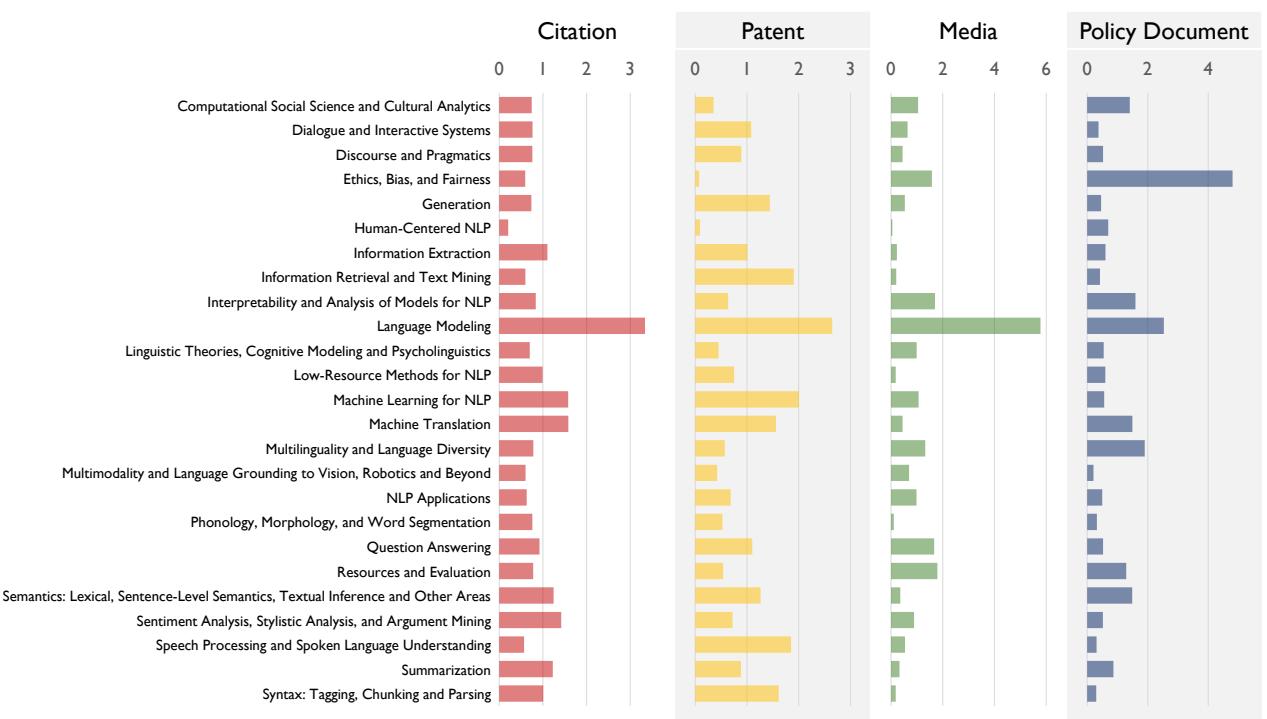
There is a lot of data here, but several key narratives emerge when we look closely.
1. The Dominance of Language Modeling
The most obvious takeaway is the overwhelming dominance of Language Modeling. Look at the top bar in the chart above. It is the only topic that scores above 1.0 in every single category.
In the academic citation space, it scores nearly a 3.0—meaning Language Modeling papers are cited three times as often as the average NLP paper. This reflects the current paradigm shift in AI, where Large Language Models (LLMs) have become the foundation for almost all other tasks. Whether you are in industry (Patents) or discussing societal impact (Media/Policy), Language Models are the center of gravity.
2. The “Ethics” Paradox
One of the most intriguing findings is the disconnect regarding Ethics, Bias, and Fairness.
- Policy Documents (Blue): This topic explodes in popularity, scoring the highest impact of any topic in the policy domain (over 4.0). Policymakers are deeply concerned with how AI affects society.
- Patents (Yellow): It ranks dead last.
- Citations (Red): It is surprisingly under-represented in academic citations (below 1.0).
This suggests a divergence. While governments and NGOs are desperate for research on fairness and bias, the academic community cites these papers less frequently than technical modeling papers, and commercial entities (patents) hardly reference them at all. For a student interested in public policy, this is a clear signal: your work here has massive external value, even if it doesn’t top the academic citation charts.
3. The Decline of Linguistic Foundations
Traditional linguistic topics—such as Phonology, Morphology, Discourse, and Theoretical Linguistics—show low impact across the board. In the era of deep learning, the field has moved away from explicit linguistic rules toward statistical modeling. These topics generally have impact scores below 1.0 in both internal and external domains.
4. Practicality Rules Patents
If you look at the Patent column (Yellow bars), you see a preference for distinct, practical applications. Topics that perform well here include:
- Information Retrieval (Search engines)
- Speech Processing (Siri/Alexa)
- Sentiment Analysis
- Machine Translation
These are the “cash cow” technologies of the tech industry. They may not generate as much media buzz as a new LLM, but they are the bedrock of intellectual property in NLP.
Correlation: Do Internal and External Impacts Align?
A major question for researchers is whether “selling out” to popular trends helps or hurts their academic career. The study analyzed the correlation between academic citations (\(I_{Citation}\)) and external domains.
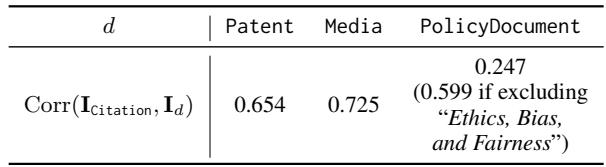
The data in Table 1 shows a strong positive correlation between academic citations and Patents/Media. Put simply: papers that get famous on Twitter or get cited in patents usually also get cited heavily by other researchers.
However, notice the lower correlation (0.247) for Policy Documents. This relates back to the “Ethics Paradox.” The things policymakers care about are not perfectly aligned with what computer scientists cite. Interestingly, if the “Ethics” topic is removed as an outlier, the correlation jumps to 0.599, suggesting that for most other topics, policy interest does align with academic interest.
Predictive Power: The “Hit Rate”
Can we predict which papers will become academic superstars based on their external usage? The author tested this by looking at the top 1% of most-cited papers.
If you pick a paper at random, you have a 1% chance of picking a top-1% paper. But what if you filter for papers that have been cited in Policy documents or Media?
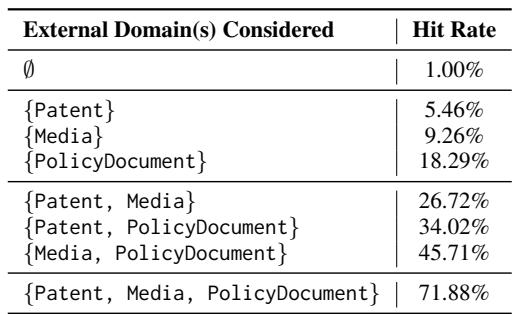
Table 2 reveals a staggering multiplier effect:
- If a paper is cited in a Policy Document, it has an 18.29% chance of being a top-1% academic paper.
- If a paper is cited in Patents, Media, AND Policy, it has a 71.88% chance of being a superstar paper.
This suggests that real-world impact is not a distraction from academic success; it is a massive indicator of it.
The GitHub Factor
In an appendix to the main paper, the author explores one additional domain that is particularly relevant to students: GitHub.
Code repositories bridge the gap between “Internal” (researchers using code) and “External” (developers building apps). The study mapped papers to their repositories and measured “Forks” as a proxy for impact.
The metric used is similar to the citation metric:

The results for GitHub impact look remarkably similar to the Patent results:
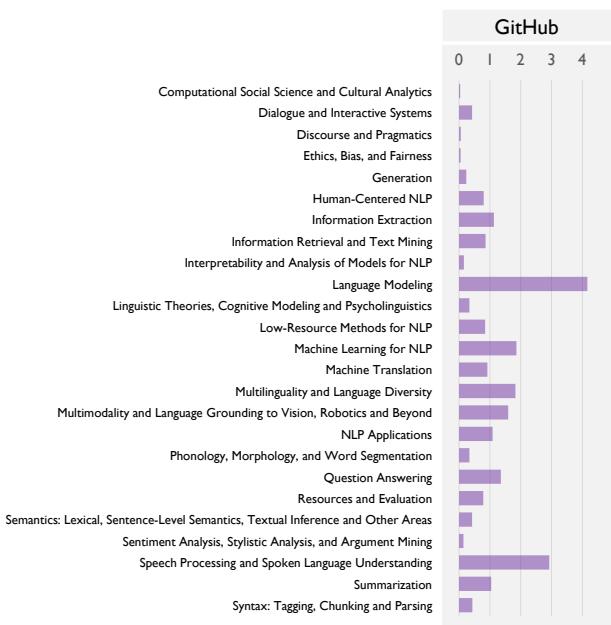
As shown in Figure A1, Language Modeling is again the dominant force. However, practical tools like Speech Processing and Machine Translation also perform very well.
The correlation analysis confirms that GitHub activity is strongly aligned with Patents (\(0.633\)), reinforcing the idea that code and commercial utility go hand-in-hand.

Conclusion
This research offers a mirror to the NLP community, reflecting not just what we write, but how the world reads it.
For students, the takeaways are actionable:
- Language Modeling is the “Safe” Bet: It is the currency of the realm in every domain—academic, commercial, and societal.
- Know Your Audience: If you want to impact legislation, focus on Ethics and Fairness. If you want to build products (and get forks on GitHub), focus on IR, Speech, or Translation.
- The Ivory Tower has Windows: The idea that academic work is isolated is a myth. There is a strong pipeline from top-tier conferences to real-world application.
Yu Zhang’s work highlights that while different sectors—media, government, industry—have different “tastes” in research, they are all consuming the output of NLP conferences. Whether ACL is strictly an “AI conference” or not, it is undeniably a venue that shapes the technological and social fabric of our time.