](https://deep-paper.org/en/paper/2505.16080/images/cover.png)
Imagine trying to navigate the streets of New York City. Now, imagine taking that same driving knowledge and instantly applying it to the winding, historic roads of Rome or the dense, multi-layered highways of Chicago. While a human driver might struggle initially, they eventually adapt, recognizing that “red means stop” and “traffic jams happen at rush hour” are universal truths, while the specific layout of the city is unique.
In the world of Artificial Intelligence, specifically spatiotemporal learning (predicting traffic flow, crowd density, or urban dynamics), this adaptation is notoriously difficult. Most current AI models are rigid. A model trained on NYC data is usually useless for Chicago. To switch cities, you typically have to scrap the old model and train a new one from scratch. This is inefficient, computationally expensive, and fails to leverage the “common knowledge” that exists across all cities.
Today, we are diving deep into a fascinating research paper titled “SynEVO: A neuro-inspired spatiotemporal evolutional framework for cross-domain adaptation.” The researchers propose a groundbreaking framework that mimics the human brain’s ability to learn, adapt, and transfer knowledge. By the end of this post, you’ll understand how imitating biological synapses can lead to smarter, more adaptable urban AI.
The Problem: Islands of Isolated Knowledge
Spatiotemporal systems—like traffic networks—are complex. They have spatial components (roads connected to other roads) and temporal components (traffic changes over time).
Current methods usually treat every dataset as an island. If you want to predict traffic in Manhattan (Source A), you train a model on Source A. If you want to predict traffic in Chicago (Source B), you train a totally independent model.
This approach suffers from three major flaws:
- Wastefulness: We ignore the shared patterns between cities (e.g., morning rush hours usually occur between 7-9 AM everywhere).
- Rigidity: Models cannot evolve. If the data distribution changes (e.g., a new road opens), the model breaks.
- No “Collective Intelligence”: We aren’t building a smarter general system; we are just building many narrow, specific ones.
The authors of SynEVO argue that the key to solving this is NeuroAI—designing neural networks that function more like the human central nervous system.
The Biological Inspiration
The human brain doesn’t learn in isolation. It uses synapses to connect neurons, sharing and cooperating to process information. Crucially, the brain uses a complementary learning system:
- The Neocortex: Stores stable, long-term knowledge (general skills).
- The Hippocampus: Acquires new, specific information quickly (specific memories).
SynEVO (Synaptic EVOlutional network) attempts to replicate this structure mathematically to solve the cross-domain adaptation problem.
SynEVO: The Framework Overview
Let’s look at the high-level architecture of SynEVO. The goal is to create a model that can take data from various domains (different cities or time periods) and “evolve” to handle them all without forgetting previous knowledge.
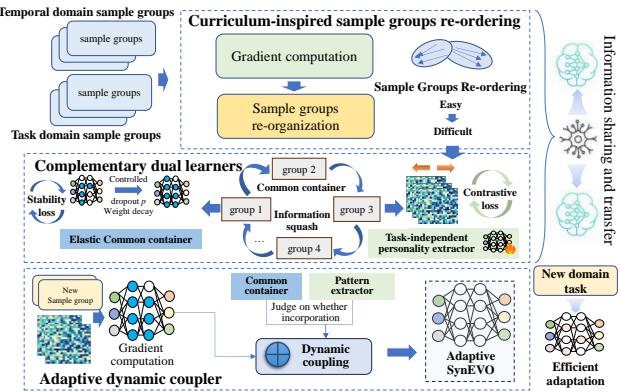
As shown in Figure 1, the framework is built on three main pillars, which we will dissect in detail:
- Curriculum-Guided Task Re-ordering: Instead of feeding data randomly, the model determines the best order to learn (from easy to difficult), mimicking human education.
- Complementary Dual Learners: The core architecture splits into two paths:
- An Elastic Common Container (the “Neocortex”) that grows to hold shared knowledge.
- A Task-Independent Personality Extractor (the “Hippocampus”) that identifies unique traits of a specific city.
- Adaptive Dynamic Coupler: A gating mechanism that decides whether new data fits the common pattern or requires specific adaptation.
The underlying mathematical philosophy is that cross-domain learning effectively expands the information boundary of the model.

This equation suggests that the information (\(Info\)) contained within the model \(\mathcal{M}\) strictly increases as it processes more domains (\(X_1\) to \(X_k\)), provided those domains share some commonality.
Pillar 1: Curriculum-Guided Task Reordering
Have you ever tried to learn advanced Calculus before learning Algebra? It’s nearly impossible. Humans learn best when they follow a curriculum—starting with easy concepts and progressively tackling harder ones.
Standard machine learning often feeds data in random batches. SynEVO changes this by analyzing the “difficulty” of a dataset before training on it. But how do you measure difficulty for a neural network?
Using Gradients as a Difficulty Metric
In neural networks, the gradient represents the direction and magnitude of changes needed to reduce error. A large gradient implies a large gap between what the model knows and what the data is saying—in other words, the task is “hard” or inconsistent with current knowledge.
The researchers compute the sum of squares of the gradients for each layer to quantify this:
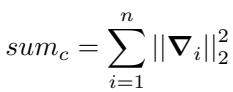
Here, \(\nabla_i\) represents the gradient of the \(i\)-th layer. The model calculates this sum (\(sum_c\)) for every potential sample group.
Next, they concatenate these gradients to form a “difficulty vector” for each domain:

To find the “easiest” starting point, they identify the domain with the minimum gradient norm (\(cat_{min}\)). Then, they calculate the difference (\(d_c\)) between every other domain and this easiest benchmark:

The Strategy: The model reorders the input data streams based on the length of \(d_c\). Data closest to the benchmark (smallest difference) is fed in first, and the most distinct/difficult data is fed in last. This prevents the model from getting confused by complex outliers early in the training process, smoothing the optimization path toward a global optimum.
Pillar 2: Complementary Dual Learners
This is the heart of the NeuroAI inspiration. The researchers realized that to adapt well, a model needs to disentangle Commonality (patterns shared by all cities) from Personality (patterns unique to one city).
To do this, they designed two separate but interacting learners.
1. The Elastic Common Container (The “Neocortex”)
In the brain, learning isn’t static. As we learn more, our synaptic connections change. SynEVO mimics this “elasticity” using two common deep learning regularization techniques: Dropout and Weight Decay, but with a dynamic twist.
Usually, Dropout (randomly turning off neurons during training) and Weight Decay (penalizing large weights) are set to fixed values (e.g., 0.5 and 0.01). However, SynEVO adjusts these dynamically based on the “difficulty” vector we calculated earlier.
The idea is simple: As the model encounters more complex or novel data, it should become more “active” (plastic) to absorb new information.
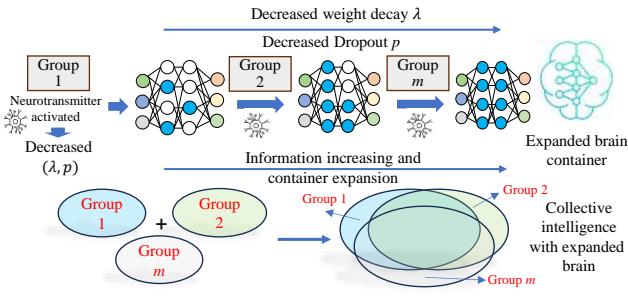
Figure 2 illustrates this concept. As we move from Group 1 to Group \(m\), the “brain container” expands.
The researchers derived a dynamic dropout formula based on biological neurotransmitter release models:

And a similar formula for dynamic weight decay:

Interpretation:
- \(l(\boldsymbol{d}_c)\) is the difficulty (difference) of the current data.
- As difficulty increases, the exponential term grows, causing \(p_c\) (dropout rate) and \(\lambda_c\) (weight decay) to decrease.
- Lower dropout and lower weight decay mean the network utilizes more parameters and has higher capacity.
This allows the “Common Container” to physically (in a parameter sense) expand its capacity to accommodate new, difficult knowledge without overwriting the old, easy knowledge.
2. Task-Independent Personality Extractor (The “Hippocampus”)
While the Common Container absorbs general trends, we still need to handle the specific quirks of a new city. The Personality Extractor is designed to capture these unique features using Contrastive Learning.
The goal is to map data inputs (\(X\)) into a representation space (\(E\)). We want representations from the same domain to be close together, and representations from different domains to be far apart.
First, they define a distance metric \(\mathcal{D}\) between two representations:

Then, they apply a contrastive loss function:

How it works:
- If two samples are from the same domain (\(\hat{y}=1\)), the model minimizes the distance \(\mathcal{D}\).
- If they are from different domains (\(\hat{y}=0\)), the model ensures the distance is at least \(m\) (a margin).
This creates a clear separation in the feature space, effectively isolating the “personality” of each dataset so it doesn’t pollute the “common” knowledge.
Pillar 3: Adaptive Dynamic Coupler
We now have an ordered list of tasks, a Common Container, and a Personality Extractor. How do they work together?
When a new batch of data (\(X_{k+1}\)) arrives, the model needs to decide: Is this similar enough to what I already know?
The Adaptive Dynamic Coupler makes this decision. It calculates the distance between the new data’s personality representation (\(E_{k+1}\)) and the representations of all previously learned domains.
It looks for the minimum distance (\(\mathcal{D}_{min}\)). A gate function \(h\) is then used:
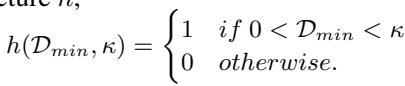
- Case 1: \(0 < \mathcal{D}_{min} < \kappa\) (Within threshold): The new data shares potential commonality. It is allowed into the Common Container. The model calculates the dynamic dropout/weight decay parameters and updates the common synaptic weights.
- Case 2: \(\mathcal{D}_{min} \geq \kappa\) (Too different): The new data is too distinct (or “alien”). It might introduce noise into the common model. In this case, the system relies on the Personality Extractor and initializes a quick adaptation branch rather than forcing an update to the core common knowledge.
This logic is encapsulated in the final loss function:
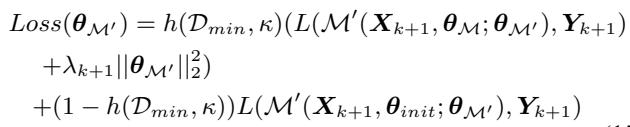
This equation ensures that the model evolves (updates \(\theta_{\mathcal{M}'}\)) using the Common Container only when appropriate, otherwise it falls back to a specialized initialization (\(\theta_{init}\)). This protects the “Collective Intelligence” from being corrupted by outliers.
Experiments and Results
Does this neuro-inspired approach actually work? The researchers tested SynEVO against state-of-the-art baselines (including Graph WaveNet, STGCN, and other advanced transformers) on four real-world datasets:
- NYC: Taxi data (Manhattan).
- CHI: Taxi data (Chicago).
- SIP: Traffic flow (Suzhou Industrial Park).
- SD: Traffic flow (San Diego).
1. Superior Accuracy
The results in Table 1 are striking.
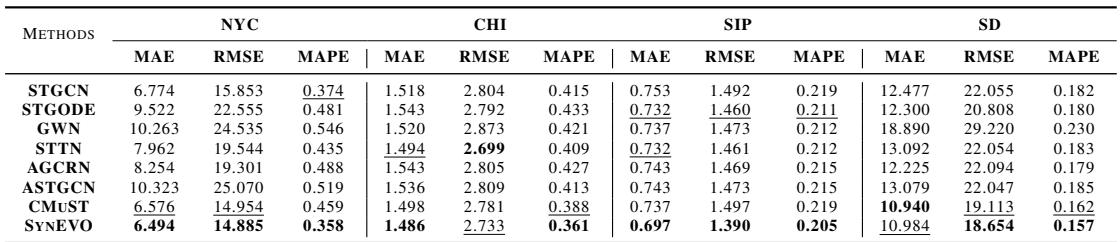
SynEVO (bottom row) achieves the lowest error rates (MAE, RMSE, MAPE) across almost all datasets.
- On the NYC dataset, SynEVO reduced the Mean Absolute Error (MAE) to 6.494, beating the standard Graph WaveNet (GWN) which had an error of 10.263. That is a massive improvement.
- It outperformed CMuST (another continuous learning model) in most cases, proving that the specific mechanisms of elastic growth and task reordering provide a tangible benefit over simple continuous learning.
2. Efficiency: Doing More with Less
One of the most impressive aspects of SynEVO is its computational efficiency. Complex models often require massive GPUs.
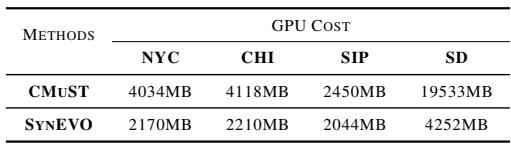
Table 2 shows the GPU memory usage. Compared to the best baseline (CMuST), SynEVO uses significantly less memory.
- On the SD (San Diego) dataset, CMuST required nearly 20GB of video memory. SynEVO required only 4.2GB.
- This represents roughly 21.75% of the memory cost of the state-of-the-art, making SynEVO feasible for deployment on edge devices or smaller servers.
3. Fast Adaptation and Zero-Shot Learning
How fast can SynEVO learn? Figure 3(b) visualizes the training loss over two cycles of learning.
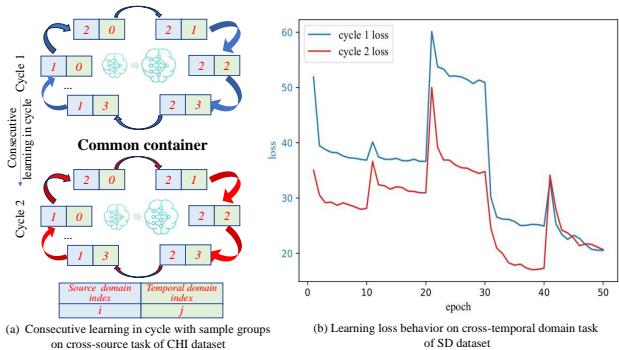
The graph shows that in “Cycle 2” (red line), the loss drops much faster and stays lower than in “Cycle 1” (blue line). This confirms that the Common Container is successfully retaining knowledge, allowing the model to adapt quickly when revisiting similar patterns.
Furthermore, the researchers tested Zero-Shot Adaptation—asking the model to predict on a new domain without any gradient updates (training) on that specific domain.
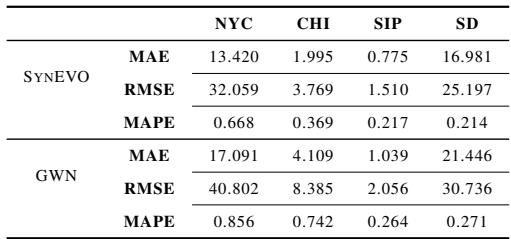
SynEVO significantly outperforms the backbone model (GWN) in zero-shot scenarios. On the NYC dataset, the MAPE (percentage error) for SynEVO was 0.668 compared to GWN’s 0.856. This proves that the “Common” knowledge captured by SynEVO is genuinely universal and robust.
4. Ablation Studies: Do we need all the parts?
To ensure every component was necessary, the researchers removed parts of the model one by one:
- SynEVO-REO: Removed curriculum re-ordering.
- SynEVO-Ela: Removed elastic growth (dynamic dropout/decay).
- SynEVO-PE: Removed the personality extractor/gate.

Table 4 reveals that SynEVO-Ela (removing the elastic growth) caused the biggest drop in performance. This highlights that the “breathing” nature of the model—expanding capacity for hard tasks—is the most critical factor in its success. However, removing the curriculum reordering also caused a noticeable drop, confirming that the order of learning matters.
5. Sensitivity Analysis
Finally, how sensitive is the model to its hyperparameters?
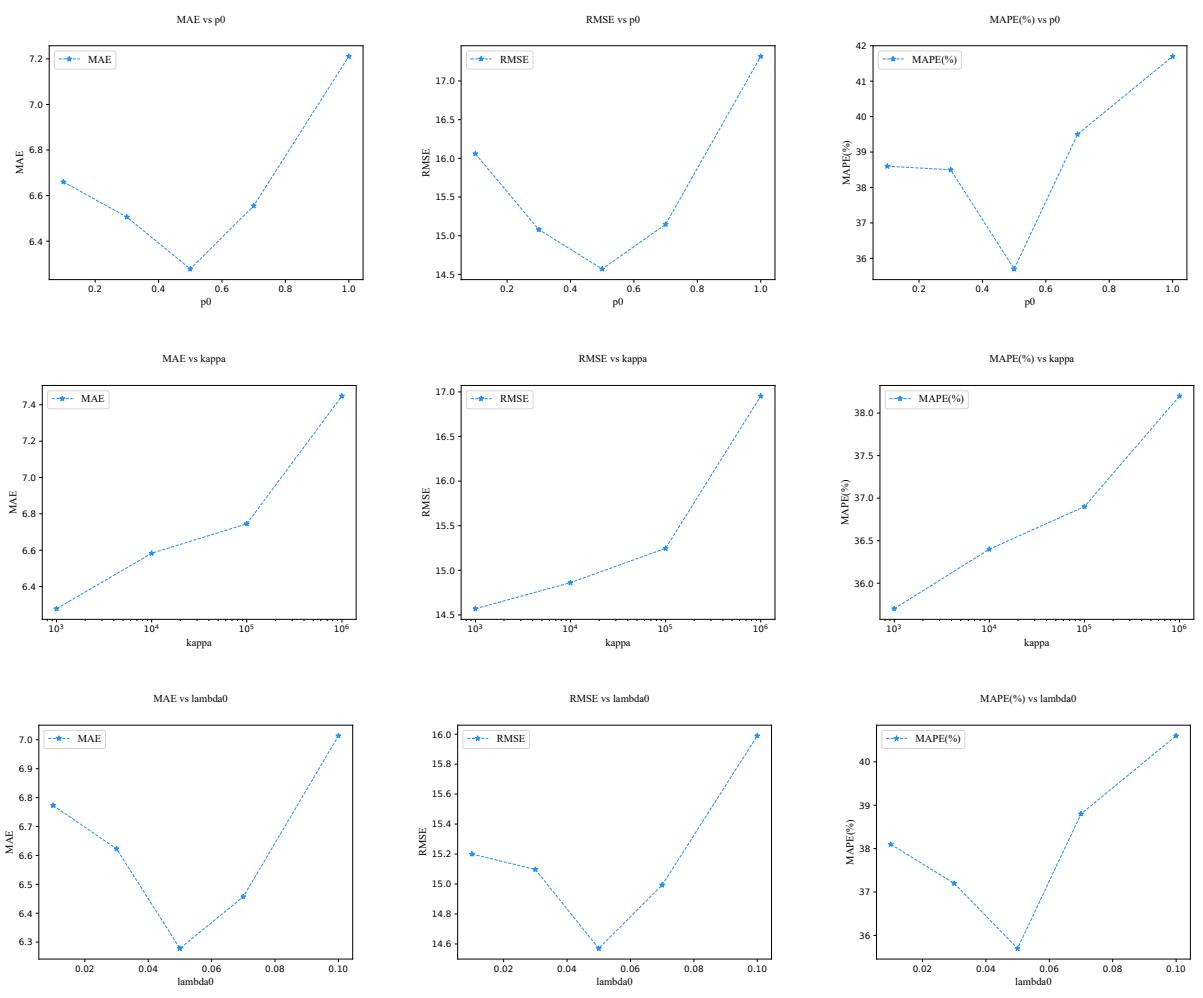
The charts (specifically on NYC) show a clear “U-shape” for parameters like \(p_0\) (initial dropout) and \(\lambda_0\) (weight decay). This indicates there is a “sweet spot.”
- If \(p_0\) is too low, the model is too rigid initially.
- If \(p_0\) is too high, the model is too noisy.
- The threshold \(\kappa\) also shows that if you are too strict (low \(\kappa\)), you block valid common knowledge. If you are too loose (high \(\kappa\)), you let in noise.
Conclusion
SynEVO represents a significant step forward in making AI systems more sustainable and adaptable. By looking at how the human brain manages knowledge—learning simple tasks first, separating general skills from specific memories, and dynamically adjusting neural plasticity—the researchers have created a framework that solves a major headache in urban computing.
The implications extend beyond just predicting traffic lights:
- Sustainable Computing: We can stop training massive models from scratch for every new city, saving electricity and hardware costs.
- Edge Intelligence: With its low memory footprint, advanced traffic prediction could run on local traffic light controllers rather than massive cloud servers.
- NeuroAI Paradigm: This reinforces the idea that biological inspiration is not just a metaphor, but a practical blueprint for superior algorithmic architecture.
As cities become smarter and more interconnected, frameworks like SynEVO will be the invisible “synapses” that keep urban life moving efficiently.