](https://deep-paper.org/en/paper/2505.16892/images/cover.png)
Imagine trying to land a spacecraft on the moon or insert a delicate plug into a socket using a robotic arm. These tasks require extreme precision. Now, imagine doing it with a joystick that has a slight delay or feels “mushy.” This is the challenge of teleoperation.
Shared autonomy is the solution: a collaborative approach where a human pilot provides high-level intent (via a joystick or VR controller), and an AI “copilot” handles the low-level precision, stabilizing the motion and avoiding collisions.
However, there has been a major bottleneck. Modern AI methods, specifically diffusion models, are incredibly good at generating smooth, human-like motions, but they are notoriously slow. They require dozens of iterative steps to “denoise” an action, making them difficult to use in real-time robotics where every millisecond counts.
In this post, we dive into a new paper, “FlashBack: Consistency Model-Accelerated Shared Autonomy,” which proposes a method called Consistency Shared Autonomy (CSA). This approach accelerates the diffusion process, allowing robots to interpret and correct human actions in a single microsecond step.

As shown above, where a human alone might fail (red X), and standard diffusion (DDPM) succeeds but slowly, CSA achieves success with high efficiency.
The Problem: The Latency of “Thinking”
To understand why CSA is necessary, we first need to look at how current shared autonomy works.
Traditionally, systems were goal-conditioned. You had to tell the robot explicitly, “I am reaching for the red mug.” The robot would then calculate a path to that mug. But what if the environment is unstructured, or the robot doesn’t know what a “mug” is?
Enter Diffusion-Based Shared Autonomy. Instead of predicting a specific goal, these models learn a distribution of “expert behaviors.” When a user provides a joystick input, the model treats it as a “noisy” or imperfect action. The diffusion model then “denoises” this action, shifting it closer to what an expert would do in that situation.
The problem? Standard diffusion (like DDPM) is iterative. To fix a user’s action, a DDPM might need to run its neural network 10, 20, or even 100 times in a loop, gradually refining the action. This creates a computational lag. In high-stakes control tasks (like catching a falling object or landing a drone), you don’t have time for 100 loops. You need an answer now.
The Solution: Consistency Models
The researchers propose replacing the standard diffusion process with a Consistency Model (CM).
The core intuition is simple: If we know the destination of a long journey, why walk every step of the path? Why not teleport directly to the end?
In mathematical terms, diffusion models solve a Probability Flow ODE (Ordinary Differential Equation). This ODE describes a smooth trajectory from pure noise to a clean data sample.
- Standard Diffusion: Marches along this trajectory step-by-step.
- Consistency Model: Learns to map any point on this trajectory directly to the start (the clean action). It learns to “jump.”
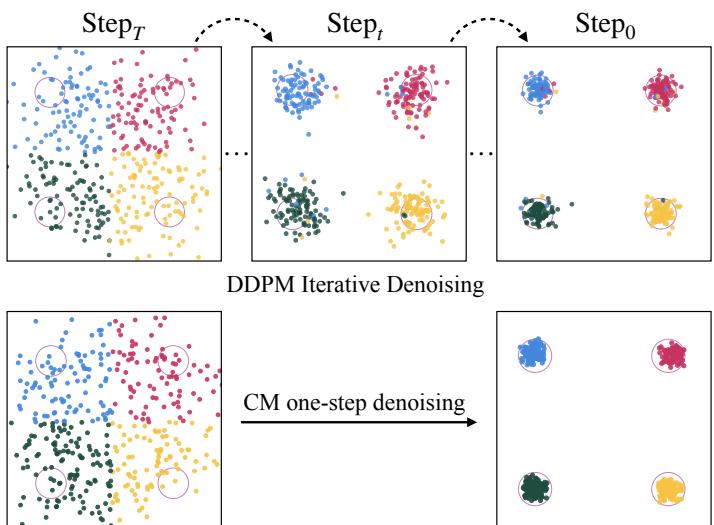
Figure 9 above illustrates this perfectly. The top row shows standard iterative denoising—a slow, multi-step evolution. The bottom row shows the Consistency Model approach—one single step to resolve the noisy input into a clean, clustered output.
Deep Dive: How CSA Works
The architecture of Consistency Shared Autonomy is a teacher-student framework. It involves training a high-precision “Teacher” and then distilling that knowledge into a fast “Student.”
1. The Teacher: An EDM Model
First, the researchers train a high-quality diffusion model based on the EDM (Elucidating the Design Space of Diffusion-Based Generative Models) framework. This model serves as the ground truth.
The teacher takes in the current state (\(s\)) and predicts the correct action (\(a\)). To make the system smarter, they also feed it a “short-term intention”: the direction the state is changing (\(s_{next} - s\)).
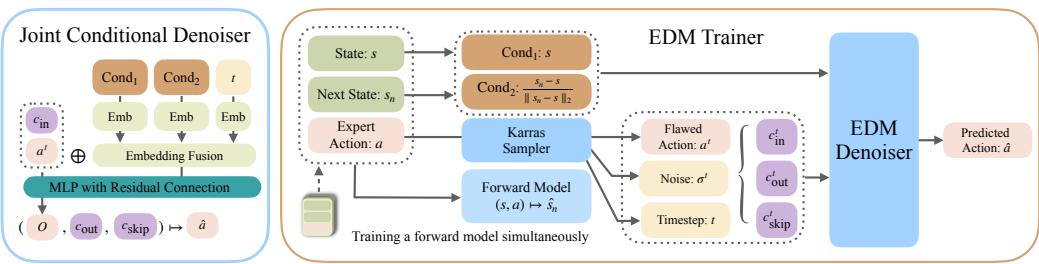
The teacher is accurate but slow because it relies on numerical solvers (like the Euler or Heun method) to traverse the ODE.
2. The Student: Consistency Distillation
Once the teacher is trained, the “Student” (the CSA model) is trained to mimic the teacher’s results but without the wait. This is done through Consistency Distillation.
The training process leverages the property that all points on a single ODE trajectory should point back to the same origin.
- Take a clean expert action \(a^0\).
- Add noise to create two points on the same trajectory: \(a^t\) (more noise) and \(a^{t-1}\) (slightly less noise).
- Ask the Student network to predict the clean original action \(a^0\) from both points.
- Minimize the difference between these two predictions.
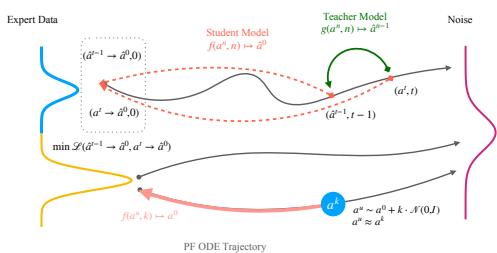
As seen in Figure 2, the model enforces “consistency.” Whether the student starts at \(a^t\) or \(a^{t-1}\), it should land on the same \(\hat{a}^0\).
The specific loss function used to enforce this is:

Here, the student \(f\) tries to match the output of a single step of the teacher’s solver. Over time, the student learns to predict the final clean action from any noise level in a single forward pass.
3. The “FlashBack” Inference
This is the most innovative part of the paper. How do we use this for shared autonomy with a human?
The researchers treat the human’s action (\(a^u\)) as if it were an intermediate state on the diffusion ODE trajectory.
- User Input: The human moves the joystick. This is \(a^u\).
- Assumption: We assume \(a^u\) is just an “expert action plus noise.”
- Noise Estimation: We assign a timestep \(t\) based on how much assistance we want to give. This \(t\) represents how “noisy” (or untrustworthy) we think the human is.
- High \(t\) = We think the user is very wrong (high correction).
- Low \(t\) = We trust the user (low correction).
- One-Step Denoising: The CSA model takes this “noisy” user action and “flashes back” to the origin of the ODE trajectory (\(t=0\)) in a single step.
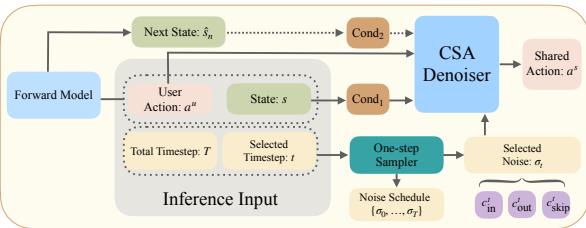
The diagram above (b) summarizes this inference loop. The user action enters the system, is assigned a noise level \(\sigma_i\), and the CSA Denoiser outputs the corrected shared action \(\hat{a}^0\) instantly.
Experiments and Results
The team tested CSA against a standard DDPM baseline in both simulation and real-world scenarios.
Simulation Tasks
They utilized three simulated environments:
- Lunar Lander: A classic 2D control task (low dimension).
- Peg Insertion: Inserting a peg with tight clearance (high dimension).
- Charger Plug Insertion: An even tighter tolerance task requiring orientation precision.
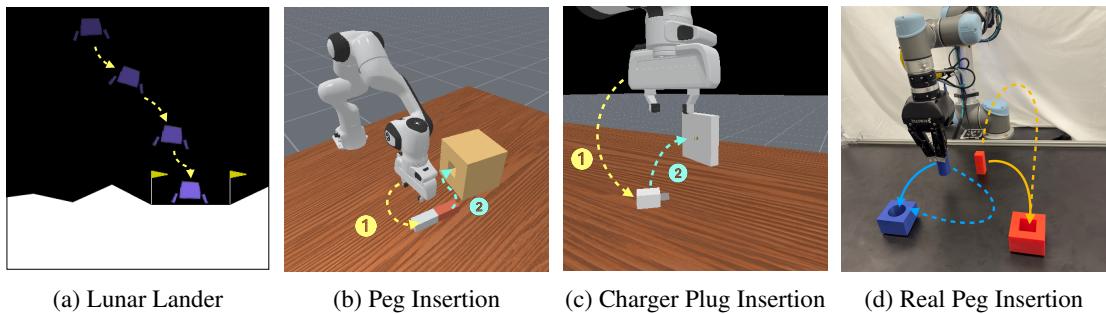
To rigorously test the system, they created “Surrogate Pilots”—synthetic bots designed to be bad at the task (Noisy, Laggy, or Slow)—to simulate an unskilled human operator.
Speed vs. Performance
The results were stark. In the Peg Insertion task, standard DDPM struggled to balance success rate with timeout rate because the inference took too long.
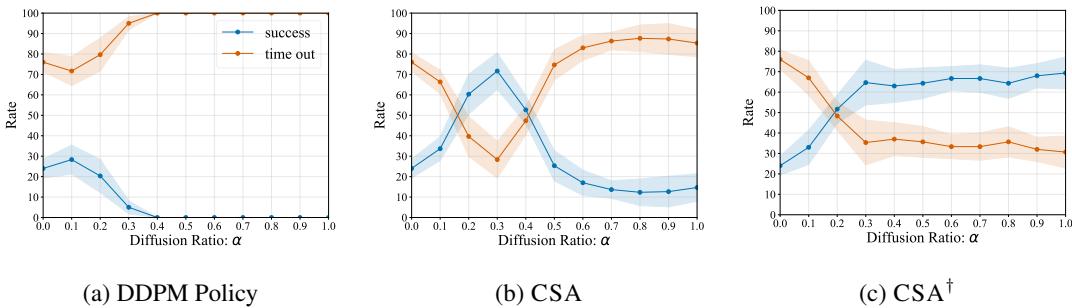
In Figure 8, look at the “CSA” graphs (center and right). The Blue line (Success) remains high even as the “Diffusion Ratio” (the amount of AI intervention) changes. In contrast, the DDPM policy (left) crashes in performance as soon as the diffusion ratio increases.
Even more impressive is the computational speedup.
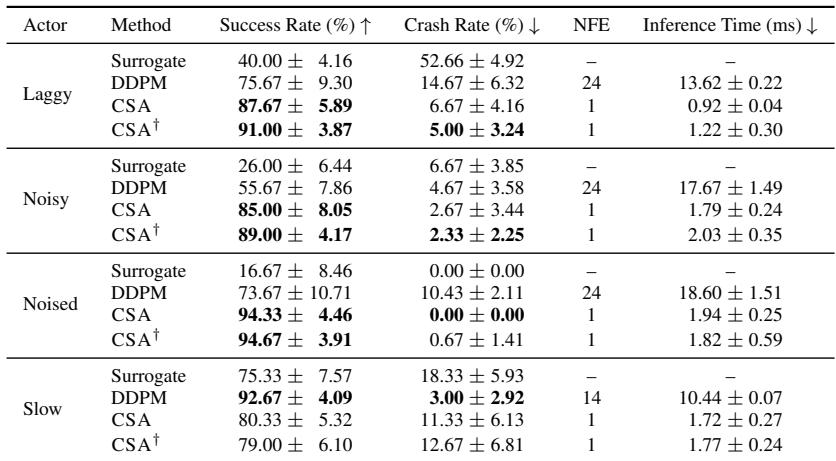
In the Lunar Lander table above, notice the NFE (Number of Function Evaluations) and Inference Time.
- DDPM: 24 evaluations, ~14ms inference.
- CSA: 1 evaluation, ~0.92ms inference.
CSA is roughly 15x faster while achieving higher success rates (87-91% vs 75%).
Real-World Robot Evaluation
The researchers deployed CSA on a real UR5 robot arm for a peg insertion task. They recruited 10 human participants to control the robot using a VR controller, viewing the task through a side-mounted camera (removing depth perception to make it harder).

Note: The table above highlights the success rates.
With no copilot, users succeeded 66.7% of the time. With the CSA copilot, success jumped to 83.3%, and the tasks were completed faster.
Participants also completed a survey regarding their experience.
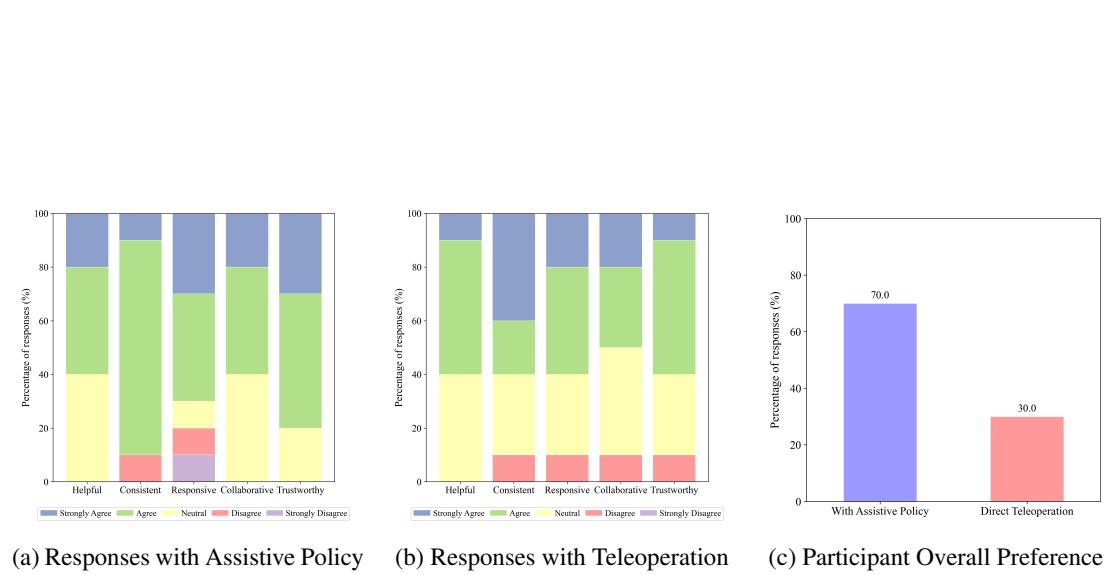
The survey results (Figure 11) show a clear preference. Users found the CSA policy (Assistive Policy) to be significantly more Collaborative and Consistent than direct teleoperation. One user noted, “It felt like I got some assistance during insertion,” confirming the seamless nature of the correction.
Conclusion: The Future of Collaborative Control
The FlashBack paper presents a significant leap forward for shared autonomy. By moving from iterative diffusion models to Consistency Models, the researchers have removed the computational latency that held back previous approaches.
Key Takeaways:
- Speed: CSA allows for one-step generation, making it feasible for real-time control loops (100Hz+).
- Performance: It outperforms standard diffusion methods in success rate, particularly in high-precision tasks.
- Simplicity: It removes the need for complex goal definitions or heuristic goal-inference modules. The “goal” is simply implicit in the expert demonstrations.
This technology paves the way for smarter prosthetics, more intuitive surgical robots, and safer teleoperated machinery—systems where the AI helps you move like an expert, without you ever feeling the lag.