](https://deep-paper.org/en/paper/2505.19155/images/cover.png)
The capabilities of Large Language Models (LLMs) have expanded dramatically in recent years, moving from text-only processing to multimodal understanding. Among these advancements, Video-LLMs stand out for their ability to watch, analyze, and answer questions about video content. However, this capability comes with a significant computational cost.
Processing video is fundamentally different from processing static images. A single video can be decomposed into hundreds or thousands of frames, and when these frames are converted into tokens, the resulting sequence length can be massive—often exceeding 100,000 tokens for a short clip.
This creates a bottleneck. Video-LLMs suffer from high inference latency, making real-time applications difficult. The culprit is the autoregressive decoding mechanism used by these models, which requires the system to repeatedly access vast amounts of memory for every single word it generates.
In this post, we will dive deep into a new research paper titled “Sparse-to-Dense: A Free Lunch for Lossless Acceleration of Video Understanding in LLMs.” This paper proposes a novel method called Sparse-to-Dense (STD), which accelerates video processing by up to \(1.94\times\) without requiring any model training or architectural changes. It achieves this by exploiting a simple observation: models rarely need to look at every single video frame to generate the next word.
The Bottleneck: Why Video-LLMs Are Slow
To understand the solution, we must first understand the problem. Modern Video-LLMs operate autoregressively. This means they generate text one token (word or sub-word) at a time. To predict the next token, the model must “attend” to—or look back at—all the previous tokens in the sequence.
In the context of a video, “all previous tokens” includes the visual tokens representing every sampled frame of the video. If a 1-hour video is sampled every 5 seconds, it produces 720 frames. In a model like VILA, this translates to over 141,000 visual tokens.
The Memory Wall and KV Caching
To avoid re-calculating the mathematical representations (Keys and Values) of these 141,000 tokens at every step, LLMs use a technique called KV Caching. They store these tensors in the GPU’s high-bandwidth memory (HBM).
While KV caching saves computation, it shifts the bottleneck to memory bandwidth. At every generation step, the GPU must fetch this massive KV cache from memory to compute attention scores. As the video length grows, the cache grows, and the Input/Output (I/O) operations required to move data between memory and the compute units become the limiting factor. This is why generating a caption for a long video feels sluggish.
The Solution: Speculative Decoding
A popular method to address this latency in text-only LLMs is Speculative Decoding. This technique relies on a “Draft-Verify” loop:
- Drafting: A smaller, faster model (the draft model) quickly guesses the next few tokens.
- Verification: The main, large model (the target model) checks these guesses in a single parallel pass.
If the draft is correct, the system accepts the tokens, effectively generating multiple tokens for the cost of one memory access by the large model. If the draft is wrong, the system discards the bad tokens and resumes standard generation.
The problem with applying this to Video-LLMs is that draft models are expensive. You typically need to train a separate, smaller model or maintain a complex auxiliary system. This adds engineering overhead and consumes extra GPU memory, which is already scarce when processing video.
Enter Sparse-to-Dense (STD)
The researchers behind Sparse-to-Dense (STD) asked a critical question: Can we perform speculative decoding without a separate draft model?
Their answer lies in the concept of sparsity.
The Core Observation
The authors analyzed the attention patterns of Video-LLMs (specifically Qwen2-VL) and made a crucial discovery. During the decoding phase, the model’s attention scores are extremely sparse. This means that for any given token generation step, the model focuses its computational attention on a very small subset of “critical” tokens, effectively ignoring the vast majority of the video frames.
Empirical tests showed that retaining only the top-K (most relevant) KV cache pairs preserved the original prediction accuracy for approximately 95% of tokens. This insight suggests that we don’t need a separate draft model. We can simply use the original model as its own drafter by restricting it to use only the most important parts of its memory.
How STD Works
STD splits the decoding process into two distinct modules that share the same model weights:
- The Sparse Module (The Drafter): This module generates speculative tokens rapidly. It uses “Top-K Attention,” meaning it only loads and attends to a small, selected subset of the video tokens (the sparse KV cache). Because it loads less data, it runs much faster than standard decoding.
- The Dense Module (The Verifier): This module uses the full self-attention mechanism with the complete KV cache. It runs in parallel to verify the tokens proposed by the sparse module.
Crucially, because the Dense Module is the original, unmodified model, this process is lossless. The final output is mathematically guaranteed to be identical to what the model would have produced normally. If the Sparse Module guesses wrong, the Dense Module corrects it.
Selecting the Important Tokens
If the Sparse Module only looks at a subset of tokens, how does it know which ones to keep? Random selection would lead to poor predictions.
The authors devised a smart, training-free metric. Since the goal is usually to answer a user’s question or follow a text prompt, the relevance of visual tokens is determined by the textual tokens.
During the “prefilling” stage (where the model first processes the video and the user prompt), the system calculates the attention scores between the textual tokens (the prompt) and the visual tokens (the video frames). The visual tokens that receive the highest attention from the text are deemed the most critical.
Formally, for each layer, the system retains the top-K visual tokens based on the average attention score they received from the text tokens. This selection happens once, before decoding starts, avoiding dynamic overhead during generation.
Efficiency Analysis
Why is this faster? Let’s look at the I/O complexity.
In standard decoding, every generated token requires loading the full cache (\(m_v + m_t\), where \(m_v\) is visual tokens and \(m_t\) is text tokens).
In STD, the Sparse Module generates \(\gamma\) (gamma) draft tokens. It only loads the small top-K cache. Then, the Dense Module loads the full cache once to verify all \(\gamma\) tokens simultaneously.
The average I/O cost per token is defined by the following equation:

Here is what the variables mean:
- \(\gamma\) (gamma): The number of speculative tokens drafted.
- \(K\): The size of the sparse cache.
- \(\alpha\) (alpha): The acceptance rate (percentage of draft tokens that are correct).
As long as the acceptance rate \(\alpha\) is high—which it is, thanks to the sparsity observation—the average memory cost per token drops significantly below the standard cost.
Experimental Results
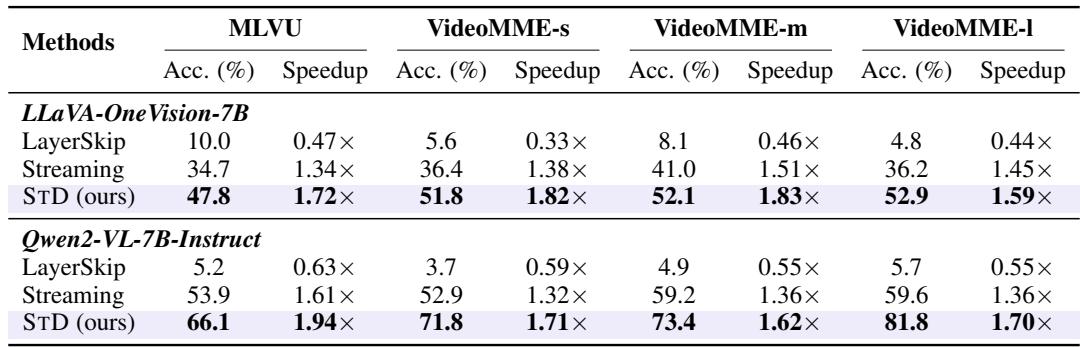
The researchers implemented STD on state-of-the-art Video-LLMs, specifically LLaVA-OneVision-7B and Qwen2-VL-7B, and evaluated them on video understanding benchmarks (MLVU and VideoMME).
They compared STD against two other training-free acceleration baselines:
- LayerSkip: A method that exits the model early at lower layers to draft tokens.
- Streaming: A method using streaming attention (window-based) as the drafter.
The results, shown in Table 1 below, are compelling.
Key Takeaways from the Data:
- Speedup: STD achieves up to a \(1.94\times\) wall-time speedup. This means video processing tasks that previously took 10 seconds could now take roughly 5 seconds.
- Superior Acceptance Rate: Notice the acceptance rates (Acc %). STD significantly outperforms LayerSkip and Streaming. For example, on MLVU with Qwen2-VL, STD has a 66.1% acceptance rate compared to LayerSkip’s 5.2%. This validates the hypothesis that “sparse attention” is a better approximation of the full model than “early layer exit.”
- Lossless: The table notes that the evaluation of generated contents is not reported because the method is lossless—the accuracy is identical to the original model by definition.
Hyperparameter Analysis
The performance of STD depends on two main hyperparameters:
- \(K\): How many visual tokens to keep in the sparse cache.
- \(\gamma\): How many tokens to draft in one go.
The researchers analyzed the impact of these variables in Figure 1.
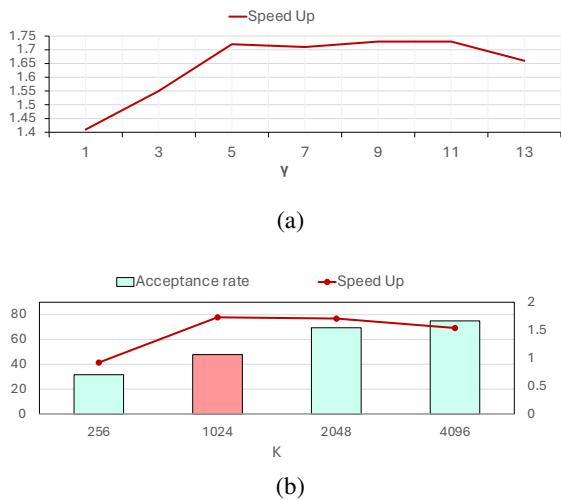
Looking at Chart (a), we see an inverted U-shape for speedup as \(\gamma\) increases. If \(\gamma\) is too small, we don’t gain much from parallelism. If \(\gamma\) is too large (e.g., 13), the draft model is forced to predict too far into the future, accuracy drops, and we waste time verifying incorrect tokens. A value around 6-9 appears optimal.
Chart (b) reveals the trade-off with \(K\). A higher \(K\) means the draft model is more accurate (higher acceptance rate, represented by the green bars). However, a higher \(K\) also means the draft model has to load more data, making it slower. The “sweet spot” ensures the draft model is accurate enough to be useful but light enough to be fast.
Conclusion and Future Implications
The “Sparse-to-Dense” paper presents a compelling argument for revisiting how we optimize large multimodal models. Instead of training complex auxiliary models or performing destructive quantization that hurts accuracy, we can leverage the inherent behavior of the attention mechanism itself.
Summary of Advantages:
- Plug-and-Play: Requires no training or fine-tuning. It can be implemented in about 20 lines of code.
- No Extra Memory: Since the sparse model is just a subset of the dense model, no additional GPU memory is needed for model weights.
- Lossless: It guarantees the exact same output distribution as the original, computationally expensive model.
This technique is a “free lunch” for anyone deploying Video-LLMs. It effectively unlocks efficient long-video processing, making applications like real-time video summarization or interactive video chat much more viable on current hardware.
While the current limitation relies on GPU HBM capacity (the full cache must still exist in memory for the verification step), future work could explore offloading parts of the cache to CPU memory or combining this with other compression techniques. For now, STD represents a significant step forward in making Video-LLMs faster and more accessible.