](https://deep-paper.org/en/paper/2505.20404/images/cover.png)
Introduction
In the world of robotic manipulation, engineers face a persistent dilemma known as the “compliance trade-off.” Traditional rigid grippers—like the metal claws found on assembly lines—are precise and strong, but they struggle with irregular shapes and can easily crush delicate objects. On the other end of the spectrum, soft robotic grippers made of silicon or rubber offer excellent adaptability and safety; they can wrap around a strawberry without bruising it. However, soft grippers often lack the strength to lift heavy tools or the precision to handle specific orientations.
How do we find the middle ground? More importantly, how do we design a gripper that is “just right” for a specific set of tasks?
Designing a soft gripper is mathematically complex because the design (morphology) and the control strategy (how it moves) are deeply intertwined. If you change the stiffness of the fingers, you must change how the robot grasps an object. If you change the grasp strategy, you might need a different finger shape. This is the co-design problem.
Solving this typically involves expensive simulations. Simulating the deformation of soft materials requires Finite Element Method (FEM) analysis, which is computationally heavy and slow. Iterating through thousands of design variations using FEM is practically impossible.
In this post, we will explore a research paper titled “Co-Design of Soft Gripper with Neural Physics” from the University of California, San Diego. The researchers propose a framework that combines specific mechanical innovations with a neural surrogate model—a deep learning network that mimics physical simulations—to rapidly co-optimize the stiffness distribution and grasping poses of a soft gripper.
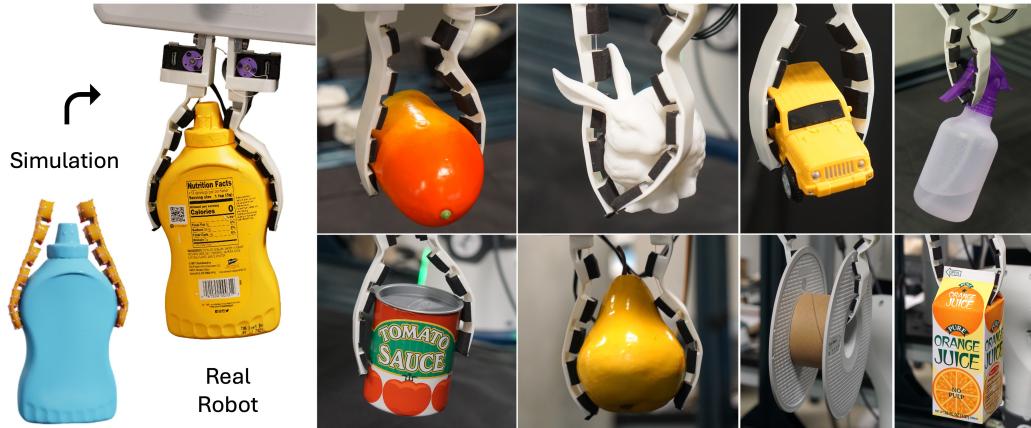
As shown in Figure 1, the result is a gripper that is neither fully rigid nor uniformly soft, but optimized with varying stiffness zones to outperform baseline designs in both simulation and the real world.
Background: The Challenge of Soft Co-Design
To understand the contribution of this paper, we need to look at the two main bottlenecks in soft robotics: actuation modeling and simulation speed.
The Actuation Problem
Soft robots often rely on pneumatic networks (air chambers) or cable-driven systems (tendons). Tendon-driven systems are popular because they allow motors to be placed far away from the fingers, keeping the hand lightweight. However, routing a tendon through a soft body is tricky. If the tendon tension isn’t distributed correctly, the finger might curl up at the tip like a scorpion tail rather than wrapping around an object. This “curling” reduces the contact area and makes the grasp unstable.
The Simulation Problem
To optimize a design, you need to test it. In robotics, we test in simulation to save time. For rigid bodies, physics engines are incredibly fast (thousands of frames per second). For soft bodies, we must calculate how every small section of the material stretches and compresses. This is usually done with FEM.
If you want to optimize a gripper’s design using an algorithm like Gradient Descent, you need a simulator that is differentiable—meaning it can tell you not just what happened, but how to change the input to improve the result. While differentiable FEM simulators exist, they are often slow and suffer from “noisy gradients,” making optimization difficult.
The researchers address these issues by:
- Deriving a mathematical model for uniform-pressure tendon routing.
- Replacing the slow FEM simulation with a fast Neural Physics model.
Part 1: Mechanical Design and Uniform Pressure
The foundation of this work is a monolithic, 3D-printable soft finger. The finger isn’t a solid block of rubber; it is composed of rigid segments connected by thin “flexure joints”—essentially thin beams of material that act as hinges.
The clever mechanical contribution here is how the tendons are routed.
The Problem with Uniform Routing
If you route a tendon at a constant distance from the center of the finger (parallel to the finger’s spine), the torque applied to the joints increases as you move away from the base. This causes the tip to bend significantly more than the base.
As illustrated in the bottom half of Figure 2b, a uniformly distributed tendon causes the finger to curl inward. The result is that only the fingertip touches the object, leading to a pinch grasp rather than a power grasp.
The Solution: Quadratic Routing
The authors propose a “Uniform Pressure” model. The goal is to apply a constant bending moment across the entire length of the finger so that it conforms to the object’s shape.
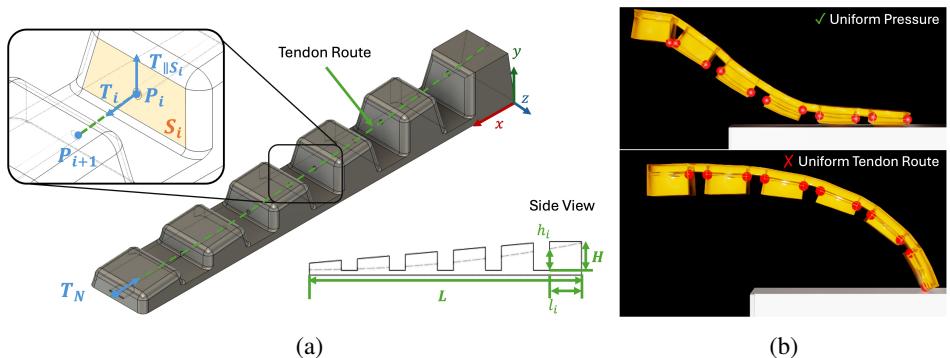
To achieve this, the distance between the tendon and the flexure joint (\(h_i\)) must change along the length of the finger. Through mechanical derivation, the researchers found that the tendon height should follow a quadratic curve:
\[ h _ { i } = H \left( 1 - \frac { l _ { i } } { L } \right) ^ { 2 } \]Where \(H\) is the height at the base, \(L\) is the total length, and \(l_i\) is the distance of the current point from the base.
By routing the tendons according to this curve (as seen in the top of Figure 2b), the finger bends uniformly, maximizing the contact area with the object. This ensures the mechanical “hardware” is capable of good grasps before any optimization even begins.
Part 2: The Neural Physics Surrogate
With a capable mechanical design in place, the next step is to figure out the optimal stiffness for each block in the finger. Should the tip be soft and the base hard? Should it be an alternating pattern?
There are 22 different blocks in the two-finger gripper. Testing every combination of stiffness alongside every possible grasp pose on a slow FEM simulator is infeasible. The solution is to train a neural network to pretend to be the simulator.
Simulation and Data Generation
The team used Nvidia Warp, a high-performance framework for GPU simulation, to build a ground-truth physics model.
- Object Set: They used the YCB dataset (common household objects like mustard bottles, scissors, and fruit).
- Sampling: They randomized the stiffness of the finger blocks (Young’s modulus ranging from 0.7 MPa to 24 MPa).
- Pose Initialization: They generated candidate grasp poses using a rigid-body approximation to find non-colliding starting points.
They ran thousands of simulations where the gripper attempts to grasp an object and lift it. They recorded the outcomes: Did it slip? What were the contact forces? Did it hit the ground?
Architecture of the Neural Surrogate
The data collected from the slow simulation was used to train the “Neural Physics” model. This model takes the design and object parameters as input and instantly predicts the grasp outcome.
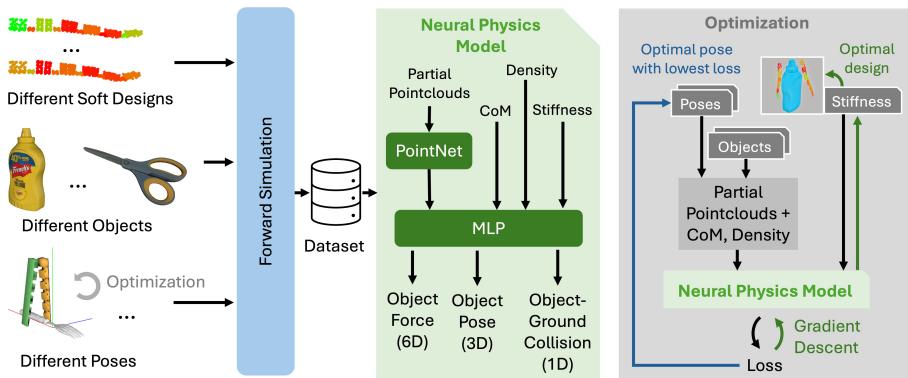
As shown in Figure 3, the architecture is split into two streams:
- Geometry Encoder (PointNet): A PointNet architecture processes the “Partial Pointclouds” of the object (the parts the robot can see). This captures the shape geometry.
- Physics Encoder (MLP): A Multi-Layer Perceptron processes the center of mass (CoM), density, and the stiffness vector of the gripper design.
These features are combined to predict:
- Object Force: The 6D force vector applied to the object (translating to grasp stability).
- Object Pose: How much the object moves during the grasp.
- Collision: Whether the object hits the ground (failure).
Why use a Neural Network?
The neural network provides two massive advantages:
- Speed: It is orders of magnitude faster than FEM simulation.
- Differentiability: The neural network is a continuous function. You can calculate the gradient of the “success” output with respect to the “stiffness” input. This allows the use of Gradient Descent to directly optimize the design.
Part 3: The Optimization Loop
This is where the “Co-Design” happens. The goal is to find a single stiffness configuration (\(k\)) that works well across a wide variety of objects, while simultaneously finding the best grasp pose (\(p\)) for each specific object.
The optimization objective (\(\mathcal{L}_{opt}\)) balances maximizing stability (force) and minimizing displacement (object slipping).
\[ \mathcal{L } _ { o p t } ( \mathbf { p } , \mathbf { k } ) = w _ { 1 } \sum _ { o \in \mathcal { O } } ( \| f \| + \| \Delta q \| ) + w _ { 2 } \sum _ { o \in \mathcal { O } } \left( \left| \operatorname* { m i n } ( f _ { y } , 0 ) \right| + \left| \operatorname* { m i n } ( \Delta q _ { y } , 0 ) \right| + c _ { g } \right) \]The optimization algorithm works in an iterative loop:
- Sample Poses: For every object, generate a set of candidate grasp poses.
- Select Best Poses: Use the current stiffness to evaluate which poses work best.
- Optimize Stiffness: Calculate the gradient of the loss with respect to the stiffness vector (\(k\)) and update the design to lower the loss across all objects.
- Repeat: As the stiffness changes, the best pose for a specific object might change, so the loop continues until convergence.
Efficiency of Neural Optimization
The researchers compared their Neural Physics approach against directly optimizing using a differentiable simulator (“DiffSim”).
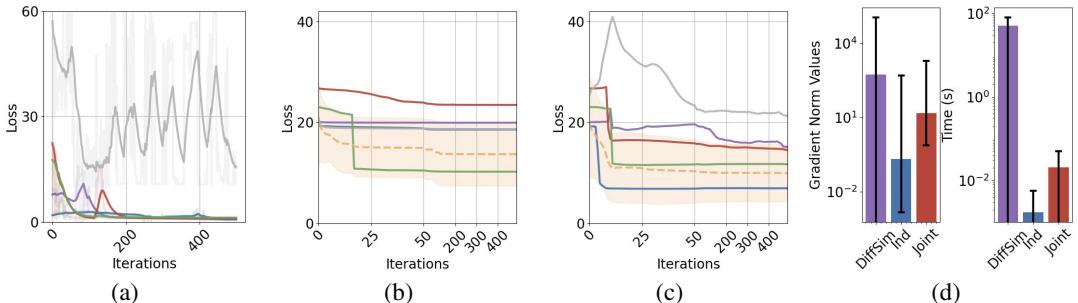
Figure 4 highlights the dramatic performance gap.
- Figure 4a vs 4c: The Neural Physics loss (4c) converges smoothly and stably, whereas the differentiable simulation (4a) is noisy and erratic.
- Figure 4d: Look at the time scale. The “Joint” (Neural) optimization takes about \(10^{-2}\) seconds per iteration, while the DiffSim takes \(10^2\) seconds. That is a 10,000x speedup.
Furthermore, the “Gradient Norm” (a measure of how steep/unstable the optimization landscape is) is much lower for the neural model, making the optimization much more likely to find a global optimum rather than getting stuck in local pits.
Part 4: From Simulation to Reality
A simulation is only useful if it translates to the real world. The researchers 3D-printed their optimized designs using TPU (Thermoplastic Polyurethane).
But how do you print “variable stiffness” with a single material?
Printing Microstructures
The team modulated the effective stiffness (Young’s modulus) by changing the infill density and wall loops of the 3D print.
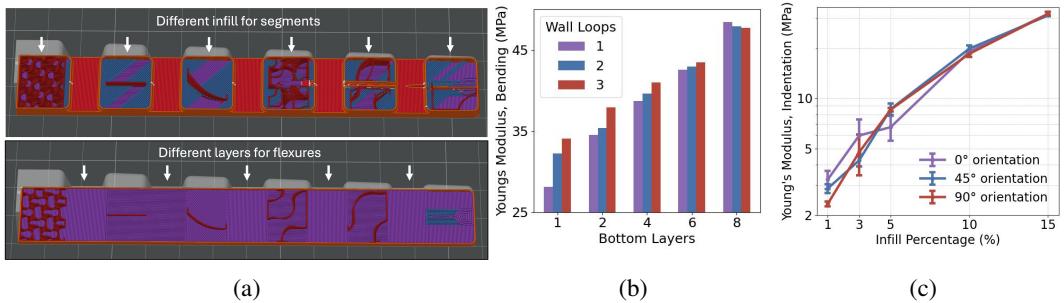
- Flexure Joints: Stiffness is controlled by the number of “wall loops” (perimeter shells). More loops = stiffer hinge (Figure 5b).
- Segment Blocks: Stiffness is controlled by the infill percentage (how much empty space is inside). Higher infill = harder block (Figure 5c).
They calibrated the printer output to match the simulation range (0.7 to 24 MPa) and printed the optimal design found by the neural network.
Experiments and Key Results
The researchers compared three main gripper types:
- Rigid: A standard hard gripper.
- Soft: A gripper with uniform low stiffness.
- Optimized: The co-designed gripper with variable stiffness.
Simulation Success
In simulation, they tested the grippers on both “in-domain” objects (seen during training) and “out-of-domain” objects (new shapes/masses).
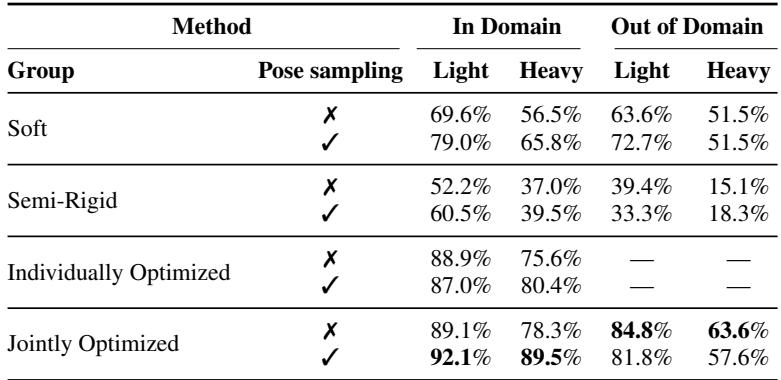
Table 1 shows the results. The Jointly Optimized method achieved the highest success rates across the board.
- Heavy Objects: Notice the massive drop-off for the “Soft” and “Semi-Rigid” grippers on heavy objects (dropping to ~51% and ~15%). The Optimized gripper maintained a 78.3% success rate.
- Generalization: The optimized design performed well even on objects it had never seen before (Out of Domain), proving that the design principles learned were robust.
Real World Performance
The team mounted the grippers on a Franka Emika robotic arm and tested them on 10 diverse objects, ranging from a light plastic spoon (41g) to a heavy spray bottle (180g).
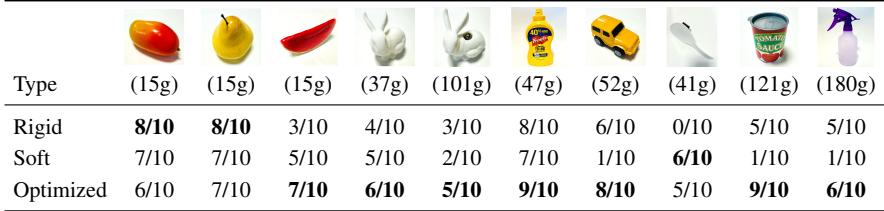
Table 2 reveals the real-world dominance of the optimized design:
- The “Goldilocks” Effect: The Rigid gripper struggled with the plastic spoon (0/10 success) because it couldn’t conform to the shape. The Soft gripper struggled with the heavy spray bottle (1/10 success) because it was too flimsy to support the weight.
- The Optimized Solution: The co-designed gripper handled the spoon (5/10) and the spray bottle (6/10) effectively, and dominated on complex shapes like the “Bottle of Dish Soap” (9/10).
The “Primate Nail” Discovery
An interesting emergent property of the optimization was the stiffness distribution. The neural network tended to select a design with stiff fingertips, mimicking the fingernails of primates.
While the middle of the finger remained soft to conform to object shapes, the rigid tip provided a distinct contact point that helped scoop thin objects off the table and provided stability against rotation. This design feature wasn’t hard-coded; the AI “discovered” that fingernails are useful for manipulation.
Conclusion and Implications
This research demonstrates the power of differentiable neural surrogates. By creating a fast, learnable approximation of physics, the researchers turned an intractable design problem into a solvable optimization loop.
Key takeaways:
- Hardware Matters: The derivation of the uniform-pressure tendon routing provided a solid mechanical baseline, preventing the “curling” issue common in soft robotics.
- Speed Enables Design: You cannot co-optimize design and control if your simulation takes minutes per frame. The 10,000x speedup from the neural network was the enabling factor.
- Hybrid Designs Win: The optimal gripper wasn’t fully soft or fully rigid. It was a heterogeneous mix, confirming that biology (with its mix of soft skin and hard bone) often has the right idea.
This framework opens the door for designing robots that are custom-tailored for their environments, moving us away from “one-size-fits-all” hardware and toward intelligent, morphologically adapted systems.