](https://deep-paper.org/en/paper/2505.21387/images/cover.png)
Introduction
In the era of big data, we rarely rely on a single source of information to understand the world. Consider an autonomous vehicle: it doesn’t just look through a camera; it listens to sonar, measures distance with LiDAR, and checks GPS coordinates. This aggregation of diverse data sources is the foundation of Multi-View Clustering (MVC). By fusing information from different “views” (e.g., audio, video, text), machine learning models can achieve a level of understanding that a single view simply cannot match.
However, there is a catch. Most existing MVC algorithms rely on a pristine, idealized assumption: that the data from all these views is clean.
But the real world is messy. Sensors fail, transmission channels get corrupted, and data collection gets interrupted. When a multi-view model is fed noisy data—garbage inputs masquerading as valid signals—the performance doesn’t just dip; it often collapses. The noise disrupts the fusion process, misleading the model into finding patterns where none exist.
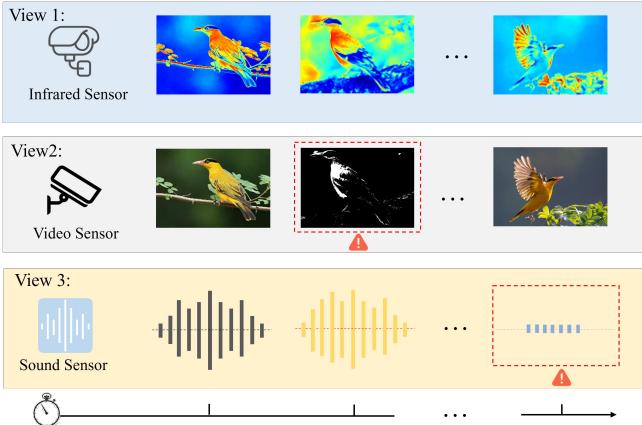
As illustrated above, imagine a scenario monitoring birds. View 1 (infrared) and View 3 (sound) might capture the bird perfectly, but View 2 (video) might suffer a glitch or occlusion at that exact moment. If the model treats View 2 as equal truth, the clustering result is compromised.
This brings us to a groundbreaking paper titled “Automatically Identify and Rectify: Robust Deep Contrastive Multi-view Clustering in Noisy Scenarios.” The researchers propose a framework called AIRMVC. Instead of blindly accepting all data, AIRMVC acts as a sophisticated filter and repair mechanic. It automatically identifies which data points are noisy and rectifies them before they can do damage, all while learning robust representations for clustering.
In this deep dive, we will unpack how AIRMVC turns noisy chaos into clustered order.
Background: The Challenge of Noisy Multi-View Clustering
To appreciate the innovation of AIRMVC, we must first understand the limitations of current approaches.
The Standard MVC Paradigm
Traditional Deep Multi-View Clustering generally follows a standard workflow:
- Encoders extract features from each view.
- Fusion Layers combine these features to find commonalities.
- Clustering Modules group the fused features into classes.
The “secret sauce” of MVC is complementary information. What is ambiguous in an image might be obvious in an audio clip. By cross-referencing, the model gains confidence.
The Noise Problem
The problem arises when “complementary” becomes “contradictory.” If a video feed turns into static noise, it doesn’t complement the audio; it fights it.
Recent attempts to handle this include methods like RMCNC (Robust Multi-view Clustering with Noisy Correspondence), which tries to tolerate noise using specific loss functions. However, tolerance is not the same as correction. Most existing methods focus on making the feature learning “tougher” against noise, but they lack a dedicated mechanism to explicitly say, “This specific sample is broken, and I am going to fix it.”
This is where AIRMVC diverges from the pack. It doesn’t just endure noise; it actively hunts it down.
The AIRMVC Framework: A Methodology Deep Dive
The core logic of AIRMVC is built on three pillars: Identification, Rectification, and Robust Contrastive Learning.
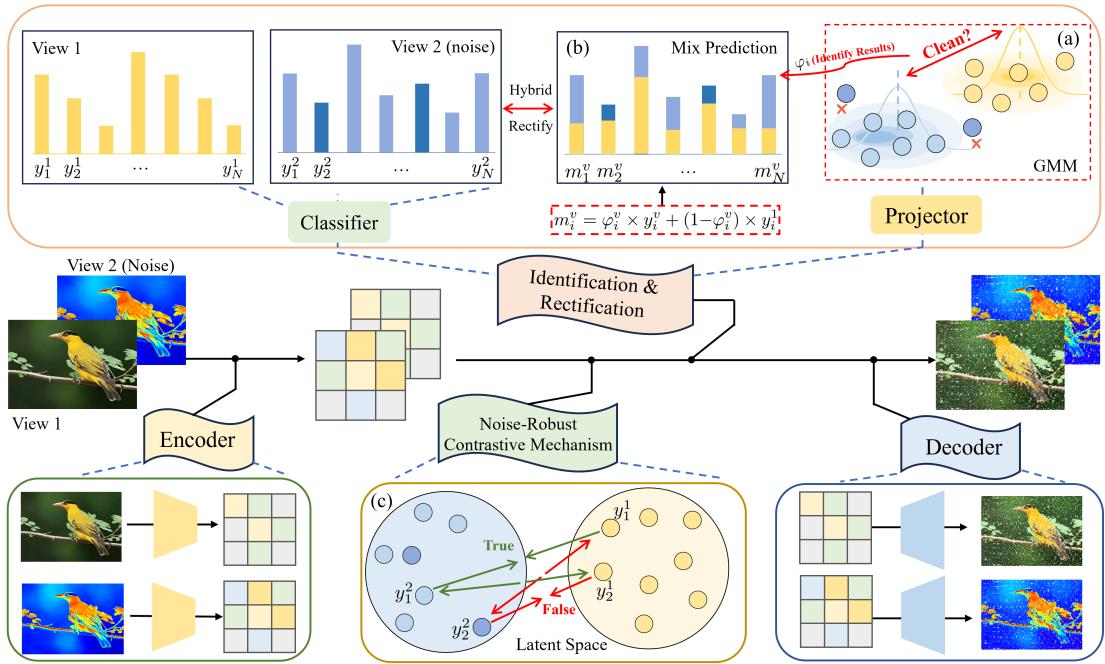
As shown in the framework diagram above, the process is cyclical and interconnected. The model encodes views, identifies anomalies (noise), rectifies them using a hybrid strategy, and reinforces the learning with a noise-robust contrastive mechanism.
Part 1: Noisy Identification via Anomaly Detection
How do you find noise in an unsupervised setting where you don’t have labels telling you what is “clean”? The researchers reformulated this as an anomaly identification problem.
The hypothesis is simple: Clean data tends to cluster consistently. Noisy data behaves like an outlier or an anomaly within the latent space. To model this, the researchers utilized a Gaussian Mixture Model (GMM).
Modeling Distribution
First, the model extracts representations (\(E\)) from the input data. The distribution of these representations is modeled as a mixture of Gaussians:
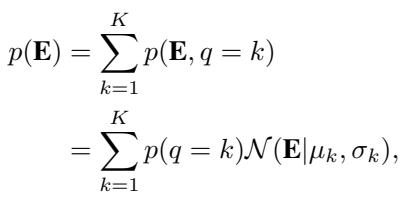
Here, \(q\) is a latent variable representing the cluster assignment. In a standard GMM, we look for the probability that a sample belongs to a specific cluster \(k\).
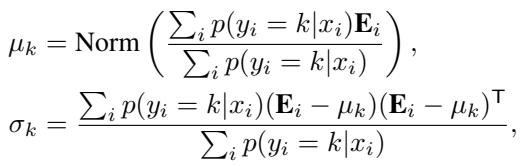
However, simply clustering features isn’t enough to find noise. The researchers took a clever step: they linked the latent variable \(q\) to the model’s soft predictions (\(y\)). A “soft prediction” is the probability distribution output by the neural network (e.g., “80% chance this is a bird, 20% chance it’s a plane”).
By replacing standard GMM assignments with the network’s soft predictions, they calculate the mean (\(\mu\)) and variance (\(\sigma\)) of the clusters dynamically:
The Clean vs. Noisy Probability
With the distributions modeled, the system calculates a posterior probability. This tells us how likely a specific sample \(x_i\) belongs to a cluster \(k\). If a sample is clean, its soft prediction should align well with the cluster distribution. If it is noisy, it will statistically look like an outlier.
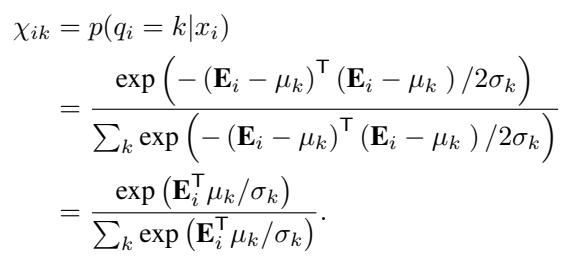
Finally, the framework assigns a “cleanliness score,” denoted as \(\varphi_i\) (phi). This is derived from a two-component GMM that specifically looks at the likelihood of the sample being clean (\(a=1\)) versus noisy (\(a=0\)).

In simple terms: \(\varphi_i\) is the probability that sample \(i\) is clean. If \(\varphi_i\) is close to 1, the data is trusted. If it is close to 0, it is flagged as noise.
Part 2: Hybrid Rectification Strategy
Once the noise is identified (\(\varphi_i \approx 0\)), what do we do with it? Deleting it might reduce the dataset size too drastically. Instead, AIRMVC employs a Hybrid Rectification Strategy.
The idea is to repair the noisy soft prediction by mixing it with a prediction from a trusted view. In this framework, the researchers assume one view (usually the primary view) acts as a relatively clean anchor, or they leverage the consensus of predictions.
The rectification is an interpolation process:

Let’s break this equation down:
- \(y_i^v\) is the original prediction of the potentially noisy view.
- \(y_i^1\) is the prediction from the reliable view (View 1).
- \(\varphi_i^v\) is the cleanliness score we calculated earlier.
If the view is clean (\(\varphi \approx 1\)), the term \((1-\varphi)\) becomes 0, and we keep the original prediction. If the view is noisy (\(\varphi \approx 0\)), the first term vanishes, and we replace the noisy prediction with the prediction from View 1. This creates a “mixed” or rectified prediction \(m_i^v\).
This rectified prediction is then enforced using a cross-entropy loss function, termed the Rectification Loss:
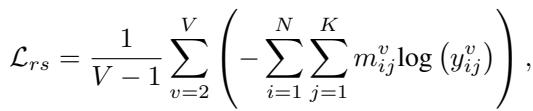
This forces the network to update its parameters so that future predictions for this sample are closer to the rectified (cleaner) version.
Part 3: Noise-Robust Contrastive Mechanism
The final piece of the puzzle is Contrastive Learning. In standard contrastive learning, the goal is to pull representations of the same sample (from different views) close together and push different samples apart.
- Positive Pair: Sample \(i\) from View A and Sample \(i\) from View B.
- Negative Pair: Sample \(i\) from View A and Sample \(j\) from View B.
However, if Sample \(i\) in View B is noisy (garbage data), pulling View A close to it will “pollute” the representation of View A. We need to prevent the model from learning consistency with noise.
AIRMVC introduces a confidence threshold (\(\tau\)) into the contrastive loss. It uses the soft predictions to verify if a pair is actually semantically similar before applying the loss.

The term \(\mathbb{I}\{ (y_i^m)^\top (y_j^n) \geq \tau \}\) acts as a gatekeeper.
- We calculate the dot product of the predictions (\(y\)) for the two views.
- If the similarity is high (above \(\tau\)), the gate opens (value 1), and we apply the contrastive loss to align their representations.
- If the similarity is low (below \(\tau\))—which happens if one view is noisy and predicting random classes—the gate closes (value 0). The model effectively ignores this pair, preventing the noise from corrupting the learned features.
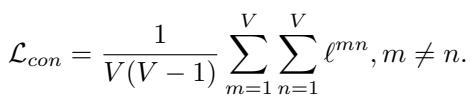
This robust loss is summed over all view pairs:
The Objective Function
The final training objective combines three losses:
- Reconstruction Loss (\(\mathcal{L}_{rec}\)): Ensures the autoencoder retains basic feature information.
- Rectification Loss (\(\mathcal{L}_{rs}\)): Fixes the noisy predictions.
- Contrastive Loss (\(\mathcal{L}_{con}\)): Aligns views while filtering out noise.

\(\alpha\) and \(\beta\) are hyperparameters balancing the contributions of rectification and contrastive learning.
Theoretical Guarantees
One of the strengths of this paper is that it doesn’t just rely on heuristics; it offers a theoretical basis for why this works. The researchers utilize Information Theory to prove that their representations maximize mutual information with the clean signal while minimizing it with the noise.
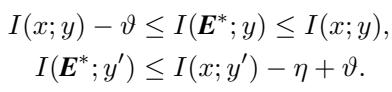
In this inequality:
- \(I(E^*; y)\) represents the information the learned representation shares with the clean prediction. The theorem proves this is maximized (close to the true input information \(I(x;y)\)).
- \(I(E^*; y')\) represents the information shared with the noisy prediction. The theorem proves this is minimized (bounded by the noise factor \(\eta\)).
Essentially, AIRMVC is mathematically proven to act as a sieve, letting clean semantic information pass through while trapping and discarding the noise.
Experiments and Results
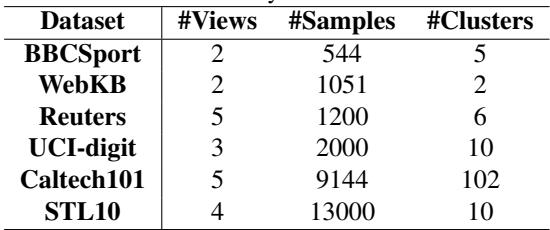
To validate AIRMVC, the authors tested it against 11 state-of-the-art baselines on 6 benchmark datasets, including BBCSport, Reuters, and Caltech101.
The Setup
They simulated real-world conditions by randomly introducing noise into the views at varying rates: 10%, 30%, 50%, 70%, and even a massive 90%.
The datasets vary in size and complexity:
Performance Comparison
The results were compelling. AIRMVC consistently outperformed competitors, particularly as noise levels increased.
Take a look at the performance on BBCSport, WebKB, and Reuters at a 10% noise rate:
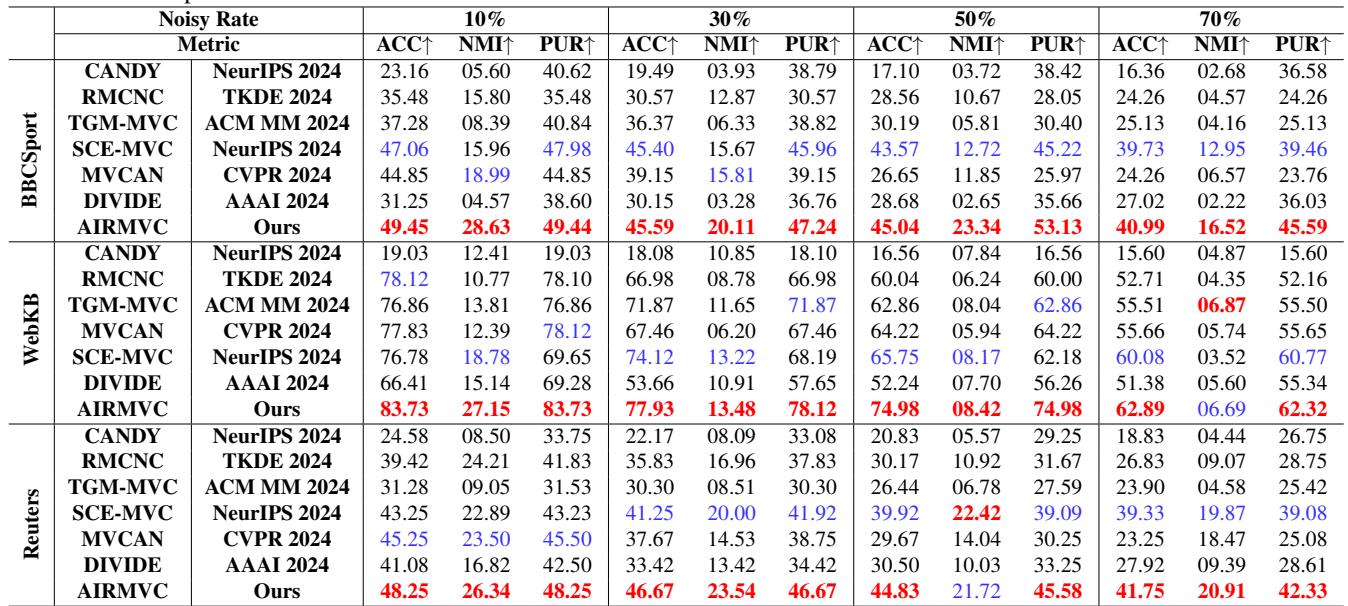
On the WebKB dataset, AIRMVC achieved an Accuracy (ACC) of 83.73%, significantly higher than the runner-up (MVCAN) at 77.83%. The margins are even wider in Normalized Mutual Information (NMI), jumping from roughly 12% (baselines) to 27.15% with AIRMVC.
Even under extreme duress—90% noise—where most models would essentially be guessing, AIRMVC maintained structural integrity better than the rest.
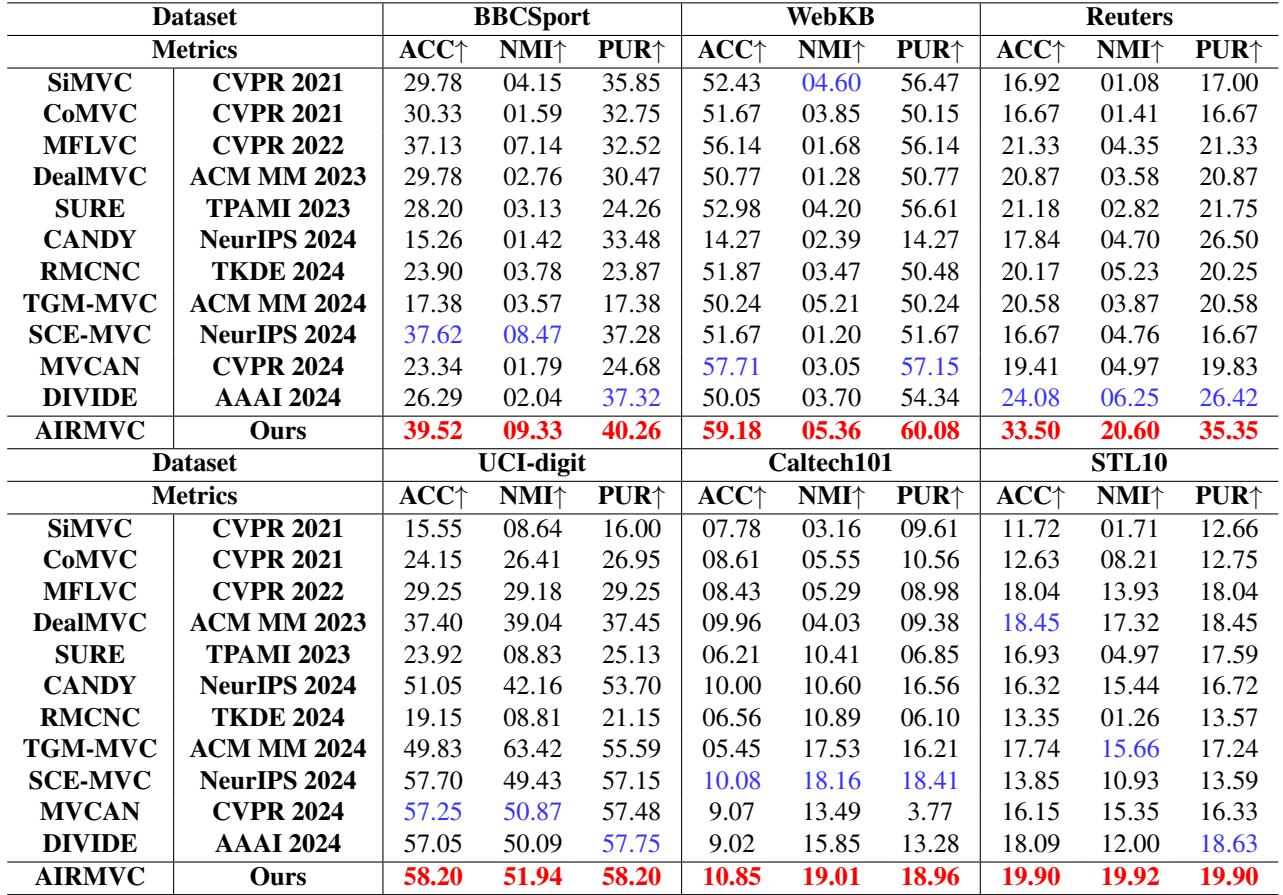
In Table 9, under 90% noise on the UCI-digit dataset, AIRMVC scored 57.70% accuracy, while many competitors like RMCNC dropped to around 19%. This demonstrates that the rectification strategy isn’t just a minor optimization; it is a survival mechanism for the model in hostile data environments.
Why Does It Work? (Ablation Studies)
The researchers stripped the model down to see which parts mattered most. They tested the model without the Identification/Rectification (D&R) module and without the Contrastive (Con) module.
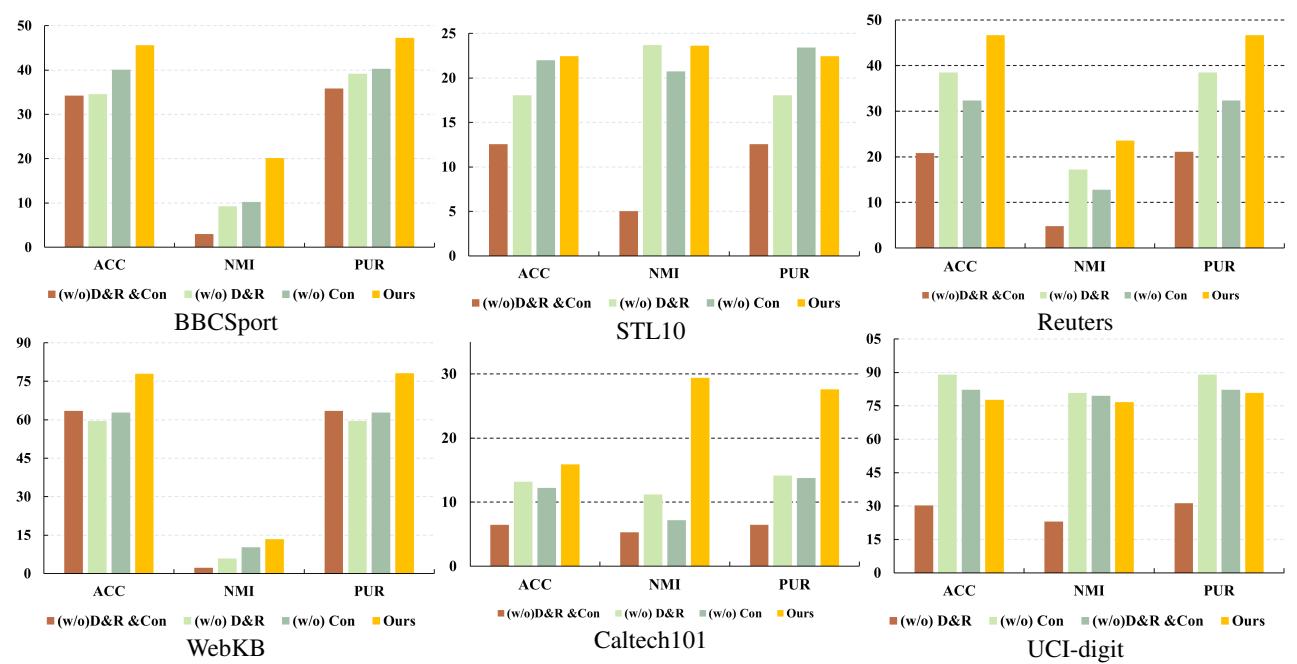
The yellow bars (Ours) represent the full AIRMVC model. In almost every case, removing the D&R module (light green) caused a massive drop in performance. This confirms that the ability to fix data is just as important, if not more so, than the contrastive learning mechanism itself.
Visualizing the Learning Process
Do the clusters actually separate? The researchers used t-SNE to visualize the feature space of the UCI-digit dataset over 200 epochs.
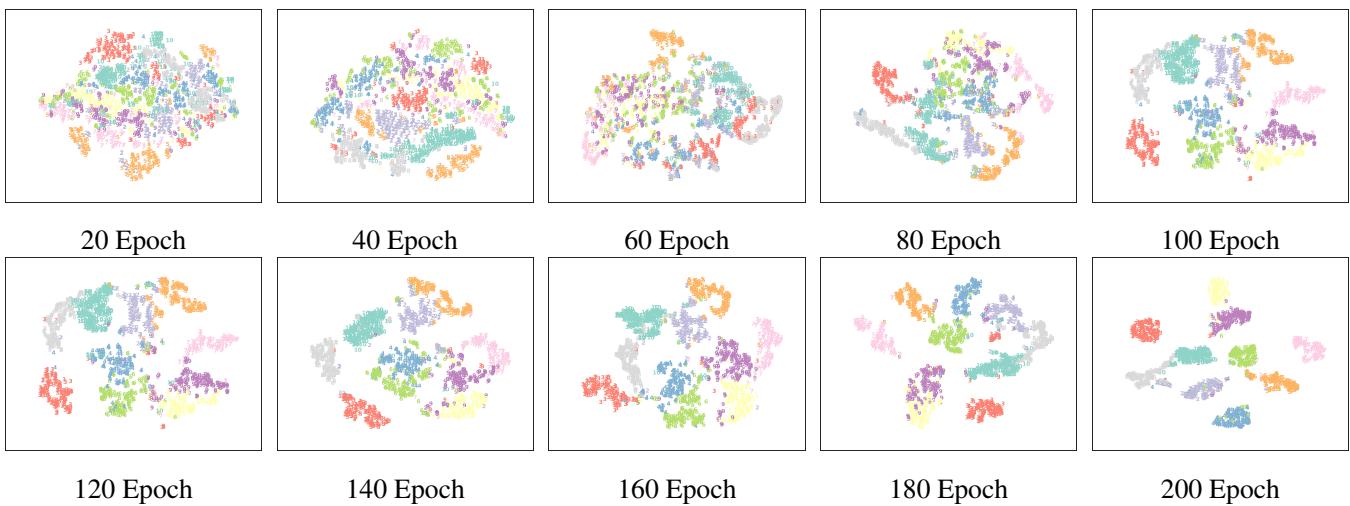
At Epoch 20 (top left), the data is a jumbled mess of colors—the model cannot distinguish digits. By Epoch 100, distinct islands begin to form. By Epoch 200 (bottom right), the clusters are crisp and well-separated. This visual evolution proves that AIRMVC successfully untangles the underlying structure of the data, even when fed noisy inputs.
Sensitivity Analysis
Finally, the researchers checked if the model was finicky about hyperparameters.
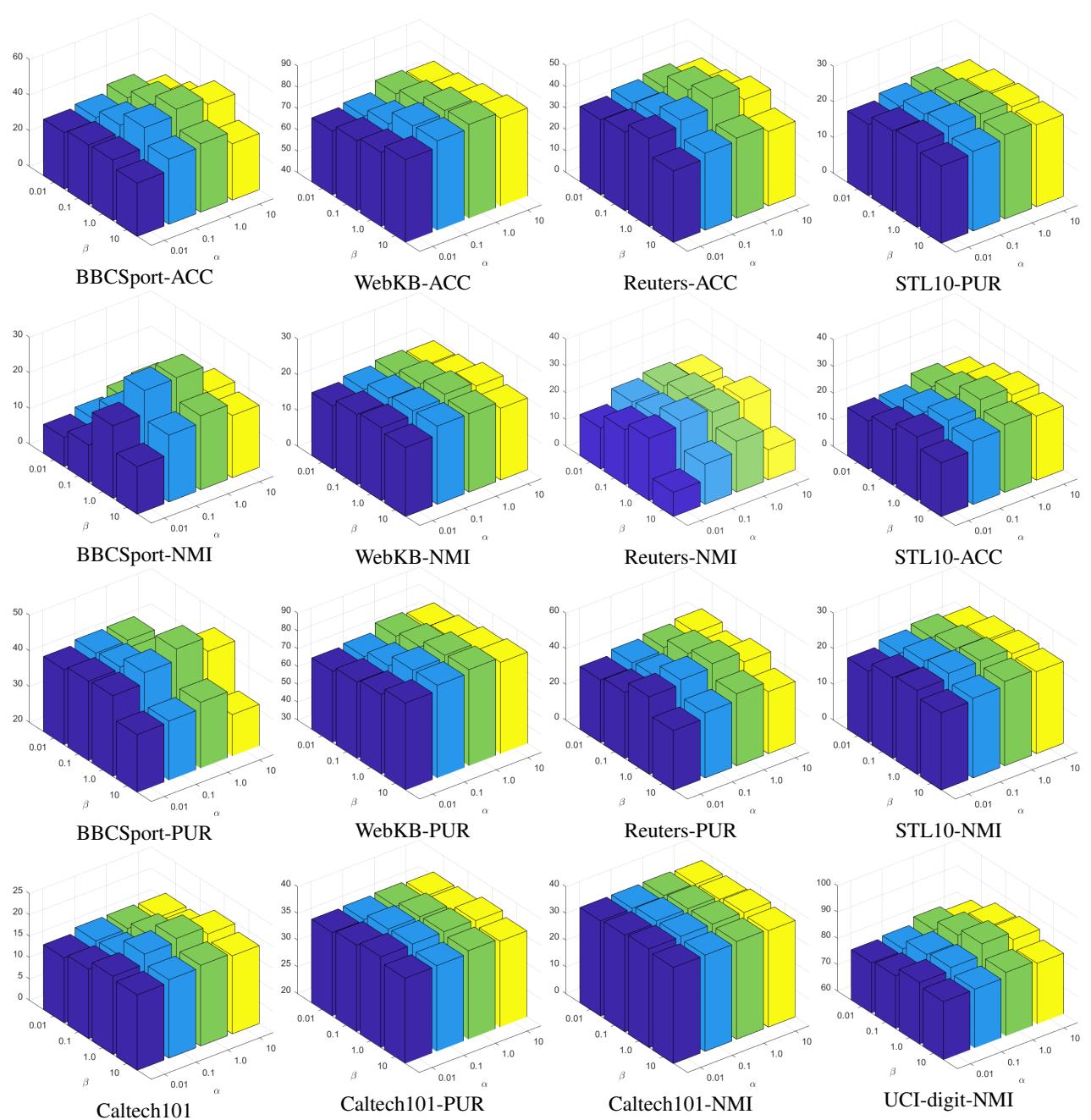
The 3D plots above show the performance (z-axis) as the hyperparameters \(\alpha\) and \(\beta\) change. The relatively flat plateaus near the center (values around 1.0) suggest the model is stable. It doesn’t require “magic numbers” to work; it performs well across a reasonable range of settings, though it degrades if the parameters are pushed to extremes (like 0.01).
Conclusion and Implications
The AIRMVC paper presents a significant leap forward in unsupervised learning. It addresses a critical flaw in previous multi-view clustering methods: the assumption that more data is always better data.
By acknowledging that real-world sensors fail and data gets corrupted, the researchers built a system that mimics a human-like quality—skepticism. AIRMVC doesn’t blindly trust its inputs. It:
- Identifies anomalies using probabilistic modeling (GMM).
- Rectifies the bad data using the good data.
- Learns strictly from verified, high-confidence associations.
The implications extend beyond just clustering. This “Identify and Rectify” paradigm could be adapted for autonomous driving (ignoring a mud-covered camera in favor of LiDAR), medical diagnostics (filtering out noisy MRI artifacts), or robust financial modeling.
In the noisy reality of big data, AIRMVC demonstrates that the key to clarity isn’t just listening to every signal—it’s knowing which ones to ignore and which ones to fix.