](https://deep-paper.org/en/paper/2505.22356/images/cover.png)
Introduction
We live in an era where machine learning models are transitioning from research labs to the real world at a breakneck pace. We train models to diagnose diseases, approve loans, and drive cars. In the controlled environment of a training lab, we measure success using labeled test sets. We know exactly how accurate the model is because we have the answer key (the ground truth labels).
But what happens the moment you deploy that model?
You send the model out into the wild, where it encounters “user data.” This data is unlabeled—if we had labels for it, we wouldn’t need the model in the first place. The fundamental problem is that the world changes. The distribution of data in the real world (deployment) often shifts away from the distribution of data used during training. This phenomenon, known as covariate shift, can silently destroy a model’s performance. A credit risk model trained on historical data might fail when economic conditions change, potentially harming underserved communities. A medical model trained on one demographic might fail on another.
How can we know if a model is failing if we can’t calculate its accuracy?
This is the “deployment gap,” and it is one of the most critical challenges in safety-critical machine learning. A new research paper titled “Suitability Filter: A Statistical Framework for Classifier Evaluation in Real-World Deployment Settings” proposes a robust solution. The researchers introduce the Suitability Filter, a statistical framework that allows us to detect performance deterioration on unlabeled data without needing ground truth.
In this post, we will tear down the Suitability Filter, explain how it uses “suitability signals” to estimate correctness, and explore the statistical machinery that decides whether a model is safe to use.
The Core Problem: Flying Blind
Before diving into the solution, let’s solidify the problem. In a standard machine learning lifecycle, you have a Model Provider and a Model User.
- The Provider trains a model \(M\) on a source distribution (\(D_{source}\)). They verify it works well on a hold-out test set (\(D_{test}\)).
- The User brings their own data (\(D_{u}\)) from a target distribution (\(D_{target}\)).
If \(D_{source}\) and \(D_{target}\) are identical, everything is fine. But they rarely are. The user wants to know: “Is the accuracy of this model on my data significantly worse than the accuracy you promised based on the test set?”
Since the user’s data is unlabeled, we cannot simply calculate accuracy. We are effectively flying blind, hoping the model generalizes well. The Suitability Filter aims to provide a dashboard instrument that lights up when the “altitude” (accuracy) drops too low.
The Solution: The Suitability Filter
The Suitability Filter is an auxiliary function that sits alongside your classifier. Its job is to output one of two decisions: SUITABLE or INCONCLUSIVE.
The definition of “suitable” here is rigorous. A model is suitable for a user dataset \(D_u\) if its accuracy on that dataset does not fall below the accuracy on the original test set (\(D_{test}\)) by more than a specific margin, \(m\).
Mathematically, the goal is to verify this inequality:
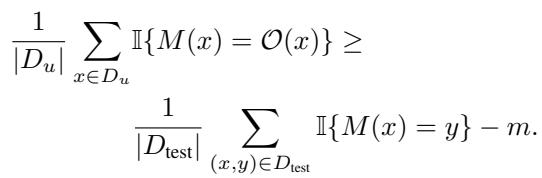
Here, \(\mathcal{O}(x)\) represents the oracle (the true label), which we don’t have for the user data. The Suitability Filter approximates this verification using a three-step process:
- Extract Signals: Gather clues from the model’s behavior on each sample.
- Estimate Correctness: Use those clues to guess the probability that the model is right.
- Statistical Testing: Compare the distribution of these guesses on the test set vs. the user set to see if there is a significant drop.
Let’s break down the architecture of this framework.
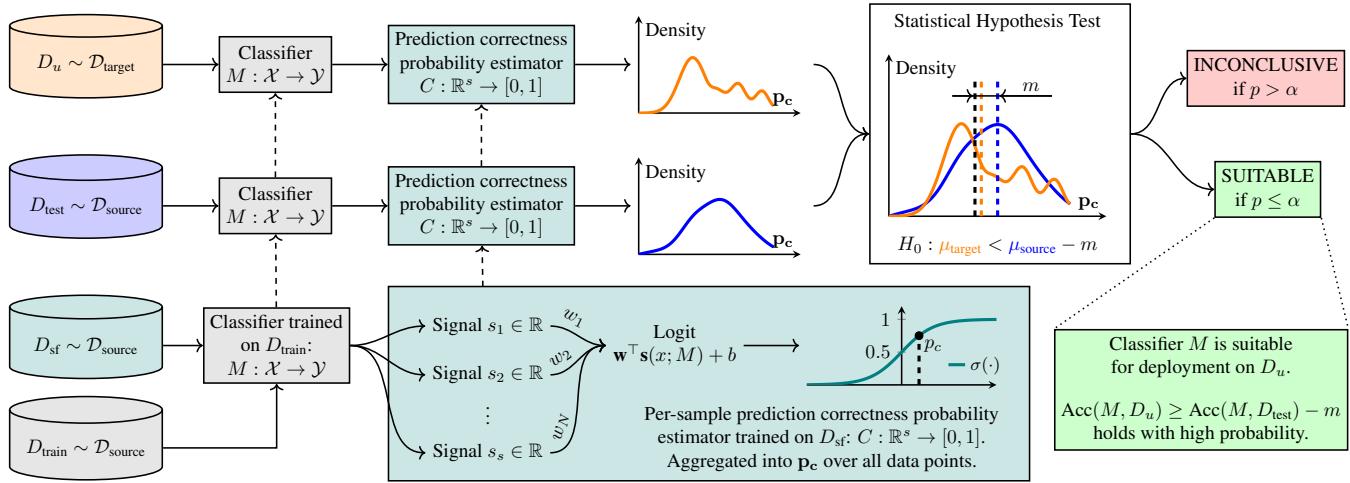
As shown in Figure 2, the process runs in parallel. We process the labeled Test Data (top path) and the unlabeled User Data (bottom path) through the same pipeline to generate “Prediction Correctness Probabilities” (\(p_c\)). We then compare these two distributions.
Step 1: Suitability Signals
How can we guess if a model is right without knowing the answer? It turns out, models often “know” when they are confused. We can extract Suitability Signals—features derived from the model’s raw output (logits and softmax probabilities)—that correlate with accuracy.
The authors utilize a variety of signals that are model-agnostic (they work for any classifier). Some common examples include:
Maximum Confidence: The highest probability assigned to a class. If a model predicts “Cat” with 99.9% confidence, it’s more likely to be right than if it predicts “Cat” with 51% confidence.

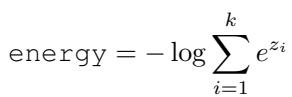
Entropy: A measure of uncertainty. If the probability is spread out evenly across all classes, entropy is high (high uncertainty).
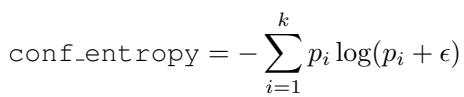
Energy: A metric derived from the raw logits (before the softmax layer), often used to detect out-of-distribution data.
Other signals include the standard deviation of logits, the margin between the top two predictions, and the cross-entropy loss (calculated against the predicted label).
Step 2: The Prediction Correctness Estimator (\(C\))
Having a bunch of signals is great, but we need to combine them into a single, interpretable number: the Probability of Correctness (\(p_c\)).
To do this, the researchers train a separate, smaller model called the Prediction Correctness Estimator (\(C\)).
- Training Data: To train \(C\), the Model Provider needs a specific dataset called \(D_{sf}\) (Suitability Filter dataset). This is a labeled hold-out set drawn from the source distribution, separate from the training and test sets.
- The Method: For every sample in \(D_{sf}\), the provider calculates the suitability signals and checks if the main model \(M\) was actually correct (since \(D_{sf}\) is labeled).
- The Model: \(C\) is typically a logistic regression model. It takes the vector of signals as input and outputs a value between 0 and 1, representing the estimated probability that \(M\) is correct.
Once trained, \(C\) can be applied to any input, whether we have labels or not. We apply it to the Test Data (\(D_{test}\)) and the User Data (\(D_{u}\)) to get vectors of correctness probabilities.

Step 3: Statistical Non-Inferiority Testing
Now we have two lists of numbers: the estimated correctness probabilities for the test set and the estimated correctness probabilities for the user set.
If we simply averaged these lists, we would get the Estimated Accuracy for both datasets.
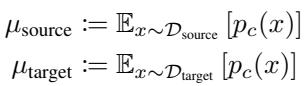
However, simply comparing averages isn’t rigorous enough for safety-critical deployment. We need to account for sample size and variance. We need a statistical test.
The authors employ a Non-Inferiority Test. Unlike a standard “difference” test (which checks if \(A \neq B\)), a non-inferiority test checks if “A is not worse than B by more than margin \(m\).”
We set up our hypotheses as follows:
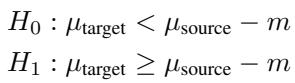
- Null Hypothesis (\(H_0\)): The performance on the user (target) data is worse than the test (source) data by more than the allowed margin \(m\). (i.e., The model is UNSUITABLE).
- Alternative Hypothesis (\(H_1\)): The performance on the user data is roughly equivalent or better (within the margin). (i.e., The model is SUITABLE).
The filter uses a Welch’s t-test to compare the distributions.
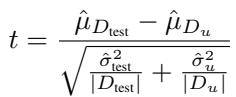
If the p-value from this test is below a significance level (\(\alpha\), typically 0.05), we reject the null hypothesis and declare the model SUITABLE. If the p-value is high, we cannot confirm suitability, and the filter returns INCONCLUSIVE.
Visualizing the Decision
The density plot below beautifully illustrates this concept.
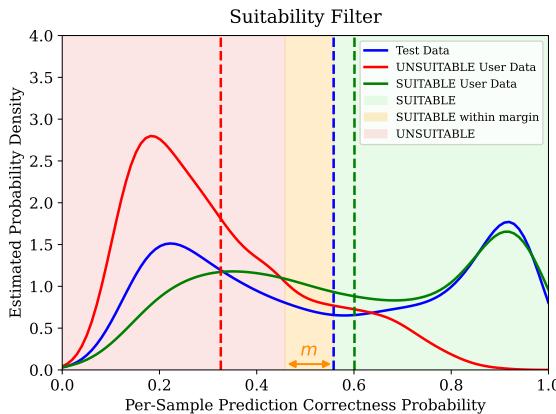
- Blue Curve: The distribution of correctness probabilities on the Test Data.
- Red Curve: A user dataset that has shifted significantly. The curve is pushed to the left (lower probability of correctness). The distance between the blue and red dashed lines is large, likely exceeding the margin \(m\). The test would fail here.
- Green Curve: A suitable user dataset. It overlaps significantly with the blue curve. The difference in means is small, falling within the “Suitability Margin.”
The Challenge of Calibration
The framework described above relies on a massive assumption: The Correctness Estimator (\(C\)) must be accurate.
If \(C\) consistently overestimates the probability of correctness, we might think the model is doing great when it’s actually failing. This is known as a Calibration Error.
The paper analyzes this theoretically using the concept of \(\delta\)-calibration.

If our estimator is perfectly calibrated (\(\delta = 0\)), the expected value of our correctness probabilities exactly equals the true accuracy. However, in reality, estimators often drift, especially when applied to the target distribution which might differ from the source.
The Margin Adjustment
To handle this, the authors propose a practical correction. If we can estimate the calibration error (the “bias” of our estimator), we can adjust the margin \(m\) to compensate.
Suppose we know that our estimator tends to overestimate accuracy on the user data. We effectively need to make the test harder to pass to ensure safety. We calculate a new margin, \(m'\), based on the empirical estimation errors (\(\Delta\)) observed on the test set and a small sample of user data.

Figure 3 visualizes this adjustment mechanism.
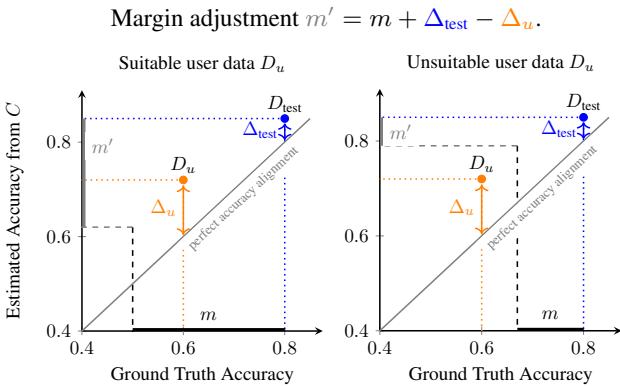
- Left Panel (Suitable): The estimation error pulls the perceived accuracy away from the diagonal (truth). By adjusting \(m\) to \(m'\), we effectively realign the acceptance criteria with reality.
- Right Panel (Unsuitable): Even with the adjustment, the user data falls below the threshold, correctly identifying the model as unsuitable.
This adjustment is vital for maintaining a Bounded False Positive Rate. The researchers prove that with this correction, the probability of incorrectly marking a bad model as “SUITABLE” is strictly controlled by the significance level \(\alpha\).
Experimental Results: Does it work?
To validate the Suitability Filter, the researchers ran extensive experiments using the WILDS benchmark, a collection of datasets specifically designed to test distribution shifts (e.g., satellite imagery over different years, medical images from different hospitals).
Sensitivity to Accuracy Drops
One of the most important questions is: “How sensitive is the filter?” If the model’s accuracy drops by 1%, does the filter notice? What about 5%?
The results on the FMoW-WILDS (satellite imagery) dataset are summarized in Figure 4.
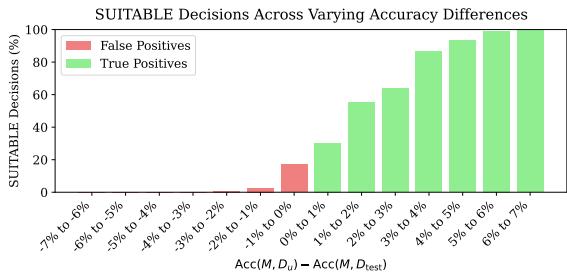
This chart is essentially a “sensitivity profile” of the filter:
- Right Side (Green): When the accuracy on user data is higher than or equal to the test data (Accuracy Difference \(\ge 0\)), the filter almost always returns SUITABLE. This is good; we want to accept good models.
- Left Side (Red): As the accuracy difference drops below -3% (meaning the model is performing 3% worse on user data), the percentage of SUITABLE decisions hits 0%. The filter catches every single instance of significant deterioration.
- The Transition: In the small window between -3% and 0%, there is some uncertainty. This is expected in statistical testing; small differences are harder to detect with high confidence without massive sample sizes.
Which Signals Matter?
The researchers also analyzed which “Suitability Signals” were actually doing the heavy lifting. Did the complex “Entropy” calculation matter, or was simple “Max Confidence” enough?
Using SHAP (SHapley Additive exPlanations) values, they ranked the importance of the signals used by the estimator \(C\).
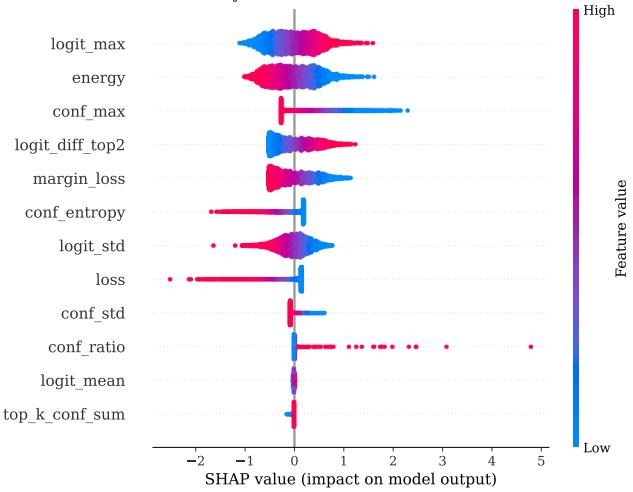
As seen in Figure 8, the most predictive signals were:
- logit_max: The raw maximum output value.
- energy: The energy score of the distribution.
- conf_max: The softmax confidence.
Interestingly, signals like logit_mean (the average value of logits) had very low impact. This insight is valuable for practitioners: if you need to implement a lightweight version of this filter, you might only need to calculate the top 3 or 4 signals rather than all of them.
Conclusion and Implications
The “Suitability Filter” represents a significant step forward for the responsible deployment of Machine Learning. It moves us away from the “deploy and pray” methodology toward a rigorous, statistically grounded framework for monitoring.
Key Takeaways:
- Label-Free Evaluation: We can estimate performance degradation without ground truth labels by leveraging suitability signals.
- Statistical Rigor: By using Non-Inferiority Testing, we can control the risk of False Positives (accepting a bad model).
- Adaptability: The framework is modular. You can swap in different classifiers, different signals, or even different statistical tests (like equivalence testing) depending on the domain.
For undergraduate and master’s students entering the field, this paper highlights a crucial lesson: Model training is only half the battle. The ability to monitor, evaluate, and reject models in dynamic real-world environments is what separates a coding project from a production-grade AI system.
The Suitability Filter provides a blueprint for creating “Auditable Service Level Agreements (SLAs)” for AI. In the future, a model provider might not just promise “99% accuracy,” but verify—day by day, dataset by dataset—that the model remains suitable for your specific needs.