](https://deep-paper.org/en/paper/2505.22483/images/cover.png)
Introduction
In the pursuit of Artificial General Intelligence, multimodal learning is a cornerstone. The logic is sound: humans perceive the world through sight, sound, and text simultaneously; therefore, AI models should benefit from combining these modalities to form a richer understanding of the data. Theoretically, adding a modality—say, adding MRI scans to patient health records—should never decrease performance. It should only add information.
However, researchers have consistently observed a baffling phenomenon known as Modality Collapse. Instead of leveraging all available data, deep learning models often over-rely on a subset of modalities while completely ignoring others. If a model is trained on video and audio, it might learn to ignore the audio entirely. This isn’t just inefficient; it’s dangerous. If the relied-upon modality goes missing at test time (e.g., a camera fails), the model becomes useless because it never learned to use the backup sensors.
While previous attempts to fix this blamed conflicting gradients or data distribution issues, recent research titled “A Closer Look at Multimodal Representation Collapse” offers a profound, “bottom-up” learning-theoretic explanation.
This post will deconstruct the paper’s findings. We will explore how polysemantic neurons (neurons doing “double duty”) and the low-rank simplicity bias of neural networks conspire to cause collapse. We will then examine a novel solution: Explicit Basis Reallocation (EBR), a method that forces the network to “make room” for all modalities, preventing collapse and enabling robust performance even when data goes missing.
The Anatomy of Collapse
To understand why models fail to fuse data, we must look inside the neural network’s fusion head—the layers responsible for combining features from different encoders (like a CNN for images and a Transformer for text).
The Problem of Polysemanticity
In an ideal world, every distinct feature from every modality would get its own dedicated neuron. This is called monosemanticity. However, neural networks are often resource-constrained relative to the complexity of the world. This leads to polysemanticity, where a single neuron activates for unrelated features from different modalities.
The authors prove that as the number of modalities increases, the probability of these “cross-modal polysemantic collisions” increases quadratically.
The real trouble begins when a noisy feature from one modality (let’s call it Modality B) shares a neuron with a predictive feature from another (Modality A).
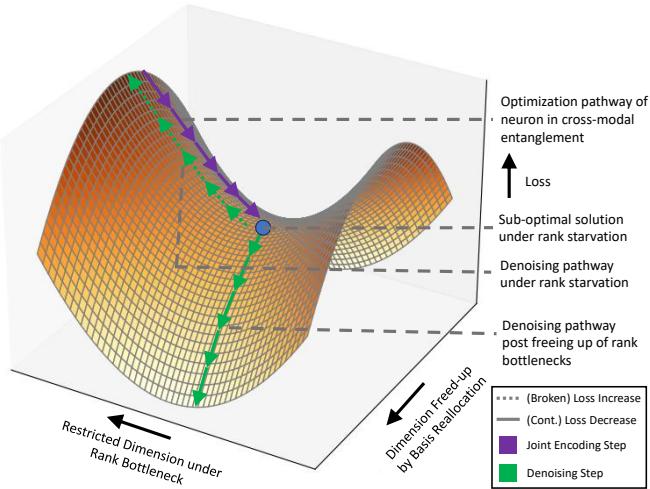
As illustrated in Figure 1, this entanglement creates a sub-optimal loss landscape. The optimization process (purple arrows) gets stuck. Why? Because the noisy feature from Modality B acts as a masker. It creates interference that diminishes the predictive value of Modality A. The network, trying to minimize loss, finds it easier to simply suppress the entangled neuron entirely rather than trying to separate the signal from the noise. The result: Modality A collapses.
Visualizing Interference
This concept is somewhat abstract, so let’s visualize the activation patterns.
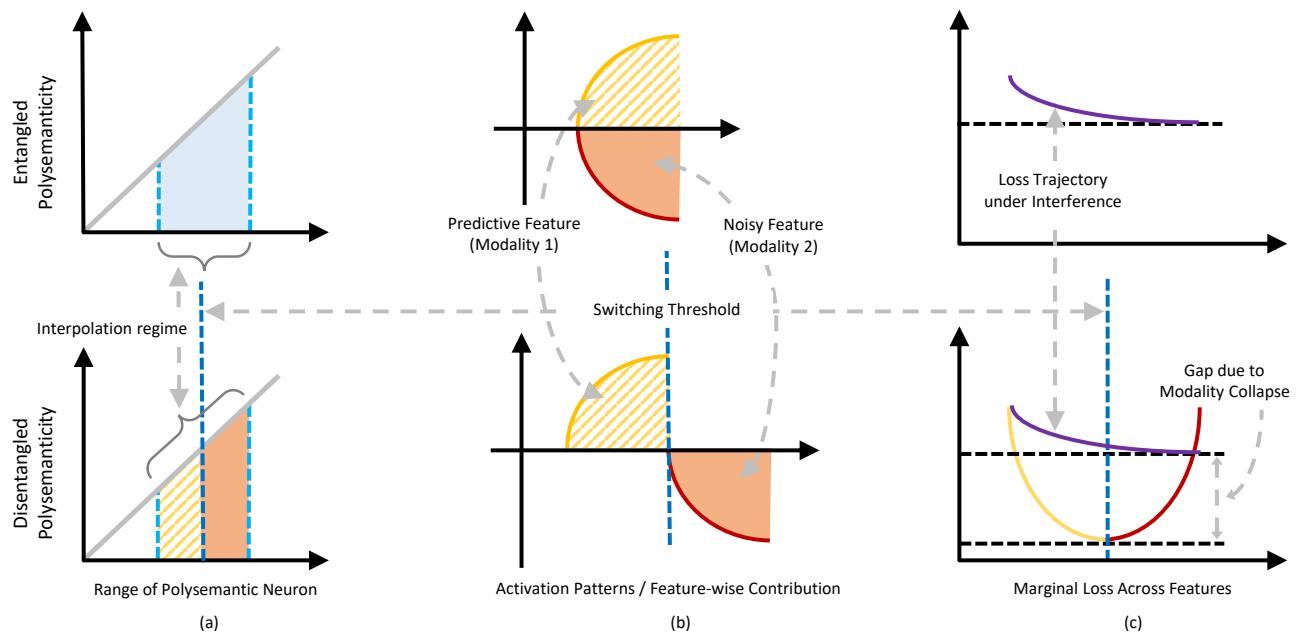
Figure 2 provides a clear breakdown of this interference:
- Panel (a) Top: In the “Entangled” regime, predictive features from Modality 1 and noisy features from Modality 2 activate the same region of the neuron.
- Panel (b) Top: Because they overlap, the noise interferes with the signal.
- Panel (c) Top: The loss trajectory hits a wall. The network cannot minimize the error further because maximizing the predictive feature brings along too much noise.
The solution, shown in the bottom half of Figure 2, is disentanglement. If the network can map these features to disjoint sub-regimes (or better yet, different dimensions entirely), the interference stops. The predictive feature can contribute to loss reduction without dragging the noise along with it.
The Culprit: Rank Bottlenecks
If disentanglement is the solution, why doesn’t Stochastic Gradient Descent (SGD) just find it automatically? The answer lies in the Low-Rank Simplicity Bias.
Deep neural networks have a known bias towards learning “simple” functions. In linear algebra terms, this means they prefer weight matrices with low rank. The authors formalize this in Theorem 2, showing that the gradient updates during training are restricted to a low-rank manifold.

This equation essentially states that the network tries to squeeze all the information into a very small number of dimensions (basis vectors). Because the “budget” of dimensions is artificially low due to this bias, the network is forced to cram different features into the same neurons. It creates the polysemantic collisions discussed above.
The rank bottleneck forces a “survival of the fittest” scenario. If Modality A is slightly easier to learn, it hogs the limited rank. Modality B, which might need a few dedicated dimensions to separate its signal from noise, gets starved of capacity and collapses.
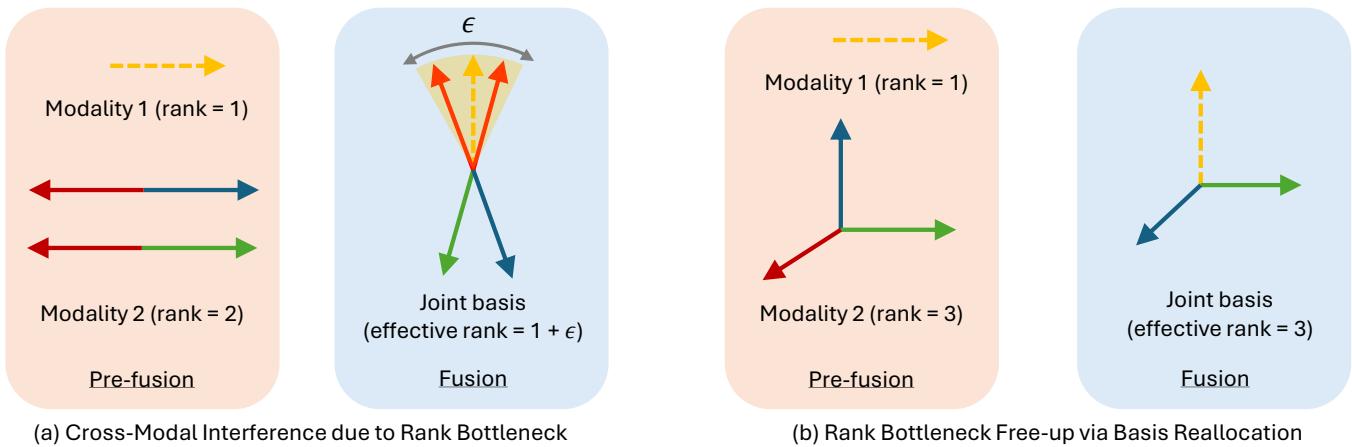
Figure 3 (a) illustrates this “Rank-Rich Bottleneck.” Even if the inputs have distinct information (represented by different colored arrows), the fusion head collapses them into a shared, entangled basis (the multi-colored bundle) because it refuses to increase the effective rank.
Figure 3 (b) shows the ideal scenario: Basis Reallocation. Here, the network allocates specific, orthogonal dimensions for the different modalities. This “frees up” the bottleneck, allowing the noisy red arrow to be isolated and ignored, while the blue and green predictive arrows are preserved.
The Solution: Basis Reallocation
The researchers propose two ways to achieve this disentanglement: an implicit method using Knowledge Distillation, and a novel explicit algorithm called EBR.
Implicit Remedy: Knowledge Distillation (KD)
Knowledge Distillation usually involves a “teacher” model guiding a “student.” The authors found that distilling knowledge from the dominant modality (the one that survives) into the weaker modality (the one collapsing) implicitly prevents collapse.
Why? The authors prove in Theorem 3 that forcing the weak encoder to mimic the strong encoder aligns their representations. This reduces the complexity the fusion head has to deal with.

More importantly, the process of distillation acts as a denoising filter. To successfully mimic the teacher, the student must discard its own noise. As the representations get cleaner and more aligned, the fusion head is less constrained by the rank bottleneck, implicitly allowing for better feature separation.
Explicit Remedy: Explicit Basis Reallocation (EBR)
While KD works, it is indirect. The authors propose Explicit Basis Reallocation (EBR) to solve the problem at its root.
EBR modifies the training of the unimodal encoders (before fusion occurs) to ensure they produce features that are disentangled and “rank-rich.”
The EBR Architecture
The method introduces two small components to each modality encoder \(f_i\):
- A Projector-Decoder pair (\(h_i \cdot h_i^{-1}\)): Maps features to a latent space and back.
- A Modality Discriminator (\(\psi\)): A small network that tries to guess which modality a feature vector came from.
The Algorithm
The training objective combines two losses: the standard Semantic Loss (classification error) and a Modality Discrimination Loss.
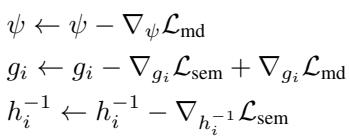
Here is the intuition behind these update rules:
- \(\psi\) (The Discriminator) tries to minimize the modality discrimination loss (\(\mathcal{L}_{md}\)), getting better at identifying the source modality.
- \(g_i\) (The Encoder) is optimized to minimize semantic loss but also minimize modality discrimination loss (adversarial training). Wait, looking closely at the equation, the gradient is added. The goal is actually to make the modalities distinct enough that they occupy their own basis, but aligned enough to be useful. Correction based on paper details: The maximization of \(\mathcal{L}_{md}\) by the encoder brings modalities within a neighborhood that allows disentanglement.
Crucially, this process forces the encoders to reallocate their basis vectors. Instead of collapsing into a shared, noisy mess, the encoders are forced to find independent directions for their features. This “pre-cleaning” means the fusion head receives orthogonal, clean inputs that don’t suffer from polysemantic interference.
Experimental Validation
The theory is compelling, but does it hold up in practice? The authors tested this on datasets like MIMIC-IV (healthcare data) and avMNIST (audio-visual digits).
1. Verifying the Theory: More Modalities = More Problems?
First, they verified that adding modalities actually causes issues in standard models.
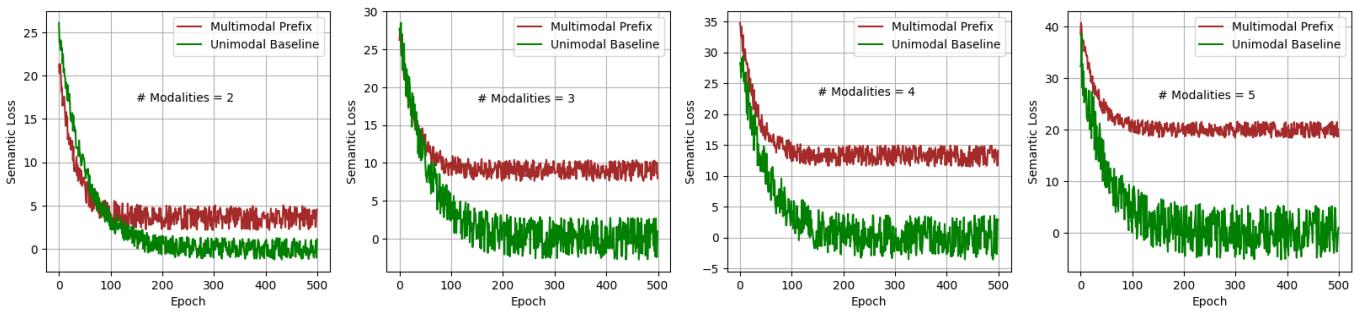
Figure 4 confirms the “quadratic collision” hypothesis. Look at the red lines (Multimodal Prefix). As the number of modalities increases from 2 to 5, the semantic loss gets stuck at higher and higher levels. The model is physically unable to minimize the loss because of the interference generated by the additional data streams. The green line (Unimodal Baseline) shows that the information is there—the model just can’t use it in a multimodal setting.
2. Does EBR Restore Rank?
The core hypothesis was that collapse is a rank problem.
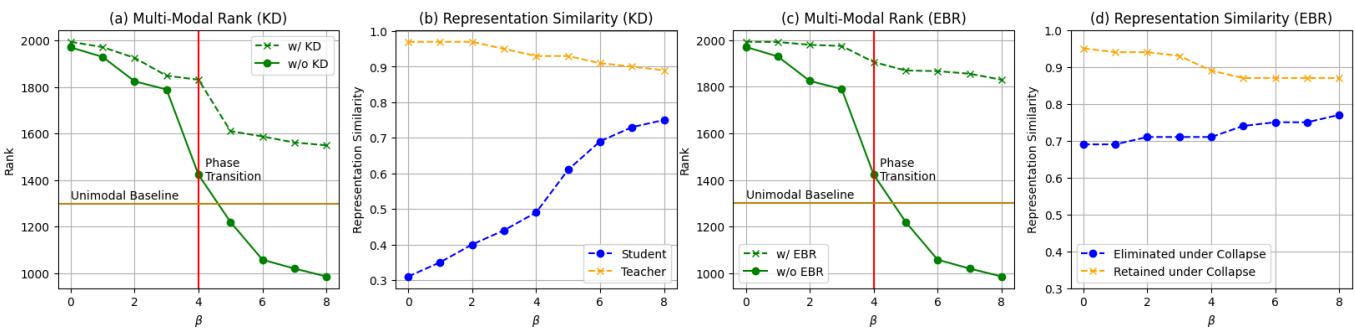
Figure 5 (c) is the smoking gun. In the standard setting (green circles, “w/o EBR”), the rank of the representation crashes as we increase \(\beta\) (the strength of the collapsing modality). This is the collapse in action. However, with EBR (green crosses), the rank remains high. The model is successfully allocating capacity (basis vectors) to the weaker modality rather than squashing it.
3. Optimization and Convergence
Does this lead to better training?
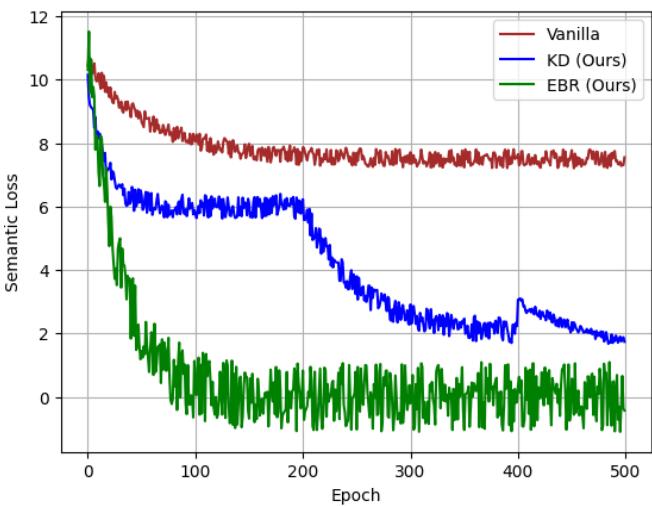
Figure 6 compares the training curves. The Vanilla model (red) plateaus at a high loss. KD (blue) helps significantly, but EBR (green) is the clear winner, achieving near-zero semantic loss rapidly. This suggests that EBR effectively transforms the optimization landscape from a difficult saddle point (full of interference) to a smoother convex bowl.
4. Robustness to Noise
The theory stated that collapse is driven by noisy features interfering with predictive ones. Therefore, EBR should be highly robust to added noise.
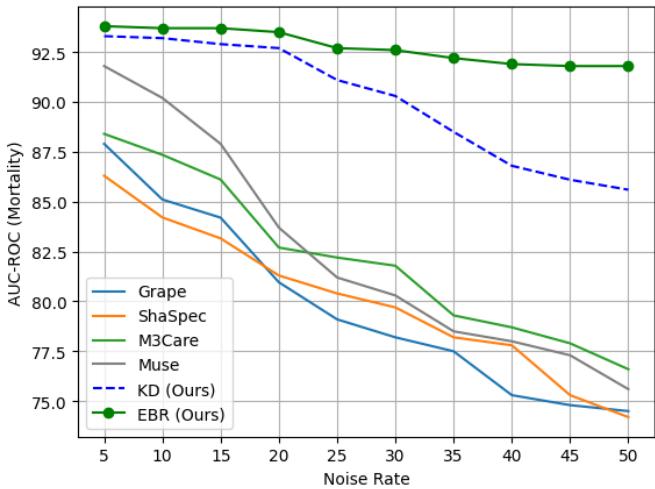
In Figure 7, the authors deliberately added noise to the data. Standard state-of-the-art models like Grape and MUSE (solid lines) degrade rapidly as noise increases. EBR (solid green line at the top), however, maintains high AUC-ROC scores even at 50% noise rates. By explicitly separating the basis, EBR prevents the noise from hijacking the predictive neurons.
Application: Missing Modalities at Test Time
The ultimate test of a multimodal model is robustness. In healthcare, a patient might have a CT scan but missing lab results. If the model ignored the CT scan during training because of collapse, the prediction will fail.
Because EBR ensures that distinct, predictive bases are learned for all modalities, it enables a clever substitution strategy. If a modality is missing at test time, we can substitute it with the available modality that is “closest” to it in the learned latent space.
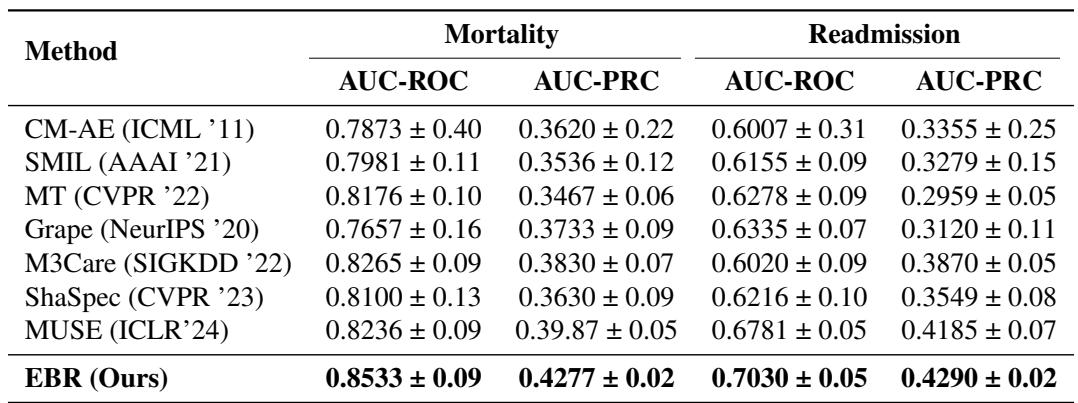
Table 1 shows the results on MIMIC-IV with missing data. EBR outperforms all baselines, including complex Transformer-based methods (MUSE) and generative approaches. It achieves an AUC-ROC of 0.8533 compared to the next best 0.8236. This gap represents a significant improvement in reliability for safety-critical applications.
Conclusion
The paper “A Closer Look at Multimodal Representation Collapse” moves beyond heuristics to provide a mechanical explanation for why multimodal models fail. It identifies the deadly combination of polysemantic neurons and rank bottlenecks as the root cause.
By understanding that neural networks naturally try to “cheap out” on rank usage—thereby forcing noisy and predictive features to share the same neurons—we can design better solutions. Explicit Basis Reallocation (EBR) works not by fighting the data, but by changing the rules of the optimization game. It forces the network to expand its capacity usage, ensuring that every modality gets the representation it deserves.
For students and practitioners, the key takeaway is clear: when designing multimodal systems, simply concatenating inputs isn’t enough. You must ensure your architecture allows for—and enforces—the independent representation of diverse data streams. Otherwise, your model might just be listening to the loudest voice in the room.