](https://deep-paper.org/en/paper/2505.23175/images/cover.png)
Imagine you are a waiter carrying a tray of drinks through a crowded restaurant. As you walk, you don’t just look at the floor to avoid tripping; you feel the weight of the tray shifting in your hands. If a glass starts to slide, your skin senses the friction change, and you instinctively adjust your gait—perhaps slowing down or stiffening your arms—to prevent a spill.
For humans, this integration of locomotion (walking) and tactile feedback (feeling) is second nature. For robots, it is an immense challenge.
While modern quadrupedal robots (like the Unitree Go1 or Boston Dynamics Spot) are exceptional at traversing rough terrain, they are generally “numb.” They rely heavily on vision and proprioception (internal joint sensing). This works for hiking, but it fails when the robot needs to interact with the world, such as carrying a loose object on its back.
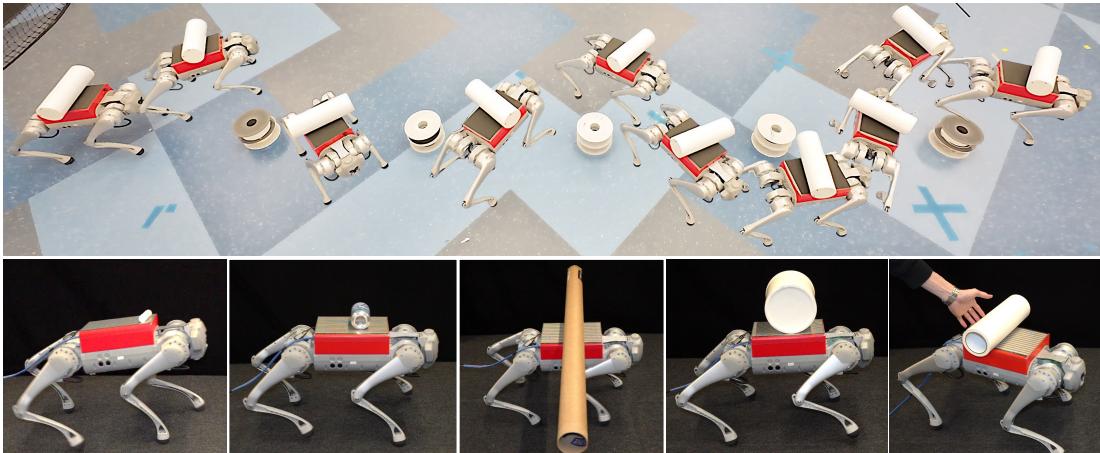
In this post, we are deep-diving into LocoTouch, a fascinating research paper that gives quadrupedal robots a sense of “touch.” We will explore how researchers combined custom low-cost hardware, clever simulation tricks, and a novel reinforcement learning pipeline to create a robot that can balance rolling cylinders, slippery bottles, and everyday objects while walking—without any boxes or fasteners.
The Problem: The “Box” Constraint
To understand why LocoTouch is significant, we first need to look at how robots currently carry things. Typically, if you want a robot dog to carry a payload, you bolt a box to its back.
This approach has three major downsides:
- Geometry Limits: The object must fit inside the box.
- Bulk: It increases the robot’s footprint even when it’s not carrying anything.
- Dynamics: The robot treats the payload as a static mass. If an object rolls around inside the box, the robot doesn’t “feel” it and cannot react to the momentum shift, potentially leading to instability.
The goal of LocoTouch is unsecured transport. The researchers wanted a robot to balance dynamic objects—specifically difficult ones like cylinders that roll—purely by adjusting its body posture and gait, guided by the sensation of the object moving on its back.
Part 1: Building a Robot “Skin”
The first challenge was hardware. You can’t train a robot to feel if it doesn’t have sensors. Commercial tactile sensors are often too small, too expensive, or difficult to wire over a large surface area like a robot’s back.
The team built a custom, high-density distributed tactile sensor.
The Sensor Architecture
The sensor uses a piezoresistive approach. Piezoresistive materials change their electrical resistance when compressed. By sandwiching a piezoresistive film (Velostat) between two layers of conductive fabric strips arranged in rows and columns, the researchers created a grid.
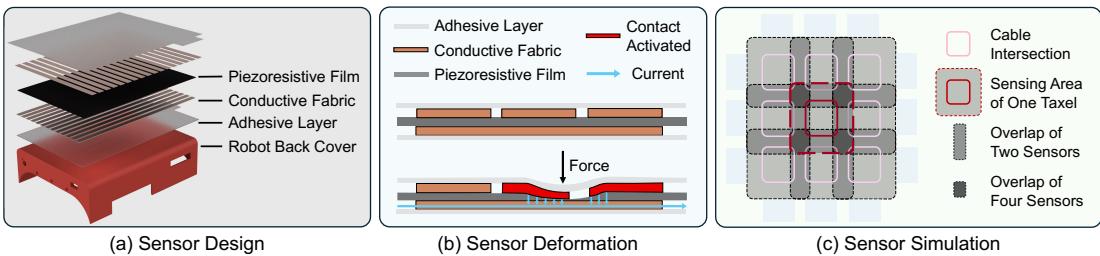
As shown in Figure 3(a), the sensor covers the entire back of the robot (\(250 \times 180\) mm). It consists of 221 sensing units, or “taxels” (tactile pixels).
The beauty of this design lies in its simplicity and scalability.
- High Sensitivity: Unlike designs that use thin threads, this design uses conductive fabric strips. This maximizes the contact area, allowing the robot to detect very light objects (as light as 30 grams).
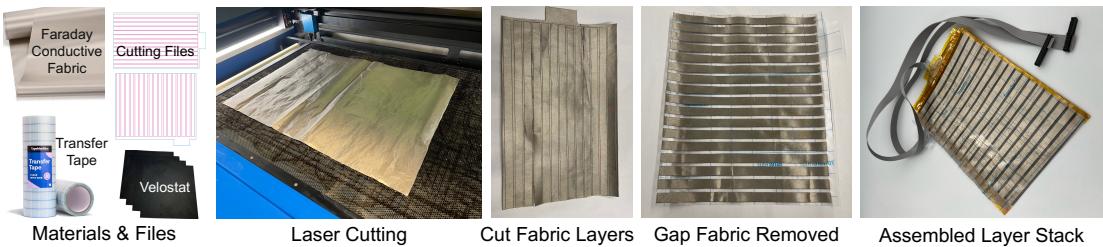
- Ease of Fabrication: The components are laser-cut and stacked like a sandwich. This makes the sensor cheap to manufacture and easy to replace.
Part 2: The Simulation Challenge
In modern robotics, we rarely train robots in the real world from scratch. It’s too slow, and robots break when they fall. Instead, we use Reinforcement Learning (RL) in simulation. We create a physics-accurate video game, let the AI play millions of times, and then transfer that “brain” to the real robot.
However, simulating tactile sensors is notoriously difficult.
The “Squishy” Problem
Real skin is soft. When you press a finger into a foam pad, the force spreads out. A single point of contact might activate several adjacent sensors. In simulation, however, contact is usually modeled as a rigid point.
If you train an AI on crisp, single-pixel simulation data, it will fail when it encounters the blurry, spread-out signals of the real world. This is known as the Sim-to-Real Gap.
The Expanded Collision Model
Calculating soft-body physics for 221 sensors at thousands of steps per second is computationally too expensive for RL. The researchers devised a clever shortcut called the Expanded Collision Model.
Instead of simulating soft foam, they simply made the simulated sensing areas larger than the real ones.
Look at Figure 3(c) above. In the simulation, the collision geometry for each taxel overlaps with its neighbors.
- If an object hits the center of a taxel, only that taxel activates.
- If an object hits the edge, the overlap causes the neighbor to activate as well.
This simple geometric trick mimics the force propagation of soft foam without requiring complex soft-body physics calculations.
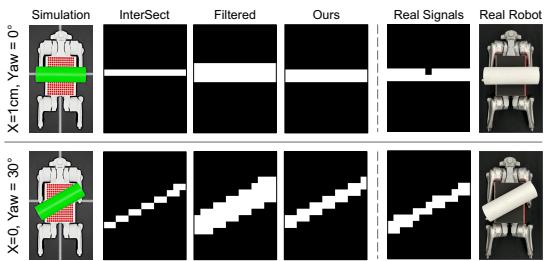
The results of this modeling choice are striking. In Figure 6, compare the “InterSect” (standard rigid model) with “Ours” (Expanded model). The standard model produces thin, unrealistic lines. The Expanded model produces thick, distributed contact patches that closely match the “Real Signals” on the right.
Part 3: The Learning Pipeline
With the hardware built and the simulation environment ready, the team needed to train the brain. They employed a Teacher-Student learning architecture.
This is a two-stage process designed to handle partial observability.
- The Teacher (Privileged): In simulation, the teacher policy knows everything. It knows the exact friction of the object, its exact mass, and its exact position (ground truth). It uses this “god mode” information to learn how to balance the object perfectly.
- The Student (Real-World): The real robot doesn’t have “god mode.” It can’t magically know the friction coefficient or exact mass. It only has its joint sensors (proprioception) and its tactile skin. The Student learns to mimic the Teacher’s actions using only the data available in the real world.

The Student uses a Conv-GRU (Convolutional Gated Recurrent Unit). The Convolutional part processes the tactile image (spatial data), while the Recurrent part (GRU) remembers the history of touches (temporal data). This memory allows the robot to infer things like object velocity and mass over time.
Part 4: The Adaptive Gait Reward (The Secret Sauce)
Simply feeding data into a neural network isn’t enough. In Reinforcement Learning, you must define a “reward function”—a score that tells the robot when it’s doing a good job.
Standard quadruped walking rewards usually force a specific rhythm (e.g., “step every 0.5 seconds”). This forces the robot into a rigid march.
But imagine carrying a bowl of soup. If the soup starts sloshing, you break your rhythm. You might pause a step or take a quick shuffle step to regain balance. A robot forced into a strict metronome rhythm would spill the soup (or drop the cylinder).
The researchers introduced a novel Adaptive Gait Reward relying on a Symmetry Function.
Defining Symmetry Without Timing
Instead of telling the robot when to step, the reward encourages the robot to be symmetric. If the front-left leg swings for 0.4 seconds, the back-right leg should also swing for roughly 0.4 seconds.
The reward equation looks like this:

Here, \(\gamma_{sym}\) is the symmetry coefficient. It dynamically adjusts based on how well the robot is doing.

The variable \(f_{sym}\) (symmetry score) is the critical innovation. It compares the air-time (swing time) of the current pair of legs to the previous pair of legs.
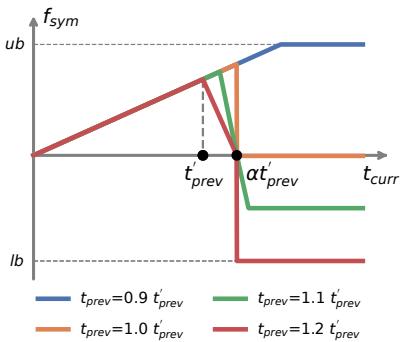
As shown in Figure 4, the function is flexible.
- If the robot is stable, it encourages longer swing times (more efficient walking).
- If the robot detects instability (via the tactile sensor), the function allows the robot to shorten its steps to regain balance without being penalized heavily for “breaking the beat.”
Why does this matter?
Without this adaptive symmetry, the robot struggles to walk straight while balancing a load.

Figure 8 illustrates the difference.
- Left (Baseline): The robot is trained with standard rewards. It drifts sideways and struggles to maintain a straight line because its gait becomes uneven under the load.
- Right (With Symmetry Function): The robot maintains a symmetric trot, cancelling out the disturbances caused by the shifting weight on its back.
Part 5: Real-World Experiments
Does it actually work? The team deployed the “Student” policy onto a Unitree Go1 robot and tested it with a variety of objects.
The Object Zoo
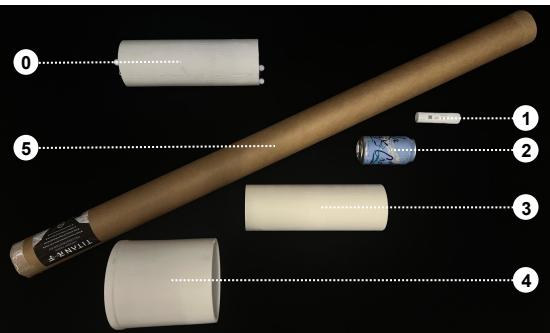
They tested the system on objects with very different properties, ranging from a light glue stick (0.03 kg) to a heavy metal cylinder (1.45 kg), and even a slippery plastic bottle.
Results
The system achieved a 100% success rate in their standardized trials (walking 6 meters).
One of the most impressive demonstrations was the robot’s ability to handle velocity changes. When the robot accelerates, the object naturally wants to roll backward due to inertia. The robot senses this backward roll via the tactile skin and automatically adjusts its pitch (tilting forward) and gait frequency to “catch” the object.

In Figure 5 (Middle), you can see the correlation. As the object slides (blue line), the robot’s pitch (green line) adjusts to compensate.
Robustness
The robot was not treated gently. The researchers tested it on:
- Slopes and Gravel: Even though it was trained on flat ground, the tactile feedback allowed it to adapt to uneven terrain.
- Long Distance: It carried a slippery drink bottle for 60 meters, constantly making micro-adjustments to keep it centered.
- Everyday Objects: It successfully carried non-cylindrical items like a cup and a wrench.


Conclusion
LocoTouch represents a significant step forward in Loco-Manipulation—the art of manipulating objects using the robot’s entire body rather than just a gripper.
By combining a low-cost, full-back tactile sensor with a sophisticated learning pipeline that understands gait symmetry, the researchers created a robot that feels and reacts like a living creature. It doesn’t just execute a pre-planned path; it negotiates with the physics of the object it carries.
The implications extend far beyond robotic waiters. This technology is crucial for search-and-rescue robots carrying supplies, logistics robots moving irregular packages, or any autonomous system that needs to interact with a dynamic, unpredictable physical world. The future of robotics isn’t just about better cameras—it’s about giving robots the ability to feel.