](https://deep-paper.org/en/paper/2505.24198/images/cover.png)
Imagine a waiter walking through a crowded restaurant carrying a tray full of drinks. They have to dodge obstacles, maintain their balance, and navigate uneven flooring. At the same time, their hands must remain perfectly steady to prevent the drinks from spilling. This is a feat of coordination that humans perform almost unconsciously, yet it remains one of the most difficult challenges in humanoid robotics.
We have seen robots do backflips, run parkour, and dance to pop music. But ask those same robots to walk across a room holding a full cup of coffee without spilling a drop, and you will likely end up with a mess.
Why is this simple task so hard for machines? It comes down to a fundamental conflict in control dynamics. Walking is a high-impact, rhythmic activity involving “heavy” movements to keep the robot upright. Stabilizing a hand (the end-effector), however, requires rapid, micro-adjustments to cancel out vibrations. When you try to train a single robotic brain to do both at once, the signals often get crossed.
In a fascinating new paper titled “Hold My Beer: Learning Gentle Humanoid Locomotion and End-Effector Stabilization Control,” researchers from Carnegie Mellon University introduce a solution called SoFTA. By splitting the robot’s control system into two distinct agents operating at different speeds, they have created a humanoid capable of “gentle” locomotion—walking robustly while keeping its hands remarkably steady.
The Problem: The Shake and The Stumble
To understand why SoFTA is necessary, we first need to look at how humanoid robots are typically controlled today. Most modern systems use Deep Reinforcement Learning (RL). In this setup, a neural network (the policy) observes the robot’s state and outputs motor commands for all the joints in the body—from the ankles to the wrists—simultaneously.
This “whole-body” approach has been very successful for robust locomotion. However, it struggles with fine-grained stabilization for two main reasons:
1. The Task Objective Mismatch
Locomotion and manipulation have opposing goals. To walk, a robot needs to be dynamic; it must shift its center of mass and absorb impacts from the ground. This naturally creates noise and vibration throughout the body. End-effector (EE) stabilization, conversely, demands a static, vibration-free base. When a single controller tries to optimize for both, it often gets stuck in a “tug-of-war.” If it prioritizes walking, the hand shakes. If it prioritizes a steady hand, the robot might stiffen up or walk too tentatively, risking a fall.
2. The Dynamics Mismatch
This is perhaps the more subtle and critical issue. The legs and the arms of a humanoid operate on different physical timescales:
- Locomotion is “Slow”: Walking is governed by the gait cycle—footsteps that happen a few times per second. The physics involves discrete contact events (hitting the ground) and managing momentum. Control here needs to be robust rather than hyper-reactive.
- Stabilization is “Fast”: To keep a cup steady while the body bounces, the arm joints need to make adjustments instantly. This requires high-frequency control to counteract accelerations the moment they are detected.
Standard controllers usually run at a single fixed frequency (e.g., 50 Hz). If this frequency is too low, the arms are too slow to stabilize the cup. If it is too high, the legs become jittery and sensitive to sensor noise, causing the robot to fall.
The Solution: SoFTA (Slow-Fast Two-Agent Framework)
The researchers propose breaking the single “brain” into two specialized agents, a method they call SoFTA. Instead of one policy controlling everything, they decouple the upper body from the lower body.
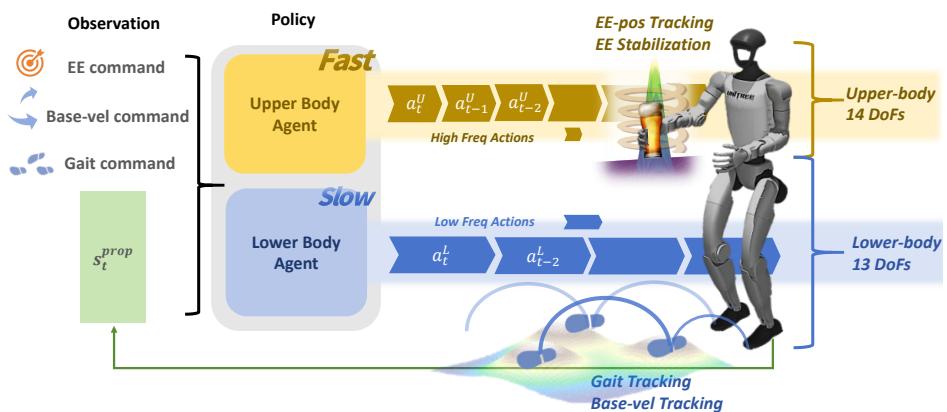
As illustrated in the architecture overview above, the framework consists of two key innovations: Frequency Decoupling and Reward Separation.
The Frequency Split: Slow Legs, Fast Arms
The core insight of SoFTA is that you don’t need to control the whole robot at the same speed. The researchers assigned different control frequencies to the different agents:
- The Lower-Body Agent (50 Hz): This agent controls the legs and waist. It operates at a standard, “slow” frequency. This is ideal for locomotion because it makes the policy less sensitive to the “sim-to-real” gap (the differences between physics simulation and the real world). A slower frequency acts almost like a low-pass filter, ignoring high-frequency sensor noise and focusing on the broader gait cycle.
- The Upper-Body Agent (100 Hz): This agent controls the arms. It runs twice as fast. This high frequency allows the arms to react immediately to the vibrations caused by footsteps. It gives the upper body the “reflexes” needed to perform active damping and stabilization.
Crucially, while they act independently, they share the same observations. The Upper Body knows what the legs are doing, and the Lower Body knows where the hands need to be. This allows them to coordinate without interfering with each other’s primary directives.
Reward Separation: Solving the Credit Assignment Problem
In Reinforcement Learning, “rewards” tell the robot when it has done a good job. In a whole-body system, the reward is a single number summing up everything: “Did you walk fast? Did you not fall? Did you keep the cup level?”
This creates a credit assignment problem. If the robot spills the water, was it because the leg took a bad step, or because the elbow didn’t compensate enough? The neural network struggles to figure this out.
SoFTA decouples the rewards:
- Lower Body Rewards: Focus purely on robust locomotion, gait tracking, and balance.
- Upper Body Rewards: Focus on minimizing end-effector acceleration and keeping the hand level (minimizing tilt).
By splitting the feedback, each agent learns its specific role much faster. The legs learn to be a sturdy mobile base, and the arms learn to be an active stabilizer.
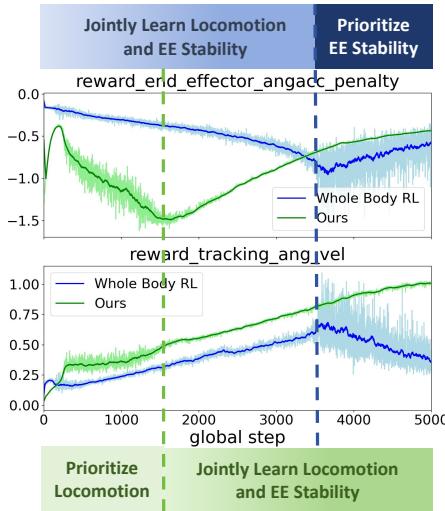
The graph above highlights this success. In standard Whole-Body RL (blue line), the robot struggles to balance the conflicting goals. When it tries to improve stabilization, locomotion suffers, and vice versa. In SoFTA (green line), the agents learn cooperatively. The separation allows the robot to achieve high locomotion performance and high stability simultaneously.
Emergent Behavior: Active Compensation
One of the most visually interesting results of this framework is the behavior that emerges naturally. The robot isn’t just holding its arm stiff; it is actively canceling out motion.
If you look at the data traces below, you can see the “compensation behavior.” As the base of the robot accelerates (due to walking or being pushed), the arm joints (specifically the wrist roll) move in the exact opposite pattern to counteract the force.
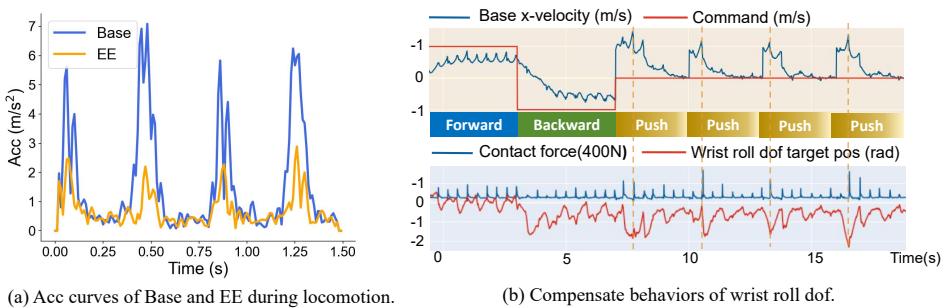
This is similar to how a gimbal camera stabilizer works, or how a chicken keeps its head perfectly still while its body moves. The 100 Hz upper-body policy is fast enough to “feel” the beginning of a step’s impact and adjust the arm trajectory before the shockwave reaches the cup.
Simulation and Real-World Results
The theory sounds solid, but does it work on hardware? The researchers tested SoFTA extensively in simulation (Isaac Gym) and on real robots (Unitree G1 and Booster T1).
Beating the Baselines
In simulation, SoFTA was compared against two common baselines:
- Lower-body RL + Inverse Kinematics (IK): Using AI for legs but standard mathematical calculation (IK) for arms.
- Whole-body RL: A single neural network controlling everything (the standard approach).
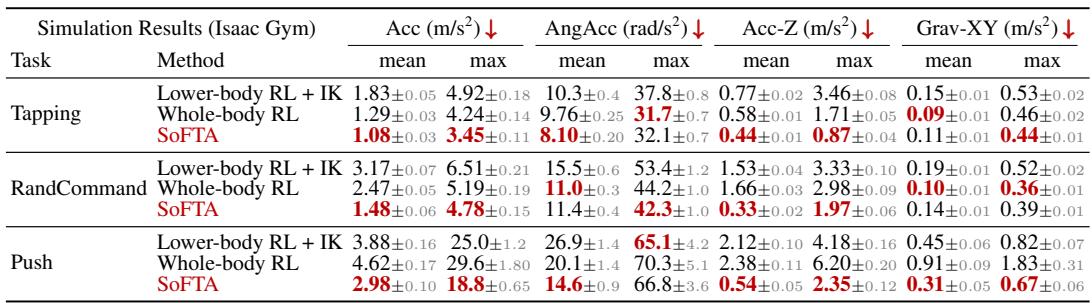
The table above shows a clear victory. SoFTA reduced end-effector acceleration (shaking) significantly compared to the baselines. Notably, it excelled in the “Push” scenario—where the robot is shoved unexpectedly. Because the upper body runs at 100 Hz, it could react to the push and stabilize the hand much faster than the 50 Hz whole-body controller.
Real-World “Spill Tests”
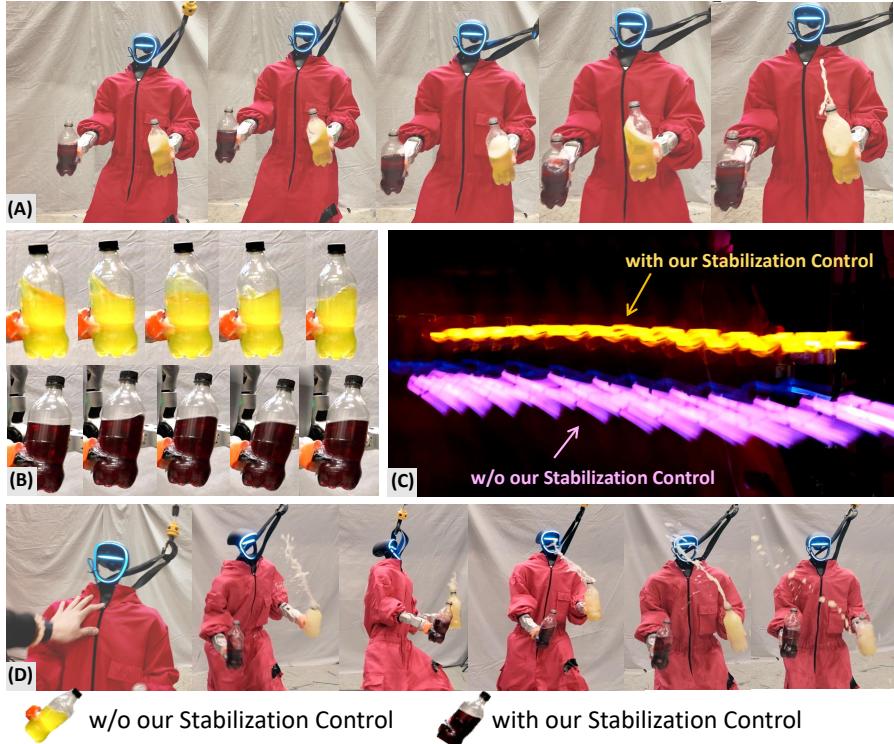
The ultimate test for this paper is, of course, carrying liquids. The researchers equipped a Unitree G1 humanoid with cups of water and colored liquids to visualize stability.
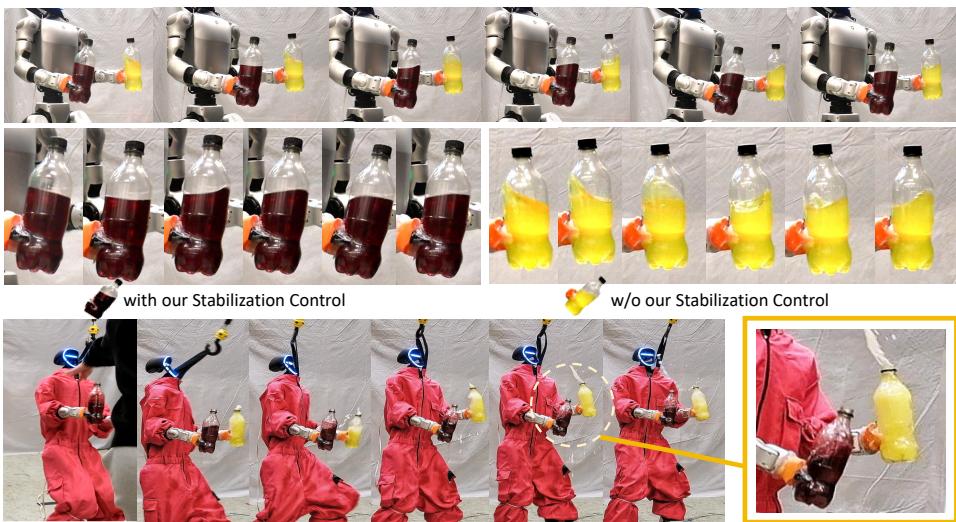
In the images above, we can see the difference. With SoFTA (labeled “with our Stabilization Control”), the liquid surface remains calm even while the robot taps its feet or walks. Without it, the liquid sloshes violently.
In one particularly impressive demo, the researchers pushed the robot fiercely. The lower body (running at 50 Hz) stumbled but recovered balance to prevent a fall. Simultaneously, the upper body (running at 100 Hz) whipped the arm into a counter-position to keep the cup upright. This decoupled reaction capability is unique to the two-agent design.
The Humanoid Cameraman
Stability isn’t just for serving drinks. It is also essential for robots that need to perform tasks using wrist-mounted cameras or sensors. If a robot is inspecting a facility, shaky video is useless for computer vision algorithms.
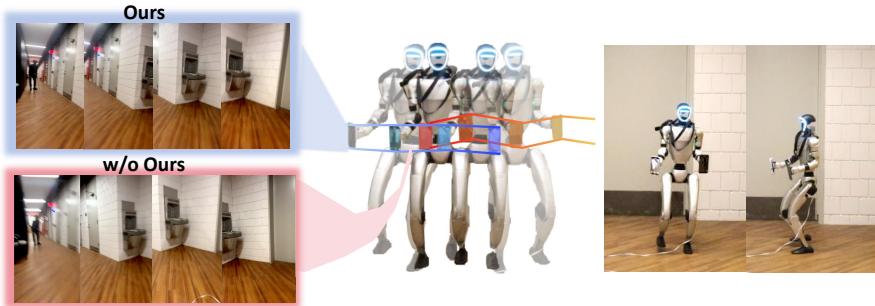
The researchers mounted a camera to the robot’s hand and had it walk in circles. The footage from the SoFTA-controlled robot was smooth, effectively turning the robot’s arm into a Steadicam. The baseline approach resulted in jittery, unusable footage.
Why Frequency Matters: A Deep Dive
You might ask: “Why not just run the whole robot at 100 Hz? Wouldn’t that be better?”
The researchers investigated this specifically. It turns out that for locomotion, slower is often better when transferring from simulation to reality. Real-world sensors have noise, and real motors have delays. A high-frequency policy on the legs tends to over-react to sensor noise, leading to “shivering” or instability.
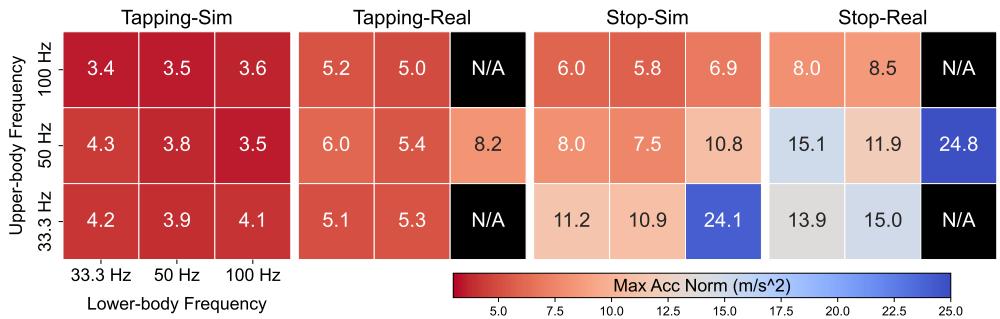
This heatmap (Figure 7) tells the story. The X-axis represents Upper Body frequency, and the Y-axis represents Lower Body frequency.
- Blue areas (Low Acceleration/High Stability): These cluster where the Lower Body is 50 Hz and the Upper Body is 100 Hz.
- Red areas (High Acceleration/Instability): These occur when the Lower Body tries to run at 100 Hz (too sensitive) or the Upper Body runs at 33 Hz (too sluggish).
This validates the core premise of SoFTA: The optimal control frequency for legs is different from the optimal frequency for arms.
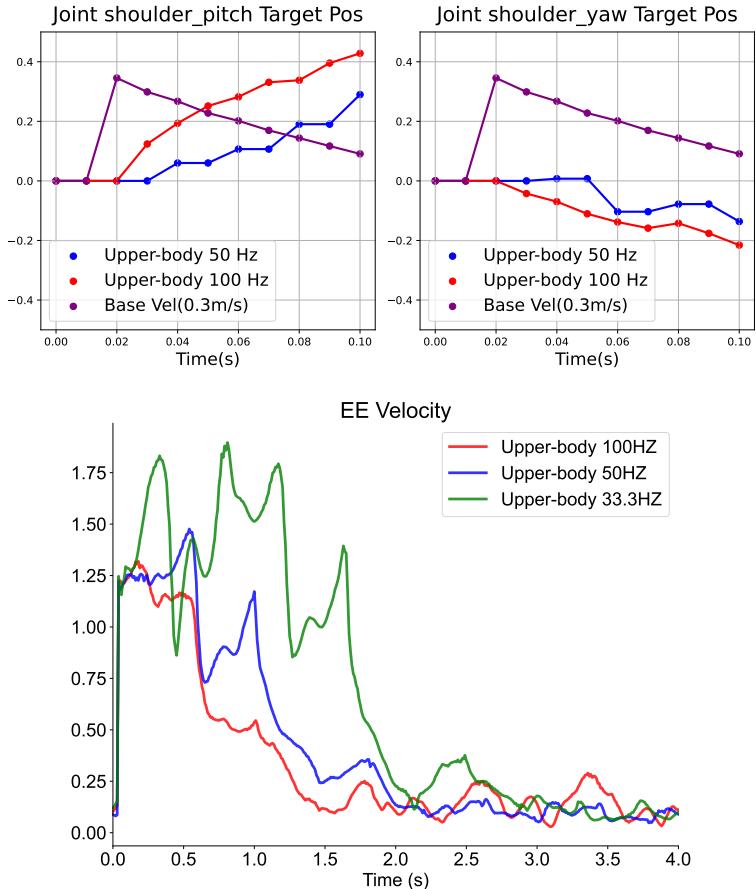
Further analysis (Figure 9) shows the recovery time. The red line (100 Hz Upper Body) recovers from a disturbance much faster than the blue line (50 Hz). This split-second difference is exactly what prevents a liquid from spilling over the rim of a cup.
Cross-Embodiment: Does it work on other robots?
Finally, to prove that this wasn’t just a fluke optimized for one specific robot, the team applied SoFTA to a completely different humanoid, the Booster T1. This robot has different limb proportions and mass distribution.
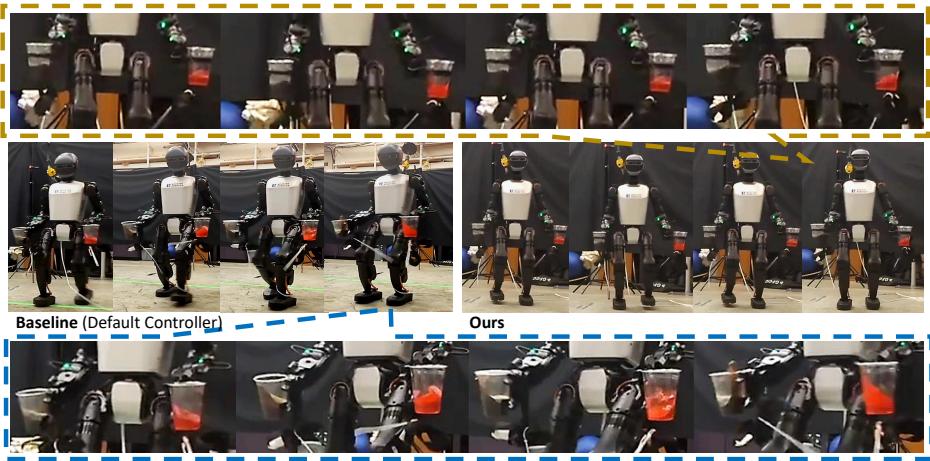
Using the exact same framework—50 Hz for legs, 100 Hz for arms, and separated rewards—the Booster T1 successfully performed the “Cola Carry” test. This suggests that the principles of SoFTA (frequency and objective decoupling) are fundamental to humanoid control and not specific to one hardware platform.
Conclusion and Future Outlook
The “Hold My Beer” paper represents a significant step forward in making humanoid robots actually useful in human environments. While walking is a solved problem, gentle walking—locomotion that allows for delicate interaction—is the new frontier.
By recognizing that different parts of the body have different “jobs” and therefore need different “speeds,” SoFTA bridges the gap between robust survival (not falling) and precise interaction (not spilling).
There are still limitations. The paper notes that while SoFTA is much better than baselines, it still isn’t quite at human capability. Humans use sophisticated predictive models and soft-tissue damping that robots currently lack. Furthermore, fully decoupling the upper and lower body might be a disadvantage in tasks that require dynamic full-body throws or heavy lifting, where the whole body must act as one unit.
However, for the day-to-day tasks of a service robot—carrying a tray, holding a flashlight, or handing you a tool—SoFTA proves that sometimes, the best way to work together is to let the legs do their thing, and let the arms do theirs.