](https://deep-paper.org/en/paper/2505.24355/images/cover.png)
Imagine trying to translate a video of someone speaking without having a transcript of what they are saying, and doing so across ten different languages simultaneously. Now, replace the speech with hand gestures, facial expressions, and body movements. This is the immense challenge of Multilingual Sign Language Translation (MLSLT).
For years, assistive technology has struggled to bridge the communication gap between the Deaf/Hard-of-hearing communities and the hearing world. While we have seen rapid progress in text-to-text translation (like Google Translate), Sign Language Translation (SLT) lags behind.
In a recent paper titled “Multilingual Gloss-free Sign Language Translation: Towards Building a Sign Language Foundation Model”, researchers from the Institute of Science Tokyo and NHK Science & Technology Research Laboratories propose a novel approach. They introduce a model that doesn’t just look at one sign language but learns from ten of them at once, without needing expensive intermediate labels known as “glosses.”
In this post, we will decode how they achieved this, the architecture behind their “Sign2(LID+Text)” method, and why this matters for the future of inclusive technology.
The Core Problem: Why is SLT so Hard?
To understand the contribution of this paper, we first need to understand the bottlenecks in current Sign Language Translation.
1. The Gloss Bottleneck
Traditionally, SLT systems are gloss-based. A “gloss” is a written label for a sign (e.g., writing “JUMP” when a signer jumps). The typical pipeline looks like this:
- Video \(\rightarrow\) Recognized Glosses (Sign Language Recognition)
- Glosses \(\rightarrow\) Spoken Text (Translation)
While effective, this approach has a major flaw: Annotating glosses is incredibly expensive and labor-intensive. It requires expert linguists to label every frame of video. This creates an “information bottleneck” and makes it nearly impossible to scale to new languages where such data doesn’t exist.
The researchers here opt for a gloss-free approach. They want to go directly from Raw Video \(\rightarrow\) Spoken Text, bypassing the need for gloss labels entirely.
2. The Multilingual Challenge
Most SLT research focuses on “one-to-one” translation (e.g., German Sign Language to German Text). But the world is multilingual. To build a robust “foundation model” (like GPT-4 but for sign language), the model needs to learn from diverse datasets.
However, simply throwing multiple sign languages into one model causes Language Conflict. Sign languages are not universal. British Sign Language (BSL) and Chinese Sign Language (CSL) have vastly different vocabularies and grammars.
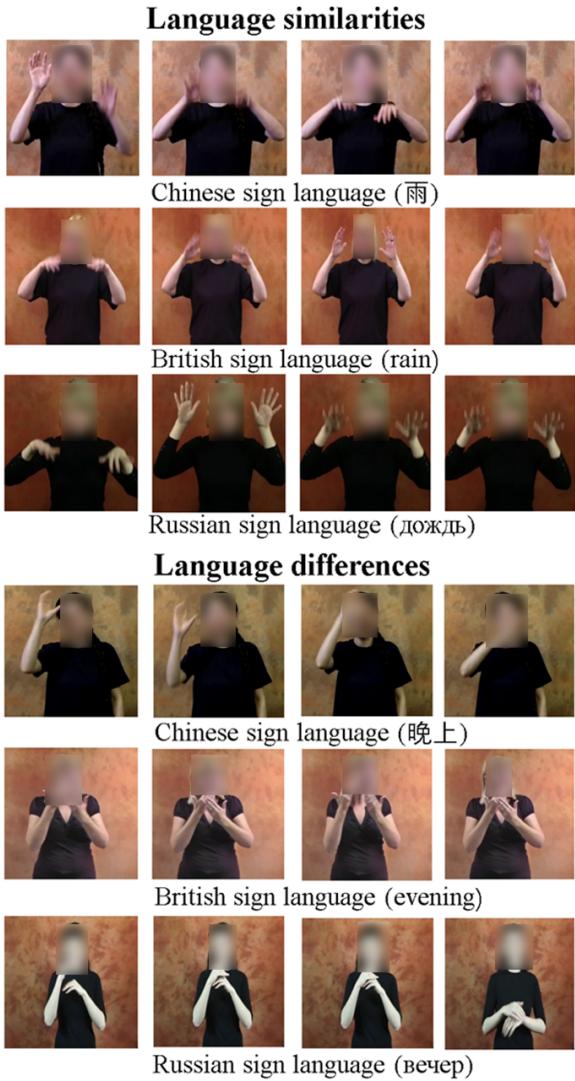
As seen in Figure 5 above, even simple concepts like “Rain” might look similar (top row), but concepts like “Evening” (bottom row) are articulated completely differently. When a model tries to learn these conflicting patterns simultaneously without guidance, its performance usually drops.
The Solution: Sign2(LID+Text)
The researchers propose a method called Sign2(LID+Text). The core idea is simple but powerful: effectively teach the model to identify which sign language it is looking at on a token-by-token basis, while simultaneously learning to translate it.
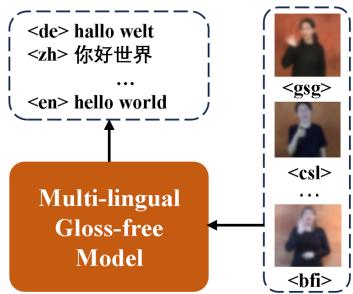
As illustrated in Figure 1, the model accepts various visual sign inputs (right) and textual inputs (left) and processes them through a unified gloss-free framework. But how does it handle the confusion between languages?
The Architecture: Hierarchical Encoder-Decoder
The model uses a Transformer-based architecture with a twist. It employs a Hierarchical Encoder that splits the job into two levels.
 (Note: Please refer to the architecture diagram in Figure 2 above for the visual flow).
Let’s break down the components shown in the architecture:
1. Feature Extractor First, the raw video frames \(\mathcal{V}\) are converted into mathematical representations (embeddings). The researchers use a pre-trained network (SlowFastSign) to extract these features.

2. The Sign2LID Module (The “Identifier”) This is the novel contribution. The initial layers of the encoder are tasked with Token-level Sign Language Identification (SLI).
Instead of just giving the whole video a single tag like “American Sign Language,” the model predicts a Language ID (LID) for every segment of the sequence. This aligns the visual features with the specific language characteristics early in the process.

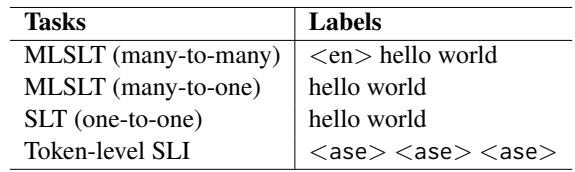
In this equation, \(\mathcal{L}_{\mathrm{LID}}\) represents the loss function for the Language ID. It forces the initial encoder layers to output a sequence of language tags (e.g., <ase>, <ase>, <ase>) that matches the length of the target text.
The output of this stage is an intermediate representation, \(\mathbf{h}_{\mathrm{int}}\), which now carries strong language-specific information:

3. The Sign2Text Module (The “Translator”) The intermediate features are then passed to the deeper layers of the encoder. These layers are responsible for reordering the sign representations to match the word order of the spoken language.
Sign languages often have different sentence structures than spoken languages (e.g., Object-Subject-Verb vs. Subject-Verb-Object). The model uses a CTC (Connectionist Temporal Classification) objective here to align the visual features with the spoken text tokens.

4. Joint Decoding Finally, the model uses a joint strategy. It combines the CTC predictions (which are good at alignment) with an Attention Decoder (which is good at generating fluent sentences).
The total training objective combines three loss functions:
- LID Loss: Did we identify the sign language correctly?
- Text CTC Loss: Did we align the signs to words correctly?
- Attention Loss: Did we generate a coherent sentence?

By balancing these three objectives (controlled by the \(\lambda\) weights), the model learns to identify, align, and translate simultaneously.
Experimental Setup
To validate this approach, the researchers tested the model on three major datasets:
- SP-10: A multilingual dataset covering 10 different sign languages (including Bulgarian, Chinese, German, Greek, English, etc.).
- PHOENIX14T: A standard German Sign Language benchmark.
- CSL-Daily: A Chinese Sign Language benchmark.
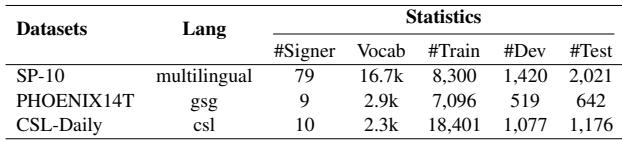
As shown in Table 6, SP-10 is the most diverse, while CSL-Daily is the largest in terms of training samples.
Key Results
The results were analyzed across three different translation scenarios.
1. One-to-One Translation (Standard SLT)
First, does this new architecture work for standard single-language translation? Yes. The addition of the “Text CTC” alignment significantly improved performance.
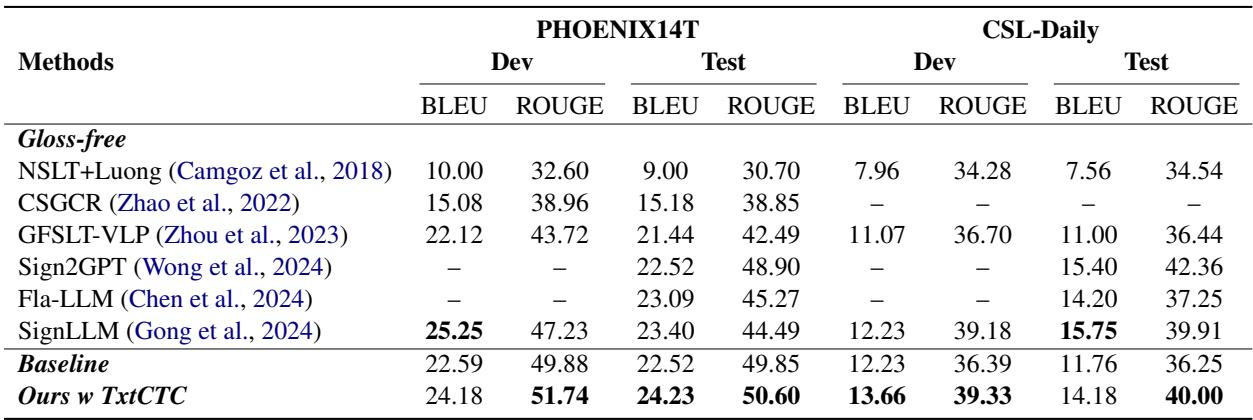
In Table 3, the proposed method (Ours w TxtCTC) outperforms the baseline and achieves competitive results against other state-of-the-art methods like SignLLM on BLEU scores (a standard metric for translation quality).
Why does it work better? The researchers analyzed the performance based on sentence length.
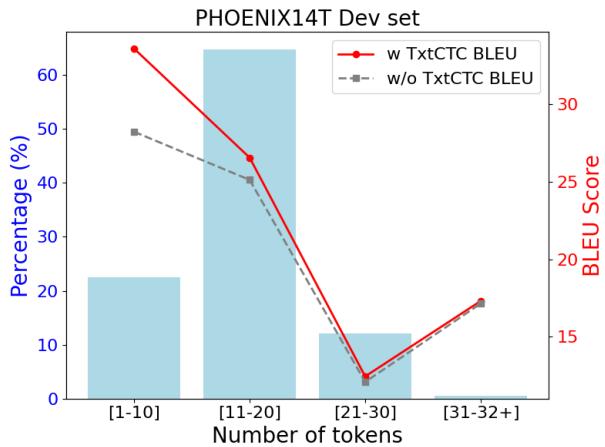
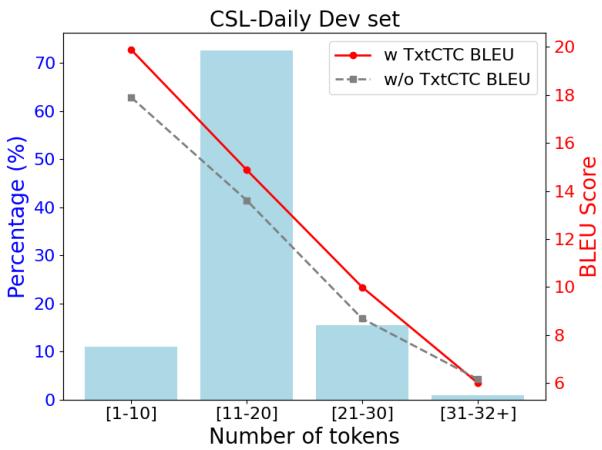
Figures 3 and 4 reveal an interesting trend. The red lines (with TxtCTC) are consistently higher than the gray lines (without). The improvement is most drastic for short and medium-length sentences. The CTC mechanism helps the model “lock on” to specific signs and words, preventing it from hallucinating or getting lost in shorter sequences where context is limited.
2. Many-to-One Translation (The “Universal” Translator)
This setting tests if one model can translate 10 different sign languages into English. This is where Language Conflict usually destroys performance.
The researchers compared training individual models for each language versus one “Universal” model.
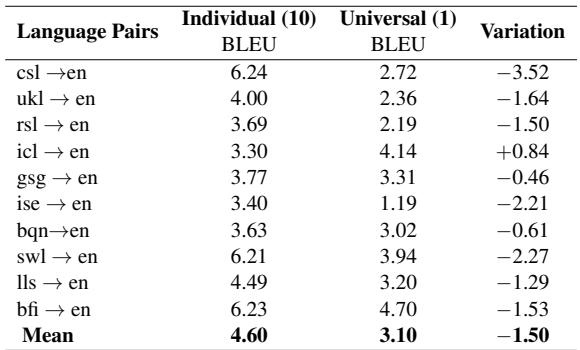
Table 8 illustrates the problem clearly. When moving from Individual models to a Universal baseline, there is a significant drop in performance (a mean decrease of 1.50 BLEU). For example, Chinese Sign Language (csl \(\rightarrow\) en) drops from 6.24 to 2.72. This confirms that without special handling, the languages interfere with each other.
However, with the proposed Sign2(LID+Text) method, the model not only recovered this loss but actually outperformed the individual models by an average of 0.58 BLEU. The token-level language identification successfully separated the linguistic patterns, allowing the model to benefit from the shared data without suffering from the conflicts.
3. Many-to-Many Translation (The Hardest Task)
Finally, they tested the model on Many-to-Many translation (e.g., translating any of the 10 sign languages to their respective spoken languages).
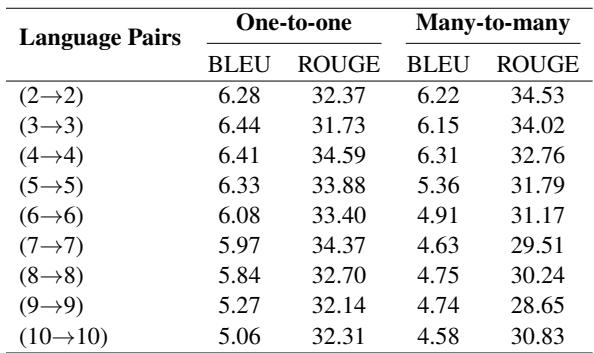
Table 5 shows that the model maintains stability even as more language pairs are added. While there is a slight dip compared to one-to-one models (which is expected given the difficulty), the performance remains robust. This suggests that the model is effectively sharing cross-lingual information, which is crucial for low-resource languages that don’t have enough data to train a good model on their own.
Conclusion and Future Implications
This research marks a significant step toward a Sign Language Foundation Model. By successfully removing the need for glosses and solving the language conflict problem through Token-level Language Identification, the authors have opened the door to more scalable and inclusive translation systems.
Key Takeaways:
- Gloss-free is viable: We don’t need expensive labeling to get good results.
- Token-level ID is crucial: Identifying the language at the token level (rather than just the video level) helps the encoder organize conflicting grammars.
- Joint Decoding works: Combining CTC (for alignment) and Attention (for generation) provides the best of both worlds, especially for shorter sentences.
While data scarcity remains a challenge—SP-10 only has about 8,300 training samples—approaches like this maximize the utility of the data we do have. As larger multilingual datasets become available, architectures like Sign2(LID+Text) will likely become the standard for breaking down communication barriers globally.