](https://deep-paper.org/en/paper/2505.24525/images/cover.png)
In the world of Natural Language Processing (NLP), there is a persistent dream: a universal translator that works for everyone, regardless of where they are from or what language they speak. While we have made massive strides with giants like English, French, and Spanish, the “long tail” of the world’s languages—specifically low-resource languages—remains left behind.
Among the most underserved are Creole languages. Born from the contact between European and African languages during the era of colonialism, Creoles like Haitian, Papiamento, and Sango are spoken by millions but are often treated as “dialects” or “broken” versions of their lexifiers (the languages providing the vocabulary). This couldn’t be further from the truth; they are fully developed languages with unique grammatical structures. However, for AI, they pose a massive problem: there simply isn’t enough parallel text data (e.g., sentences translated from English to Haitian) to train massive models effectively.
The standard solution in AI is Cross-Lingual Transfer. The logic is intuitive: if you want to teach a model Haitian Creole, you should let it borrow knowledge from French (its “parent” or lexifier). It’s like assuming that if you know how to play the violin, learning the viola will be easier.
But a fascinating research paper, “Limited-Resource Adapters Are Regularizers, Not Linguists,” challenges this fundamental assumption. The researchers discovered that when trying to improve translation for Creoles, “helping” the model with related languages worked… but so did helping it with completely unrelated languages, or even just random mathematical noise.
In this post, we will dissect this paper to understand why neural networks might not be the linguists we think they are, and how “souping” up models with random noise might be the key to unlocking low-resource translation.
The Problem: Fine-Tuning Giants on Tiny Datasets
To understand the solution, we first need to understand the problem. Modern Machine Translation (MT) relies on massive pre-trained models, such as NLLB-200 (No Language Left Behind), which supports 200 languages.
These models are huge (billions of parameters). If you want to improve NLLB’s performance on a specific Creole language using a tiny dataset (say, a few thousand sentences), you run into two main risks:
- Catastrophic Forgetting: The model learns the new data but forgets everything else it knew.
- Overfitting: The model memorizes the tiny training set perfectly but fails to generalize to new sentences.
Enter the Adapter
To solve this, researchers use Adapters. Instead of re-training the entire massive brain of the model, they insert tiny, trainable neural network layers (adapters) between the frozen layers of the pre-trained model. You only train these small adapters, which is computationally cheap and preserves the original model’s knowledge.
The authors of this paper took this a step further by combining adapters with a technique called Adapter Souping and Cross-Attention Fine-Tuning (CA-FT).
The Methodology: Mixing a Linguistic Soup
The core method proposed in the paper involves a specific architectural pipeline designed to squeeze the most performance out of limited data.
1. The Architecture
The researchers used a Transformer-based architecture (specifically NLLB-200). As illustrated in the diagram below, the process is bidirectional.
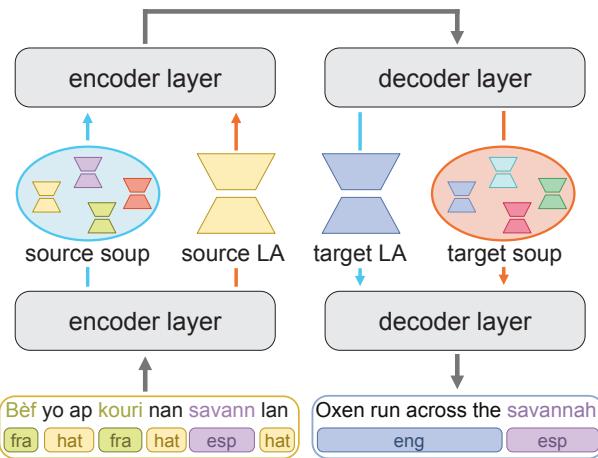
Here is what is happening in the image above:
- Encoder (Left): The model takes the source text (e.g., “Béf yo ap kouri…”). It uses a specific Source Language Adapter (Source LA) to process the input.
- Decoder (Right): This is where the magic happens. The decoder generates the translation, but it doesn’t just use one target adapter. It uses a “Soup”—a mixture of different adapters averaged together.
- Cross-Attention Fine-Tuning: The cross-attention mechanism (the part of the decoder that “looks back” at the encoder’s output) is unfrozen and fine-tuned on the small parallel dataset.
2. The Secret Sauce: Adapter Souping
“Souping” might sound like a culinary term, but in Machine Learning, it refers to weight averaging. The idea is to take the weights (\(\theta\)) of several different adapters and average them into a single set of weights (\(\theta_{soup}\)).
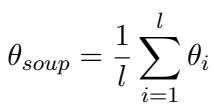
The hypothesis was simple: if we are translating into Haitian Creole, we should “soup” the Haitian adapter with adapters from related languages.
- Phylogenetic Transfer: Mix Haitian with French (Indo-European ancestor) or Fon (Niger-Congo ancestor).
- Typological Transfer: Mix Haitian with languages that have similar grammar rules (word order, etc.).
By averaging these weights, the hope was that the model would inherit linguistic “intuition” from the related languages to fill in the gaps for the low-resource Creole.
3. The Experimental Setup
The researchers tested this on three Creole languages:
- Haitian Creole (hat): French lexifier, spoken in the Caribbean.
- Papiamento (pap): Portuguese/Spanish lexifier, spoken in the ABC islands.
- Sango (sag): Ngbandi lexifier, spoken in the Central African Republic.
They sourced their training data from MADLAD (web-scraped data) to train the adapters and NLLB-OPUS for the fine-tuning stage.
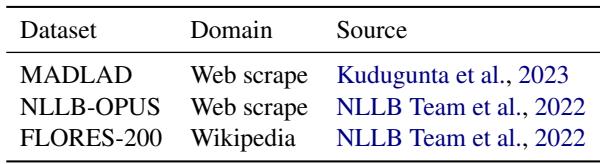
To rigorously test the “Linguistic Transfer” hypothesis, they selected a wide variety of “helper” languages to mix into the soup.
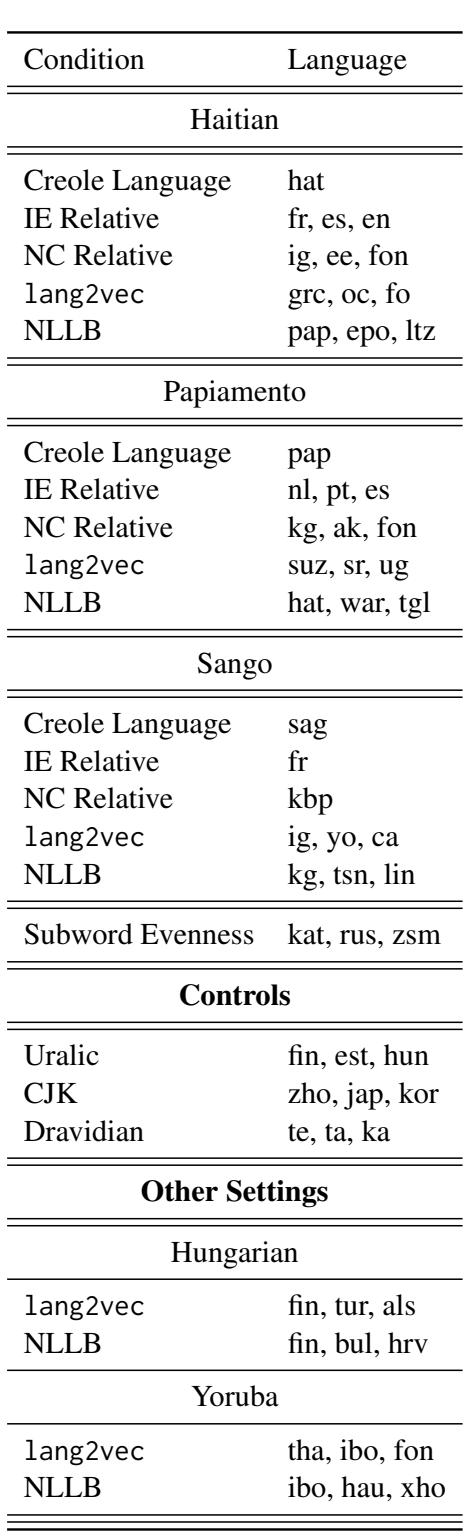
The crucial part of this setup is the Control Group. They didn’t just test related languages; they also tested:
- Unrelated Languages: Uralic (Finnish/Hungarian), Dravidian, and CJK (Chinese/Japanese/Korean). These have nothing in common with Caribbean Creoles.
- Untrained Adapters: An adapter initialized with random numbers and never trained on any text. Essentially, pure mathematical noise.
The Results: A Plot Twist
If the “Linguistic Transfer” hypothesis were true, we would expect the “Soup” containing French and Fon to vastly outperform the “Soup” containing Chinese or random noise when translating Haitian Creole.
That is not what happened.
The table below details the BLEU scores (a metric for translation quality, where higher is better).
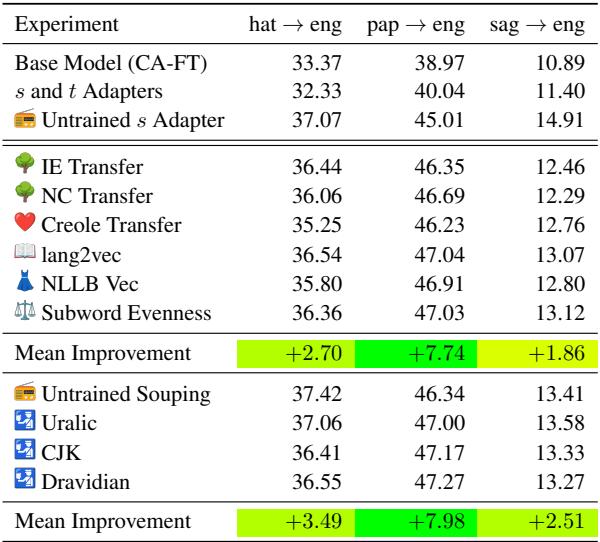
Look closely at the Haitian \(\to\) English (hat \(\to\) eng) column:
- Base Model: 33.37
- IE Transfer (using French/Spanish): 36.44
- Uralic (using Finnish/Hungarian): 37.06
- Untrained Souping (Random Noise): 37.42
The Shocking Finding: Using a random, untrained adapter was actually better than using carefully selected linguistic relatives. The differences between using “smart” linguistic relatives and “random” unrelated languages were negligible across all three Creoles.
Why is this happening?
The authors argue that the adapters are not acting as linguists; they are acting as regularizers.
In machine learning, regularization is a technique used to prevent overfitting. It adds a bit of “friction” or “noise” to the training process so the model doesn’t just memorize the training data.
When the researchers “souped” the Creole adapter with other adapters (whether French, Chinese, or Random), they were essentially smoothing out the parameter space. They weren’t transferring knowledge about verbs or nouns; they were stabilizing the math.
The Evidence for Regularization
To prove this, the authors looked at Parameter Variance. This measures how much the weights of the model fluctuate. High variance often signals instability and overfitting.
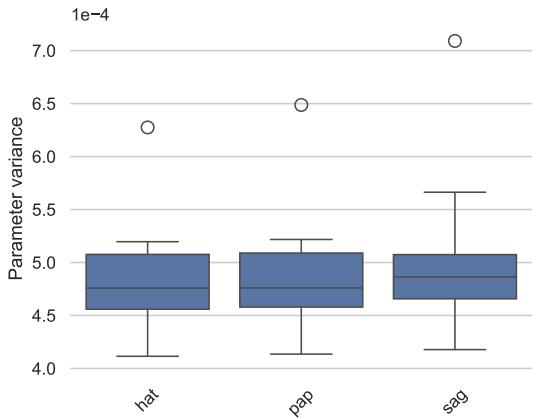
As shown in the figure above, the single adapters (the dots at the top) have high variance. The “souped” versions (the box plots) have much lower variance. It didn’t matter what was in the soup, as long as it was a soup. The act of averaging weights—even with noise—constrained the model, keeping it from going off the rails during fine-tuning.
This explains why Untrained Souping worked so well. It provided the necessary mathematical constraint without introducing potentially conflicting linguistic information.
Verifying the Hypothesis: The Catalan Check
The researchers wanted to be sure this wasn’t just a fluke of the NLLB model. They ran a counter-experiment on Catalan, a high-resource language. If adapters are just regularizers, the effect should be different when you already have plenty of good data.
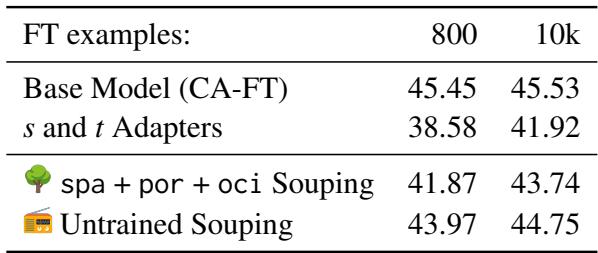
For Catalan, the base model was already excellent (BLEU ~45.5). Adding adapters—whether related (Spanish/Portuguese) or random—actually hurt performance or kept it stagnant.
This confirms that the “regularization benefit” is specific to the low-resource setting. When a model is starving for data (like with Creoles), it is prone to overfitting, so the “noise” from the adapters helps stabilize it. When a model is well-fed (like with Catalan), the noise is just… noise.
What Does This Mean for AI and Linguistics?
The paper concludes with a humbling realization for NLP researchers: “Limited-Resource Adapters Are Regularizers, Not Linguists.”
This has significant implications:
- Don’t Overthink the Linguistics: We often spend significant effort trying to model language family trees to help AI. This paper suggests that for neural networks, mathematical stability (regularization) might be more important than linguistic purity.
- The Power of Noise: It seems counterintuitive that adding “junk” data (untrained adapters) improves translation. But in the fragile context of low-resource learning, that noise prevents the model from becoming too confident in the wrong patterns.
- Better Tools for Creoles: Regardless of why it works, the method (Adapter Souping + CA-FT) yielded substantial improvements (up to +8 BLEU for Papiamento). This is a real-world win for speakers of these languages.
Native Speaker Verification
Ideally, we shouldn’t trust numbers alone. The authors included a qualitative evaluation by a native Haitian Creole speaker.
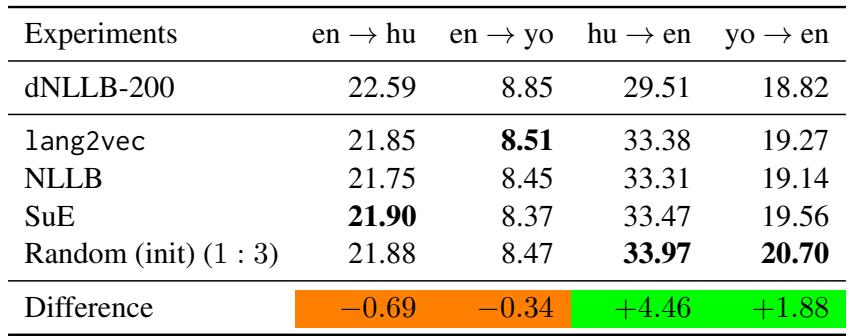
The native speaker analysis confirmed the metrics: The Untrained Souping method (marked with \(\blacksquare\)) often produced fewer grammatical errors than the phylogeny-based method (\(\clubsuit\)). The noise didn’t just improve the score; it improved the grammar.
Conclusion
This research serves as a fascinating reality check. We often personify AI, imagining it learning languages the way humans do—by relating new concepts to old ones. But deep down, these models are mathematical engines.
For low-resource Creole languages, the path to better translation wasn’t found in a linguistics textbook, but in the statistical properties of neural networks. By accepting that adapters act as regularizers, researchers can stop chasing perfect linguistic matches and start utilizing robust mathematical techniques to close the language gap. Sometimes, the best ingredient for your soup isn’t a fancy spice—it’s just a little bit of water.