](https://deep-paper.org/en/paper/2506.00304/images/cover.png)
Introduction: The Voice Within
Imagine trying to speak, but no sound comes out. You form the words with your mouth, your tongue moves, your jaw articulates, but the vocal cords remain silent. For millions of people suffering from speech impairments—such as those who have undergone laryngectomies—this is a daily reality.
Technology has long sought to bridge this gap through Silent Speech Interfaces (SSIs). One of the most promising technologies in this field is surface electromyography (sEMG). By placing electrodes on the skin around the face and neck, sensors can detect the electrical activity of the muscles used for speech. Theoretically, if a computer can read these electrical signals, it can translate them into text.
However, there is a catch. Most existing systems require “paired” data to learn. They need to hear the user speak out loud (audio) while simultaneously recording the muscle signals (EMG) to learn the correlation. But what if the user cannot produce sound at all? If a patient has already lost their voice, they cannot provide the audio data needed to train the system.
This brings us to a fascinating research question: Can we teach a computer to understand unvoiced speech using only muscle signals, without ever hearing a sound?
In the paper “Can LLMs Understand Unvoiced Speech?”, researchers from Northwestern University propose a groundbreaking solution. They leverage the immense power of Large Language Models (LLMs)—the same technology behind ChatGPT and Llama—to decode silent muscle movements. By treating muscle signals as a new “language” modality, they demonstrate that LLMs can act as highly efficient translators for the voiceless, even when training data is incredibly scarce.
Background: From Audio to Biosignals
To understand why this approach is novel, we first need to look at how speech recognition usually works.
The Standard Approach
Traditional Automatic Speech Recognition (ASR) relies on audio waveforms. The models are trained on thousands of hours of spoken language. When researchers started working with EMG, they typically tried to map the electrical signals to these audio waveforms or phonemes (the distinct units of sound).
Specialized models, such as those developed by Gaddy and Klein (prominent figures in this specific sub-field), have achieved good results. However, they generally rely on “voiced EMG”—signals recorded while the person is actually speaking aloud. This allows the model to use the audio as a “crutch” during training to align the messy muscle signals with the correct words.
The “Unvoiced” Challenge
The problem arises when we move to unvoiced EMG. This is when a person mouths words silently. The muscle patterns are slightly different than when speaking aloud (a phenomenon known as the Lombard effect or articulation differences). More importantly, for a mute user, there is no audio track to help the computer learn. The system must figure out what “Hello” looks like in electrical impulses without ever hearing “Hello.”
Enter the Large Language Model
LLMs like Llama-2 and Llama-3 have “read” almost everything on the internet. they have a deep, statistical understanding of how language works—grammar, syntax, and the probability of one word following another.
The researchers hypothesized that this pre-existing knowledge could be a superpower for silent speech. Instead of training a model from scratch to understand that “muscle twitch A” plus “muscle twitch B” equals the word “Apple,” they could feed the muscle signals into an LLM. Because the LLM already knows that “Apple” is a noun that might follow “Red,” it can use its linguistic reasoning to correct errors and fill in the gaps that the noisy muscle sensors might miss.
The Core Method: The EMG Adaptor
The researchers did not simply plug an electrode into a chatbot. They had to build a bridge between the raw electrical signals and the high-dimensional “embedding space” where LLMs operate.
The Architecture
The system consists of two main parts: a Trainable EMG Adaptor and a Frozen LLM.

As shown in Figure 1, the pipeline operates in several distinct stages:
- Input (Unvoiced EMG): The process begins with raw signals from 8 channels of EMG electrodes placed on the neck and face. These signals are captured at a high frequency (often >800 Hz).
- Downsampling (1D Conv Layer): Because muscle signals are captured at such high speeds, feeding every single data point into an LLM would result in a sequence way too long for the model to handle. A 1D Convolutional layer acts as a downsampler, reducing the time steps while preserving the essential information.
- Feature Extraction (ResBlock): The signal passes through Residual Blocks (ResBlocks). These are neural network layers designed to identify local patterns in the signal—perhaps recognizing the specific muscle flare associated with closing the lips or lifting the tongue.
- Sequential Modeling (BiLSTM): This is a crucial design choice. The researchers use a Bidirectional Long-Short-Term Memory (BiLSTM) network. Unlike standard feed-forward networks, LSTMs have “memory” and can look at the sequence of muscle movements over time. The “Bidirectional” part means it looks at both past and future signals to understand the context of the current movement.
- Projection: Finally, a linear layer projects these processed EMG features into the exact same dimension as the LLM’s input embeddings.
Speaking the LLM’s Language
Once the muscle signals are converted into embeddings (vectors of numbers), they are wrapped in a prompt. The system constructs a prompt that looks like this:
Unvoiced EMG: [INSERT MUSCLE EMBEDDINGS HERE] Prompt: Convert unvoiced EMG embeddings to text
To the LLM (like Llama-3), the muscle signals just look like a foreign language it needs to translate. The fascinating part of this architecture is that the LLM is frozen. Its weights are not updated during training. The system is only training the “Adaptor” (the blue and orange blocks in Figure 1) to translate muscle signals into a format the LLM can understand.
The Mathematical Objective
How does the model learn? It uses a standard Cross-Entropy loss function, which is the standard way LLMs are trained to predict the next word.
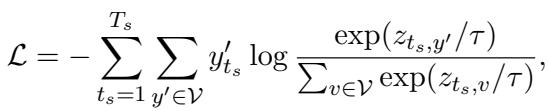
In this equation, the model is penalized if it predicts the wrong word based on the muscle input. By minimizing this loss, the Adaptor gradually learns to shape the electrical signals so that they trigger the correct word associations inside the frozen LLM.
Experiments & Results
The researchers tested their approach on a “closed-vocabulary” dataset. This means the model was trained and tested on a specific list of 67 words. While this is simpler than open-ended conversation, it is a standard benchmark for measuring the precision of silent speech interfaces.
Result 1: LLMs Beat Specialized Models
The primary metric used is Word Error Rate (WER). A lower WER is better (0.0 means perfect transcription).
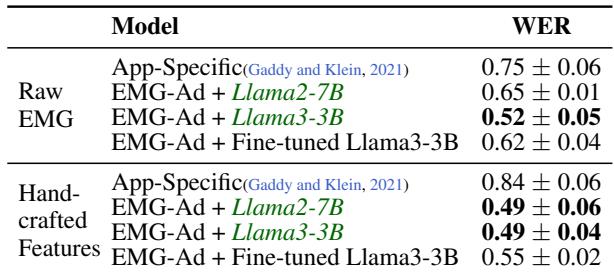
Table 1 reveals a striking finding. The standard “App-Specific” model (the specialized model by Gaddy & Klein) achieved a WER of 0.75 on raw EMG data. The new method using Llama-3 (EMG-Ad + Llama3-3B) achieved a WER of 0.52.
This is a massive improvement. It suggests that the general language knowledge held within the LLM allows it to make much better guesses about what was said, even when the muscle signals are noisy or ambiguous.
Result 2: Data Efficiency (The “Six Minute” Miracle)
Perhaps the most impactful finding for real-world application is how little data the LLM needs. Collecting EMG data is tiring for patients. A system that needs 100 hours of data is useless to a patient who fatigues after 10 minutes.
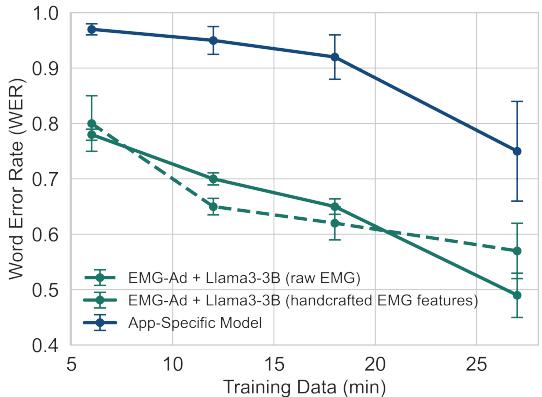
Figure 2 plots the error rate against the amount of training data in minutes.
- Blue Line: The specialized model starts with a near 100% error rate at 5 minutes of data and slowly improves.
- Green Lines: The LLM-based models (dashed) start with significantly lower error rates.
With just six minutes of training data, the LLM approach outperforms the specialized model by nearly 20%. This proves that LLMs are excellent “few-shot learners”—they can adapt to a new user’s unique muscle patterns very quickly.
Result 3: Raw vs. Handcrafted Features
In deep learning, we usually prefer “raw” data, letting the AI figure out the features. However, Table 1 shows an interesting nuance. When the researchers used Handcrafted Features (mathematically pre-calculated features like spectral power) instead of raw voltage, the LLM performed even better, dropping the WER to 0.49.
Interestingly, the specialized baseline model got worse with handcrafted features (0.84 WER). This suggests that while specialized models act like raw signal processors, LLMs act more like logical reasoning engines—they prefer input that has already been somewhat structured and cleaned up (handcrafted features).
Result 4: The Difficulty of the Modality
Is reading muscles harder than reading lips or hearing audio? Yes.
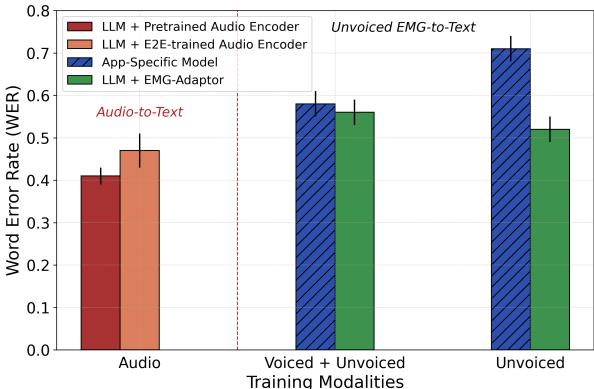
Figure 3 compares the system’s performance when adapting an LLM to Audio (left side) versus Unvoiced EMG (right side). The error bars for audio are significantly lower. This confirms that unvoiced EMG is a much “noisier” and more difficult language to learn than sound. The electrical signals from muscles are chaotic and lack the distinct clarity of acoustic phonemes. Yet, despite this difficulty, the LLM manages to decode it.
Technical Deep Dive: Why LSTMs?
For the students reading this, you might wonder: “Why did they use an LSTM (Long Short-Term Memory) network in the adaptor? Isn’t the Transformer architecture (what LLMs are made of) superior?”
The researchers actually tested this. They performed an Ablation Study, where they swapped parts of the architecture to see what worked best.
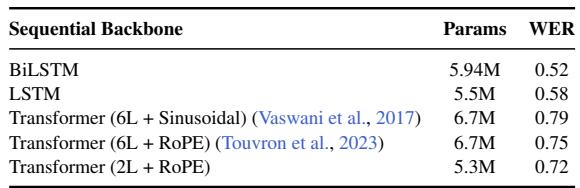
Table 6 shows the results.
- BiLSTM: 0.52 WER (Best)
- Transformer (6 Layers): 0.79 WER
Surprisingly, the older LSTM architecture beat the Transformer for the adaptor module. The authors hypothesize this is because the dataset is small and the sequences are short (averaging 4 words). Transformers typically shine when they have massive datasets to learn complex attention maps. For smaller, strictly sequential signal processing tasks like this, the inductive bias of an LSTM (which forces the model to process time sequentially) is actually an advantage.
Conclusion: A Voice for the Voiceless
This research represents a pivotal first step. By achieving a Word Error Rate of 0.49 on unvoiced speech without ever using audio data, the authors have proven that LLMs can understand biosignals.
The implications are profound:
- Accessibility: Patients who have lost their voice can potentially train a communication device in minutes, not hours.
- Privacy: Silent speech allows for communication that cannot be overheard, perfect for sensitive environments.
- Cross-Modality: It reinforces the idea that LLMs are not just text processors; they are reasoning engines capable of interpreting any sequence of data, whether it’s words, code, or the firing of neurons in your neck.
While the current system is limited to a closed vocabulary, the foundation is laid. As LLMs become more multimodal, we may soon see a future where the barrier between thought, muscle, and speech is dissolved, giving a voice back to those who have lost it.
Key Takeaways for Students
- Adaptors are Powerful: You don’t always need to fine-tune a massive 7-billion parameter model. A small, trainable “adaptor” network can often bridge the gap effectively.
- Data Scarcity: When you don’t have much data, leveraging a pre-trained giant (like Llama) is usually better than training a small model from scratch.
- Architecture Matters: Don’t blindly use Transformers for everything. In signal processing with limited data, LSTMs/RNNs can still be state-of-the-art.