](https://deep-paper.org/en/paper/2506.00457/images/cover.png)
Introduction
In the current era of Artificial Intelligence, Large Language Models (LLMs) like GPT-4 and LLaMA have become the hammer for every nail. From writing code to analyzing legal documents, their generalization capabilities are nothing short of extraordinary. Recently, this excitement has spilled over into the domain of time-series forecasting—the art of predicting future numerical values based on past data.
The premise is seductive: If an LLM can predict the next word in a sentence, can’t it predict the next number in a sequence? This has given rise to “Zero-Shot Forecasting,” where pre-trained LLMs are used to predict stock prices, weather, or energy consumption without any domain-specific training.
However, a recent research paper titled “Revisiting LLMs as Zero-Shot Time-Series Forecaster: Small Noise Can Break Large Models” pumps the brakes on this hype train. The researchers conducted a rigorous evaluation comparing LLMs against state-of-the-art domain-specific models. Their findings are startling: not only do LLMs struggle to match the accuracy of specialized models, but they are also often outperformed by simple linear models that can be trained in seconds.
In this post, we will deconstruct this paper to understand why LLMs struggle with numerical forecasting, the “David vs. Goliath” battle between GPT-4 and simple linear regression, and the fundamental issue that plagues token-based models: sensitivity to noise.
Background: The Zero-Shot Promise
Time-series forecasting is traditionally handled by models explicitly designed to process numerical sequences. These range from statistical methods like ARIMA to complex Transformer-based architectures like PatchTST or iTransformer. These models usually require a training phase on historical data to learn the specific patterns (seasonality, trends) of that domain.
Zero-Shot Forecasting attempts to bypass this training phase. By converting a sequence of numbers into a string of text (e.g., “12, 14, 16, …”), researchers can prompt an LLM to “complete the sequence.”
If effective, this would be a game-changer. It would allow for instant predictions on new datasets without the computational cost and time required to train a new model from scratch. But for this to be a viable alternative, it must meet at least one of two criteria:
- Speed: It must be faster than training and deploying a specific model.
- Accuracy: It must be more accurate (or at least comparable) to justify the cost.
The researchers set out to test precisely these two criteria.
The Core Investigation
To evaluate the true effectiveness of LLMs, the authors compared them against two types of competitors:
- SoTA Domain-Specific Models: Complex deep learning models like iTransformer and PatchTST.
- Single-Shot Linear Models: Extremely simple linear models (DLinear-S, RLinear-S) trained on only the input sequence provided to the LLM.
The inclusion of “Single-Shot Linear Models” is a critical part of this study. It ensures a fair comparison: if the LLM only sees the last 100 data points to make a prediction (zero-shot), the linear model is also restricted to learning from those same 100 data points (single-shot).
The Trade-off: Accuracy vs. Efficiency
The results of this comparison are summarized beautifully in the following figure.
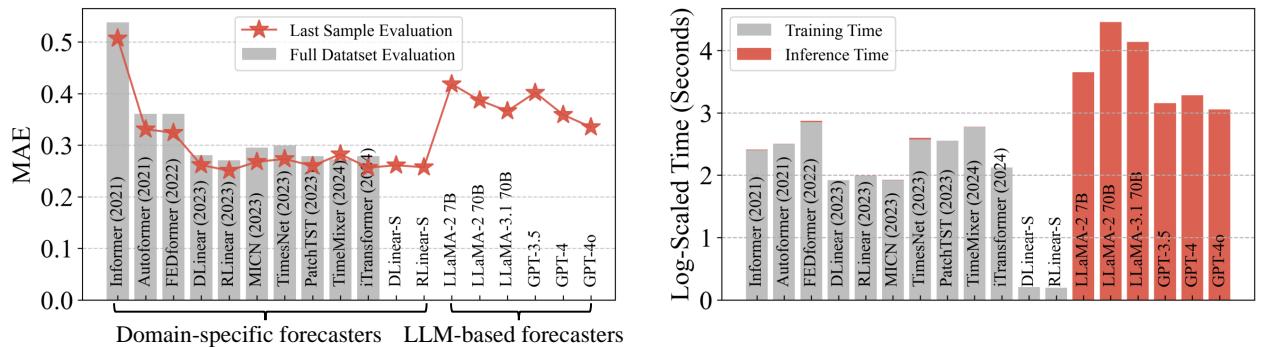 Figure 1: (Left) Mean Absolute Error (MAE) comparison. Lower is better. Domain-specific models generally outperform LLMs. (Right) Log-scaled time cost. LLMs are significantly slower.
Key Takeaways from Figure 1:
- Accuracy (Left Chart): The red stars indicate the performance on the “Last Sample” (the standard way LLMs are evaluated). Notice how LLMs (like GPT-4 and LLaMA) consistently show higher error rates (higher MAE) compared to models like PatchTST or the simple DLinear-S.
- Speed (Right Chart): The difference in speed is massive (note the log scale). LLM inference is incredibly computationally expensive. In fact, the gray bars show that you can train and run a domain-specific model faster than you can get a single prediction from a large LLM.
This immediately challenges the viability of LLMs for real-time forecasting. If a simple linear model is both more accurate and orders of magnitude faster, the use case for LLMs shrinks significantly.
The Single-Shot Linear Model Strategy
It is worth elaborating on the “Single-Shot” models because they serve as the baseline that LLMs fail to beat. The authors devised a method to train linear models using a sliding window approach on just the input sequence.

As shown in the equation above, the available input length (\(I\)) is sliced into smaller training windows to teach the linear model local trends. This allows a simple regression model to “learn” the pattern of the current data stream instantly, effectively mimicking the “zero-shot” capability of an LLM but with mathematical precision rather than probabilistic text generation.
The Achilles’ Heel: Noise Sensitivity
Why do LLMs, which possess vast “world knowledge,” fail at predicting numbers? The researchers identified the root cause: Noise.
LLMs are excellent at pattern matching when the pattern is perfect (e.g., a Fibonacci sequence). However, real-world data—energy usage, traffic flow, exchange rates—is messy. It contains “noise,” which creates small fluctuations that obscure the true underlying signal.
The Smoking Gun
The researchers utilized a “Function Dataset” containing clean mathematical waves and added varying amounts of noise to test robustness. The results were visually striking.
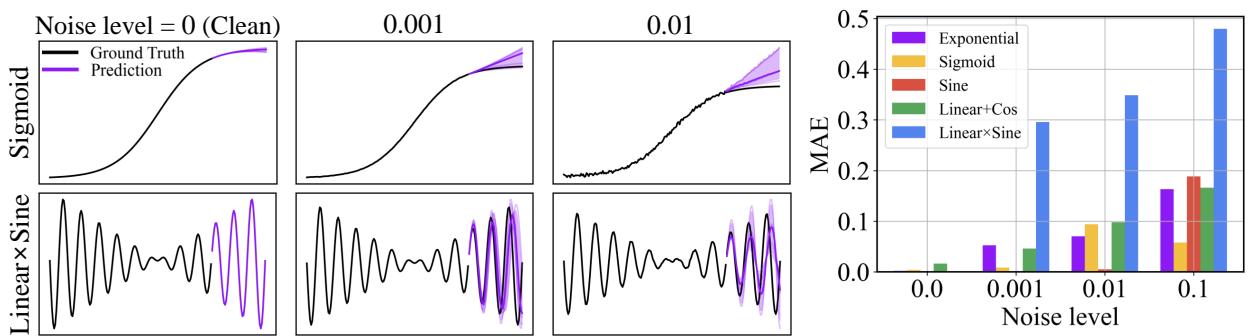 Figure 2: This figure demonstrates the catastrophic failure of LLMs when noise is introduced. On the left, the top row shows a sigmoid function. With 0 noise (leftmost), the prediction is perfect. With tiny noise (0.001, middle), the prediction deviates. With slightly more noise (0.01, right), the prediction breaks completely.
As observed in Figure 2, LLMs (specifically GPT-4 in this test) perform perfectly on clean data. However, adding a Gaussian noise with a standard deviation of just 0.001 causes the error to spike.
The bar chart on the right of Figure 2 quantifies this. As noise levels increase from 0.0 to 0.1, the Mean Absolute Error (MAE) for various function types skyrockets. This suggests that LLMs are not actually “forecasting” by understanding numerical trends; they are pattern-matching token sequences. When noise disrupts the exact token sequence, the model’s ability to retrieve the correct continuation collapses.
Mathematical Definitions of Noise
To be rigorous, the authors tested against three specific types of noise common in robustness literature:
Constant Noise: A fixed deviation added to the value.
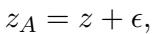
Missing Noise: Where values drop out completely.
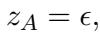
Gaussian Noise: Random statistical variations.

In all cases, while linear models remained robust (because they fit a line through the noise), LLMs treated the noise as part of the pattern, leading to erratic predictions.
Can We Fix It? Prompts and Filters
Naturally, one might ask: “Can’t we just prompt the LLM better?” or “Can’t we filter the noise first?” The paper explores both avenues.
1. Better Prompting
The researchers tested standard prompting strategies (like LLMTime) against more advanced techniques like Chain-of-Thought (TS-CoT), where the model is asked to “think step by step” about the trend, and In-Context Learning (TS-InContext).
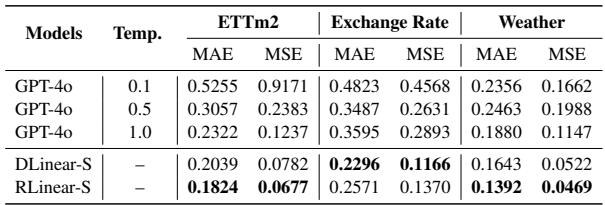 Figure 4: Examples of prompts used. Even with sophisticated instructions (b), the fundamental issue of tokenization remains.
Despite these sophisticated prompting strategies, the performance gains were marginal. Table 5 (from the study) revealed that while different prompts shifted performance slightly, none could bridge the gap with simple linear models.
2. Increasing Context Length
Perhaps the model just needs to see more data to ignore the noise? The researchers increased the input sequence length, hoping the LLM would learn to average out the fluctuations.
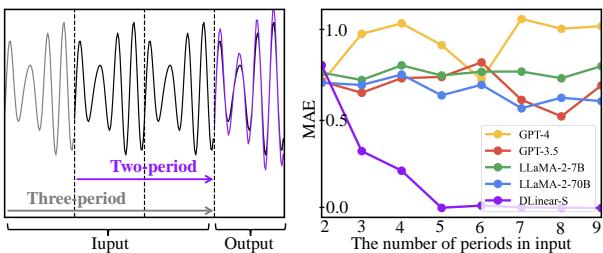 Figure 3: Increasing input length (number of periods) improves the Linear Model (purple dotted line) significantly. However, LLMs (Orange, Green, Blue lines) show very little improvement, plateauing quickly.
Figure 3 illustrates a critical limitation. As you give a linear model more data (moving right on the x-axis), its error (y-axis) drops sharply because it has more points to fit a robust line. LLMs, however, struggle to utilize long numerical contexts effectively. Their performance stays relatively flat, indicating that a longer context window does not help them distinguish signal from noise.
Experimental Results: The Final Verdict
The paper concludes with a comprehensive evaluation across multiple real-world datasets, including Electricity, Traffic, and Weather data.
Quantitative Results
The summary of these experiments is dense but telling.
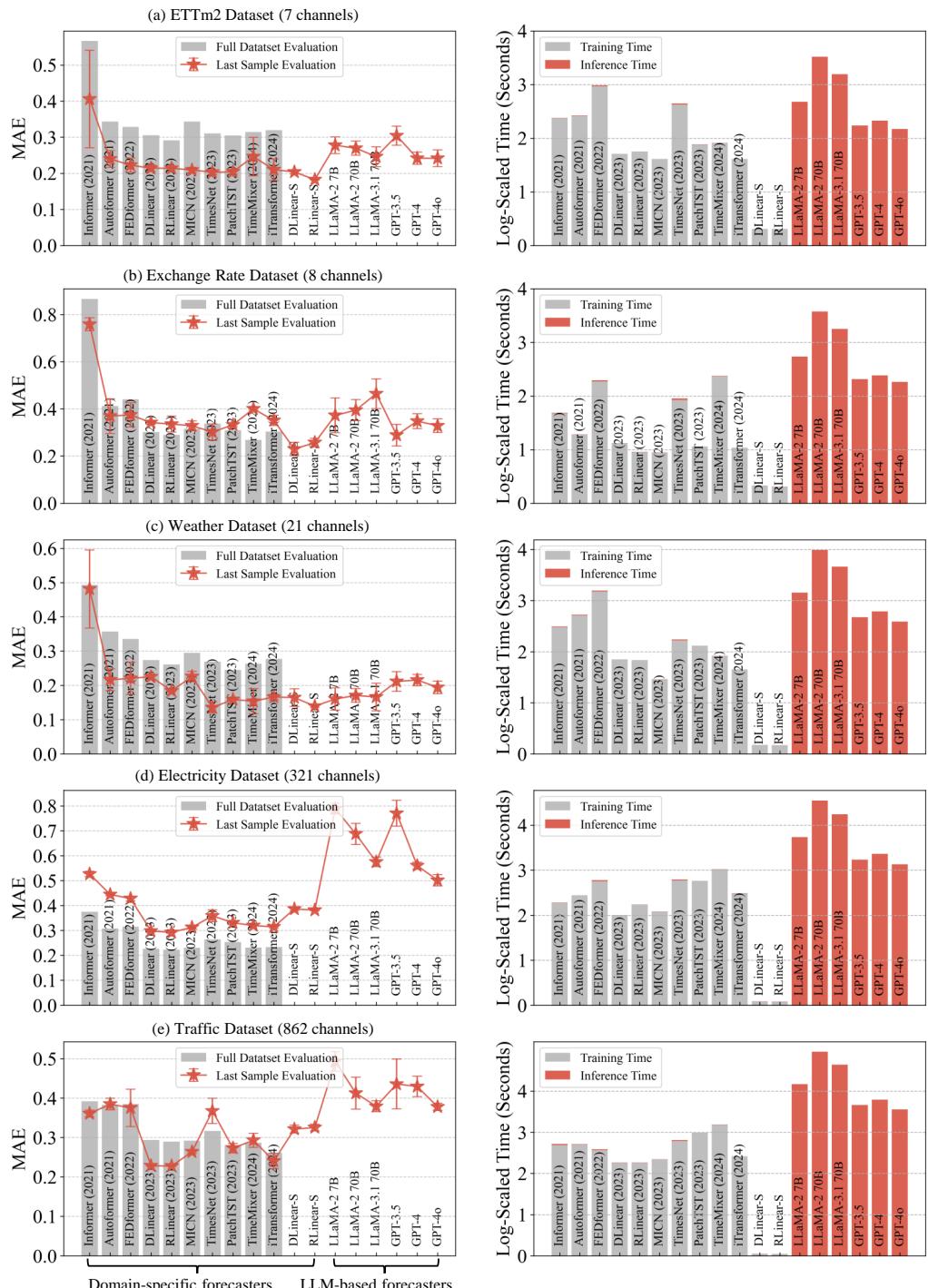 Figure 12: Comprehensive results across datasets. The height of the bars represents error (MAE). In almost every category, the Single-Shot Linear models (Red/Orange bars) and Domain Specific models (Gray bars) are significantly lower than the LLM approaches.
The data in Figure 12 reinforces the earlier findings. Whether dealing with the 862 channels of Traffic data or the 7 channels of ETTm2 (electricity transformer temperatures), the LLM-based forecasters generally lag behind.
Qualitative Results: Seeing is Believing
Numbers in a table are one thing, but visualizing the actual forecast lines makes the difference obvious.
Electricity Dataset:
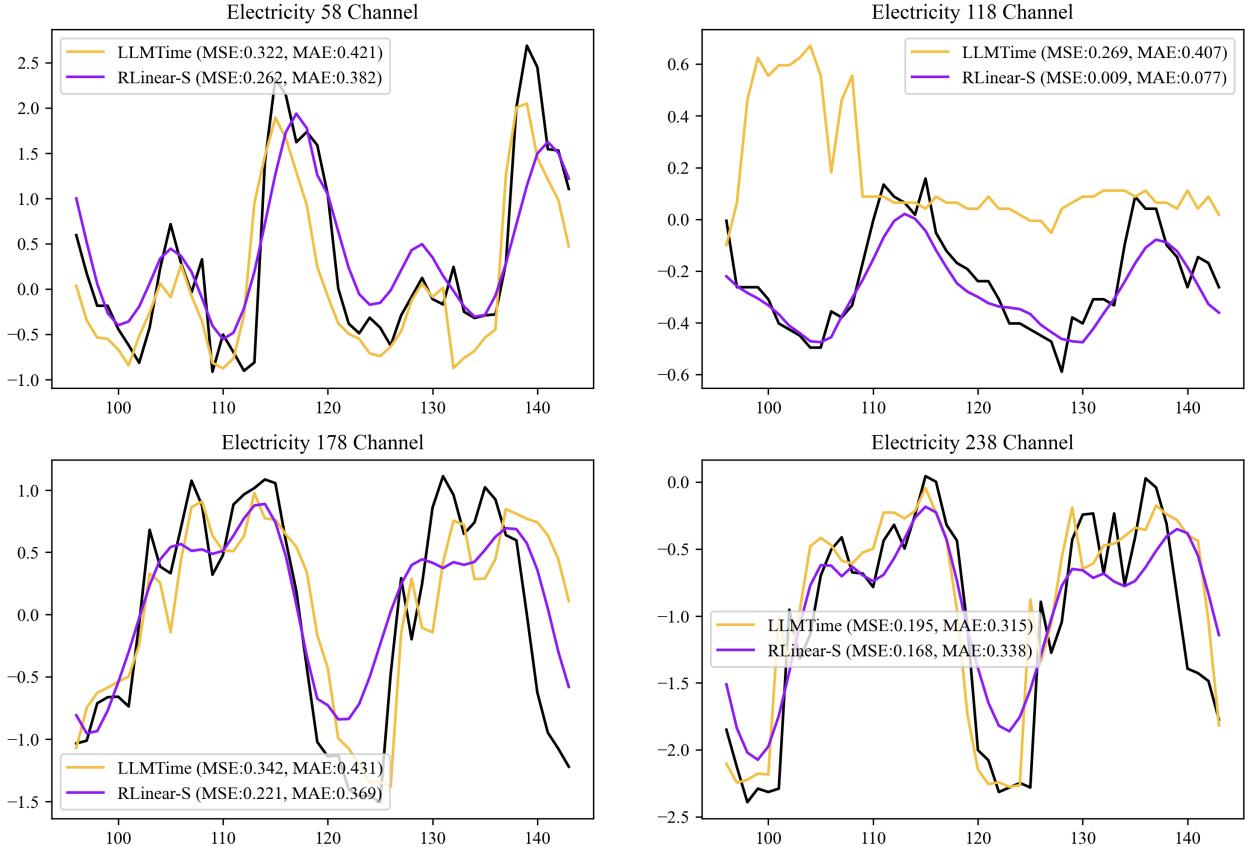 Figure 7: The black line is the ground truth. The Purple line is the Single-Shot Linear model (RLinear-S). The Yellow line is LLMTime. Note how the Purple line tracks the black line tightly, while the Yellow line often wanders off or fails to capture the amplitude.
Traffic Dataset:
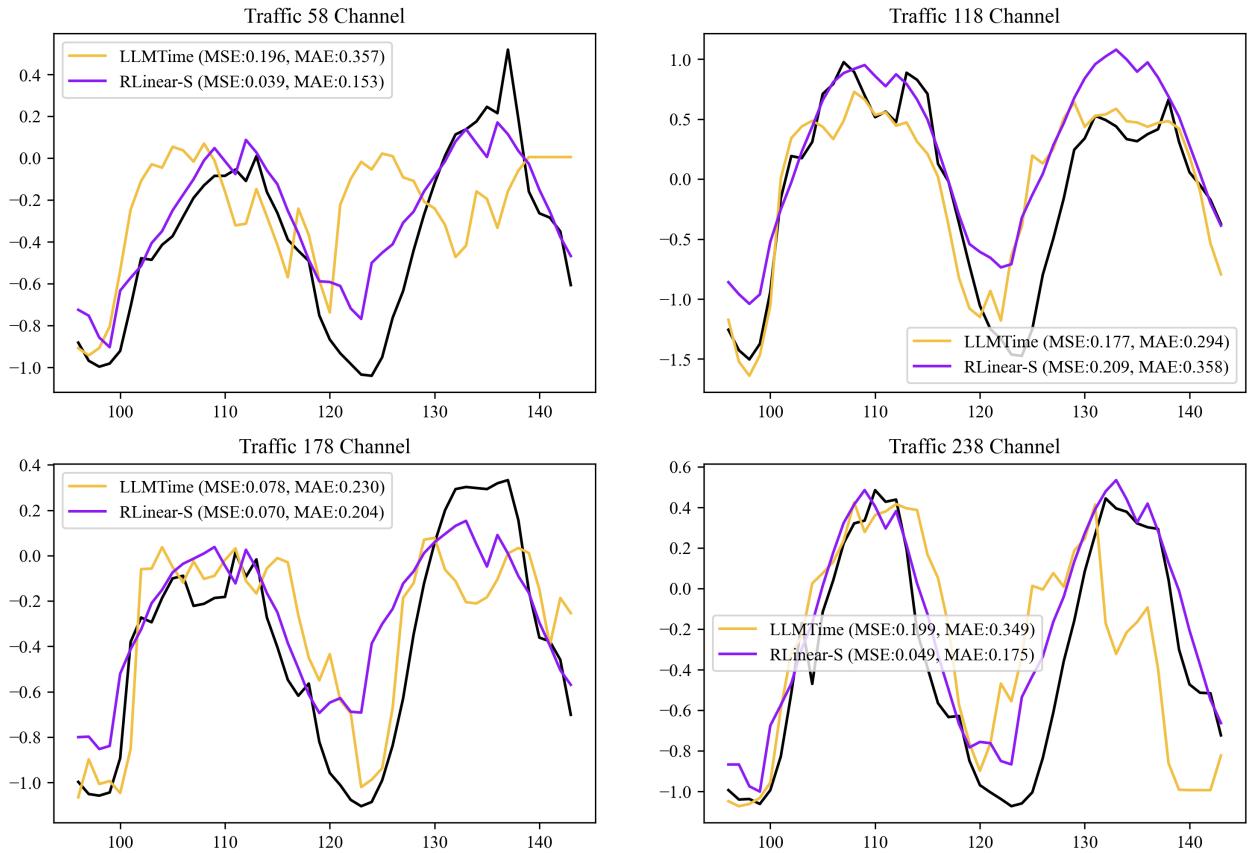 Figure 11: Traffic data is highly periodic. The Linear model (Purple) captures this rhythm almost perfectly. The LLM (Yellow) struggles with the magnitude of the peaks and troughs.
These visualizations highlight the “hallucination” problem in numerical data. The LLM produces a sequence that looks like a time series (it goes up and down), but it fails to ground that generation in the precise mathematical reality of the input data.
Conclusion
The paper “Revisiting LLMs as Zero-Shot Time-Series Forecaster” serves as a crucial reality check. While LLMs are powerful reasoning engines, their architecture—based on tokenizing text—is inherently ill-suited for the precise, noise-intolerant world of numerical forecasting.
Key Takeaways:
- Inefficiency: LLMs are orders of magnitude slower and more expensive than domain-specific models.
- Noise Sensitivity: Small amounts of noise, which are present in almost all real-world data, cause disproportionately large errors in LLMs.
- Simplicity Wins: Simple linear models (Single-Shot), trained on the fly, are faster, cheaper, and more accurate than GPT-4 for this specific task.
The Path Forward: The authors suggest that we shouldn’t abandon LLMs for time series entirely, but we should abandon the “Zero-Shot” dream. The future likely lies in fine-tuning—adapting the internal weights of the LLM to better process numerical sequences—rather than relying on the model to “guess” the pattern from a text prompt. Until then, for your forecasting needs, standard statistical or linear models remain the champion.