](https://deep-paper.org/en/paper/2506.01319/images/cover.png)
Introduction
Imagine standing in the middle of a crowded jazz club. The drummer is keeping a complex beat, the bassist is walking through a progression, the pianist is improvising, and the crowd is murmuring. If someone asked you, “How many instruments are playing?” or “Is the saxophone playing right now?”, your brain wouldn’t process every single photon of light or every microsecond of sound pressure. Instead, you would filter out the noise. You would focus on key visual cues—the glint of the saxophone, the movement of the drummer’s sticks—and isolate specific audio frequencies. You intuitively discard the redundancy to answer the question.
For Artificial Intelligence, however, this “filtering” process is incredibly difficult. Most current multimodal models try to drink from the firehose, processing dense, continuous audio and visual streams in their entirety. This is computationally expensive and, ironically, often leads to worse performance because the model gets distracted by irrelevant data.
In this post, we are doing a deep dive into a fascinating paper titled “Learning Sparsity for Effective and Efficient Music Performance Question Answering.” The researchers introduce a framework called Sparsify, which proves that by strategically ignoring large chunks of data—through masking, merging, and selective training—we can actually make AI smarter and significantly faster.
The Unique Challenge of Music AVQA
To understand why this paper is important, we first need to understand the task: Music Audio-Visual Question Answering (Music AVQA).
In general Audio-Visual QA, an AI watches a video and answers questions based on both sight and sound. However, not all videos are created equal.
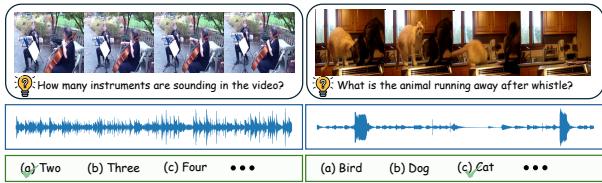
As shown in Figure 1 above, there is a distinct difference between general audio events and music performances.
- The Right Side (General QA): Look at the example of the dog and the whistle. The audio is “sparse.” There is a whistle, then silence, then maybe a bark. It is a discrete event. It is easy for a model to say, “The sound happened at timestamp X.”
- The Left Side (Music QA): This is a music performance. The audio is dense. The sound is continuous, overlapping, and rich in harmonic structure. Visually, multiple musicians are moving constantly. There is massive redundancy; the frame at 10.1 seconds looks almost identical to the frame at 10.2 seconds, and the guitar chord usually sustains across multiple frames.
Current state-of-the-art methods struggle here. They rely on “dense” representations, processing every token of information. This leads to three major problems:
- Inefficiency: Processing redundant background noise wastes compute power.
- Dilution: Critical information gets lost in the sea of data.
- Slow Training: The models take forever to converge because they are trying to learn from every single sample, even the easy, uninformative ones.
The Sparsify framework addresses these by asking: How much can we remove while improving accuracy?
The Sparsify Framework: A Deep Dive
The core philosophy of Sparsify is that not all data is created equal. Some video patches are just background walls; some audio segments are just silence or sustain. By removing these, the model can focus on the complex interplay between the musician’s movements and the resulting sound.
Let’s break down the architecture. The framework operates on an end-to-end pipeline that integrates three distinct “sparsification” strategies.
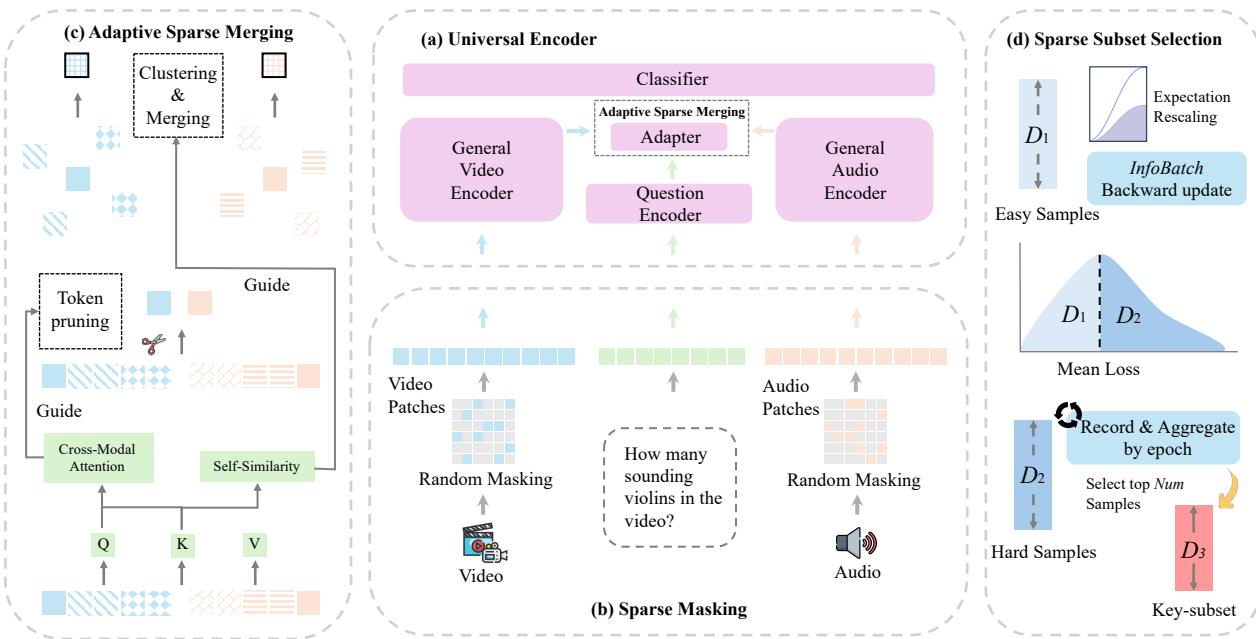
As illustrated in Figure 2, the pipeline is divided into four main stages. Let’s explore each one.
1. The Universal Encoder (Figure 2a)
Before we can sparsify anything, we need to encode the raw data. The authors utilize a “Universal Encoder” setup adapted from previous work (Amuse).
- Visuals: Handled by Swin-V2, a powerful vision transformer that processes images in hierarchical windows.
- Audio: Handled by HTS-Audio Transformer, which converts raw waveforms into mel-spectrograms (visual representations of sound frequencies).
- Question: A standard text transformer encodes the user’s question (e.g., “Which instrument starts playing first?”).
These encoders create the initial “tokens”—chunks of digital information representing parts of the image or audio.
2. Sparse Masking: The Art of Random Deletion (Figure 2b)
The first layer of efficiency is surprisingly simple: just hide things. This technique is known as Sparse Masking.
Music videos have high “spatial redundancy.” If you mask out 50% of the pixels in an image of a drummer, you can still clearly tell it’s a drummer. The authors apply this logic to both vision and audio.
- Visual Modality: They randomly mask 50% of the image patches.
- Audio Modality: They apply the same 50% masking ratio to the mel-spectrograms.
Why does this work? By forcing the model to reconstruct the scene from only 50% of the data, the model is forced to learn “structural sparsity.” It stops relying on pixel-perfect details and starts understanding the broader semantic content. It significantly reduces the computational load right at the entrance of the pipeline.
3. Adaptive Sparse Merging (Figure 2c)
While random masking is great for redundancy, it doesn’t account for importance. Some tokens are definitely more important than others (e.g., the pixel containing the guitar pick is more important than the pixel containing the drummer’s shoe).
To handle this, the authors introduce Adaptive Sparse Merging. This step doesn’t just delete data; it consolidates it.
How it works:
- Cross-Modal Attention: The model looks at the relationship between the audio and visual tokens. It calculates an attention score to see which tokens are interacting the most.
- Identifying Key Tokens (IQR): Using the Interquartile Range (IQR) method, the model dynamically identifies the “top-tier” tokens—the ones with the highest importance scores. These are marked as Key Tokens.
- Clustering & Merging: The remaining tokens (the non-essential ones) aren’t just thrown away. They are clustered and merged into the nearest Key Token based on similarity.
This effectively compresses the internal representation. Instead of passing 100 tokens to the next layer, the model might merge them down to 25 “super-tokens” that contain the aggregated information of the original group. This ensures the model focuses its computational power on the salient features—the actual music-making actions.
4. Sparse Subset Selection: Training on What Matters (Figure 2d)
The final innovation isn’t about the model architecture, but about how the model learns. In any dataset, some examples are “easy” (the model gets them right immediately) and some are “hard.”
Training repeatedly on easy samples is a waste of time. The authors propose a Key-subset Selection Algorithm.
- Categorization: During training, the framework tracks the loss (error rate) for every sample. Samples with low loss are “easy” (\(D_2\) in the diagram), and samples with high loss are “hard” (\(D_1\)).
- Prioritization: Hard samples are prioritized. Their importance is weighted so that difficult examples seen earlier in training are still remembered.
- Pruning: The algorithm selects the top \(N\) most informative samples (the Key-subset).
- InfoBatch: To prevent the model from becoming biased by only seeing hard examples, they use a technique called InfoBatch to rescale the gradients. This mathematically balances the training so the “easy” stuff is still accounted for, just processed less frequently.
The result? The model can train on a fraction of the data while learning just as effectively.
Experiments & Results
The theory sounds solid, but does it work in practice? The authors tested Sparsify on two major benchmarks: MUSIC-AVQA and MUSIC-AVQA v2.0.
State-of-the-Art Accuracy
The results were compared against strong baselines like AVST, LAVisH, and DG-SCT.
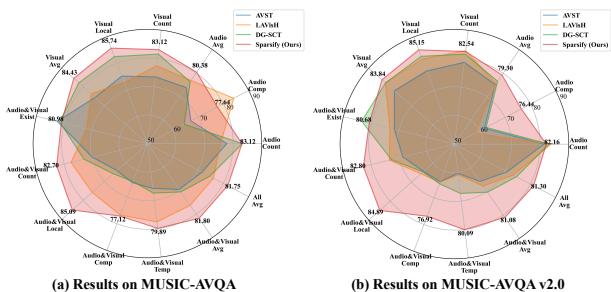
As shown in the radar charts in Figure 3, Sparsify (the red line) consistently envelops the other methods.
- Visual Questions: Sparsify excels here. By reducing visual clutter through masking, the model is less confused by background elements. It achieved 84.43% accuracy on MUSIC-AVQA, beating the runner-up by over 2%.
- Audio Questions: By removing spectral redundancy, the model focuses on distinct acoustic patterns.
- Audio-Visual Questions: This is the hardest category, requiring the model to link sound and sight (e.g., “Is the violin sounding?”). Sparsify outperformed the previous best model (DG-SCT) by over 10% on the v2.0 dataset.
Data Efficiency: Doing More with Less
One of the most striking claims of the paper is the ability to train on a smaller dataset without collapsing the model’s performance.
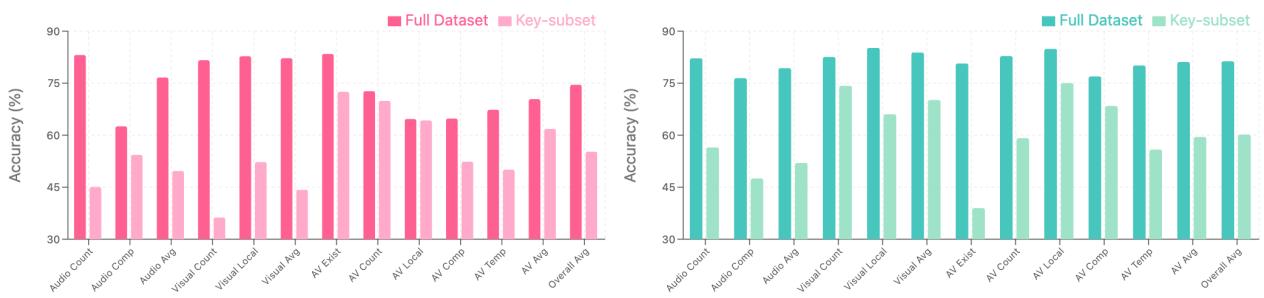
Figure 4 visualizes this efficiency. The teal bars represent Sparsify trained on the full dataset, while the green bars represent training on just the Key-subset (approx. 25% of the data).
While there is a drop in accuracy (which is expected when discarding 75% of your training data), the model retains a massive 70-80% of its full performance. This proves that the Key-subset Selection algorithm successfully identifies the specific video clips that actually matter for learning. For researchers with limited compute resources, this is a game-changer.
Training Speed
Finally, let’s look at the raw speed. Complexity usually kills training time, but Sparsify is designed to be lean.
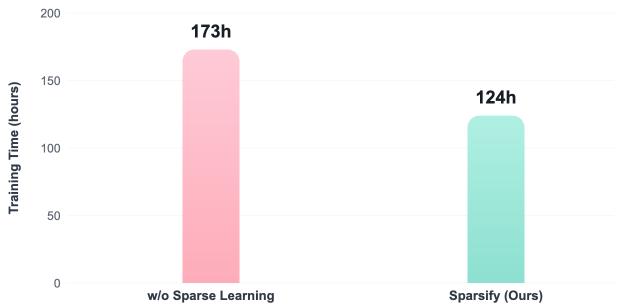
Figure 5 compares the training hours required for Sparsify versus a “Dense” variant (where all the sparsification strategies are turned off).
- Dense Model: 173 Hours
- Sparsify: 124 Hours
That is a 28.32% reduction in training time. By masking inputs early and merging tokens in the middle, the network has significantly fewer floating-point operations to calculate. By using subset selection, it iterates through epochs faster. It is a compounding efficiency gain.
Conclusion and Implications
The “Sparsify” framework offers a compelling lesson for the future of Multimodal AI: We don’t need to process everything.
In the domain of music performance, where audio is continuous and visuals are repetitive, redundancy is the enemy. By implementing “Sparsity” at three levels—Input (Masking), Feature (Merging), and Dataset (Subset Selection)—this research demonstrates that we can build models that are not only more accurate but also significantly lighter and faster to train.
For students and researchers entering this field, the takeaways are clear:
- Don’t ignore the nature of your data. Music data behaves differently than speech or event data.
- Attention is a filter. Use attention mechanisms not just to connect modalities, but to prune away what isn’t needed.
- Data curation is part of the architecture. Selecting which samples to train on is just as powerful as designing the network itself.
Sparsify achieves State-of-the-Art performance while cutting training costs by nearly a third. As we move toward analyzing longer and more complex videos, these sparse learning strategies will likely become the standard for efficient AI.