](https://deep-paper.org/en/paper/2506.02587/images/cover.png)
Introduction
Imagine you are driving a car. Your eyes (cameras) see the red stop sign ahead, and your brain estimates the distance. Now, imagine a sophisticated autonomous vehicle. It doesn’t just rely on cameras; it likely uses LiDAR (Light Detection and Ranging) to measure precise depth. Ideally, the camera and the LiDAR should agree perfectly on where that stop sign is located in 3D space.
But what happens if they don’t?
In the world of robotics and autonomous driving, this is known as the sensor calibration problem. If a LiDAR sensor is shifted even by a few centimeters or tilted by a fraction of a degree relative to the camera, the data becomes misaligned. A pedestrian detected by the camera might appear to be standing in a different location according to the LiDAR. This misalignment can lead to catastrophic failures in decision-making.
Traditionally, fixing this required “target-based” calibration—tedious processes involving checkerboards, specific rooms, and manual labor. While “target-less” deep learning methods have emerged, they often struggle to maintain geometric accuracy or require heavy computational resources.
Enter BEVCALIB. In a new research paper, researchers from USC and UC Riverside propose a novel approach that leverages a Bird’s-Eye View (BEV) representation to solve the calibration puzzle. By projecting both camera images and LiDAR points into a shared top-down map, they allow a neural network to “see” the geometric misalignment and correct it with state-of-the-art accuracy.
In this post, we will tear down the architecture of BEVCALIB, explain why BEV is the perfect candidate for this task, and look at how it outperforms existing methods by a significant margin.
Background: The Geometric Alignment Challenge
To understand why BEVCALIB is necessary, we first need to understand the difficulty of LiDAR-Camera extrinsic calibration.
The goal is to find a transformation matrix (composed of rotation and translation) that perfectly maps points from the LiDAR coordinate system to the camera coordinate system.
The Old Way vs. The Deep Learning Way
- Target-based methods: These rely on objects with known geometries (like checkerboards). They are accurate but impractical for “in-the-wild” calibration. You can’t stop a self-driving car on the highway to show it a checkerboard if its sensors get jostled by a pothole.
- Target-less methods: These use natural features in the environment (edges, planes). Deep learning approaches in this category try to match features between the 2D image and the 3D point cloud. However, matching 2D pixels to 3D points is inherently difficult because they exist in different spatial domains.
Why Bird’s-Eye View (BEV)?
The researchers identified that the main bottleneck in previous deep learning methods was the lack of explicit geometric constraints.
BEV representations have taken the computer vision world by storm recently, particularly for tasks like object detection and path planning. A BEV representation transforms sensor data into a top-down 2D grid—essentially a map.
- LiDAR is naturally 3D and fits easily into a BEV grid.
- Cameras capture perspective views, but can be “lifted” into 3D and then projected onto a BEV grid.
By converting both modalities into a shared BEV space, BEVCALIB creates a unified playground where geometric relationships are preserved, making it much easier for a network to figure out how to align them.
The Core Method: Inside BEVCALIB
The BEVCALIB architecture is a single-stage, end-to-end pipeline. It takes a raw image and a raw point cloud (along with a noisy initial guess of the calibration), and outputs the predicted correction needed to align them.
Let’s break down the architecture step-by-step.

As shown in Figure 1, the workflow consists of three main stages:
- BEV Feature Extraction: Processing inputs into a shared space.
- FPN BEV Encoder: Enhancing features at multiple scales.
- Geometry-Guided BEV Decoder (GGBD): The novel mechanism for predicting the calibration parameters.
1. Feature Extraction and Fusion
The first challenge is that cameras and LiDARs speak different languages. Cameras output dense RGB pixels; LiDARs output sparse 3D points.
The LiDAR Branch: The model takes the raw point cloud and processes it through a sparse convolutional backbone (specifically using a VoxelNet-style approach). The 3D features are flattened along the height dimension to create a 2D BEV feature map.
The Camera Branch: This is slightly more complex. The system uses a standard 2D backbone (like a Swin-Transformer) to extract image features. To get these into 3D, the authors use a technique called LSS (Lift, Splat, Shoot).
- Lift: Each pixel in the image is “lifted” into a 3D frustum by assigning it a set of discrete depth probabilities.
- Project: These frustum features are transformed using the initial guess of the extrinsic matrix (\(T_{init}\)).
- Splat: The features are pooled onto the shared BEV grid.
Fusion: Once both modalities are on the same grid (the BEV plane), they are concatenated and fused using a simple convolution layer. This results in a unified feature map that contains information from both sensors.
2. Geometry-Guided BEV Decoder (GGBD)
This is the most innovative part of the paper. A standard approach might be to take the entire fused BEV map and feed it into a regressor. However, BEV maps are large and contain a lot of empty space or irrelevant background noise.
The authors propose the GGBD, which specifically focuses on areas where the camera and LiDAR data overlap.
The Feature Selector
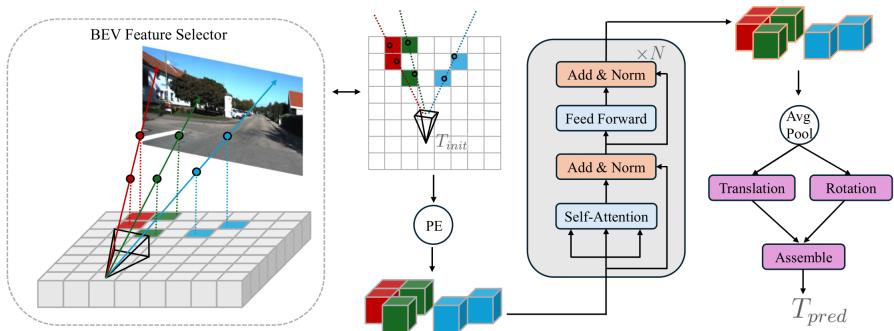
As illustrated in Figure 2 (left side), the model doesn’t process every grid cell equally. It uses a Geometry-Guided Feature Selector.
The system takes the 3D coordinates generated from the camera frustum (which we calculated during the “Lift” phase) and projects them onto the BEV plane. These projected points represent exactly where the camera “thinks” the world is, based on the current calibration guess.
The set of selected BEV feature positions, \(P_B\), is defined mathematically as:

By selecting only the BEV features at these specific coordinates (\(x_B, y_B\)), the model inherently focuses on the overlapping regions between the camera and LiDAR. This acts as an implicit “geometric matcher,” filtering out redundant features and reducing memory consumption.
The Refinement Module
Once the relevant features are selected, they are passed through a refinement module (Figure 2, right side). This module uses a Self-Attention mechanism (similar to Transformers) to understand the global context of the misalignment.
The process is described by the following equation:

Here, the selected features (\(F_\delta\)) act as the Query, Key, and Value for the attention block. To ensure the model understands where these features are, Positional Embeddings (PE) are added.
Finally, the output is split into two heads:
- Translation Head: Predicts the \(x, y, z\) offset.
- Rotation Head: Predicts the quaternion rotation correction.
3. Loss Functions: How It Learns
To train the network, the authors use a combination of three loss functions, denoted in Figure 1 as \(\mathcal{L}_R\), \(\mathcal{L}_T\), and \(\mathcal{L}_{PC}\).
- Rotation Loss (\(\mathcal{L}_R\)): Uses geodesic distance to measure the difference between the predicted rotation quaternion and the ground truth. It essentially minimizes the angle difference on a 3D sphere.
- Translation Loss (\(\mathcal{L}_T\)): A standard Smooth-L1 loss to minimize the distance error in meters.
- Reprojection Loss (\(\mathcal{L}_{PC}\)): This is a direct geometric check. The model transforms the input point cloud using the predicted calibration and compares it to the point cloud transformed by the ground truth. This forces the network to care about the actual alignment of the physical scene, not just the abstract parameters.
Experiments and Results
The researchers evaluated BEVCALIB on two major autonomous driving datasets—KITTI and NuScenes—and introduced their own dataset, CALIBDB, which contains heterogeneous extrinsic setups to test generalization.
To simulate real-world errors, they added random noise to the sensor positions (up to ±1.5 meters and ±20 degrees) and tasked the model with correcting it.
Quantitative Analysis
The results were compared against several baselines, including traditional methods and other deep learning approaches like LCCNet and RegNet.
Performance on KITTI
On the KITTI dataset, BEVCALIB achieved remarkable precision.
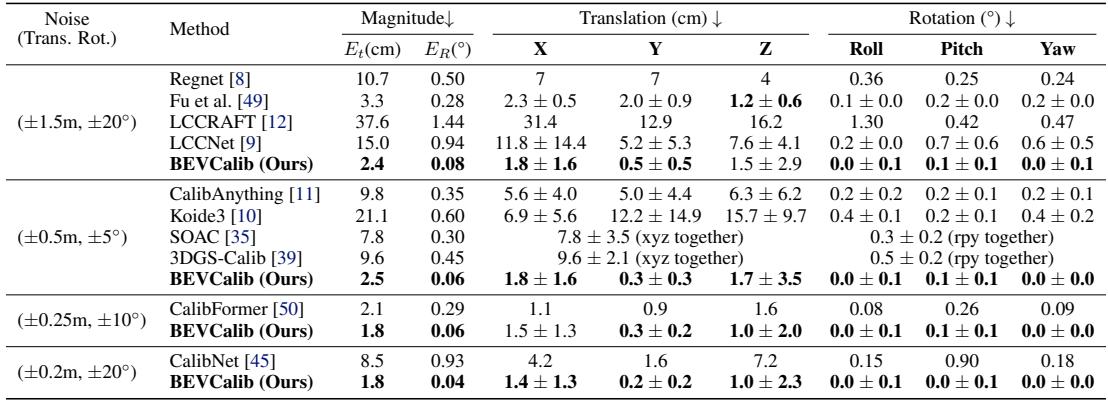
Looking at Table 2, we can see that under the high noise setting (±1.5m, ±20°):
- Translation Error: Reduced to 2.4 cm. Compare this to RegNet (10.7 cm) or LCCNet (15.0 cm).
- Rotation Error: Reduced to 0.08 degrees. This is near-perfect alignment.
Performance on NuScenes
NuScenes is generally considered a harder dataset due to more diverse scenes and sensor setups.

Table 3 confirms the trend. Even with smaller noise initialization (±0.5m, ±5°), BEVCALIB outperforms the closest competitors (Koide3 and CalibAnything) significantly, achieving a translation error of just 4.3 cm compared to 19.7 cm for CalibAnything.
Open-Source Baselines Comparison
The authors went a step further and reproduced several open-source methods to ensure a fair, apples-to-apples comparison on identical hardware and noise settings.
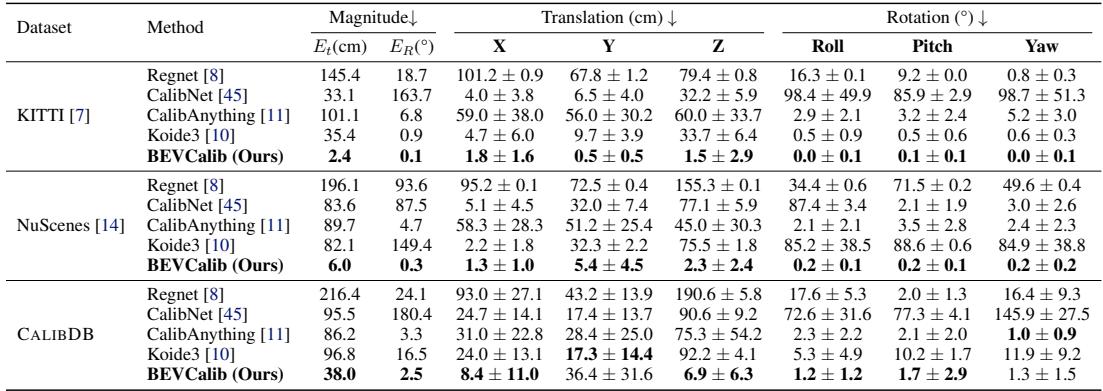
Table 4 highlights the gap in the current open-source landscape. Methods like CalibNet and RegNet struggled massively with high noise, sometimes showing errors exceeding 1 meter. BEVCALIB maintained centimeter-level accuracy across KITTI, NuScenes, and the new CALIBDB.
Error Distribution
It is also helpful to look at the consistency of the errors. A good calibration tool shouldn’t just be accurate on average; it needs to be reliable every time.
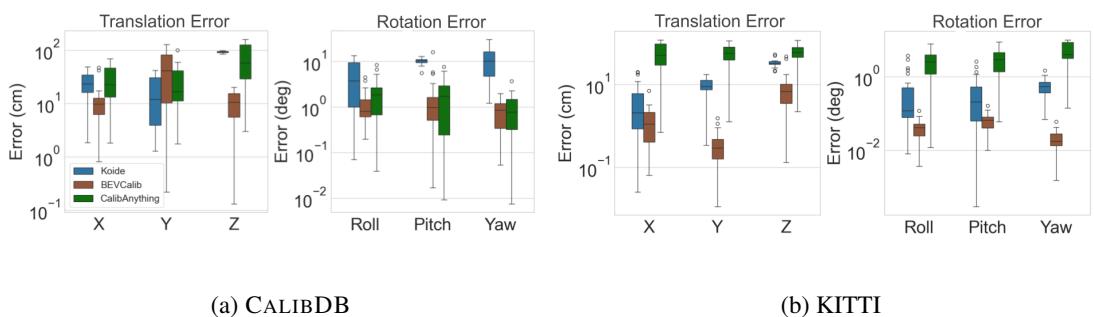
Figure 3 shows box plots of the error distribution. Note the logarithmic scale on the Y-axis. The “box” for BEVCALIB (in brown/orange) is consistently much lower and tighter than the competitors, indicating high stability and reliability.
Qualitative Results: Seeing is Believing
Numbers are great, but in calibration, visual overlays tell the true story. If you project the LiDAR points onto the camera image using the predicted matrix, they should line up perfectly with the objects in the photo.
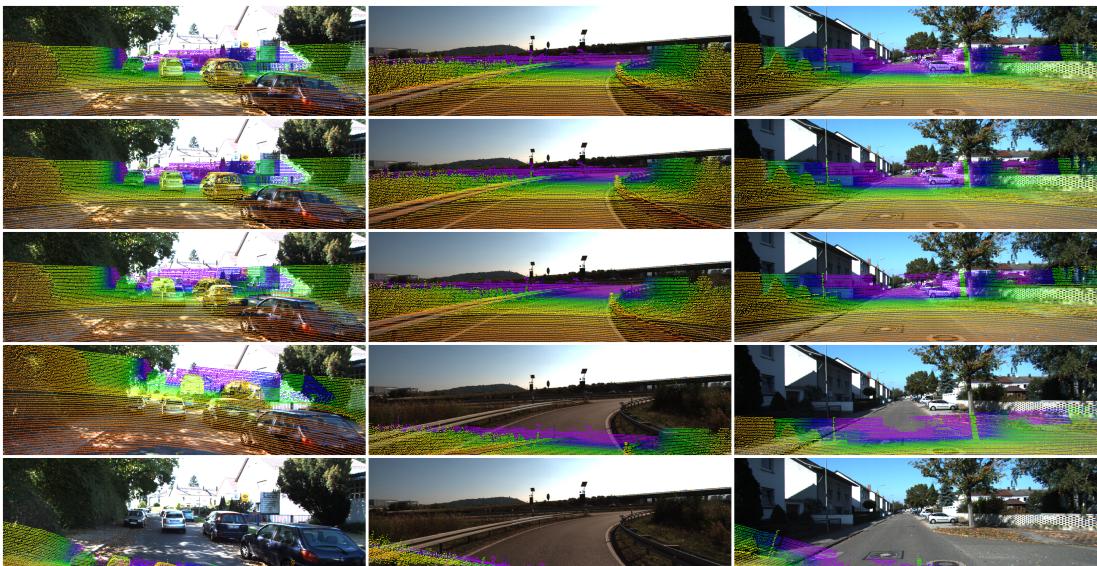
In Figure 4, you can see the difference:
- Misalignment: In the RegNet and CalibAnything rows (bottom), notice how the ground plane (colored lines) seems to float or tilt unnaturally. The LiDAR lines do not match the road surface.
- Alignment: In the BEVCALIB row (second from top), the colored LiDAR points hug the road and the cars tightly, looking almost identical to the Ground Truth (top row).
Ablation Study: Does the Feature Selector Matter?
You might wonder if the complicated “Feature Selector” in the GGBD is actually necessary. Could we just use all the features?

Table 5 provides the answer. When the researchers removed the BEV selector and used all features ("* – BEV selector"), the translation error jumped from 8.4 cm to 23.1 cm. Using all features introduces too much background noise, confusing the model about which features actually correspond between the camera and LiDAR.
Conclusion and Implications
BEVCALIB represents a significant step forward in multi-modal sensor calibration. By moving the calibration task into the Bird’s-Eye View (BEV) space, the authors leveraged the natural geometric strengths of BEV representations to solve the misalignment problem.
Key Takeaways:
- Unified Representation: Transforming camera and LiDAR data into a shared BEV space makes geometric alignment much more intuitive for neural networks.
- Geometry-Guided Selection: The novel GGBD module filters out noise by focusing only on spatially relevant features, guided by the camera’s projection.
- State-of-the-Art Performance: The method reduces calibration errors to just a few centimeters and fractions of a degree, outperforming existing baselines by orders of magnitude in some cases.
For students and researchers in autonomous driving, this paper underscores the versatility of BEV representations. Originally popularized for perception tasks like detecting cars or mapping lanes, BEV is now proving to be a powerful tool for the fundamental infrastructure of robotics: keeping the sensors aligned and the vehicle safe.
The robustness of BEVCALIB suggests that future autonomous systems could perform “self-healing” calibration on the fly, correcting for bumps and vibrations without ever needing to visit a garage or stare at a checkerboard.