](https://deep-paper.org/en/paper/2506.03110/images/cover.png)
Introduction
In the world of Computer Vision, the Vision Transformer (ViT) has become the reigning champion. By pre-training on massive datasets like ImageNet, ViTs learn to recognize everything from golden retrievers to sports cars with incredible accuracy. But there is a catch: these models are data-hungry. When you try to apply a pre-trained ViT to a specialized downstream task—like detecting rare diseases in chest X-rays or classifying crop pests—where you might only have a handful of training examples, the model often struggles.
This scenario is known as Cross-Domain Few-Shot Learning (CDFSL). The challenge is double-edged: not only is the data scarce (Few-Shot), but the new domain looks nothing like the original training data (Cross-Domain).
How do we bridge the gap between a model trained on dog photos and a task involving satellite imagery? A research paper titled “Revisiting Continuity of Image Tokens for Cross-Domain Few-shot Learning” proposes a counter-intuitive solution: break the images.
The researchers discovered that deliberately disrupting the “continuity” of images—shuffling patches or scrambling their textures—during the training process actually helps the model generalize better to distant domains. In this blog post, we will unpack this fascinating phenomenon, explain why “breaking” an image helps, and detail the ReCIT method proposed by the authors.
The Mystery of Continuity
To understand the paper’s contribution, we first need to understand how Vision Transformers see the world. Unlike Convolutional Neural Networks (CNNs) that slide a window across an image, ViTs chop an image into fixed-size squares called “patches” (or tokens). These tokens are fed into the model as a sequence.
Usually, we assume that the order and smoothness (continuity) of these pixels matter immensely. After all, a dog is defined by the smooth transition from nose to snout to ears.
However, the researchers stumbled upon a strange phenomenon. They experimented with disrupting this continuity by shuffling the patches or messing with their frequency components.
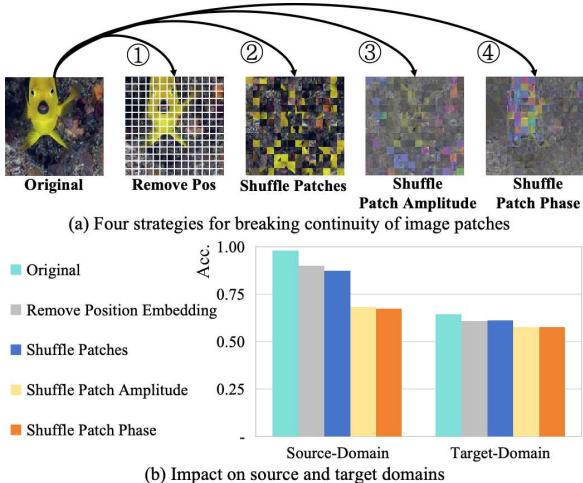
As shown in Figure 1 (a) above, they tested four strategies:
- Remove Pos: Removing the position embeddings that tell the model which patch goes where.
- Shuffle Patches: Randomly scrambling the grid of image patches.
- Shuffle Patch Amplitude: Swapping the “style” (amplitude) information in the frequency domain.
- Shuffle Patch Phase: Swapping the “structure” (phase) information.
The Result: Look at Figure 1 (b). The gray bars represent the Source Domain (ImageNet-style data). When continuity is broken, performance drops significantly. This makes sense; if you scramble a dog, it’s harder to recognize.
But look at the Target Domain (orange bars). The performance barely drops. In some cases, disrupting continuity has almost no negative effect on the model’s ability to handle the downstream task.
This led to a pivotal question: If continuity matters so much for the source domain, why doesn’t it seem to matter for the target domain?
Interpreting the Phenomenon: Large vs. Small Patterns
To solve this mystery, we need to look at what kind of features the model is actually learning.
The authors hypothesize that continuity helps the model learn large spatial patterns. Think of the overall shape of a fish or the silhouette of a car. These patterns require smooth transitions across many patches. When you shuffle the patches, you destroy these large patterns.
However, small patterns—features contained entirely within a single patch, like the texture of scales or the curve of an eye—remain intact even if the patches are shuffled.
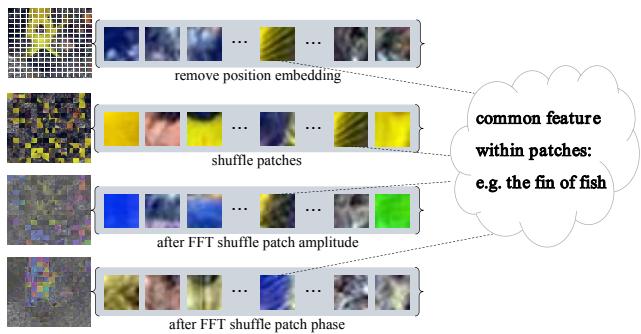
As illustrated in Figure 3, even when the fish image is scrambled, you can still recognize individual parts like fins and eyes within the patches.
The Domain Gap Connection
Here is the critical insight: Large spatial patterns (like the shape of a Golden Retriever) are rarely transferable to distant domains (like X-rays or Satellite maps). A lung opacity looks nothing like a dog’s ear.
However, smaller patterns (edges, textures, local gradients) are much more universal. The texture of fur might share mathematical similarities with the texture of a forest in a satellite image.
When the researchers disrupted continuity, they forced the model to stop relying on large, non-transferable patterns and focus on the smaller, transferable patterns inside the patches. This explains why the Source Domain performance dropped (it lost the large patterns it relies on) but the Target Domain performance remained stable (it relies on small patterns anyway).
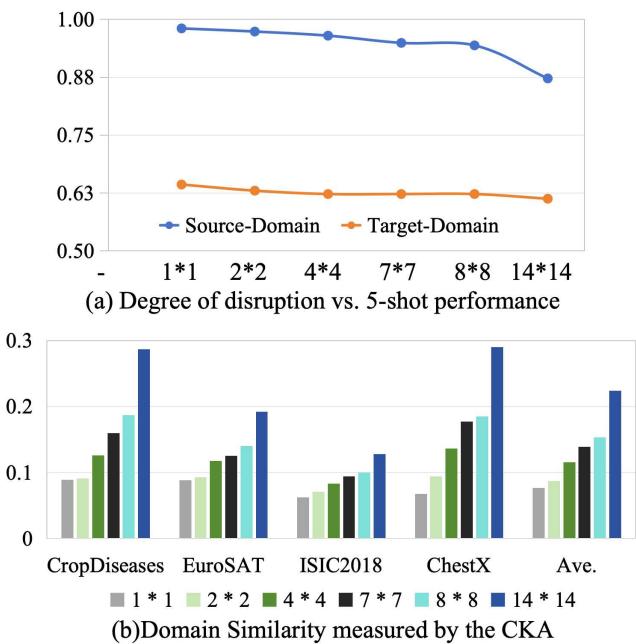
Figure 4 confirms this. The researchers divided images into “pseudo-patches” of decreasing sizes.
- Graph (a): As patches get smaller (breaking more continuity), performance drops.
- Graph (b): However, Domain Similarity (measured by CKA, a metric for feature similarity) actually increases.
By breaking the image, the model’s representation of the Source domain became more similar to the Target domain because both were now being represented by local, textural features rather than global shapes.
The Method: ReCIT
Based on these findings, the authors propose ReCIT (Revisiting Continuity of Image Tokens). The goal is to design a training pipeline that deliberately disrupts continuity to force the model to learn these robust, transferable small patterns.
The method consists of two main steps: Warm-Up Spatial-Domain Disruption and Balanced Frequency-Domain Disruption.
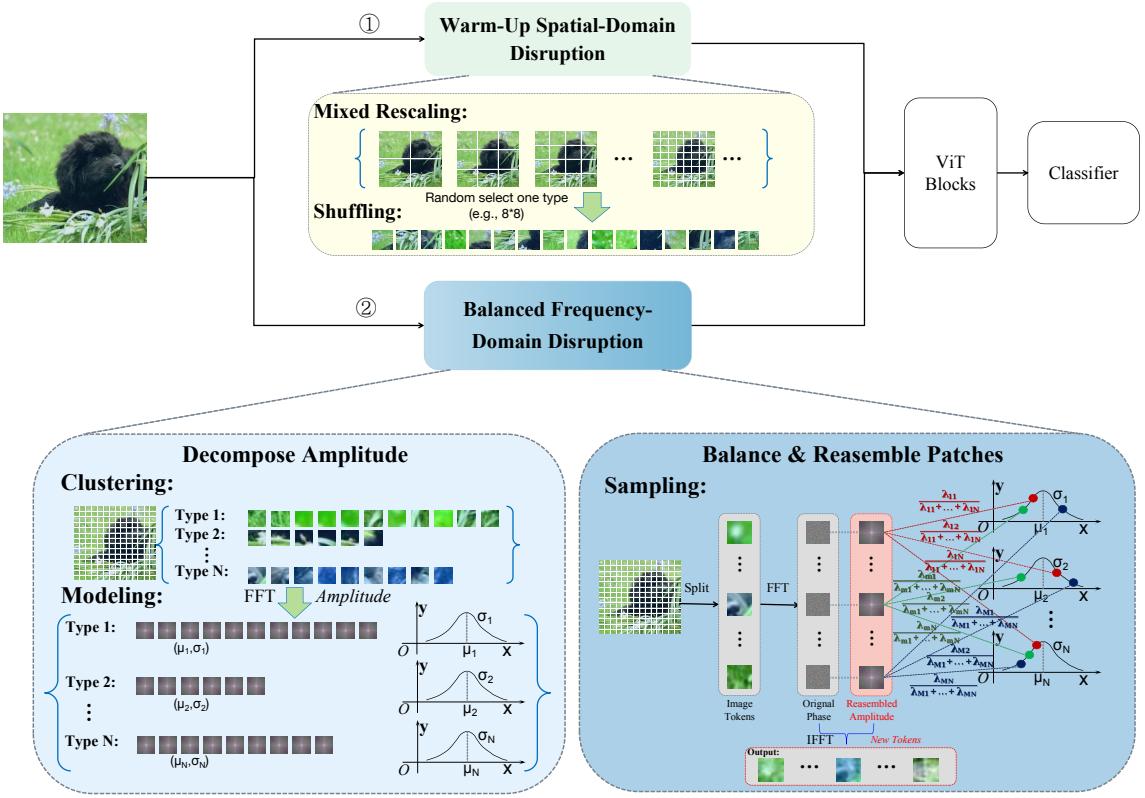
Step 1: Warm-Up Spatial-Domain Disruption
Since pre-trained ViTs are used to seeing perfect images, showing them completely scrambled noise immediately might make training difficult. The authors introduce a “warm-up” phase.
In this step, the image is divided into a random number of patches, and these patches are shuffled. This is visually represented in the top branch of Figure 5.
Mathematically, the input sequence \(z_0\) is altered. Instead of a sequential flow of patches, we feed a shuffled sequence:
\[ z _ { 0 } = \Big [ x _ { \mathrm { c l a s s } } ; x _ { p } ^ { 1 ^ { \prime } } E ; x _ { p } ^ { 2 ^ { \prime } } E ; \cdot \cdot \cdot ; x _ { p } ^ { L ^ { \prime } } E \Big ] + E _ { \mathrm { p o s } } , \](Note: The prime notation \(x'\) indicates the shuffled order.)
This forces the model to begin looking at the content within the patches rather than just their neighbors.
Step 2: Balanced Frequency-Domain Disruption
The second step is more sophisticated. The researchers found that simply shuffling patches wasn’t enough. They wanted to disrupt the “style” and “texture” continuity even further. To do this, they turned to the Frequency Domain using Fourier Transforms (FFT).
In image processing, the Amplitude of the Fourier spectrum generally contains style/texture information, while the Phase contains spatial structure (shape). By shuffling Amplitudes, you can mix up the textures while keeping the geometry somewhat intact.
However, a simple shuffle isn’t always effective. If you have an image of a jellyfish in the ocean, most of the patches are just dark water. Swapping one “dark water” amplitude for another “dark water” amplitude doesn’t disrupt anything.
To solve this, ReCIT uses Balanced Clustering.
1. Clustering Patches
First, the method groups patches that look similar. It calculates the cosine similarity between patches:
\[ c o s ( x _ { p } ^ { i } , x _ { p } ^ { j } ) = \frac { x _ { p } ^ { i } \cdot x _ { p } ^ { j } } { | | x _ { p } ^ { i } | | \cdot | | x _ { p } ^ { j } | | } , \]Patches that are similar (e.g., all the water patches) are grouped into a cluster \(Cluster_{x_p^i}\):
\[ C l u s t e r _ { x _ { p } ^ { i } } = \{ x _ { p } ^ { j } \mid c o s ( x _ { p } ^ { i } , x _ { p } ^ { j } ) \geq s i m , x _ { p } ^ { j } \in x _ { p } \} , \]2. Modeling Amplitude Distribution
Once clustered, the algorithm looks at the Amplitudes (\(A\)) of these patches. It models the distribution of amplitudes in each cluster as a Gaussian distribution (defined by a mean \(\mu\) and variance \(\sigma\)):
\[ \begin{array} { l l } { \displaystyle \mu ( C l u s t e r _ { A _ { p } ^ { i } } ) = \frac { 1 } { M _ { i } } \sum _ { j = 1 } ^ { M _ { i } } A _ { p } ^ { j } , \quad } & { { A } _ { p } ^ { j } \in C l u s t e r _ { A _ { p } ^ { i } } , } \\ { \displaystyle \sigma ( C l u s t e r _ { A _ { p } ^ { i } } ) = \frac { 1 } { M _ { i } } \sum _ { j = 1 } ^ { M _ { i } } \left[ A _ { p } ^ { j } - \mu ( C l u s t e r _ { A _ { p } ^ { i } } ) \right] ^ { 2 } , } \end{array} \]3. Reassembly with Balance
Finally, the model generates new amplitudes. Instead of just picking existing ones, it samples from these distributions. Crucially, it balances the sampling so that rare textures (like the jellyfish tentacles) have a higher probability of being selected relative to their size, ensuring diverse disruption.
The new amplitude \(\mathcal{A}_p^j\) is constructed by a weighted sum of samples from different clusters:
\[ \begin{array} { l } { { \displaystyle { \cal A } _ { p } ^ { j } = \sum _ { i = 1 } ^ { N } p _ { A _ { p } ^ { i } } * \epsilon _ { C l u s t e r _ { A _ { p } ^ { i } } } , } } \\ { { \displaystyle p _ { A _ { p } ^ { i } } = \frac { \epsilon _ { p r o _ { A _ { p } ^ { i } } } } { \sum _ { i = 1 } ^ { N } \epsilon _ { p r o _ { A _ { p } ^ { i } } } } , \epsilon _ { p r o _ { A _ { p } ^ { i } } } \sim N ( 0 , \alpha ) } } \end{array} \]This creates a new set of tokens that are statistically diverse and devoid of the original smooth continuity, forcing the ViT to learn incredibly robust local features.
Experiments and Results
Does this theory hold up in practice? The researchers tested ReCIT on four challenging target domains using miniImageNet as the source.
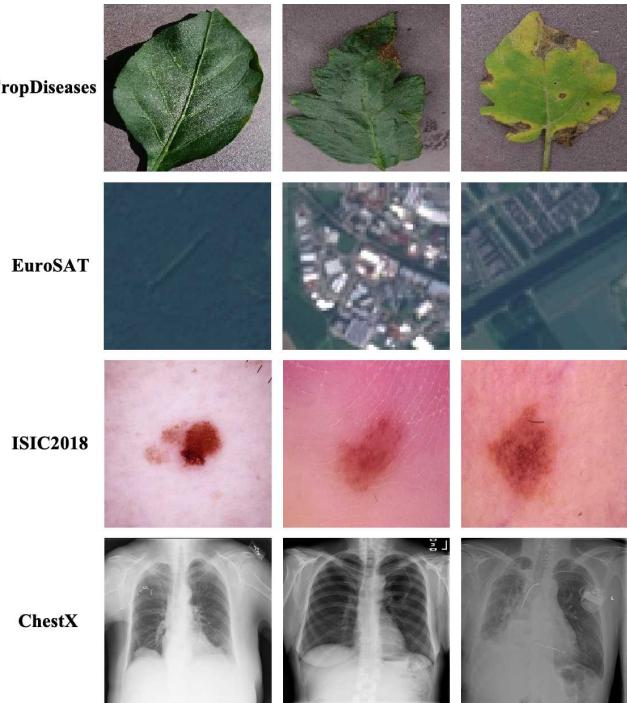
As seen in Figure 10, the target domains are vastly different from standard photos:
- CropDiseases: Close-ups of leaves.
- EuroSAT: Aerial terrain views.
- ISIC2018: Skin lesions.
- ChestX: X-ray imaging.
Quantitative Performance
The results were compared against state-of-the-art (SOTA) methods in Cross-Domain Few-Shot Learning.
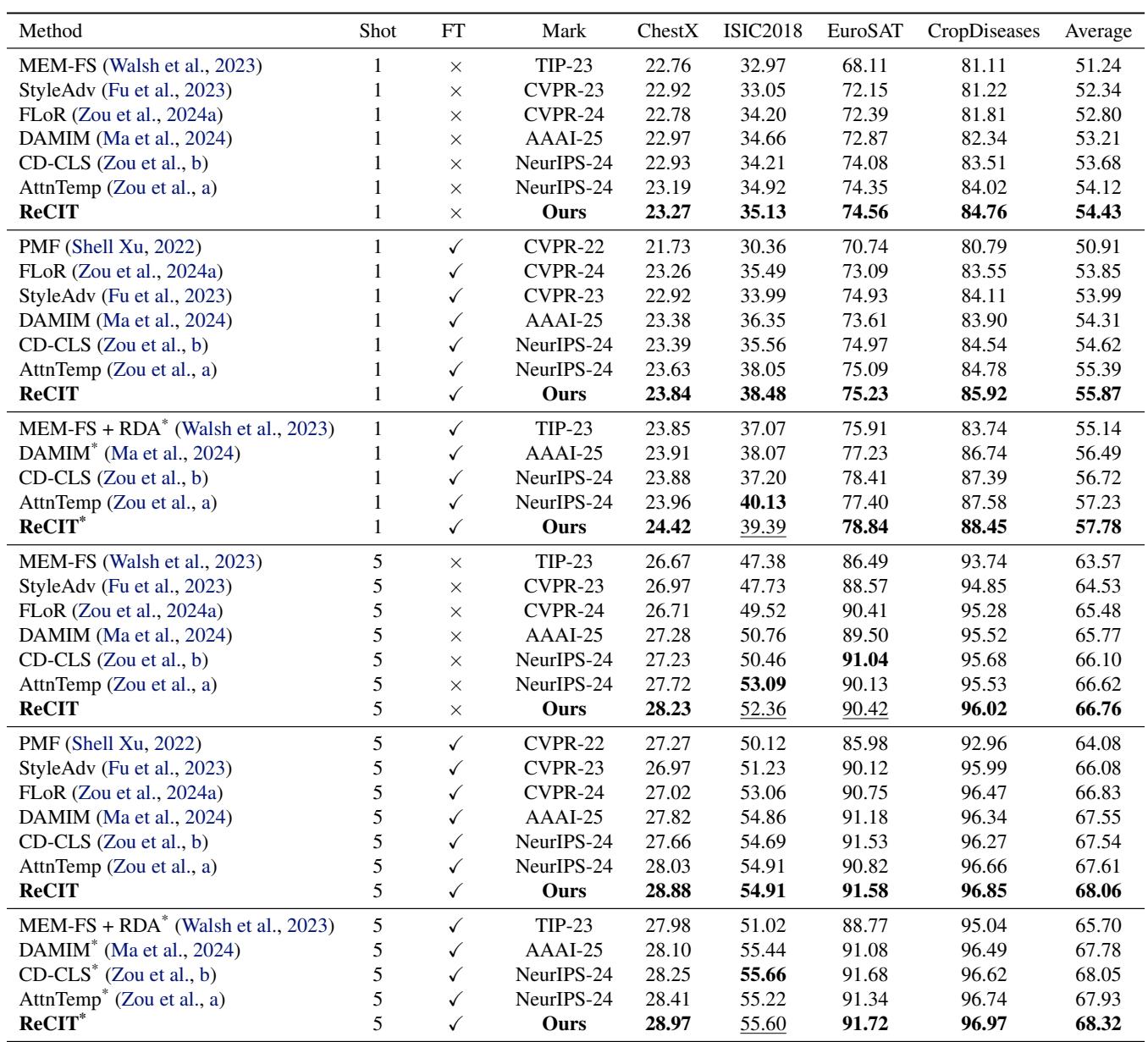
Looking at Table 1, ReCIT (Ours) achieves the highest average accuracy across the board.
- In the 5-shot setting (where the model sees 5 examples per class), ReCIT reaches 68.06% accuracy, outperforming previous methods like StyleAdv and masked auto-encoder approaches.
- The gains are particularly notable in “difficult” domains where texture matters more than shape.
Improving Domain Similarity
The authors also verified their core hypothesis: does this method actually make the source and target domains look more similar to the model?
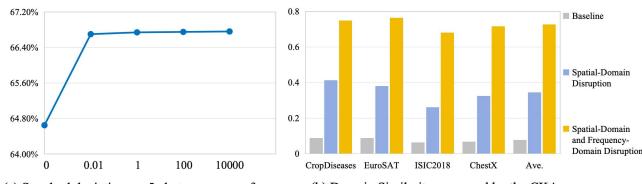
Figure 7 (b) shows the CKA Domain Similarity. The gray bars are the baseline. The orange bars represent ReCIT. Across all datasets, ReCIT increases the similarity between the source and target representations. This confirms that by breaking continuity, the model learns features that are more universal.
Visualizing the Impact
Numbers are great, but seeing is believing. The authors used attention maps to visualize what the model is looking at.
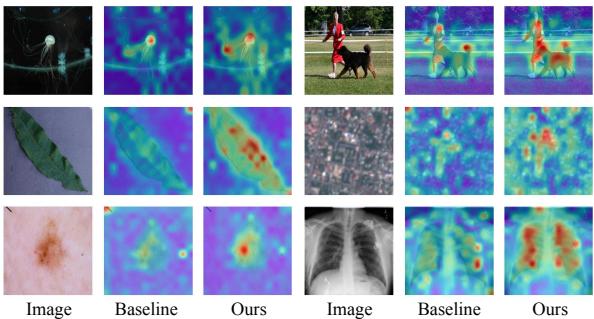
In Figure 8, compare the Baseline (middle column) with Ours (right column).
- Baseline: The attention is often focused on a single, large area. It’s looking for a “shape.”
- ReCIT: The attention is dispersed. The model is looking at multiple small details scattered across the image—edges of the skin lesion, specific textures on the leaf, or various buildings in the satellite view.
This “scattered” attention proves that the model has learned to identify small, local patterns rather than relying on a single large object, making it much more robust when transferring to new domains where the “large objects” are completely different.
Conclusion
The paper “Revisiting Continuity of Image Tokens” offers a refreshing perspective on transfer learning. It challenges the assumption that preserving the integrity of training images is always best.
Key Takeaways:
- Continuity is a Crutch: For Source Domains (like ImageNet), continuity helps recognize large objects. But for Cross-Domain generalization, this reliance on large objects becomes a weakness.
- Small Patterns Transfer Best: Local textures and gradients are more universal than global shapes.
- Break it to Fix it: By intelligently disrupting image continuity using ReCIT (Spatial shuffling and Frequency balancing), we can force Vision Transformers to learn these robust, transferable features.
This research paves the way for more efficient AI in specialized fields like medicine and agriculture, proving that sometimes, you have to break things down to build them up better.