](https://deep-paper.org/en/paper/2506.04218/images/cover.png)
Introduction
Imagine you are teaching a student driver. To test their skills, you have two options. Option A is to sit in the passenger seat while they drive through rush-hour traffic. It’s realistic and gives you immediate feedback, but it’s dangerous and stressful. Option B is to show them a video of a drive and ask, “What would you do here?” It’s safe and easy to grade, but it doesn’t tell you if they can actually handle the car when things go wrong.
This dilemma mirrors the primary crisis in developing Autonomous Vehicles (AVs). We need to know if an AI driver is safe before it hits the road, but our current evaluation methods are stuck between “dangerous and expensive” (real-world testing) or “safe but unrealistic” (simulation).
In a recent paper, researchers proposed a novel third option: Pseudo-Simulation. This new paradigm attempts to combine the realism of real-world data with the robustness checks of simulation. By leveraging state-of-the-art neural rendering (specifically 3D Gaussian Splatting), they have created a way to test how AVs recover from mistakes without needing a computationally heavy interactive simulator.
In this post, we will deconstruct this research paper, explaining why current methods fail, how pseudo-simulation works, and why it might be the future of benchmarking autonomous driving systems.
Background: The Evaluation Gap
To understand why pseudo-simulation is necessary, we must first understand the limitations of the two dominant evaluation paradigms: Closed-Loop and Open-Loop.
Closed-Loop Evaluation
Closed-loop evaluation is like a video game. The AV controls the car, and the environment reacts. If the AV steers left, the car moves left in the next frame.
- Pros: It tests “compounding errors.” If the AV drifts slightly off-center, we can see if it corrects itself or crashes. It captures the consequences of decisions.
- Cons: It is incredibly hard to simulate the real world accurately. Most simulators look like cartoons compared to reality, creating a “domain gap” where the AV fails simply because the shadows look wrong. Furthermore, running high-fidelity physics and rendering for every frame is computationally expensive and slow.
Open-Loop Evaluation
Open-loop evaluation uses pre-recorded logs of human driving. We feed the AV a snapshot of the world and ask, “Where should we go?” We then compare the AV’s plan to what the human expert actually did.
- Pros: It uses real sensor data (perfect photorealism) and is very fast/scalable.
- Cons: It assumes the AV follows the perfect path. In reality, an AV’s trajectory will deviate slightly from the human’s. In open-loop testing, because we reset the car to the human’s position at every timestamp, we never test if the AV can recover from its own small deviations. This blindness to “drift” is a major safety blind spot.
The Research Goal: The authors aimed to create a system that uses real data (like open-loop) but assesses the ability to recover from errors (like closed-loop), all while remaining computationally efficient.
The Core Method: What is Pseudo-Simulation?
The core innovation of this paper is a two-stage evaluation process that introduces “synthetic” futures. Instead of a fully interactive video game, the system pre-calculates a variety of possible future situations the car might find itself in.
![Figure 1: Pseudo-simulation. (Top) From an initial real-world observation (a), we generate synthetic observations (b,c,d) via a variant of 3D Gaussian Splatting specialized for driving scenes [9]. Crucially, these synthetic observations are pre-generated prior to evaluation, unlike traditional interactive simulation where observations are generated online. (Bottom) Pseudo-simulation involves two stages.In Stage 1, we evaluate the AV’s trajectory output for (a). Stage 2 involves evaluation on trajectories output for (b,c,d). Stage 2 scores are weighted based on the proximity of the Stage 2 synthetic observation start point to the Stage 1 planned endpoint. The aggregated score assesses robustness to small variations near the intended path, prioritizing the most likely futures.](/en/paper/2506.04218/images/001.jpg#center)
As illustrated in Figure 1, the process is split into two distinct stages:
Stage 1: Initial Observations (Real Data)
The first stage looks exactly like standard open-loop evaluation. The AV is presented with a real-world image (Frame a in the diagram above) and sensors data. It plans a trajectory for the next 4 seconds.
- The system evaluates this trajectory using a metric called EPDMS (Extended Predictive Driver Model Score). This metric checks for collisions, comfort, and progress.
- Crucially, the system records where the AV ends up at the end of this planned trajectory.
Stage 2: Synthetic Observations (The “Pseudo” Part)
This is where the magic happens. In a traditional open-loop test, the evaluation stops here. In pseudo-simulation, the researchers introduce “what if” scenarios.
Prior to the evaluation, the researchers used 3D Gaussian Splatting to generate synthetic images from different viewpoints around the expert’s path (Frames b, c, and d in Figure 1). These represent “perturbed” states—positions the car might be in if it drifted slightly left, right, forward, or backward.
- The AV is fed these synthetic images (which it has never seen before).
- It generates a new trajectory for each of these potential situations.
- The system scores these new trajectories.
The Weighting Scheme: Linking the Stages
The brilliant part of this method is how it combines the scores. We don’t care about every possible synthetic future equally. We care most about the future the AV actually planned for.
The final score is a weighted combination of the Stage 1 score and the Stage 2 scores. The weights for Stage 2 depend on proximity.

Let’s break down the equation above:
- \(s_{combined}\): The final score.
- \(s_1\): The score from the real-world frame.
- \(s_2\): The aggregated score from the synthetic frames.
- \(w^i\): The weight for a specific synthetic scenario.
The term \(\exp( - \lVert x^i - \hat{x} \rVert ^2 )\) essentially says: “If the AV’s Stage 1 plan ended near synthetic point \(x^i\), give that synthetic point a high weight.”
If the AV plans to drive straight, the system heavily weights the synthetic views corresponding to driving straight. If the AV in Stage 2 fails to drive straight (e.g., it crashes in that synthetic timeline), the final score drops significantly. This effectively tests consistency and recovery—can the planner handle the state it put itself in?
Technology Enabler: 3D Gaussian Splatting
Generating these synthetic views requires a rendering engine that is both photorealistic and fast. Traditional graphics engines (like Unreal Engine) struggle to replicate real-world sensor noise and lighting perfectly.
The researchers utilized a modified version of Multi-Traversal Gaussian Splatting (MTGS). This is a neural rendering technique that represents a scene as a cloud of 3D Gaussians (blobs). It allows for:
- Photorealism: It preserves the exact look of the real world, including lighting and sensor characteristics.
- View Synthesis: It allows the camera to be moved to new positions (e.g., drifting into the next lane) to generate new images that didn’t exist in the original log.
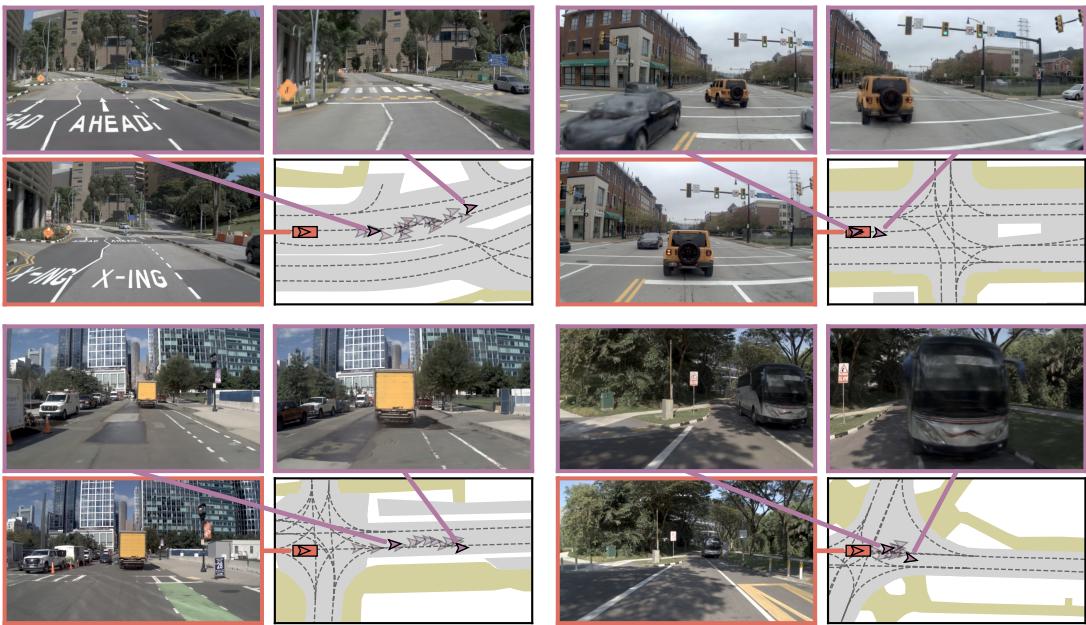
Figure 2 demonstrates the quality of these synthetic observations. The images marked with the hollow triangle (\(\triangleright\)) are synthetic. Notice how they maintain the visual complexity of the urban environment, including lighting conditions and object placement. This high fidelity is crucial; if the synthetic images looked “fake,” the AV might fail simply because it doesn’t recognize the scene, not because it’s a bad driver.
Experiments & Results
The researchers needed to prove two things:
- Correlation: Does pseudo-simulation actually predict how an AV performs in a full, expensive closed-loop simulation?
- Fidelity: Are the synthetic images good enough to fool the AVs?
Correlation with Closed-Loop Simulation
The researchers tested 83 different planners (both rule-based and deep learning-based) on the nuPlan benchmark. They compared the scores from pseudo-simulation against the “ground truth” of running a full closed-loop simulation.
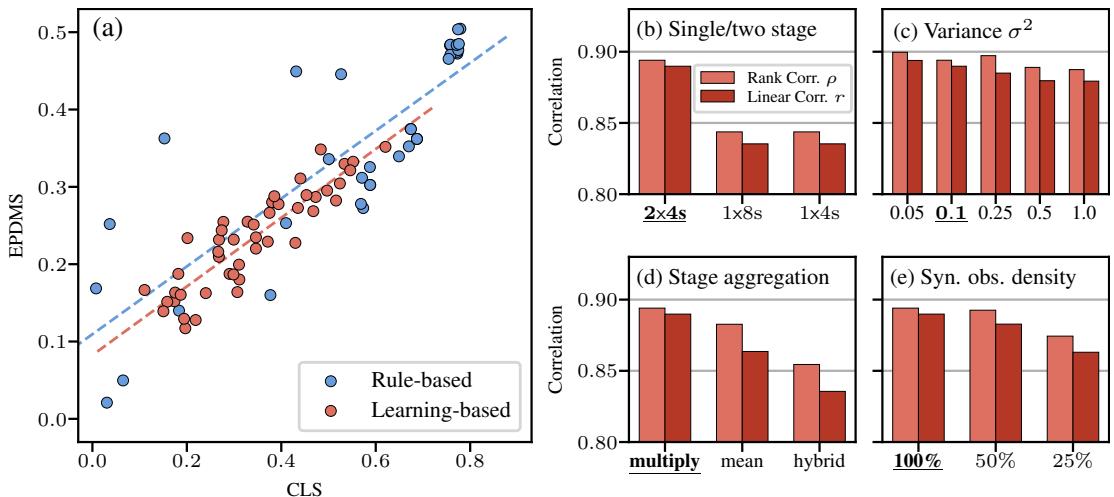
Figure 3(a) shows the results. The x-axis represents the closed-loop score (the rigorous, expensive test), and the y-axis represents the pseudo-simulation score.
- There is a strong linear relationship (\(R^2 = 0.8\)).
- If a planner performs well in pseudo-simulation, it is highly likely to perform well in closed-loop simulation.
- Crucially, Figure 3(b) shows that the “Two-Stage” (pseudo-simulation) approach correlates much better (\(r=0.89\)) than standard single-stage open-loop evaluation (\(r=0.83\)).
This confirms that adding those synthetic “what-if” frames significantly improves our ability to predict real-world robustness.
Efficiency Comparison
The paper highlights a massive efficiency gain. A standard closed-loop simulation in nuPlan requires 80 sequential planner inferences (running at 10Hz for 8 seconds). Pseudo-simulation requires only about 13 inferences (1 real + ~12 synthetic). Furthermore, because the synthetic frames are pre-generated, these inferences can be run in parallel. This makes pseudo-simulation roughly 6x more efficient in terms of interactions, while providing parallelization capabilities that sequential simulation cannot match.
The NAVSIM v2 Leaderboard
To push the community forward, the authors established a new benchmark called navhard, focusing on challenging scenarios like unprotected turns and dense traffic.
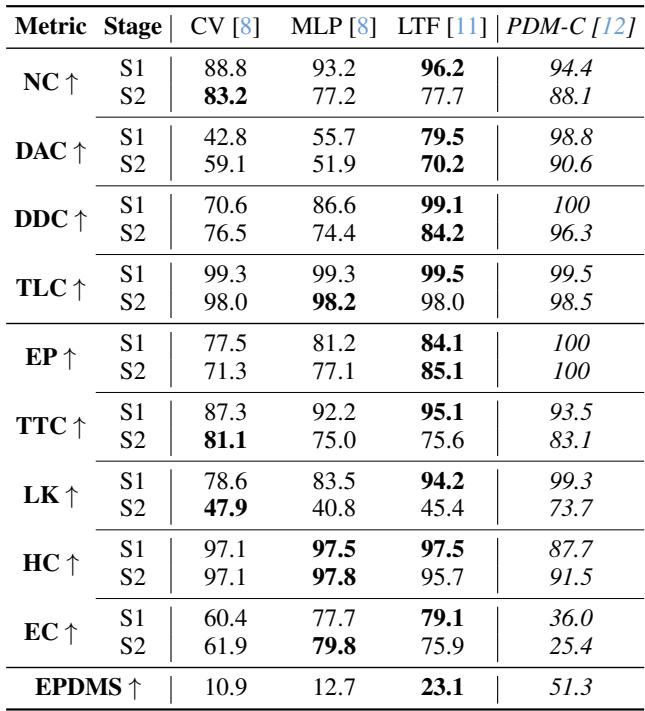
Table 2 reveals interesting insights about current state-of-the-art planners:
- PDM-Closed (a rule-based planner) scores the highest overall (51.3).
- However, looking at the “Comfort” scores (HC and EC), it performs poorly compared to learned models like LTF (Latent TransFuser).
- This suggests that while rule-based systems are safe (high collision avoidance), they drive “jerkily” or uncomfortably. Pseudo-simulation successfully captures these nuances, which standard open-loop metrics often miss.
Visual Fidelity Analysis
Finally, the researchers had to ensure their synthetic images weren’t breaking the AVs’ perception systems. They took an end-to-end planner (LTF) trained only on real images and tested it on the synthetic frames.
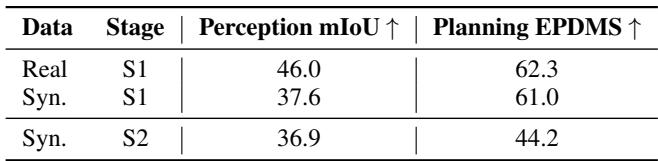
Table 3 shows the results.
- Perception (mIoU): There is a drop in segmentation quality (from 46.0 on real data to 37.6 on synthetic). This is expected; no simulation is perfect.
- Planning (EPDMS): Despite the drop in perception quality, the planning score remains stable (dropping slightly from 62.3 to 61.0 in Stage 1).
This indicates that while the neural rendering isn’t pixel-perfect, it preserves the semantic information necessary for driving. The car still recognizes “this is a road” and “that is a car,” even if the fine textures are slightly smoothed by the Gaussian Splatting process.
Conclusion & Implications
The “Pseudo-Simulation” paradigm represents a significant step forward in autonomous vehicle evaluation. By intelligently combining real-world logs with neural rendering, the researchers have created a testing ground that is:
- Scalable: It runs on datasets, not heavy physics engines.
- Parallelizable: It avoids the sequential bottleneck of closed-loop sim.
- Robust: It tests error recovery and causal confusion, unlike standard open-loop tests.
The introduction of the NAVSIM v2 benchmark enables the research community to move away from simple “replay” metrics and towards evaluations that actually penalize brittleness.
For students and researchers in the field, this paper highlights a critical lesson: How we measure progress is just as important as the progress itself. A planner that gets a perfect score on a static dataset might fail catastrophically in the real world if it cannot recover from a 10cm drift. Pseudo-simulation offers a computational efficient mirror to reality, forcing our models to be not just accurate, but resilient.