](https://deep-paper.org/en/paper/2506.04226/images/cover.png)
Imagine you have just deployed a massive Large Language Model (LLM). It works beautifully, until a user asks, “Who is the Prime Minister of the UK?” and the model confidently names a politician who left office three years ago.
Retraining the model is out of the question—it costs too much money and takes too much time. This is where Knowledge Editing comes in. Techniques like MEMIT (Mass-Editing Memory in a Transformer) allow us to surgically alter the weights of a model to update specific facts without ruining the model’s general capabilities.
But there is a catch that most papers gloss over. Before you can edit a single fact in a model like Llama-2 or GPT-J, you must perform a massive precomputation step. This step involves running millions of tokens through the model to calculate covariance statistics, a process that can take up to 40 hours on a high-end GPU. It’s the equivalent of needing to warm up your car for a full day just to drive to the grocery store.
In this post, we will deep dive into the research paper “Efficient Knowledge Editing via Minimal Precomputation.” We will explore how the researchers discovered that this massive precomputation overhead is largely unnecessary. By understanding the linear algebra behind model editing, we can reduce the data required for this step by over 99%, turning a 40-hour wait time into a matter of minutes.
The Problem: The Hidden Cost of Model Editing
To understand why this paper is significant, we first need to look at how current state-of-the-art editing methods work.
Methods like ROME and MEMIT fall under the “locate-then-edit” paradigm. The idea is simple: specific layers in a Transformer (usually the Multi-Layer Perceptrons, or MLPs) act as key-value memories.
- The Key (\(k\)): Represents the subject or the context (e.g., “The capital of France”).
- The Value (\(v\)): Represents the retrieved knowledge (e.g., “Paris”).
To edit a fact, we want to change the model weights so that a specific key vector produces a new value vector. However, we have a constraint: while changing the weights to learn the new fact, we must ensure that all other existing knowledge remains unchanged.
The Math Behind the Edit
The mathematical objective for MEMIT tries to balance two goals: Memorization (learning the new fact) and Preservation (keeping old facts stable).
The researchers formulate this as a least-squares problem. We want to find a weight change (\(\Delta\)) that minimizes the error on both the new fact and the old knowledge. The solution to this optimization problem gives us the update rule for the weights:

In this equation:
- \(\hat{W}\) is the new weight matrix.
- \(K_E\) and \(V_E\) represent the keys and values for the edit (the new fact).
- \(C_0\) is the covariance matrix of the keys we want to preserve.
This \(C_0\) matrix is the culprit. It represents the distribution of the keys for “general knowledge” that the model has already learned. To ensure the model doesn’t “forget” how to speak English while learning a new fact, the algorithm uses \(C_0\) to constrain the update.
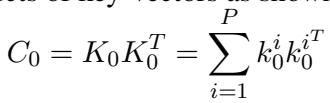
The covariance matrix \(C_0\) is defined as the sum of the outer products of preserved key vectors (\(k_0\)):
The Bottleneck
Here is where the inefficiency lies. In the original MEMIT paper, the authors calculated \(C_0\) by running a massive chunk of Wikipedia (about 44 million tokens) through the model. They collected the key vectors \(k_0\) for every token to build a robust estimate of the covariance.
For a model like Llama-2-7B, calculating this matrix requires:
- Loading 44 million tokens.
- Running a forward pass through the model.
- Caching the hidden states at the specific layer being edited.
As noted in the paper, this takes 36 hours for GPT-J and 40 hours for Llama-2 on a single NVIDIA A6000 GPU. If you want to edit a different layer, or a different model, you have to start over. This bottleneck makes “fast” model editing painfully slow in practice.
The Theoretical Insight: Linear Algebra to the Rescue
The authors of this paper asked a fundamental question: Do we actually need 44 million vectors to solve this equation?
Let’s look at the term in the update equation that needs to be inverted (let’s call it \(C_{\text{eff}}\)). This matrix determines the stability of the solution:
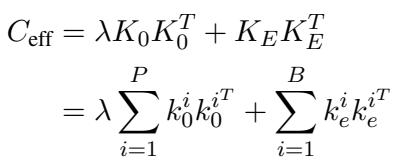
This matrix is a square matrix with dimensions equal to the hidden size of the layer (let’s call the dimension \(d\)). For example:
- In GPT-2 XL, the hidden dimension \(d\) is 6,400.
- In GPT-J, \(d\) is roughly 16,000.
From a linear algebra perspective, for a matrix of size \(d \times d\) to be invertible (a requirement for the closed-form solution to exist), it must have full rank. This means you generally need at least \(d\) independent vectors to construct it.
The Minimum Requirement
If the hidden dimension is 6,400, you theoretically only need 6,400 independent vectors to ensure the matrix is invertible.
The original MEMIT method uses 44,000,000 vectors. This is orders of magnitude higher than the theoretical requirement. The authors hypothesize that as long as we have enough vectors to span the vector space of the hidden layer, the editing algorithm should work perfectly fine.
This leads to a redefined calculation for the covariance matrix, where we replace the massive \(P\) (44 million) with a much smaller \(P'\):
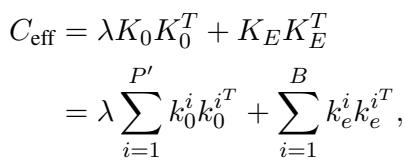
Here, \(P'\) is calculated as:
\[P' = d_m \cdot d_k\]- \(d_k\): The dimensionality of the key vector (the theoretical minimum).
- \(d_m\): A Dynamic Multiplier. This is a safety factor. Since random vectors from Wikipedia might not be perfectly linearly independent, we multiply the minimum requirement by a small factor (like 2, 4, or 10) to guarantee invertibility and stability.
By using a dynamic multiplier of just 2 or 3, we reduce the precomputation requirement from millions of tokens to just a few thousand.
The “Fast” Family of Methods
Based on this insight, the authors introduce efficient versions of the standard editing algorithms:
- FastMEMIT
- FastROME
- FastEMMET (EMMET is a generalized batched version of ROME).
These methods are algorithmically identical to their predecessors, with one change: the \(C_0\) matrix is computed using a tiny fraction of the data.
How much data are we saving?
For GPT-J (6B):
- Original MEMIT: ~44,000,000 tokens.
- FastMEMIT (\(d_m=2\)): ~32,000 tokens.
That is a reduction of 99.92%. Consequently, the time required to prepare the model for editing drops from days to seconds.
Experiments and Results
Theory is great, but does it work? If we use fewer data points to estimate the covariance of “general knowledge,” do we risk breaking the model? The researchers tested this on three models: GPT2-XL, GPT-J (6B), and Llama-2 (7B) using the CounterFact dataset.
They evaluated performance using standard metrics:
- Efficacy Score (ES): Did the model learn the new fact?
- Paraphrase Score (PS): Does the model recognize the fact even if phrased differently?
- Neighborhood Score (NS): Did the model preserve unrelated knowledge (locality)?
- Overall Score (S): A harmonic mean of the above.
Results on GPT-J
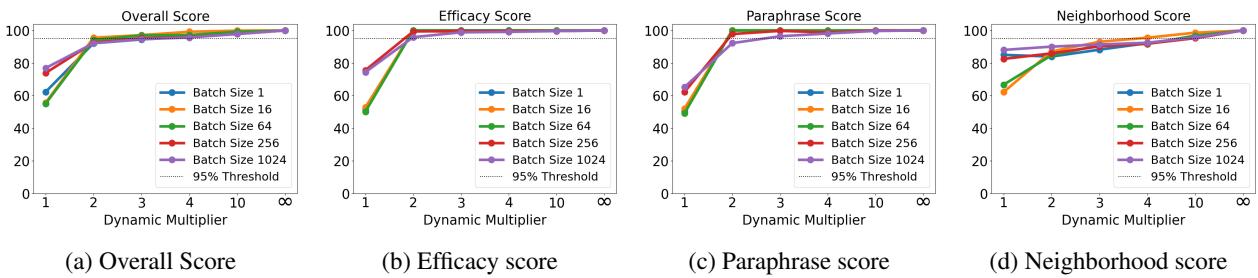
Let’s look at the results for FastEMMET on GPT-J. The graphs below plot the performance scores against the Dynamic Multiplier (the x-axis). The value “1” on the x-axis represents the theoretical minimum number of tokens. The \(\infty\) symbol represents the original, full 44M token precomputation.
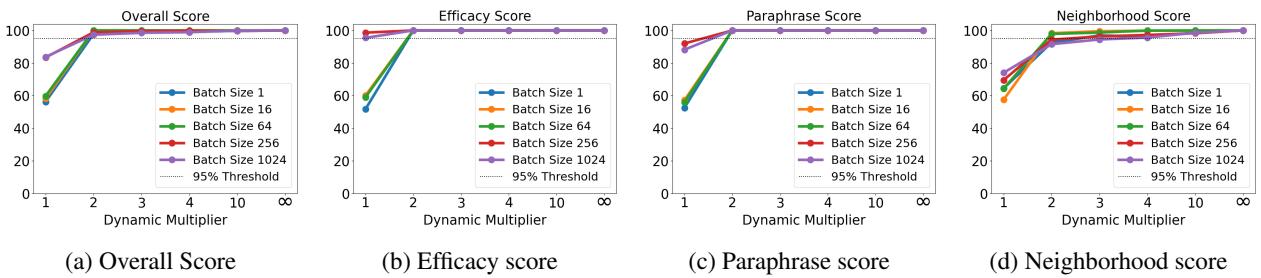
Interpretation:
- Look at the Overall Score (a) chart.
- When the multiplier is 1 (using exactly \(d\) vectors), performance is good but slightly unstable for specific batch sizes.
- However, as soon as the multiplier hits 2, the curves flatten out.
- The performance lines for FastEMMET intersect the dotted “95% Threshold” line almost immediately.
- This proves that using just twice the theoretical minimum data yields performance nearly identical to using the full 44 million tokens.
The same trend holds true for FastMEMIT:

Here, we see an even tighter convergence. By the time the dynamic multiplier reaches 10, the “Fast” method is indistinguishable from the computationally expensive original method.
Results on Llama-2
Llama-2 is a more complex model, and the results show slightly more nuance.
In FastEMMET for Llama-2 (Figure 3), we see that the method is highly effective. Even with a multiplier of 2 or 3, the Overall Score hovers near the 95% threshold of the full-compute version.
However, FastMEMIT on Llama-2 presents an interesting edge case:
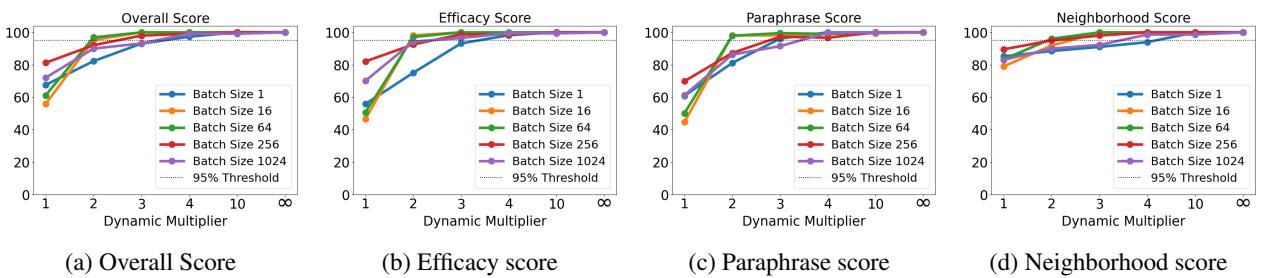
Notice the blue line (Batch Size 1) in the Efficacy score (b) and Overall Score (a) charts. It struggles at lower multipliers. The authors note that for Llama-2, using the theoretical minimum (\(d_m=1\)) resulted in non-invertible matrices for small batch sizes. This suggests that the hidden representations in Llama-2 are highly correlated—vectors derived from different Wikipedia sentences end up looking mathematically similar, failing to span the full vector space.
The Fix:
- Increase the Multiplier: Setting \(d_m = 10\) resolves most issues, bringing performance back to par. This is still only ~0.25% of the original 44M tokens.
- Regularization: The authors mention that adding a minor regularization term to the closed-form solution (discussed in the full paper) stabilizes the inversion for these small batch sizes.
Detailed Data Breakdown
For those interested in the raw numbers, the improvement is stark. Let’s look at the data for GPT2-XL.
When using a Dynamic Multiplier of just 1 (the absolute theoretical minimum), the Efficacy (ES) drops significantly for the FastMEMIT method at low batch sizes:

You can see in the table above that for Batch Size 1, FastMEMIT’s efficacy is only 50.6%. This confirms that the absolute minimum isn’t quite robust enough due to vector correlation.
However, simply increasing the multiplier to 4 fixes this completely:

With a multiplier of 4, the Efficacy jumps back up to 99.4%, and the Overall Score (S) beats the original MEMIT baseline (85.73 vs 83.56). This validates the “Fast” approach: you need some margin of safety above the minimum, but you definitely do not need millions of tokens.
Conclusion and Implications
The primary contribution of this paper is a demonstration of efficiency. For years, the community assumed that “Locate-then-Edit” methods required a heavy precomputation tax. This paper proves that this tax is artificial—a result of over-estimating the data required to calculate a covariance matrix.
Key Takeaways:
- Minutes, not Hours: You can achieve state-of-the-art model editing performance with less than 0.3% of the precomputation data originally recommended.
- The Magic Number: A “Dynamic Multiplier” of 10 is a safe bet for almost all models (GPT-J, Llama-2, GPT-2). This ensures mathematical stability without wasting compute.
- Accessibility: This reduction removes a major barrier to entry. Researchers and engineers can now spin up editing pipelines on consumer hardware without waiting two days for a pre-processing script to finish.
By understanding the linear algebra bounds of the problem, the authors have essentially optimized the “startup sequence” of model editing, making LLMs significantly more adaptable and easier to maintain. As LLMs continue to grow in size, efficiency hacks like FastMEMIT will be crucial for keeping these systems up-to-date with the ever-changing world.