](https://deep-paper.org/en/paper/2506.04362/images/cover.png)
Introduction
Imagine you are driving an off-road vehicle through a rocky field. You see a sharp, jagged rock ahead. If you hit it head-on, you’ll likely pop a tire or break an axle. However, if you approach that same rock at a slight angle, your tire might ride up the side smoothly, allowing you to pass without damage.
This scenario highlights a fundamental truth in off-road navigation: risk is state-dependent. Whether a piece of terrain is traversable often depends not just on the terrain’s geometry, but on the robot’s angle of approach.
For human drivers, this calculation is intuitive. For autonomous robots, it is a massive computational headache. Traditional methods often simplify the world into “safe” or “unsafe” patches based on elevation maps, ignoring the nuance of approach angles. Naive deep learning attempts to fix this by feeding the angle as a simple input often fail because they require massive amounts of data to learn the continuous nature of rotation, or they become too slow to use in real-time planning.
In this post, we will deep dive into a research paper titled “Learning Smooth State-Dependent Traversability from Dense Point Clouds”. The authors introduce SPARTA, a novel method that leverages geometric deep learning to solve this problem. By using Fourier basis functions, SPARTA forces the neural network to learn smooth, periodic risk functions. The result is a system that can accurately predict traversal risk from any angle, runs efficiently on hardware, and drastically outperforms baselines in complex environments.
The Background: Why Maps Aren’t Enough
To understand why SPARTA is necessary, we first need to look at how robots currently perceive the world.
The Information Loss in Elevation Maps
The standard approach for off-road navigation involves processing LiDAR data into a 2.5D elevation map. This is essentially a grid where each cell contains a height value. While efficient, elevation maps discard crucial geometric details.
Consider a thin, sharp vertical plate. On an elevation map, this might look like a steep gradient, indistinguishable from a smooth but steep ramp. To a robot’s wheel, however, the plate is a tire-slashing hazard, while the ramp is a navigable slope.
 Figure 1: Top Right: A dense point cloud captures the fine geometric details of the environment, separating the ground from noise like leaves. Bottom Right: When discretized into an elevation map, this detail is lost. The system (Green circle) might incorrectly classify a risky approach (Magenta) as safe because the elevation map blurs the sharp obstacle into a smooth gradient.
As shown in Figure 1, point clouds retain the full 3D geometry. SPARTA builds upon this by processing raw point clouds directly, allowing the model to “see” the sharp edges that elevation maps hide.
The Problem with Angles
Recognizing that geometry matters is step one. Step two is understanding how the robot interacts with that geometry. If we agree that the angle of approach changes the risk, we need a way to model it.
A naive deep learning engineer might design a network that takes two inputs: the terrain point cloud and the robot’s current yaw angle \(\phi\). The network would output a risk score.
This approach has two major flaws:
- Data Sparsity & Generalization: To learn that risk changes smoothly as the robot turns, you would need training data covering every possible angle for every possible rock. In robotics, data is expensive. A standard network might overfit, learning that 45 degrees is safe but 46 degrees is dangerous, failing to generalize the physics of the interaction.
- Computational Cost: A robot planner (like MPPI, which we will discuss later) simulates thousands of potential paths per second. If the network has to run a full inference pass every time the planner queries a different angle, the system becomes too slow for real-time driving.
SPARTA solves both of these problems by changing what the network predicts. Instead of predicting a scalar risk value, it predicts a function.
The Core Method: SPARTA
SPARTA stands for Smooth Point-cloud Approach-angle Reasoning for Terrain Assessment. The core insight of the paper is that the relationship between the approach angle and risk is periodic and smooth.
The Architecture Overview
The pipeline works as follows:
- Input: The robot scans a local patch of terrain, represented as a dense point cloud.
- Encoder: A neural network (specifically, a PointPillars backbone) processes this cloud into a feature vector.
- Decoder: Instead of outputting a single risk number, the network outputs a set of Fourier Coefficients.
- Reconstruction: These coefficients are used to construct an analytical function defined over the unit circle (\(S^1\)).
- Query: During planning, we can plug any angle \(\phi\) into this function to instantly get the risk distribution.
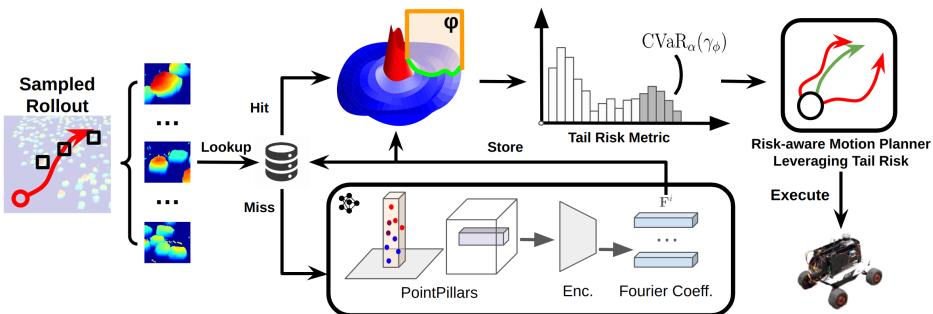 Figure 2: The SPARTA Pipeline. If a terrain patch is new, the network computes Fourier coefficients and stores them. For subsequent queries (even at different angles), the planner retrieves the coefficients and computes risk using a fast analytical function.
Dealing with Uncertainty: The Categorical Distribution
Before diving into the Fourier math, we must define “risk.” Predicting a single deterministic value (e.g., “damage = 0.5”) is dangerous because the real world is noisy. This noise is called aleatoric uncertainty—uncertainty that cannot be reduced even with more data (e.g., slight wheel slip, sensor noise).
SPARTA models risk as a Categorical Distribution. Imagine a histogram with \(B\) bins (in this paper, \(B=8\)), representing different levels of risk (e.g., tire deformation). The network predicts the shape of this histogram.
The probability mass function (PMF) for a risk variable \(\gamma\) given an angle \(\phi\) is calculated by normalizing “concentration parameters” \(\bar{\gamma}\):
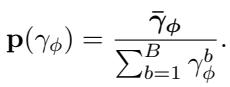
The model is trained to minimize the Earth Mover’s Distance (EMD) between the predicted distribution and the ground truth distribution observed in simulation. EMD is an excellent metric here because it penalizes the network not just for getting the wrong bin, but for how far the prediction is from reality.

The Geometric “Secret Sauce”: Fourier Basis Functions
This is the most critical part of the paper. The angle of approach \(\phi\) lives on the 1-Sphere (\(S^1\)), which is a fancy way of saying “the unit circle.”
The variable \(\phi\) wraps around: \(0\) radians is the exact same physical orientation as \(2\pi\) radians. Standard neural networks struggle with this. If you feed \(0\) and \(6.28\) (\(2\pi\)) into a standard MLP (Multi-Layer Perceptron) as scalar inputs, the network treats them as values far apart, often creating a discontinuity in prediction (the “wrap-around discontinuity”).
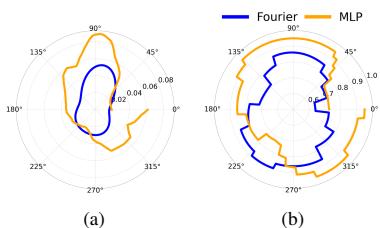 Figure 3: (a) A naive MLP model (Orange) fails to understand that 0 and 360 degrees are the same, resulting in a jump (discontinuity) in prediction. SPARTA (Blue) uses Fourier basis functions, which are naturally periodic, creating a perfectly smooth loop. (b) This smoothness propagates to the risk estimation (CVaR).
To enforce periodicity and smoothness, SPARTA uses Fourier Series. Any smooth function on a circle can be represented as a sum of sines and cosines.
Instead of the network taking \(\phi\) as an input, the network outputs coefficients \(a\) and \(b\). The concentration parameter for the \(i\)-th bin of the risk distribution at angle \(\phi\) is computed as:

Here, \(n\) is the maximum frequency (the authors found \(n=3\) to be sufficient). \(\sigma\) is the sigmoid function, ensuring the output is positive.
Why is this better?
- Guaranteed Periodicity: By definition, \(\cos(0) = \cos(2\pi)\). The wrap-around discontinuity is mathematically impossible.
- Smoothness (Generalization): In machine learning, we often want our models to be Lipschitz continuous—meaning the output doesn’t change arbitrarily fast with the input. By limiting the Fourier series to low frequencies (\(n=3\)), the authors place a theoretical upper bound on how fast the risk prediction can change as the robot turns.
The authors provide a theoretical bound for the Lipschitz constant \(L^i\) of their learned function:
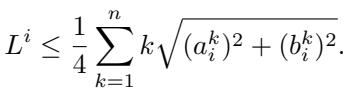
This bound implies that the model will “fill in the gaps” between training data points smoothly. If it knows the risk at \(10^{\circ}\) and \(20^{\circ}\), it won’t predict a crazy spike at \(15^{\circ}\).
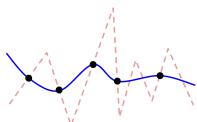 Figure 4: A conceptual demonstration. A model that overfits (Red) might hallucinate risk spikes between data points. The Fourier-based smooth model (Blue) acts as a regularizer, creating a plausible interpolation.
Efficiency in Planning
The second major benefit is speed. In a typical Model Predictive Control (MPC) setup, the planner might look at the same patch of terrain from 50 different angles as it explores different trajectories.
- Naive Approach: Run the deep neural network 50 times. (Slow)
- SPARTA Approach: Run the deep neural network once to get the coefficients. Then, for all 50 angles, simply perform a dot product (Equation 3). (Fast)
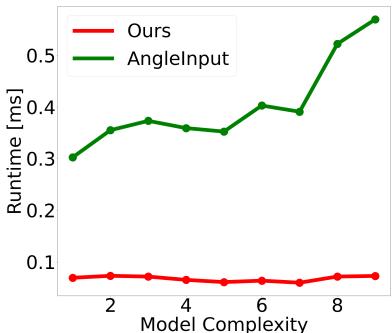 Figure 5: Runtime comparison. The naive “AngleInput” model (Green) gets slower as you add model complexity. SPARTA (Red) remains nearly constant and incredibly fast because the heavy lifting (the backbone) is only run once per terrain patch.
The Planner: Risk-Aware Navigation
Having a great risk estimator is useless if you don’t use it to make decisions. The authors integrate SPARTA into an MPPI (Model Predictive Path Integral) planner.
They don’t just use the average risk. They use CVaR (Conditional Value at Risk). CVaR focuses on the “tail” of the distribution. It asks: “In the worst 10% of outcomes, how bad is the damage?” This is crucial for safety-critical robotics. You don’t care that the average traversal is safe if there is a 5% chance the robot is destroyed.
The optimization problem looks like this:
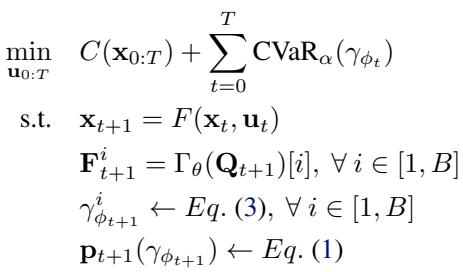
Here, the planner minimizes a cost function \(C\) that includes the goal distance and the CVaR of the predicted risk \(\gamma_{\phi}\) at every timestep.
The total cost function combines goal reaching, velocity limits, and the risk metric:
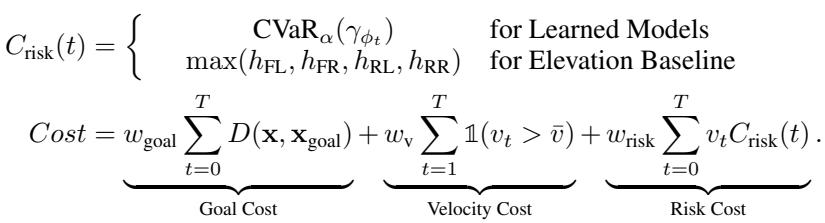
Note the term \(v_t C_{risk}\). This scales risk by velocity—the faster you drive over an obstacle, the higher the penalty.
Experiments & Results
The authors validated SPARTA in both high-fidelity simulation and on a physical robot. They focused on tire deformation as a proxy for vehicle damage.
Simulation: The Boulder Field
The ultimate stress test was a 40m wide field filled with 1,500 randomly placed boulders. The robot had to cross it without exceeding a tire deformation threshold (which would simulate a flat tire or broken axle).
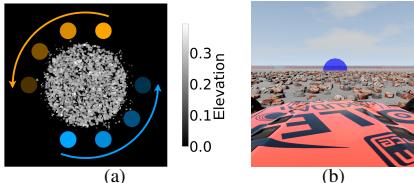 Figure 6: The Boulder Field. (a) Top-down view showing start points (orange) and goals (blue). (b) The driver’s point of view. It is a dense, chaotic environment.
The authors compared SPARTA against:
- AngleInput: A standard network that takes angle as an input.
- AngleFree: A network that ignores angle (treats obstacles as isotropic).
- Elev: A baseline using heuristics on an elevation map.
The Results:
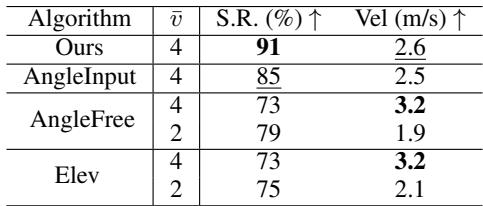 Table 1: SPARTA achieves a 91% success rate, significantly outperforming the baselines. Notice that the angle-aware models (Ours and AngleInput) dominate the angle-agnostic ones.
Why did the baselines fail?
- AngleFree and Elev couldn’t distinguish between a rock that is safe to climb straight-on versus one that requires a diagonal approach. Consequently, they treated safe obstacles as risky (causing unnecessary slowing) or risky obstacles as safe (causing crashes).
- AngleInput performed decently but suffered from the “overfitting” and “wrap-around” issues mentioned earlier, leading to a lower success rate (85% vs 91%).
We can visualize this difference in behavior:
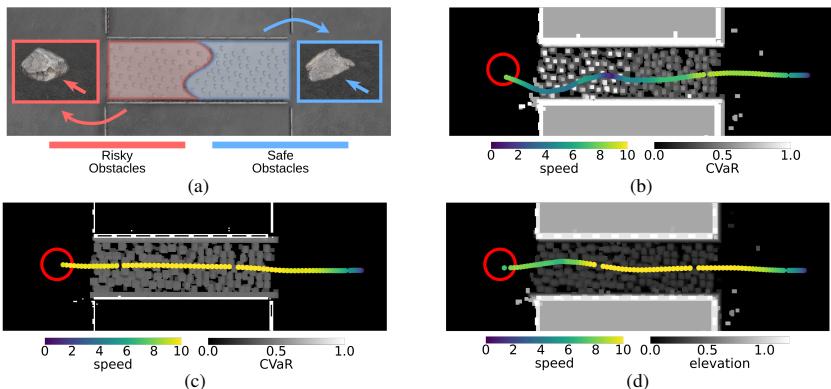 Figure 7: (a) The setup: Risky obstacles (Red) and Safe obstacles (Blue). (b) SPARTA correctly identifies the risky zones (bright yellow/green CVaR) and slows down or avoids them. (c) AngleFree treats everything as a roughly uniform risk blob. (d) The elevation baseline also fails to distinguish the nuance.
Generalization: Learning Curve
A key hypothesis was that the geometric structure (Fourier basis) acts as a strong prior, helping the model generalize better with less data. This was confirmed by analyzing the test loss during training.
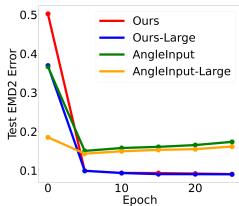 Figure 8: SPARTA (Red/Blue) achieves a significantly lower test error compared to the AngleInput baseline (Green/Orange). The baseline quickly overfits (error goes up or plateaus high), while SPARTA continues to learn effective features.
Real-World Hardware Test
Simulation is great, but does it work on real robots? The authors deployed SPARTA on an AgileX Scout Mini.
They set up a clever experiment: two paths.
- Left Path: An obstacle placed such that the robot approaches its smooth side.
- Right Path: The exact same obstacle, but rotated 180 degrees so the robot would hit a sharp, damaging edge.
To an elevation map or an angle-agnostic method, these two obstacles look identical in height and size.
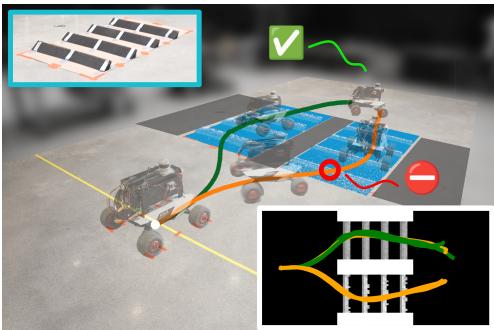 Figure 9: Hardware demonstration. The robot must choose between two paths. The obstacles are identical but rotated. SPARTA (Green trajectory) recognizes that the left approach is safe and the right approach is risky. The Elevation baseline (Orange trajectory) cannot tell the difference and often chooses the path that leads to a collision.
SPARTA successfully identified the safe path in 5/5 trials. The elevation baseline failed 3/5 times, choosing the risky path because it only looked at height changes, not the interaction geometry.
Visualizing the Learned Function
Finally, looking at what the model actually learned is fascinating. In Figure 10 below, we see point clouds of obstacles and a “ring” around them. The color of the ring represents the predicted risk (CVaR) for approaching from that specific angle.
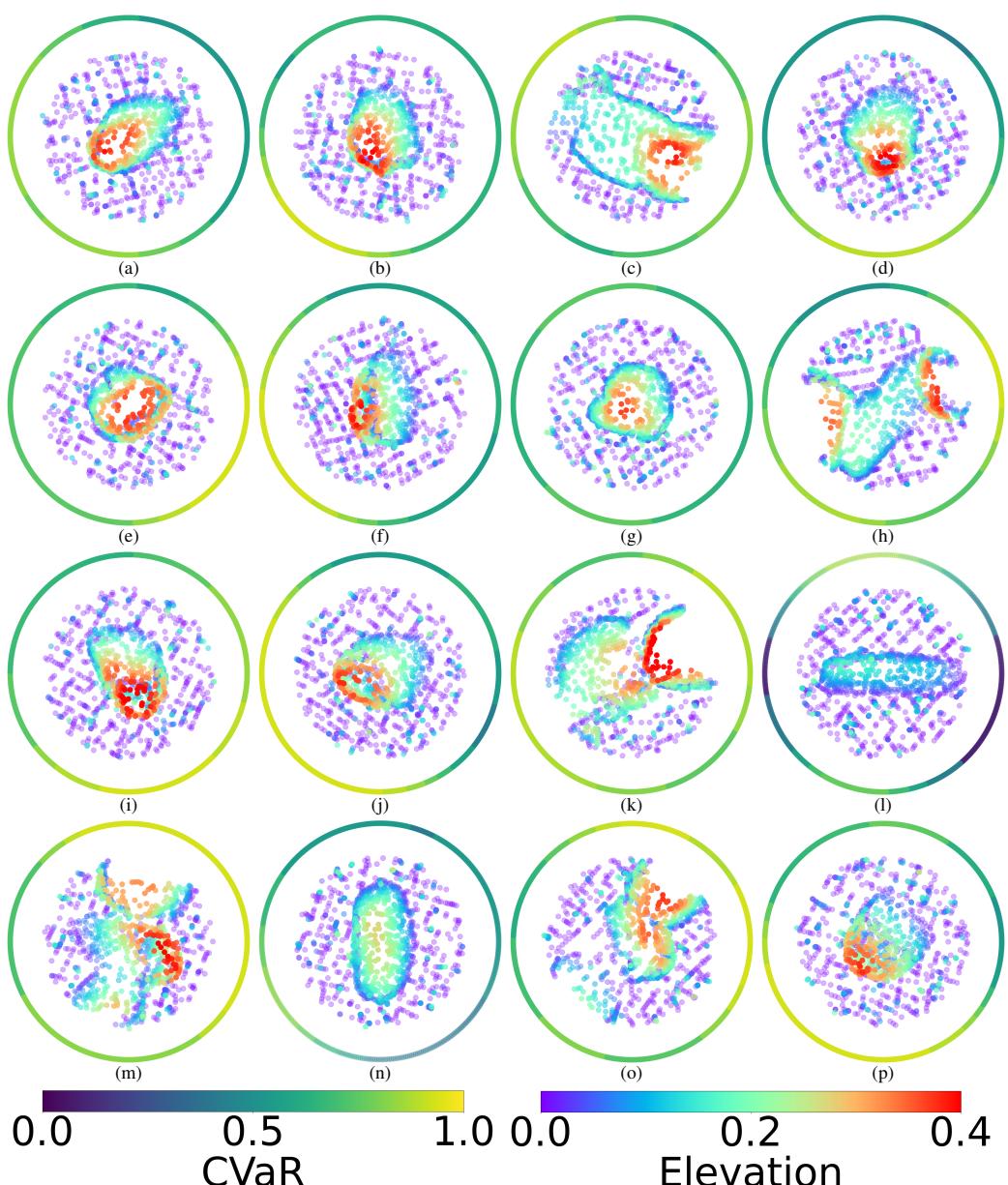 Figure 10: Visualizing the learned risk. The central dots are the obstacle point cloud (colored by height). The surrounding ring is the risk predicted by SPARTA for that angle of approach. Notice how the model predicts low risk (purple/blue) for smooth approaches and high risk (green/yellow) for sharp, jagged approaches.
Conclusion
The SPARTA paper represents a significant step forward in off-road autonomy. It moves away from the simplified view of the world where obstacles are just “obstacles,” and towards a nuanced understanding of interaction.
By treating risk as a continuous, periodic function over the angle of approach, the authors achieved three major wins:
- Geometric Consistency: Solved the wrap-around discontinuity problem using Fourier basis functions.
- Data Efficiency: Improved generalization by enforcing smoothness (Lipschitz continuity).
- Computational Speed: Enabled extremely fast querying during planning by decoupling the heavy neural network inference from the lightweight angle query.
For students and researchers in robotics, SPARTA is a great example of Geometric Deep Learning—the idea that encoding the laws of physics and geometry into your neural network architecture is often more powerful than simply throwing more data at a generic model.
Whether it’s a rover on Mars or a rescue robot in a disaster zone, understanding how to approach an obstacle is just as important as knowing where it is. SPARTA gives robots the mathematical intuition to make that call.