](https://deep-paper.org/en/paper/2506.04600/images/cover.png)
Introduction
In the modern era of machine learning, the scale of datasets and models has grown exponentially. Training these massive models often requires distributed computing across clusters of machines. Traditionally, this is done using a centralized parameter server—a conductor that coordinates the entire orchestra. However, this central server creates a communication bottleneck and a single point of failure.
Enter Decentralized Optimization. Imagine an orchestra without a conductor, where musicians only listen to their immediate neighbors to stay in sync. In this setting, nodes (computers) exchange information locally to collaboratively minimize a global loss function.
While this sounds elegant, the geometry of the communication network matters immensely. Most theoretical breakthroughs have assumed “undirected” networks (if I talk to you, you talk to me) or idealized weight matrices. But real-world networks—like the internet, sensor arrays, or social graphs—are often directed. Information flows one way.
This blog post explores a groundbreaking paper that tackles the hardest version of this problem: Row-stochastic networks. We will dive into how the researchers established the first optimal convergence rates for these networks and designed an algorithm that actually achieves them.
The Problem Setup
Let’s define the mathematical goal. We have \(n\) nodes, and each node \(i\) holds a local loss function \(f_i\). We want to find a global parameter vector \(x\) that minimizes the average of all these local functions:

The challenge is that node \(i\) only knows its own data distribution \(\mathcal{D}_i\) and cannot see the data of others. They must communicate to reach a consensus.
The Matrix Zoo
To understand why this paper is significant, we need to understand Mixing Matrices. These matrices (\(A\)) describe how nodes average their parameters with neighbors.
- Doubly-Stochastic: Rows and columns sum to 1. Ideally suited for undirected graphs. Convergence theory here is mature and “easy.”
- Column-Stochastic: Columns sum to 1. This happens in directed graphs where nodes know their out-degree (how many people they are talking to). Recent work has solved optimal complexity here.
- Row-Stochastic: Rows sum to 1. This is the setting where a node knows its in-degree (how many messages it receives) but potentially nothing about who receives its messages. This is the ROW-ONLY setting.
Until this paper, the optimal complexity for the Row-Stochastic setting was an open mystery. Existing algorithms worked, but we didn’t know if they were fast enough or stable enough.
Characterizing the Network
Before fixing the algorithms, the authors first had to measure the difficulty of the network. In an undirected network, we use the “spectral gap” to measure how well connected the graph is. For row-stochastic directed graphs, it’s more complicated.
The authors propose using two specific metrics to capture the network’s influence:
1. The Generalized Spectral Gap (\(\beta_A\))
This metric measures how fast the network mixes information. If we start with some data and let nodes gossip endlessly, how quickly does it settle into a stable state?

A lower \(\beta_A\) means faster mixing.
2. Equilibrium Skewness (\(\kappa_A\))
In a directed graph, some nodes are more influential than others. The network converges to a weighted average determined by a vector \(\pi_A\) (the Perron vector), rather than a simple average. \(\kappa_A\) measures the imbalance of this influence.

If \(\kappa_A\) is large, the network is highly skewed, making optimization harder.
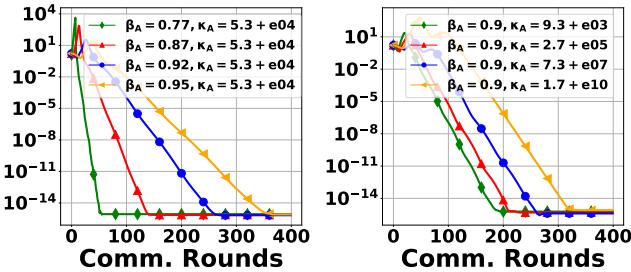
To visualize this, look at Figure 1 below. It shows the convergence of a basic protocol (PULL-DIAG) on different matrices.
- Left: Fixed skewness, varying spectral gap. As \(\beta_A\) gets closer to 1 (worse gap), convergence slows down.
- Right: Fixed spectral gap, varying skewness. As \(\kappa_A\) explodes (orange diamonds), convergence slows drastically.
The Theoretical Limit: How Fast Can We Go?
A major contribution of this work is establishing the Lower Bound. This is the theoretical speed limit—no algorithm using row-stochastic gradients can possibly converge faster than this rate.
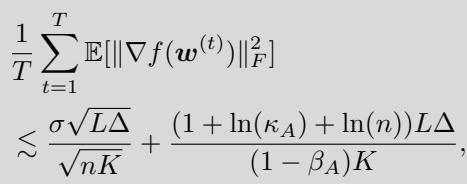
The authors prove that for any algorithm in this class, the error after \(K\) iterations is bounded by:

This formula tells us two critical things:
- Linear Speedup: The first term contains \(\frac{1}{\sqrt{nK}}\). This is the “Holy Grail” of distributed computing. It means if you quadruple the number of nodes (\(n\)), you converge twice as fast.
- Network Penalty: The second term depends on the network structure (\(\kappa_A\) and \(\beta_A\)). A bad network will hurt convergence, but its impact diminishes as \(K\) gets larger (since it divides by \(K\), not \(\sqrt{K}\)).
The Core Algorithm: PULL-DIAG-GT
Existing algorithms for this setting generally rely on a protocol called PULL-DIAG.
Understanding PULL-DIAG
In row-stochastic networks, standard averaging leads to a biased solution. You end up minimizing a weighted sum of losses, not the true average. PULL-DIAG fixes this by running two parallel processes:
- One process averages the model parameters.
- Another process tracks the “weights” (influence) of each node.
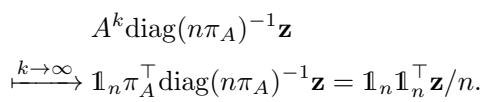
By dividing the parameters by these tracked weights, nodes can recover the true average:
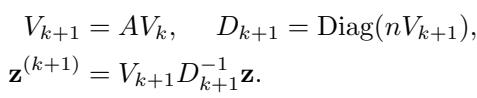
The specific implementation involves updating a matrix \(V\) (to track mixing) and a matrix \(D\) (diagonal correction):
Adding Gradient Tracking (GT)
To handle stochastic gradients (where data is noisy) and ensure we converge to the exact solution, the authors combine PULL-DIAG with Gradient Tracking. This technique helps nodes estimate the global average gradient locally.
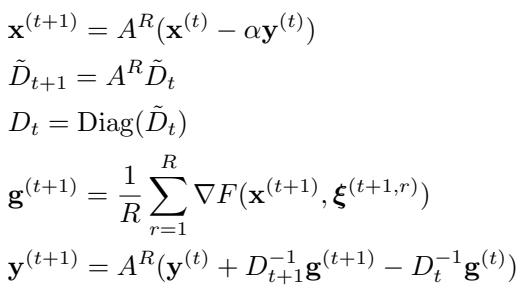
The combined algorithm, PULL-DIAG-GT, looks like this:

Here, \(\mathbf{x}\) is the model, \(\mathbf{y}\) tracks the gradients, and \(D\) acts as the de-biasing correction.
The Problem: Descent Deviation
While PULL-DIAG-GT seems sound, proving it works is incredibly difficult. Why? Because strictly speaking, the algorithm does not descend along the true gradient direction.
Ideally, we want the system to behave like centralized SGD:

But in PULL-DIAG-GT, the effective update direction deviates from this ideal. The authors define this as Descent Deviation:

If this deviation is too large, the algorithm might diverge or converge to the wrong point.
The Breakthrough Analysis
The authors developed a new analysis framework to bound this deviation. They derived a “Descent Lemma” that explicitly accounts for two types of errors:
- Consensus Error: How far are individual nodes from the group average?
- Descent Deviation: How far is the update direction from the true gradient?
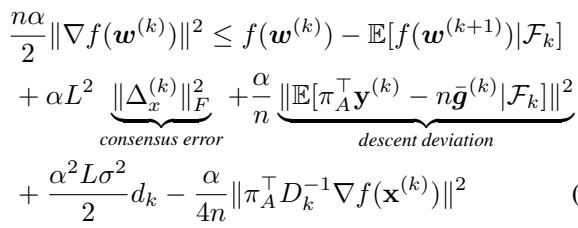
By carefully bounding these terms, they proved that PULL-DIAG-GT achieves Linear Speedup. This is the first time a ROW-ONLY algorithm has been proven to achieve this efficiency.

Perfecting the Method: MG-PULL-DIAG-GT
There was still one catch. The proof for PULL-DIAG-GT relied on an assumption that the diagonal elements of the mixing matrix don’t get too small (denoted by \(\theta_A\)).

In practice, for sparse directed graphs, these diagonal entries can be tiny, causing numerical instability when inverted (\(D^{-1}\)). This prevents the algorithm from being truly “optimal” relative to the lower bound derived earlier.
The Solution: Multi-Step Gossip (MG)
To fix this, the authors introduced MG-PULL-DIAG-GT. The idea is simple but powerful: instead of communicating once per gradient step, nodes communicate \(R\) times.
This essentially replaces the mixing matrix \(A\) with \(A^R\).
Why does this help?
- Better Mixing: \(A^R\) mixes much faster than \(A\), improving the spectral gap.
- Stability: For large enough \(R\), the matrix \(A^R\) becomes strictly positive and stable, eliminating the need for the bounded diagonal assumption.
By tuning \(R\) logarithmically with respect to the network condition number \(\kappa_A\), the authors proved that MG-PULL-DIAG-GT matches the theoretical lower bound (up to logarithmic factors).
Experimental Validation
Theory is good, but does it work in practice? The authors tested these algorithms on various challenging topologies, including Ring, Grid, and Exponential graphs.
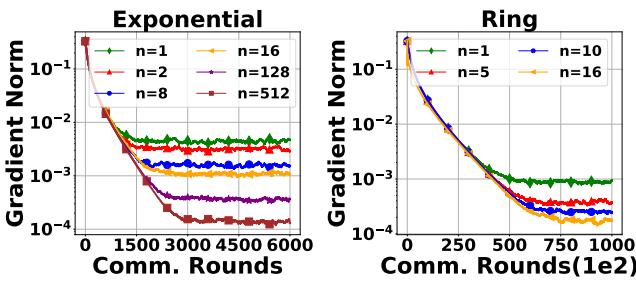
1. Verifying Linear Speedup
Using a non-convex logistic regression task, they varied the number of nodes (\(n\)). As predicted by the theory, increasing \(n\) shifted the convergence curves downward, confirming the linear speedup capability of PULL-DIAG-GT.
2. Neural Network Training (MNIST & CIFAR-10)
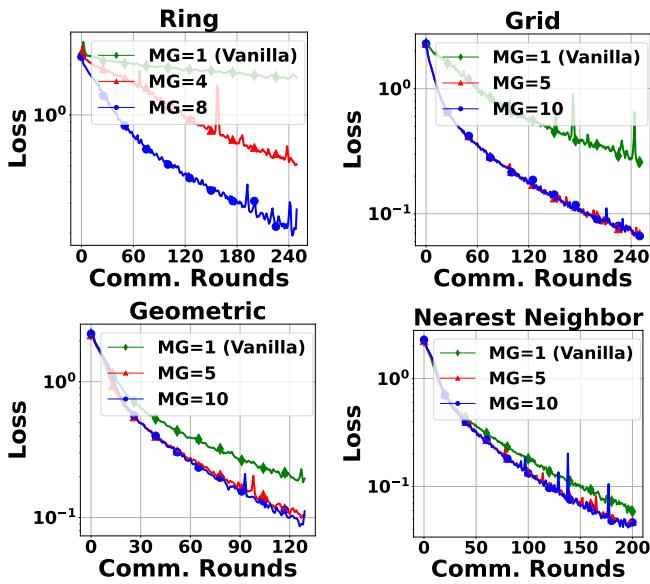
They then trained Deep Learning models. They compared the standard PULL-DIAG-GT (Vanilla, MG=1) against the Multi-Gossip versions (MG=5, MG=10).
On MNIST: Notice in Figure 3 how increasing the gossip steps (Blue lines, MG=10) leads to significantly faster convergence in terms of communication rounds compared to the vanilla version (Green lines), especially on harder graphs like the Ring.
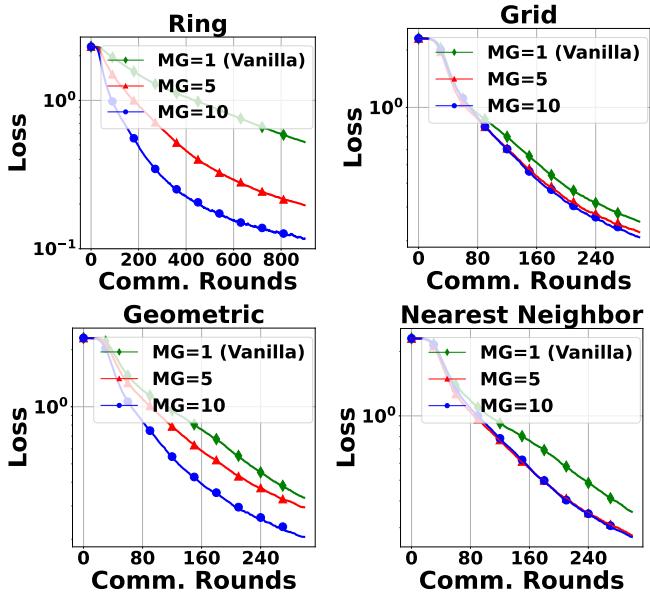
On CIFAR-10: The trend holds for more complex image classification tasks. The MG-PULL-DIAG-GT algorithm consistently achieves lower loss and better stability.
Conclusion
Decentralized learning over directed graphs has long been a thorny problem due to the lack of symmetric communication. This paper bridges a major gap in the field.
Key Takeaways:
- Row-Stochastic is Solved: We now have the first theoretical lower bound for this setting.
- PULL-DIAG-GT works: It achieves linear speedup, meaning adding more nodes effectively speeds up training.
- MG-PULL-DIAG-GT is Optimal: By simply allowing for multiple rounds of communication per computation step, we can eliminate numerical instability and achieve near-optimal convergence rates.
This research paves the way for more robust distributed learning systems that can operate on real-world, imperfect, and directed networks without sacrificing performance.