](https://deep-paper.org/en/paper/2506.05407/images/cover.png)
In the current era of Artificial Intelligence, we are witnessing a paradox. On one hand, we have incredibly powerful Generative APIs (like Stable Diffusion or DALL-E) that can create almost any image from a simple text prompt. On the other hand, the specialized domains that need these tools the most—such as healthcare and high-precision manufacturing—are often starved for data.
Clinics may have only a handful of X-rays for a rare condition. Factories might have only a few dozen images of a specific defect on a production line. This is the “few-shot” data problem. To make matters more complicated, this data is often highly sensitive. A hospital cannot simply upload patient records to a public cloud API to generate more training data due to privacy regulations like HIPAA or GDPR.
So, how do we leverage the power of modern generative models to create useful synthetic datasets without exposing sensitive, few-shot private data?
This is the problem tackled by the research paper “PCEvolve: Private Contrastive Evolution for Synthetic Dataset Generation via Few-Shot Private Data and Generative APIs.” In this post, we will deep-dive into how this new method allows resource-constrained organizations to generate high-quality, privacy-preserving synthetic data.
The Problem with Existing Solutions
To understand the innovation of PCEvolve, we first need to understand why current methods fail. The standard approach to protecting data privacy is Differential Privacy (DP). In the context of generating images, previous state-of-the-art methods, such as Private Evolution (PE), use a process called “similarity voting.”
Here is how PE works:
- It generates random synthetic images using an API.
- It compares these synthetic images to the private data.
- It adds “noise” to the similarity scores to protect privacy (the essence of DP).
- It selects the “best” synthetic images to guide the next round of generation.
This works well when you have thousands of private images. The signal from the data is strong enough to withstand the added noise. However, when you only have few-shot data (e.g., 10 images), the noise completely overwhelms the signal.
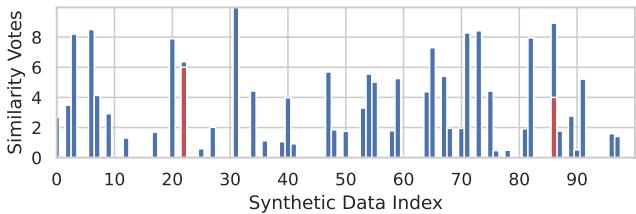
As shown in Figure 1, when private data is scarce (the red bars), the DP noise (the blue bars) drowns out the actual votes. The system effectively starts selecting synthetic images at random. If you feed random images back into the generator as guidance, you get garbage out. This leads to synthetic datasets that look nothing like the target domain and fail to train effective downstream models.
Enter PCEvolve: A New Approach
The researchers propose PCEvolve (Private Contrastive Evolution). Instead of relying on simple voting mechanisms that crumble under strict privacy noise, PCEvolve introduces a sophisticated selection engine designed specifically for few-shot scenarios.
The core philosophy of PCEvolve is to squeeze more information out of the limited private data by looking at relationships between classes, rather than just individual points. It employs an iterative “evolution loop” that refines synthetic data over time.
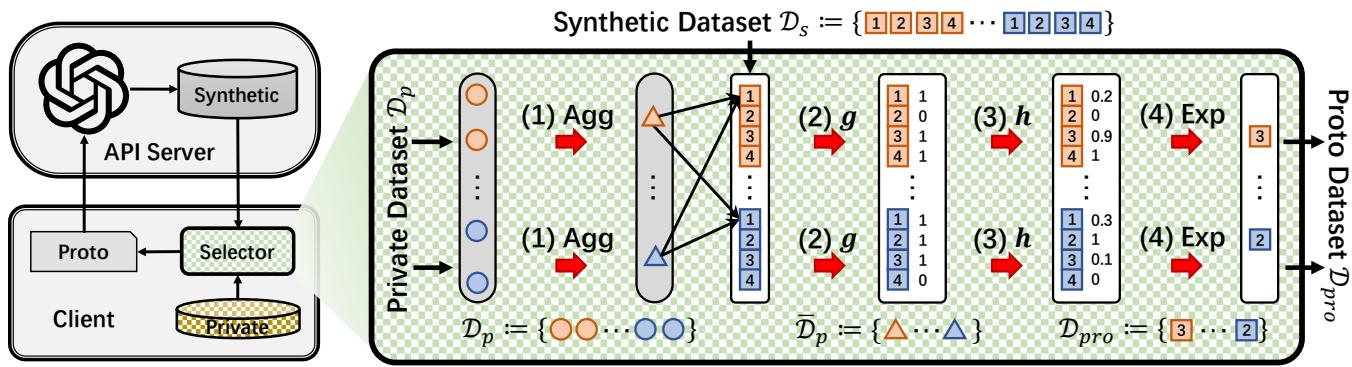
As illustrated in Figure 2, the process involves a cycle:
- Generate: Start with initial synthetic images from a text-to-image API.
- Select: Use a specialized “DP-protected selector” to pick the best “prototypical” synthetic images (\(D_{pro}\)).
- Refine: Feed these prototypes back into an image-to-image API to generate better versions.
- Repeat: This loop continues, improving the quality of the dataset with each iteration.
The magic lies entirely within that Selector block. Let’s break down the mathematics and logic that make it work.
The Core Method: Inside the Selector
The selector needs to identify which synthetic images are high quality (similar to private data) without revealing the private data itself. PCEvolve achieves this through four key steps.
1. Aggregating Class Centers
In few-shot learning, individual data points can be outliers or noisy. If you rely too much on a single image, you bias your results. PCEvolve starts by calculating the centroid (average feature representation) for each class in the private dataset. This stabilizes the signal, giving the algorithm a reliable target to aim for, rather than chasing scattered data points.
2. The Contrastive Filter (\(g\))
This is where the “Contrastive” part of the name comes in. It is not enough for a synthetic image of a “cut defect” to look like a cut defect; it must also not look like a “droplet defect” or a “normal surface.”
The researchers devised a contrastive filter function, \(g\). This function acts as a gatekeeper. It checks if a synthetic image is closer to the correct private class center than to any other private class center.

If the synthetic image (\(d_s^c\)) is closer to its target class center (\(\bar{d}_p^c\)) than to any other class center (\(\bar{d}_p^{c'}\)), it gets a score of 1. Otherwise, it gets 0. This simple binary check ensures that the algorithm only considers synthetic images that are discriminative—meaning they are distinct enough to be classified correctly.
3. The Similarity Calibrator (\(h\))
Passing the contrastive filter is just the first hurdle. Among the images that pass, some are much closer to the private data than others. We need to measure similarity.
However, raw distances in high-dimensional feature spaces can be messy. In the early stages of generation, synthetic images might be very far from private images, resulting in massive distance values. In later stages, they might be close.
To handle this, PCEvolve introduces a Similarity Calibrator (\(h\)). This function converts raw distance into a normalized probability score between 0 and 1.
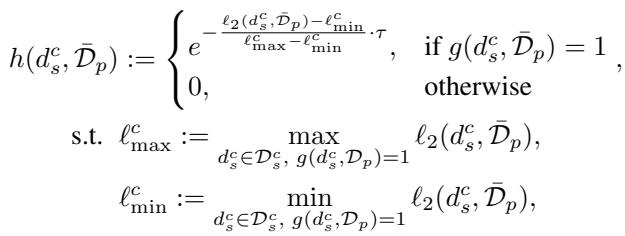
Here is what is happening in this equation:
- Normalization: The distance \(\ell_2\) is scaled based on the minimum (\(\ell_{min}\)) and maximum (\(\ell_{max}\)) distances observed in the current batch. This ensures the scores always span the full range from 0 to 1.
- The \(\tau\) Factor: A hyperparameter \(\tau\) controls the sharpness of the curve. It pushes the scores of poor candidates toward zero and the best candidates toward one.
- Result: This calibration ensures that even when the overall quality is low (early iterations), the algorithm can clearly distinguish the relative best candidates.
4. The Exponential Mechanism (\(M_u\))
Finally, the algorithm must select the “prototype” images to send back to the API. This is where Differential Privacy is enforced. Instead of adding noise to the votes (Gaussian Mechanism) like the failed PE method, PCEvolve uses the Exponential Mechanism (EM).
EM is a standard tool in DP that selects items with a probability proportional to their utility (quality). Because PCEvolve calibrated the utility scores (\(u\)) so effectively using the function \(h\) above, EM works beautifully here.

This equation dictates that the probability of selecting a specific synthetic image \(r\) depends on its utility score \(u\). The privacy parameter \(\epsilon\) controls how “strict” the selection is. A higher score dramatically increases the chance of selection, but the randomness ensures privacy is mathematically preserved.
Why This Works for Few-Shot Data
The combination of these components solves the “noise” problem we saw in Figure 1.
- Contrastive Filter removes confusing data immediately.
- Calibration ensures the utility scores span a wide range (\([0, 1]\)), maximizing the gap between “good” and “bad” images.
- Exponential Mechanism is naturally better suited for selection tasks than the Gaussian noise addition used in previous methods.
Experimental Results
The researchers tested PCEvolve on four specialized datasets across healthcare and industry, including COVIDx (Chest X-rays), Camelyon17 (Tumor tissue), and MVTecAD (Industrial defects). These are exactly the kinds of domains where data is scarce and privacy is paramount.
Comparison with Baselines
The results were compared against several baselines, including:
- PE: The previous state-of-the-art method.
- DPImg: Directly adding noise to images (which usually destroys them).
- Text-to-Image only (B, LE): Using APIs without the evolution loop.
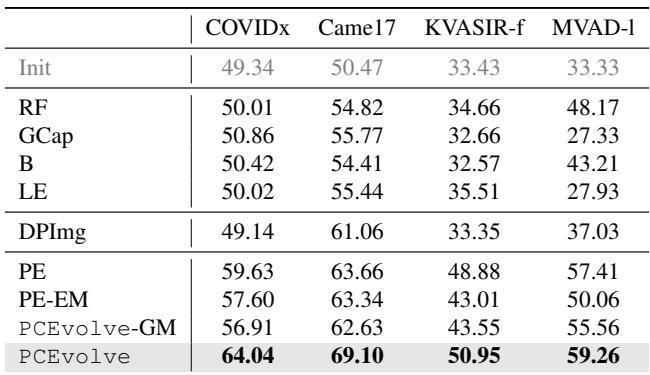
Table 1 shows the classification accuracy of models trained on the synthetic data generated by these methods.
- PCEvolve (bottom row) consistently achieves the highest accuracy across all datasets.
- On the Camelyon17 dataset, PCEvolve reached 69.10%, significantly outperforming the original PE method (63.66%).
- The gap is even visible against “non-private” methods in some cases, showing how effective the evolution loop is at refining quality.
Visual Quality
Numbers are great, but in generative AI, seeing is believing. Let’s look at the generated images for the industrial leather defect dataset.
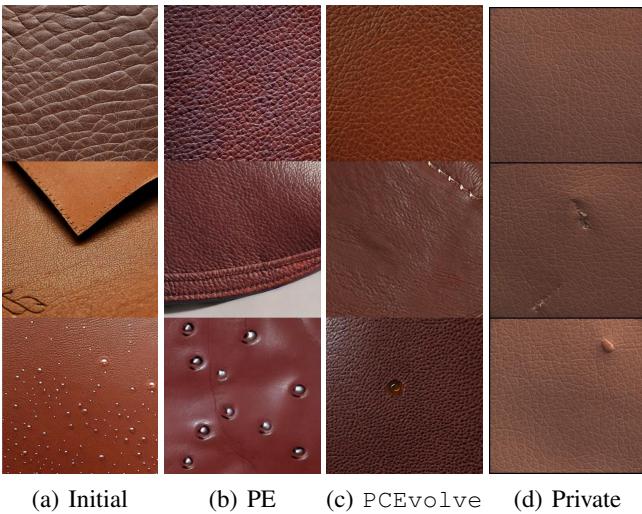
In Figure 6, row (d) shows the real private data.
- Row (b) shows the competitor, PE. Notice how the “cut defect” looks like a weird boundary line? It failed to capture the texture and nature of the cut because the noise drowned out the guidance.
- Row (c) shows PCEvolve. The synthetic images clearly depict realistic cuts and droplets that closely mimic the private data styles, while maintaining diversity.
Efficiency and Convergence
One of the major claims of the paper is that PCEvolve isn’t just better; it’s more efficient. It learns faster during the evolution loop.
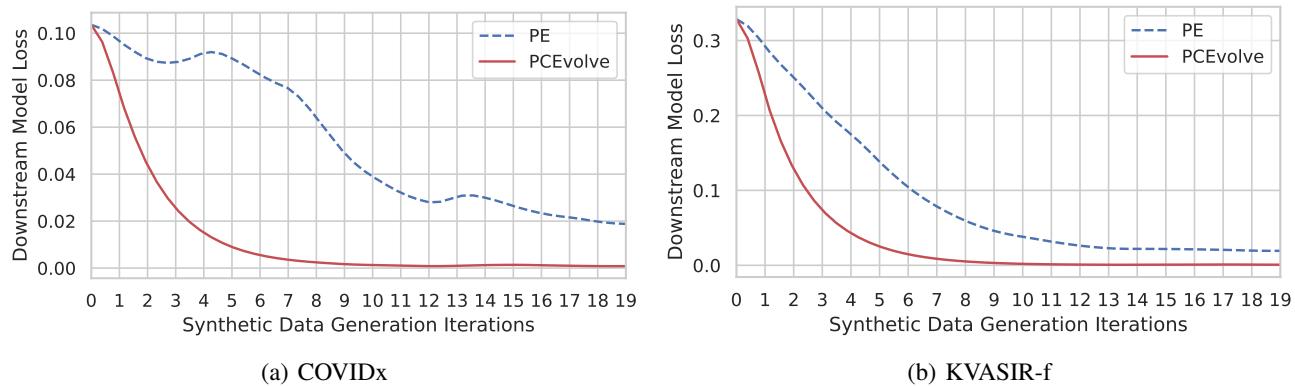
Figure 7 tracks the loss (error rate) of the downstream model as the synthetic data generation evolves over iterations.
- The Red Line (PCEvolve) drops rapidly, approaching near-zero loss very quickly (around iteration 5-6).
- The Blue Line (PE) struggles to converge, fluctuating significantly. This proves that the guidance provided by PCEvolve’s selector is much cleaner and more useful to the generative API.
The Impact of Data Volume
Finally, how does the method handle the specific “few-shot” constraint? Does it fall apart if we have very few private images?
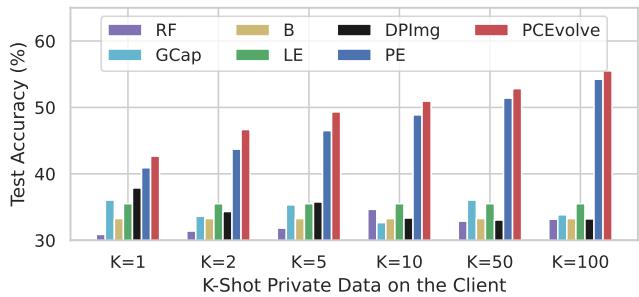
Figure 3 shows the performance as the number of private shots (\(K\)) increases. Even at very low shots (K=2 or K=5), PCEvolve (Red bar) maintains a lead over other methods. While all methods improve with more data, PCEvolve’s ability to extract utility from as few as 10 images is a game-changer for small clinics or specialized manufacturing lines.
Conclusion and Implications
PCEvolve represents a significant step forward in privacy-preserving machine learning. It successfully bridges the gap between powerful, public Generative APIs and sensitive, private, small-scale datasets.
By moving away from simple noise addition and towards a contrastive, calibrated selection mechanism, the authors have created a way to generate high-fidelity synthetic data without compromising user privacy.
Key Takeaways:
- Privacy does not have to mean low quality: With the right mechanism (Exponential Mechanism vs. Gaussian), we can maintain utility even with strict privacy guarantees.
- Context matters: The “Contrastive Filter” proves that knowing what an image is not is just as important as knowing what it is.
- Scaling is crucial: The “Similarity Calibrator” solves the issue of fluctuating distance metrics, allowing the selection engine to work effectively from the very first iteration.
For the future of AI in sensitive industries, tools like PCEvolve suggest a path where small institutions can collaborate and utilize state-of-the-art AI models without ever fearing a data breach.