](https://deep-paper.org/en/paper/2506.05629/images/cover.png)
ID-SPAM: Making Soft Prompts Smarter with Self-Attention
The rise of Large Language Models (LLMs) like GPT-4, Llama, and RoBERTa has created a massive “elephant in the server room.” These models are incredibly capable, but they are also incredibly heavy. When you want to adapt a model with billions of parameters to a specific task—like legal analysis or medical diagnosis—retraining the whole thing (fine-tuning) is often computationally impossible for most researchers and smaller organizations.
This has led to a gold rush in Parameter-Efficient Fine-Tuning (PEFT). The goal is simple: can we tweak just a tiny fraction of the model’s weights and still get expert-level performance?
One of the most popular techniques is Soft Prompting. Instead of writing a text prompt like “Translate this sentence,” we feed the model a sequence of learnable numbers (vectors) that act as a prompt. However, most soft prompting methods have a major flaw: they are static. They use the exact same “soft prompt” regardless of whether the input is a simple greeting or a complex philosophical paragraph.
In this post, we are diving into a paper that proposes a solution: ID-SPAM (Input-Dependent Soft Prompting with Attention Mechanism). This method argues that a prompt should be tailored to the specific input at hand. By using a lightweight self-attention mechanism, ID-SPAM dynamically generates a custom prompt for every single input sentence, achieving state-of-the-art results while training only a tiny sliver of parameters.
The Background: Why Soft Prompts Needed an Upgrade
To understand ID-SPAM, we first need to look at the landscape of efficient fine-tuning.
The Problem with Full Fine-Tuning
Imagine you have a pre-trained model like RoBERTa-Large. It has hundreds of millions of parameters. To fine-tune it on a sentiment analysis dataset, you would typically update all of those parameters. This requires massive GPU memory to store gradients and optimizer states for the whole model.
The Soft Prompting Solution
Soft prompting (or Prompt Tuning) offers a clever workaround. You freeze the entire massive LLM. You don’t touch its weights. Instead, you add a small set of trainable vectors—let’s say 10 “virtual tokens”—to the beginning of your input.
When you train, you only update these 10 vectors. The model learns to interpret these vectors as instructions for the specific task. This drastically reduces the number of trainable parameters.
The Limitation: The “One-Size-Fits-All” Trap
Traditional soft prompting (like the original method by Lester et al.) learns a single, static prompt vector \(S\). During inference, if you feed the model Sentence A, it gets prepended with Prompt \(S\). If you feed it Sentence B, it also gets Prompt \(S\).
The authors of ID-SPAM argue that this is suboptimal. A “unified prompt” struggles to handle the diversity of language. In the same way that a human might need a different hint to solve a math problem versus a history question, an LLM benefits from prompts that react to the content of the input.
While some previous works tried to make prompts input-dependent, they often involved complex architectures, such as injecting prompts at every single layer of the transformer, which increased training time and complexity.
The Core Method: How ID-SPAM Works
The researchers propose a method that is both input-dependent and architecturally simple. The core idea is to employ a small, trainable neural network that looks at the input sentence, decides which parts are important, and generates a custom soft prompt on the fly.
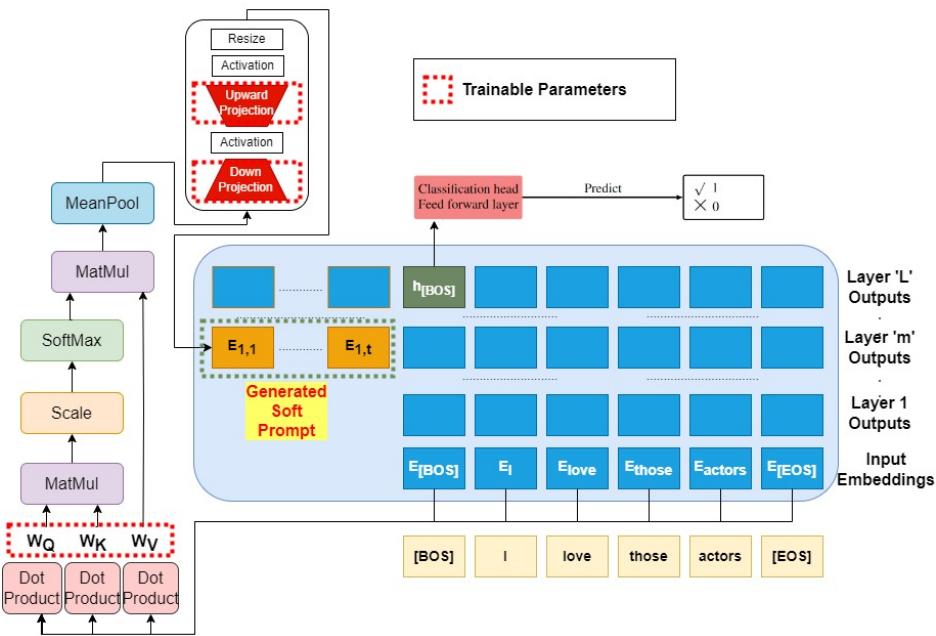
As shown in Figure 1 above, the architecture allows the base LLM (the blue blocks) to remain completely frozen. The red-outlined components represent the ID-SPAM module, which is the only part that gets trained.
Let’s break down the generation process step-by-step.
Step 1: Input Embeddings and Self-Attention
The process starts with the input sentence (e.g., “I love those actors”). The text is converted into input embeddings.
Standard soft prompting ignores the specific content of these embeddings when creating the prompt. ID-SPAM, however, passes these embeddings through a Learnable Self-Attention Layer. This is crucial. By using attention, the mechanism can weigh different tokens with varying importance. For a sentiment task, it might focus heavily on the word “love”; for a classification task, it might focus on nouns.
The mathematical formulation for this context-rich representation \(A\) is:

Here, \(W_Q\), \(W_K\), and \(W_V\) are the trainable query, key, and value matrices. This is the classic attention mechanism from the Transformer architecture, but applied solely for the purpose of generating the prompt.
Step 2: The Bottleneck MLP
Once the attention layer processes the input, the output is averaged to create a context vector. But this vector might not be the right shape or contain the right features to serve as a prompt for the LLM.
To refine this information, the authors use a two-layer Multi-Layer Perceptron (MLP) with a bottleneck structure:
- Downward Projection: Compresses the information into a smaller dimension (\(c\)).
- Activation: A ReLU non-linearity is applied.
- Upward Projection: Expands the information back out to match the dimensions needed for the prompt.
This “bottleneck” approach helps in learning compact, efficient features while keeping the parameter count low.
Step 3: Resizing and Injection
Finally, the output of the MLP is resized to form the final Soft Prompt matrix \(S_T\).

This generated prompt \(S_T\) is then prepended to the input. Interestingly, the authors don’t just restrict this to the very first layer. As indicated in Figure 1, the soft prompt can be injected at the input of any specific transformer layer (e.g., Layer 5 or Layer 12). The base LLM then processes this combined sequence (Prompt + Input) to produce the final classification.
Experiments and Results
The authors evaluated ID-SPAM extensively against several strong baselines, including:
- Full Fine-Tuning (The gold standard, but expensive).
- LoRA (Low-Rank Adaptation, a very popular PEFT method).
- Prompt Tuning (Standard static soft prompting).
- P-Tuning & LPT (Advanced prompting variants).
The experiments covered the GLUE and SuperGLUE benchmarks, which include tasks like sentiment analysis (SST-2), paraphrase detection (MRPC), and natural language inference (MNLI).
1. Performance on GLUE
The results were impressive. ID-SPAM consistently outperformed other soft-prompting methods.
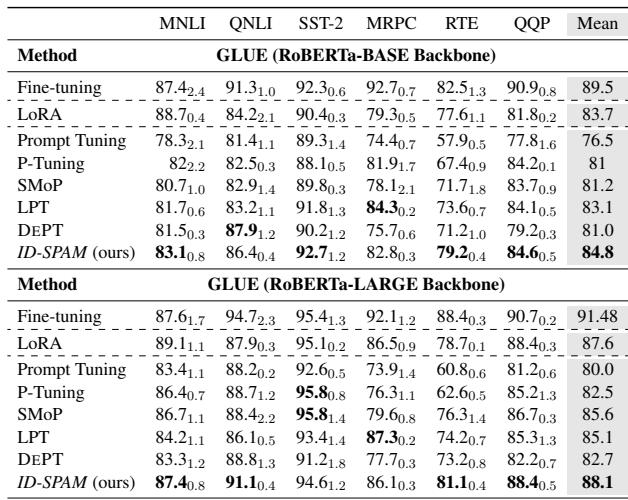
Looking at Table 2:
- Vs. Static Prompting: ID-SPAM beats standard Prompt Tuning by a massive margin (e.g., 84.8% vs 76.5% average score on RoBERTa-BASE). This proves that making prompts input-dependent is highly effective.
- Vs. LoRA: ID-SPAM actually outperforms LoRA on the average score (84.8 vs 83.7), despite LoRA being a very strong competitor that modifies internal weights.
- Consistency: The method holds up whether using the smaller RoBERTa-BASE or the larger RoBERTa-LARGE backbone.
2. Efficiency: The “Bang for the Buck”
One of the main claims of the paper is efficiency. Does ID-SPAM achieve these results by simply adding way more parameters?

Table 12 shows the parameter counts. ID-SPAM uses significantly fewer parameters than LoRA (roughly 2 million vs. 3.5 million for RoBERTa-BASE) and is comparable to or smaller than Late Prompt Tuning (LPT).
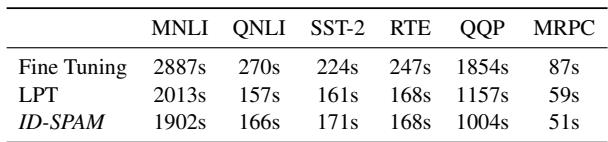
Furthermore, the authors compared training times. ID-SPAM generally converged faster than LPT (about 7.3% faster on average).
3. Ablation: Does the “Attention” Matter?
A skeptic might ask: “Is it really the self-attention layer helping, or just the extra neural network layers?”
To test this, the authors ran an ablation study where they removed the attention mechanism and just used Mean Pooling on the input embeddings.
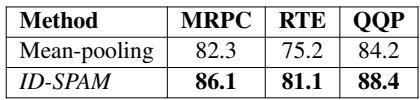
As Table 3 illustrates, removing the attention mechanism caused a significant drop in accuracy (e.g., from 88.4 to 84.2 on QQP). This confirms that the model is actively learning which parts of the input to focus on when generating the prompt.
4. Where should the prompt go?
Unlike standard prompting which usually happens at the very input (Layer 0), ID-SPAM allows injection at intermediate layers. The authors analyzed which layer yielded the best performance.
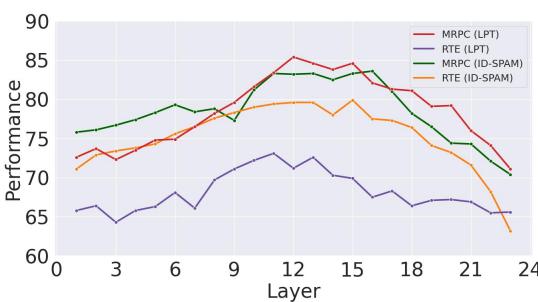
Figure 2 reveals an interesting trend. Performance often peaks in the middle-to-late layers (around layer 11-13 for RoBERTa-Large).
- Early layers: The prompt is generated from raw embeddings. Prepending this to deep layers (which represent highly abstract features) creates a mismatch.
- Middle layers: This seems to be the “sweet spot” where the generated prompt integrates best with the model’s internal representations.
Why This Matters: Zero-Shot Domain Transfer
One of the most exciting results in the paper is about generalization. If you train ID-SPAM on a movie review dataset (SST-2), does it work on a different movie review dataset (IMDB) without any extra training? This is known as Zero-Shot Domain Transfer.
Because ID-SPAM learns an attention mechanism—a way of looking at input—rather than just memorizing a static vector, it captures generalized patterns better.
The authors found that ID-SPAM outperforms baselines significantly in this area. For example, transferring from QQP to MRPC (both paraphrase tasks), ID-SPAM achieved a score of 70.9, while standard Prompt Tuning only managed 54.1. It even outperformed full fine-tuning in several transfer scenarios. This suggests ID-SPAM is learning robust, transferable skills rather than overfitting to the specific training data quirks.
Conclusion
The paper “Leveraging Self-Attention for Input-Dependent Soft Prompting in LLMs” introduces a compelling evolution in the field of parameter-efficient fine-tuning. By recognizing that context is king, the authors moved away from static soft prompts and embraced a dynamic, attention-based generation method.
Key Takeaways:
- Contextual Prompts: ID-SPAM generates unique prompts for every input using a lightweight self-attention mechanism.
- High Efficiency: It achieves better results than LoRA and other prompting methods while often using fewer parameters.
- Robustness: The mechanism shows superior ability to transfer knowledge across different domains (Zero-Shot Transfer).
- Simplicity: It requires training a small external module and injecting it into a single layer, avoiding the complexity of modifying every layer of the LLM.
For students and practitioners working with LLMs, ID-SPAM represents a sweet spot: it offers the high performance of complex fine-tuning methods with the low resource requirements of soft prompting. As models continue to grow in size, techniques like this will be essential for making them adaptable and accessible.