](https://deep-paper.org/en/paper/2506.06866/images/cover.png)
Introduction
In the modern era of Deep Learning, we are witnessing a “battle of the scales.” On one side, models are becoming exponentially larger—Large Language Models (LLMs) with billions of parameters are now standard. On the other side, the resources required to deploy these models are limited. We want to run these intelligent systems on phones, laptops, and edge devices, which simply cannot handle the memory and computational load of massive dense networks.
This has led to a surge in sparsification research—the art of removing the vast majority of a network’s parameters without destroying its intelligence. We call this process pruning.
However, there is a catch. When you prune a network aggressively, performance almost inevitably drops. The prevailing wisdom suggests this is a capacity issue; a smaller brain simply can’t think as well. But what if the problem isn’t just the number of connections, but the geometry of the solution we find?
Recent research has shown that “flat” minima—regions in the loss landscape where the error remains low even if weights are perturbed slightly—generalize far better than “sharp” minima.
In this post, we will dive deep into a paper titled “SAFE: Finding Sparse and Flat Minima to Improve Pruning.” The researchers propose a novel optimization framework that doesn’t just look for a sparse network; it hunts for a sparse network that lives in a flat, robust region of the loss landscape.
The Background: Sparsity vs. Flatness
To understand SAFE (Sparsification via ADMM with Flatness Enforcement), we need to revisit two foundational concepts that are usually treated separately: Sparsity and Sharpness-Aware Minimization.
The Challenge of Sparsity
Mathematically, pruning is an optimization problem. We want to minimize a loss function \(f(x)\) (like Cross-Entropy) subject to a constraint that the number of non-zero elements in our weight vector \(x\) is less than a specific limit \(d\).
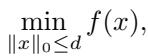
Here, \(\|x\|_0\) is the \(L_0\)-norm, which counts non-zero entries. Solving this directly is incredibly difficult because the \(L_0\)-norm is discrete and non-differentiable. You can’t calculate a gradient for it. Standard approaches often rely on heuristics, like training a dense model and then cutting off the smallest weights (Magnitude Pruning), or using relaxations like \(L_1\) regularization (LASSO).
The Importance of Flat Minima
Why do some neural networks generalize better to unseen data than others, even if they have the same training accuracy? The geometry of the loss landscape offers a clue.
If a model converges to a sharp minimum, a slight shift in the input distribution (or noise) can push the model up the steep walls of the loss function, resulting in high error. In contrast, a flat minimum is stable. Small perturbations don’t change the loss much.
To explicitly find these flat regions, researchers developed Sharpness-Aware Minimization (SAM). Instead of just minimizing the loss \(f(x)\), SAM minimizes the maximum loss found within a small neighborhood \(\epsilon\) around \(x\).
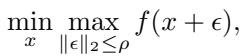
This forces the optimizer to find a region where the loss is low not just at a single point, but everywhere nearby.
The SAFE Method
The core innovation of SAFE is combining these two distinct goals—sparsity and flatness—into a single, rigorous mathematical framework. The authors don’t just hack a heuristic together; they formulate a constrained min-max optimization problem.
1. Problem Formulation
The goal is to find parameters \(x\) that satisfy the sparsity constraint (\(L_0 \le d\)) while minimizing the worst-case loss in the neighborhood (flatness).
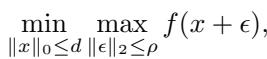
This equation represents the “Holy Grail” of robust pruning. We want a model that is tiny (sparse) but also incredibly robust (flat).
2. Solving with Augmented Lagrangian
Attempting to solve the equation above using standard Gradient Descent is impossible due to the discrete sparsity constraint. To get around this, the authors utilize a technique from optimization theory called the Augmented Lagrangian, specifically inspired by the ADMM (Alternating Direction Method of Multipliers) framework.
The trick is variable splitting. Instead of trying to optimize one variable \(x\) that has to handle both the loss topology and the hard sparsity constraint simultaneously, we introduce a second variable \(z\).
- \(x\) will focus on the loss landscape (flatness).
- \(z\) will satisfy the sparsity constraint.
- We strictly enforce that \(x = z\).
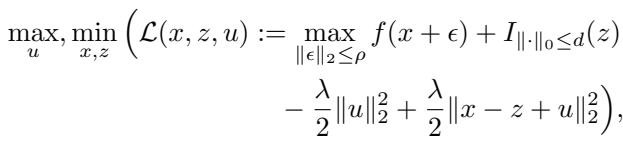
We can rewrite the problem like this:

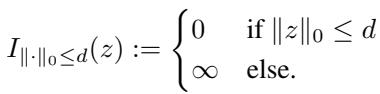
Here, \(I(z)\) is an indicator function that is 0 if \(z\) is sparse enough, and infinity otherwise.
Now, we construct the Augmented Lagrangian. We add a dual variable \(u\) (which acts like a Lagrange multiplier) and a quadratic penalty term \(\frac{\lambda}{2}\|x - z + u\|^2\). This penalty acts like a rubber band, pulling \(x\) and \(z\) together. If they drift apart, the penalty increases.
3. The Iterative Algorithm
The beauty of this formulation is that it allows us to solve for \(x\), \(z\), and \(u\) iteratively. We update one while holding the others constant. This breaks a massive, impossible problem into smaller, solvable sub-problems.
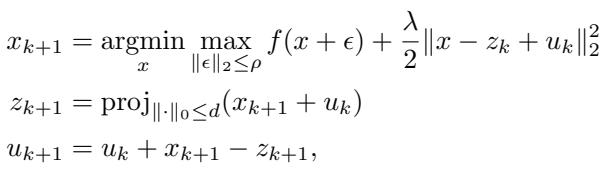
Let’s break down these three specific steps, as they are the engine of the SAFE algorithm.
Step A: The x-minimization (Learning Flatness)
In the first step, we want to find the best weights \(x\) that minimize the loss and stay close to our sparse target \(z\).

Notice the objective function here. It contains the SAM objective (minimizing max loss) plus a quadratic term pulling \(x\) toward \(z\). This means \(x\) is allowed to be dense and explore the loss landscape to find a flat region, but it is “tethered” to the sparse solution \(z\).
To solve this, the authors approximate the inner maximization (finding the worst-case perturbation \(\epsilon\)) using a gradient ascent step, similar to standard SAM.
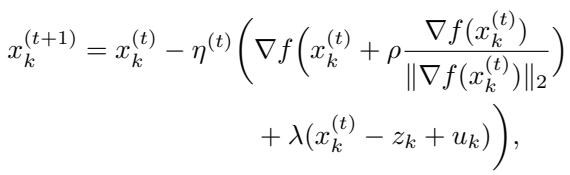
This update rule looks like standard Stochastic Gradient Descent (SGD), but with two twists:
- The gradient is calculated at a perturbed point \(x + \epsilon\) (to ensure flatness).
- There is a “decay” term \(\lambda(x - z + u)\) that steers the weights toward the sparse configuration.
Step B: The z-minimization (Enforcing Sparsity)
Once we have an updated \(x\), we need to update \(z\). Since \(z\)’s only job is to satisfy the sparsity constraint and be close to \(x\), this step actually has a closed-form solution!
In the standard SAFE version, this is a Euclidean projection. We simply look at the vector \((x + u)\) and keep the top-\(d\) elements with the largest magnitude, setting the rest to zero. This is mathematically equivalent to the “Hard Thresholding” operator.
Step C: The u-maximization (Dual Update)
Finally, we update the dual variable \(u\). This variable accumulates the error between \(x\) and \(z\). If \(x\) and \(z\) are consistently different, \(u\) grows, effectively increasing the penalty in the next round to force them together.
4. Extension: SAFE+ and Generalized Projection
The standard SAFE method assumes that the best way to project onto the sparsity constraint is by keeping the weights with the largest magnitude. However, in many cases (especially LLMs), magnitude isn’t the best proxy for importance.
The authors propose SAFE+, which introduces a Generalized Projection. Instead of standard Euclidean distance, they use a weighted distance metric defined by a positive-definite matrix \(\mathbf{P}\).
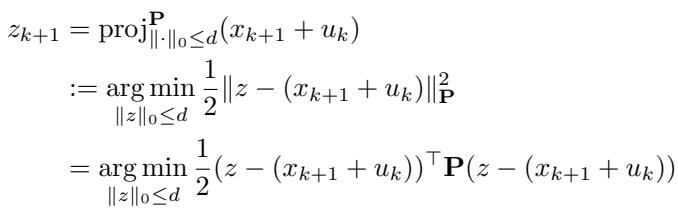
This allows SAFE+ to incorporate advanced pruning metrics:
- Optimal Brain Damage: Set \(\mathbf{P}\) to the diagonal of the Hessian.
- Wanda (for LLMs): Set \(\mathbf{P}\) based on activation magnitudes.
This flexibility makes SAFE+ incredibly powerful for post-training pruning of Large Language Models, where calculating gradients is expensive, but using activation statistics is cheap.
Does It Actually Work?
The theory is sound, but the proof is in the experiments. The authors conducted extensive testing on Image Classification (CIFAR) and Large Language Models (LLaMA).
Visualizing the Landscape
First, let’s confirm that SAFE does what it claims: finds sparse and flat minima.
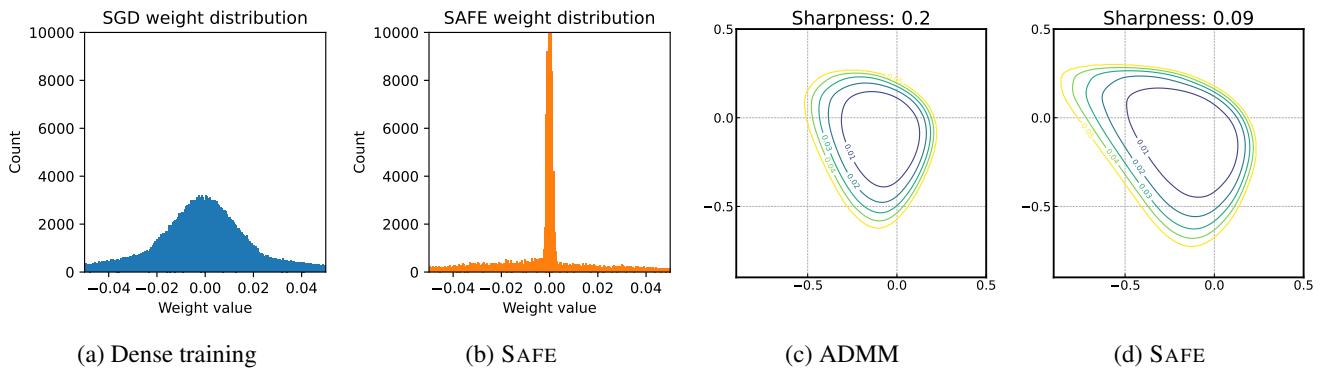
In Figure 1 (above), look at panels (c) and (d).
- Panel (c) shows the solution found by ADMM (without flatness enforcement). The contours are tight; the valley is narrow. The maximum Hessian eigenvalue (a measure of sharpness) is 0.2.
- Panel (d) shows the solution found by SAFE. The contours are widely spaced, indicating a broad, flat valley. The sharpness is significantly lower at 0.09.
This visual confirmation proves that the optimization strategy successfully navigates to flatter regions of the parameter space.
Image Classification Results
The authors compared SAFE against established pruning baselines like GMP (Gradual Magnitude Pruning), LTH (Lottery Ticket Hypothesis), and ADMM on ResNet and VGG architectures.
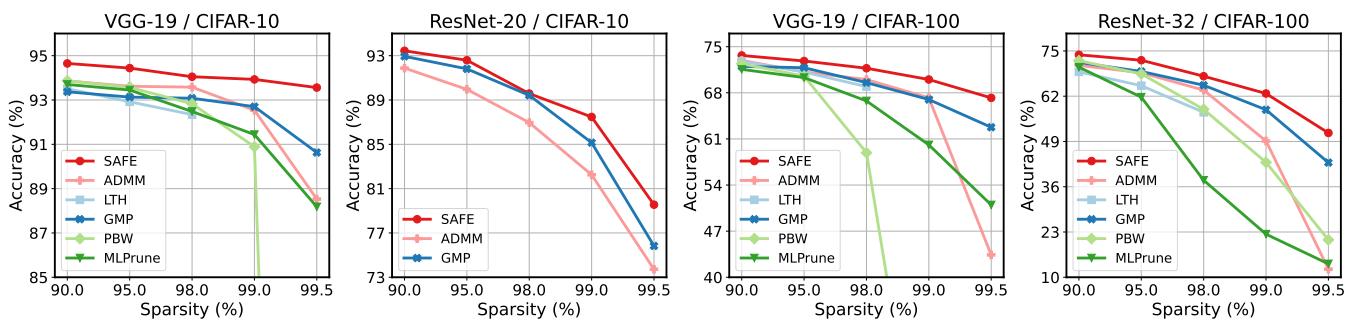
The graphs in Figure 2 tell a compelling story, particularly at extreme sparsity levels.
- Look at the red lines (SAFE). They consistently stay higher than the baselines as sparsity increases.
- At 99% sparsity (meaning only 1% of weights remain!), standard methods like MLPrune (green) and PBW drop off a cliff. SAFE maintains significantly higher accuracy.
This suggests that when you have very few parameters to work with, it becomes critical that those parameters sit in a stable, flat region of the loss landscape.
For a detailed numerical breakdown, we can look at the validation accuracy table:
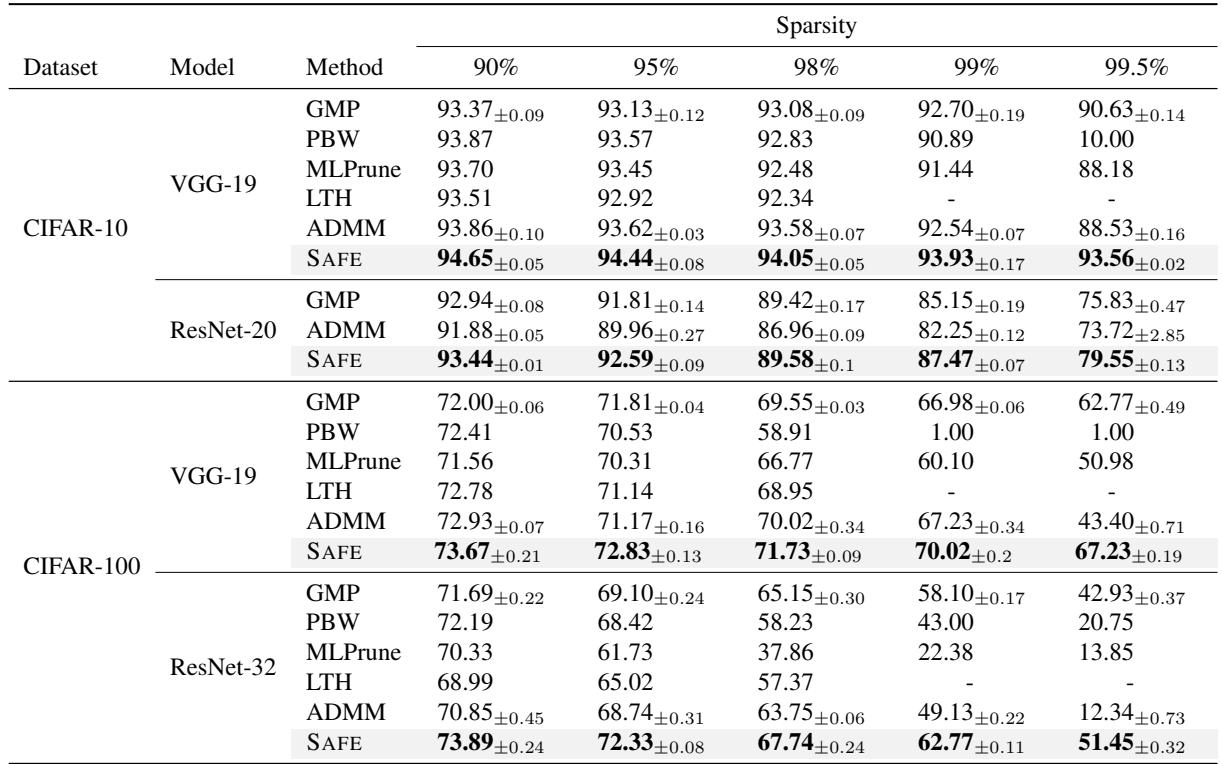
On ResNet-20 (CIFAR-10) at 99.5% sparsity, SAFE achieves 79.55% accuracy, whereas standard ADMM fails dramatically (73.72% with high variance), and other methods plummet.
Pruning Large Language Models (LLMs)
Perhaps the most relevant test for today’s AI landscape is applying SAFE to Transformers. The authors adapted SAFE+ (using the Wanda metric for the projection step) to prune LLaMA-2 and LLaMA-3 models.
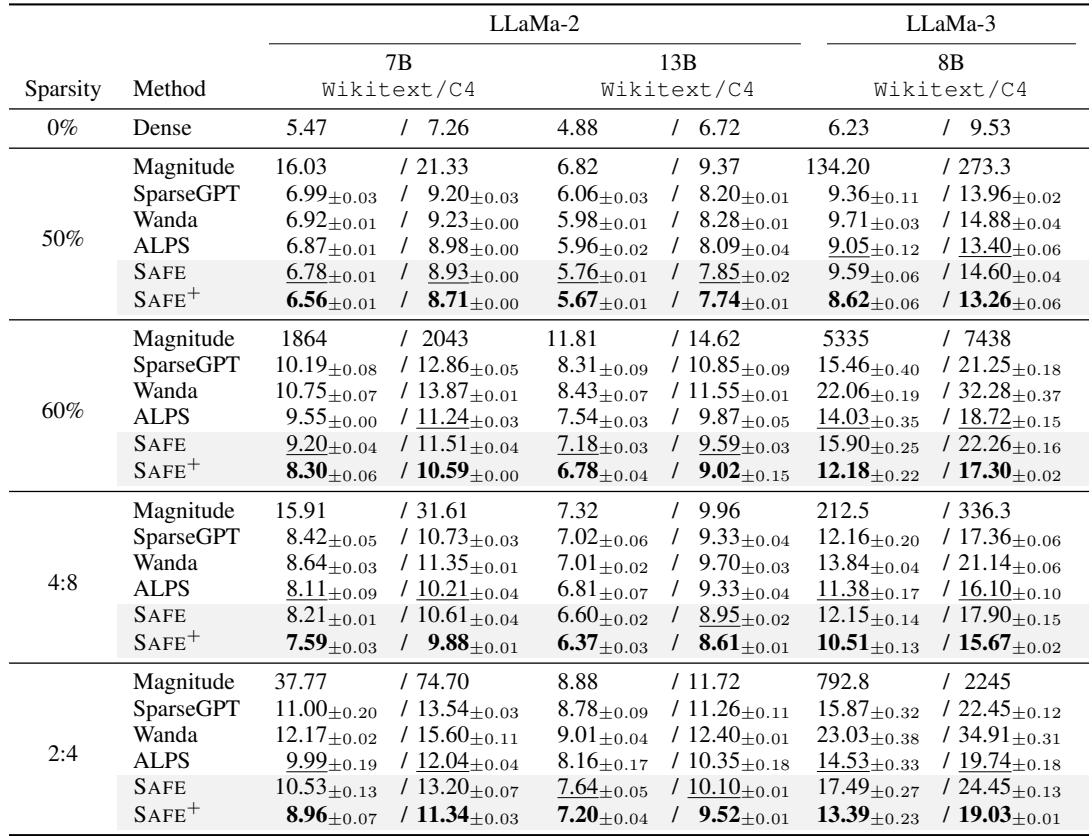
In Table 1, lower perplexity is better.
- SAFE+ consistently outperforms baselines like SparseGPT and standard Wanda across different model sizes (7B, 13B, 8B) and sparsity levels (50%, 60%, 2:4 structured).
- For example, on LLaMA-2-7B at 50% sparsity, SAFE+ achieves a perplexity of 6.56, beating SparseGPT (6.99) and even the dense baseline in some configurations (though direct comparison to dense is nuanced due to calibration data).
This demonstrates that SAFE is not just a theoretical curiosity for small CNNs; it scales to modern Foundation Models.
Robustness to Noise
One of the theoretical benefits of flat minima is robustness. The authors tested this by training on noisy labels (incorrectly labeled data).
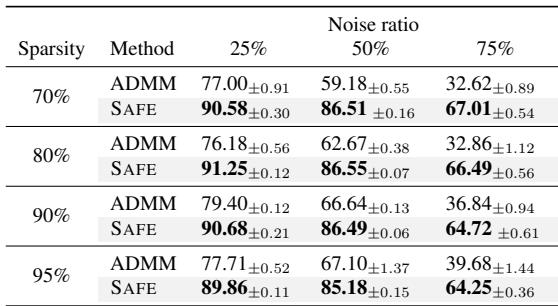
Table 2 is striking. When 50% of the training labels are corrupted (noise ratio 50%), standard ADMM pruning yields only 59-67% accuracy depending on sparsity. SAFE achieves roughly 86% accuracy.
Because SAFE seeks flat regions, it naturally ignores the “sharp” erratic minimizers created by mislabeled data, focusing instead on the broader patterns that represent the true signal.
Ablation Studies: What Matters?
The authors performed careful ablation studies to understand the hyperparameters. One critical factor is the penalty parameter \(\lambda\) (lambda).
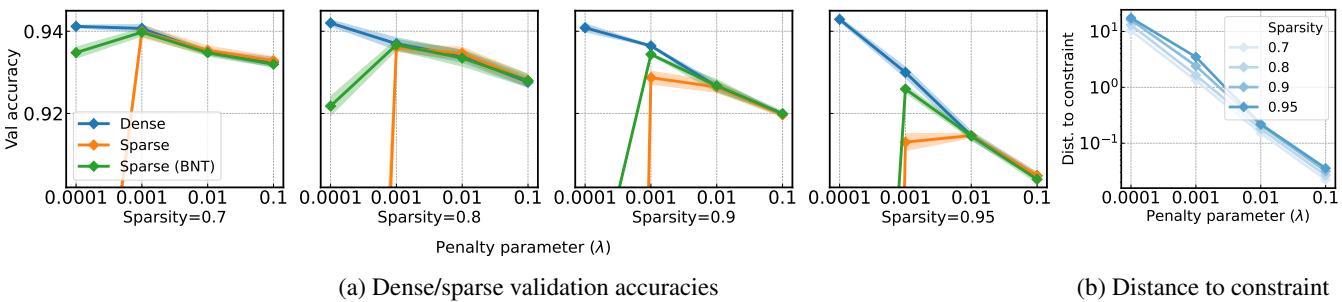
As shown in Figure 3, \(\lambda\) controls the trade-off.
- Small \(\lambda\): The constraint is loose. The model stays accurate (dense accuracy is high) but fails to become truly sparse (distance to constraint is high).
- Large \(\lambda\): The model is forced strictly to sparsity, but the aggressive penalty can hurt the original dense performance.
- The sweet spot lies in the middle, and using a scheduler (gradually increasing \(\lambda\)) helps the model learn first and sparsify later.
Conclusion
The paper “SAFE: Finding Sparse and Flat Minima to Improve Pruning” provides a principled answer to the problem of model compression. It argues successfully that we should not optimize for sparsity in isolation.
By viewing pruning through the lens of loss landscape geometry, the researchers developed a method that:
- Mathematical Rigor: Uses Augmented Lagrangian to mathematically enforce flatness and sparsity simultaneously.
- Flexibility: Can be extended via Generalized Projections (SAFE+) to incorporate modern pruning metrics for LLMs.
- Performance: Delivers superior accuracy at high sparsity and remarkable robustness to noisy data.
For students and practitioners, SAFE highlights a crucial lesson: in Deep Learning, how you arrive at a solution (the path through the landscape) is often just as important as the solution itself. A sparse network is good, but a sparse, flat network is safe.