](https://deep-paper.org/en/paper/2506.07087/images/cover.png)
Introduction
In nature, survival often depends on the ability to disappear. From the leaf-tailed gecko blending into tree bark to the arctic hare vanishing into the snow, camouflage is a sophisticated evolutionary biological mechanism designed to evade predators. In the world of Computer Vision, replicating the predator’s ability to spot these hidden creatures is known as Camouflaged Object Detection (COD).
COD is significantly harder than standard object detection. The targets share similar textures, colors, and patterns with the background, making boundaries incredibly difficult to discern. While fully supervised deep learning methods have made strides in this area, they come with a heavy cost: they require massive datasets with pixel-perfect human annotations. Labeling a camouflaged object is laborious and expensive because the objects are, by definition, hard to see.
This brings us to the frontier of Unsupervised Camouflaged Object Detection (UCOD)—teaching AI to spot hidden objects without being told explicitly where they are. A recent paper, “UCOD-DPL: Unsupervised Camouflaged Object Detection via Dynamic Pseudo-label Learning,” proposes a novel framework that not only tackles this challenge but achieves performance rivaling some fully supervised methods.
In this post, we will break down how the authors achieved this using a “Teacher-Student” framework, a clever way of mixing knowledge, and a mechanism that mimics how humans “zoom in” to spot details.
The Problem with Current Unsupervised Methods
To train a model without human labels, researchers often rely on pseudo-labels. These are “fake” ground-truth masks generated by algorithmic strategies (like analyzing pixel similarities or background variances).
Existing UCOD methods usually follow a rigid pipeline:
- Take an image.
- Use a fixed strategy (a pre-defined algorithm) to guess where the object is.
- Use that guess as the ground truth to train a simple neural network (often just a \(1 \times 1\) convolutional layer).
The authors of UCOD-DPL identified two fatal flaws in this approach, as illustrated below.
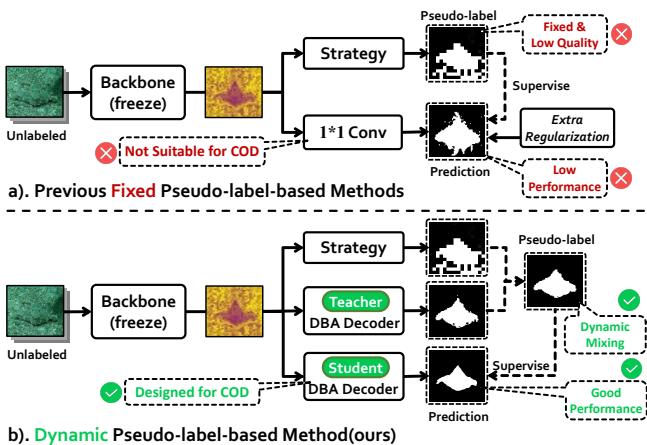
1. Noisy Knowledge: The fixed strategies are not perfect. They often generate masks with significant noise. If a model treats these noisy masks as absolute truth, it learns incorrect information that it can never correct.
2. The Resolution Limit: Simple decoders and fixed strategies often result in low-resolution outputs. They fail to capture the semantic complexity of camouflaged objects, leading to a “blobby” output that misses fine details, especially for small objects.
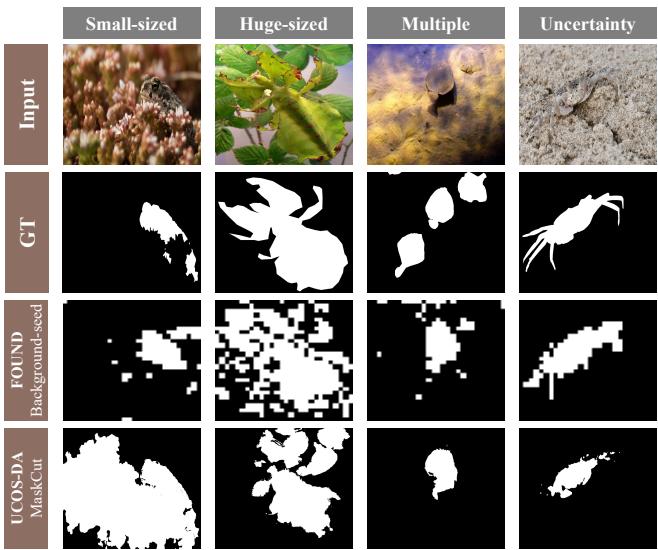
As shown in Figure 2 above, fixed strategies (like “Background-Seed” or “MaskCut”) often produce fragmented or blocky labels. The proposed method (UCOD-DPL) aims to generate sharp, accurate segmentation maps, even in challenging scenarios.
The UCOD-DPL Framework
To solve these issues, the researchers propose a Teacher-Student framework augmented with three key innovations:
- Adaptive Pseudo-label Mixing (APM)
- Dual-Branch Adversarial (DBA) Decoder
- Look-Twice Refinement Strategy
Let’s look at the high-level architecture before diving into the details.

The system uses a Student model (which we want to train) and a Teacher model (an exponential moving average of the student). Instead of relying solely on the noisy “Fixed Strategy” pseudo-labels, the system dynamically mixes them with the Teacher’s predictions to create a better training target.
1. Adaptive Pseudo-label Mixing (APM)
The core philosophy here is trust management.
At the beginning of training, the neural network (Teacher/Student) knows nothing. Its predictions are random garbage. During this phase, the “Fixed Strategy” (heuristic algorithms), despite being noisy, is the most reliable source of truth.
However, as training progresses, the Teacher model starts learning semantic features of the camouflaged objects. Eventually, the Teacher becomes smarter than the fixed strategy. The Adaptive Pseudo-label Mixing (APM) module manages this transition.
The Discriminator
The authors introduce a Discriminator (\(\mathcal{D}\)) designed to tell the difference between the fixed pseudo-label (\(\hat{P}_i^{fs}\)) and the student’s prediction (\(\hat{Y}_i^{FG}\)).

The discriminator outputs a probability score (\(\hat{y}\)) indicating how likely a mask is to be from the fixed strategy.
The Scoring Function
A dynamic scoring function, \(S\), determines the mixing weight. This function includes a time constraint (based on the current epoch \(t\)) and a cosine similarity term.

- Early Training: The score leans towards the fixed strategy because the model isn’t ready yet.
- Late Training: The score leans towards the Teacher’s predictions, allowing the model to “self-correct” the noise found in the fixed strategy.
The Mixing
Finally, the system calculates a weight \(W_i^t\) and mixes the Teacher’s pseudo-label (\(\hat{P}_i^t\)) with the fixed pseudo-label (\(\hat{P}_i^{fs}\)) to create the final dynamic pseudo-label \(P_i\).
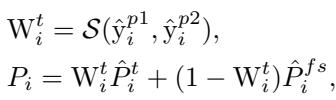
This dynamic label \(P_i\) is what supervises the Student model. This clever mechanism prevents the model from overfitting to the initial noisy data while ensuring it has a stable starting point.
To train the discriminator itself, a standard binary cross-entropy loss is used:

2. Dual-Branch Adversarial (DBA) Decoder
In previous methods, a simple convolutional layer was used to predict the mask. This is insufficient for camouflage, where foreground and background pixels are visually nearly identical. The authors propose the Dual-Branch Adversarial (DBA) Decoder to explicitly force the model to separate foreground features from background features.
Splitting the Features
First, the features (\(F_i\)) extracted from the backbone (DINOv2) are split into two separate streams: one for the Foreground (\(FG\)) and one for the Background (\(BG\)).

Learned Embeddings and Attention
The model maintains learnable embeddings (\(E_{FG}\) and \(E_{BG}\)) that store “knowledge” about what foregrounds and backgrounds generally look like. These are used to calculate attention queries (\(Q\)).

These queries help the model focus on specific regions of the feature map. The system then generates two distinct masks: one predicting the foreground and one predicting the background.

The Adversarial Twist (Orthogonal Loss)
Here is the genius part: typically, if you have two branches, they might accidentally learn similar features. To prevent this, the authors apply an Orthogonal Loss (\(\mathcal{L}_{\perp}\)). This mathematical constraint forces the Foreground Attention Map and the Background Attention Map to be as different as possible.
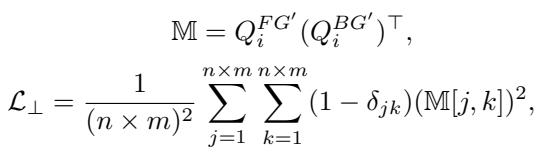
If the foreground branch looks at the object, the background branch must look elsewhere. This adversarial pressure helps the model disentangle the object from its surroundings.
The segmentation loss combines the predictions from both branches against the dynamic pseudo-label:

3. Look-Twice Refinement
Even with a great decoder, small camouflaged objects are hard to spot because they occupy very few pixels on the feature map. Inspired by human behavior—where we spot a speck and then lean in closer to see what it is—the authors devised the Look-Twice strategy.
Step 1: Identify Candidates
The model looks at its initial coarse prediction and finds connected components (blobs) that might be objects.

Step 2: Calculate Ratios
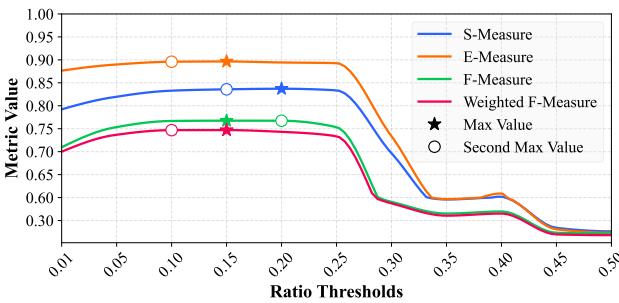
It calculates the area ratio of these blobs. If a blob is too small (below a threshold \(\tau\), set to 0.15), it is flagged for refinement.
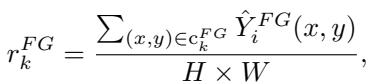
Step 3: Zoom and Refine
The system crops the image around this small object, enlarging it to the input size (effectively “zooming in”). It ensures enough background context is included by calculating an expansion scale.

This zoomed-in patch is fed back into the network to get a high-resolution prediction, which is then pasted back onto the original coarse mask. This significantly sharpens the boundaries of small insects or distant animals.
The total loss function combines the segmentation, orthogonal, and discriminator losses:

Experiments and Results
The authors evaluated UCOD-DPL on four benchmark datasets (CHAMELEON, CAMO, COD10K, and NC4K) using standard metrics like S-measure and F-measure. They used the powerful DINOv2 as the backbone for feature extraction.
Quantitative Superiority
The results are impressive. As seen in Table 1, UCOD-DPL (Ours) outperforms all other unsupervised methods. More surprisingly, it even beats several semi-supervised and fully-supervised methods.
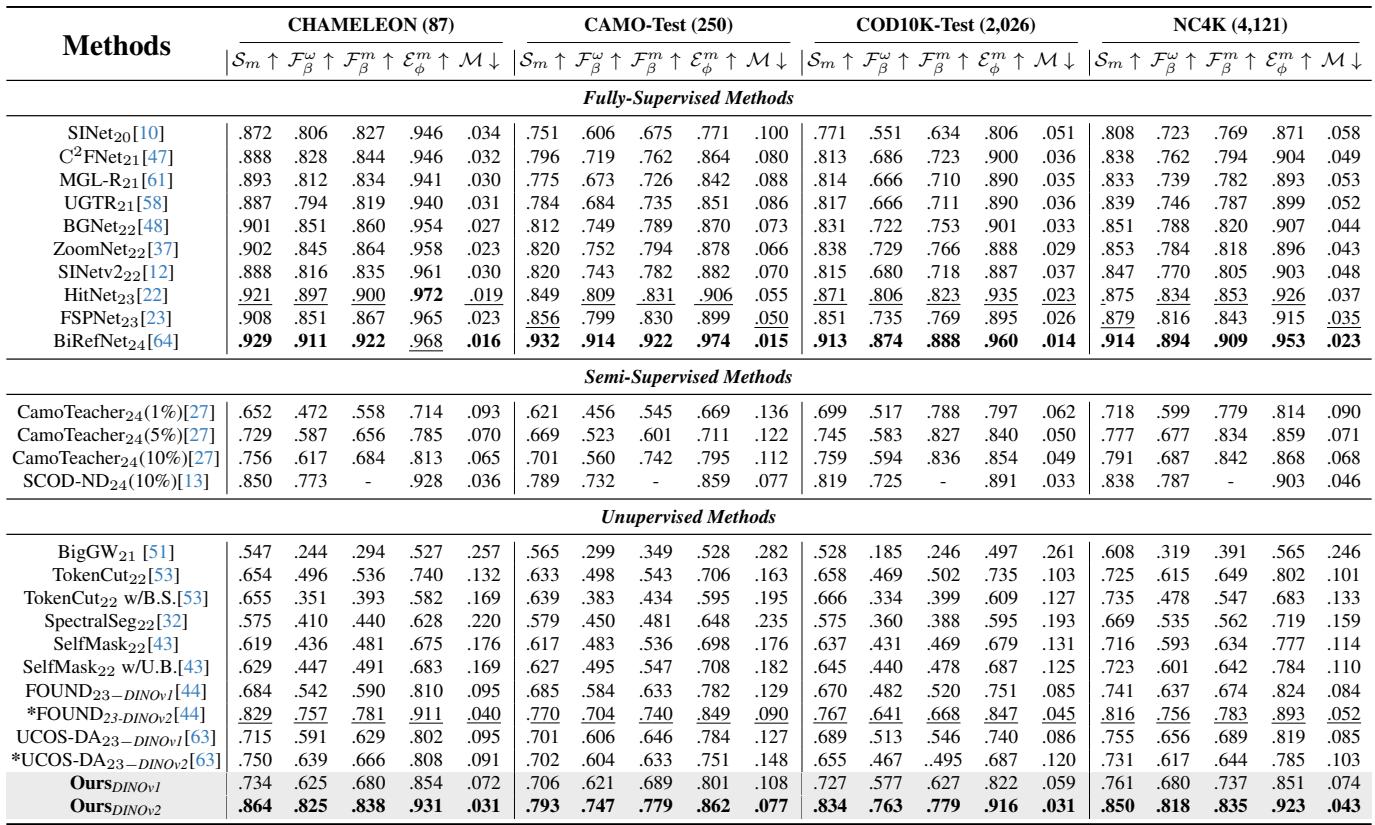
For example, on the challenging COD10K dataset, the DINOv2 version of UCOD-DPL achieves an S-measure (\(\mathcal{S}_m\)) of 0.834, significantly higher than the previous best unsupervised method (FOUND at 0.767).
Visual Quality
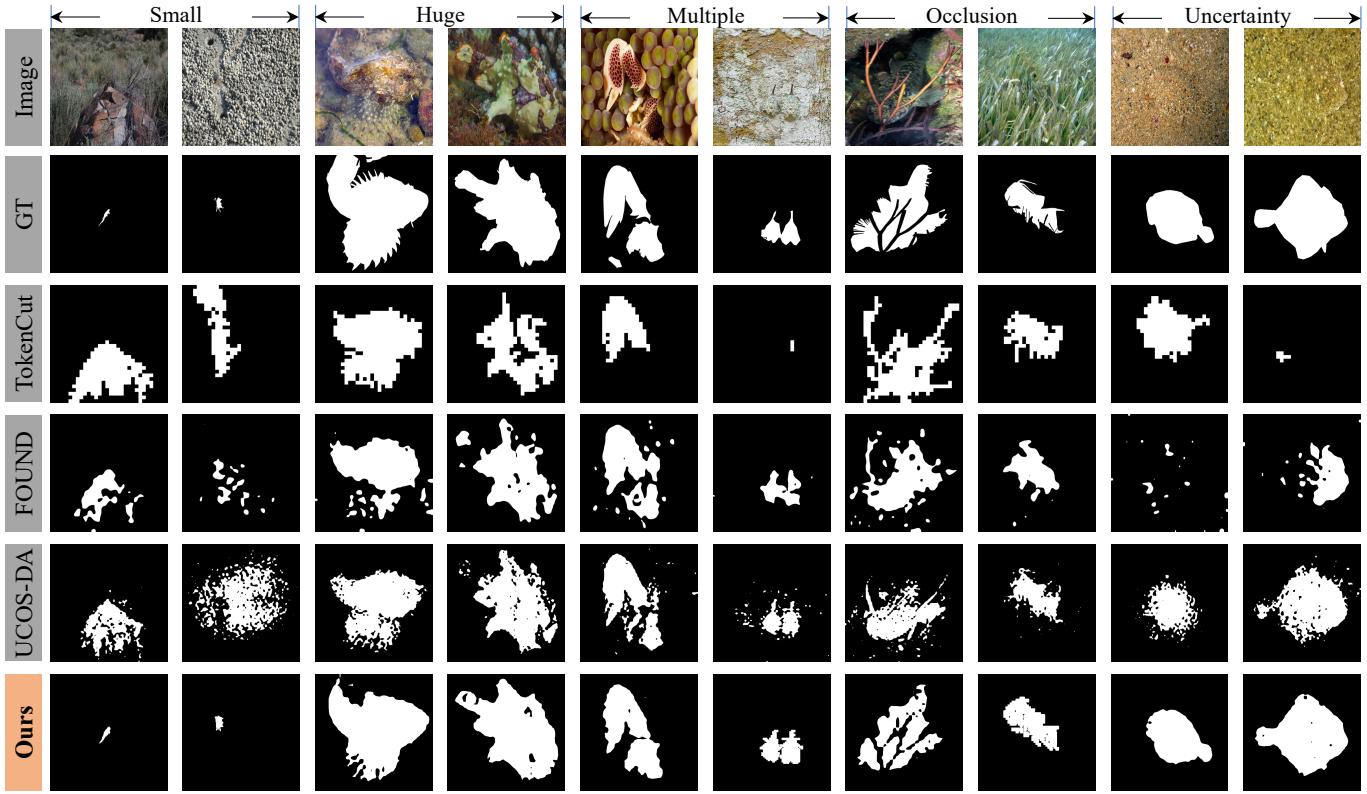
The numbers are backed up by visual evidence. Figure 4 below shows how UCOD-DPL handles complex scenarios involving underwater creatures and occlusion. While other methods produce noisy scattered pixels or miss the object entirely, UCOD-DPL produces a clean, cohesive mask.
Ablation Studies
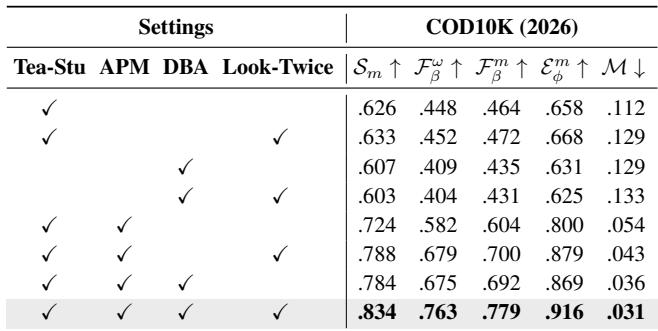
To prove that every component matters, the authors performed ablation studies.
- Without APM: The model relies too much on fixed labels or noisy teacher predictions, dropping performance.
- Without DBA: The simple decoder fails to separate the object from the background texture.
- Without Look-Twice: Performance on small objects suffers.
Table 2 highlights that the combination of all three yields the highest scores.
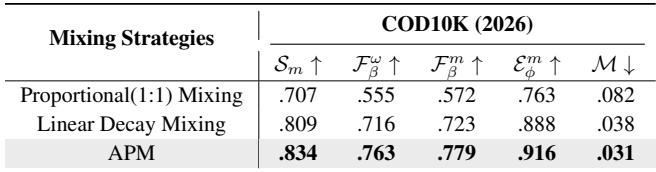
Furthermore, Table 3 proves that the proposed Adaptive Pseudo-label Mixing (APM) is superior to simple averaging or linear decay strategies.
Robustness on Object Sizes
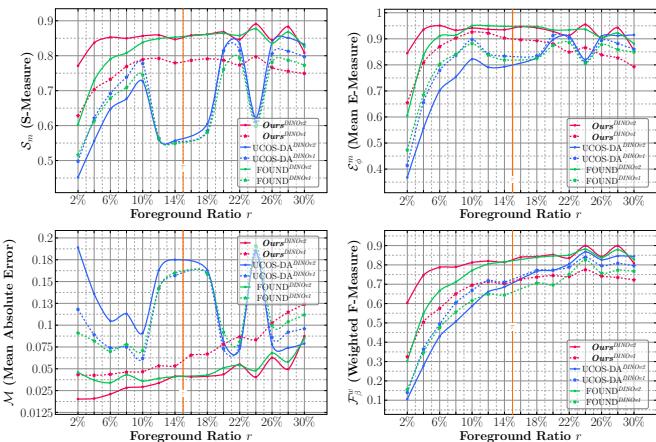
A key claim of this paper is improved performance on small objects. The graph below (Figure 6) plots performance against foreground size. The blue line (Ours) consistently stays above competitors, particularly on the left side of the graphs, which represents smaller object ratios.
The authors also analyzed the hyper-parameter \(\tau\) (the threshold for defining “small” objects) and found that 0.15 was the sweet spot for triggering the Look-Twice mechanism.
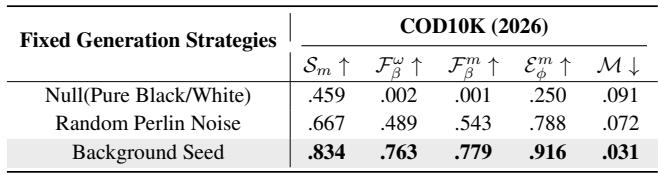
Finally, they tested different “Fixed Strategies” to initialize the APM. Interestingly, using a “Background Seed” strategy worked best. Using random noise or blank masks failed, confirming that the model needs some reasonable starting point to bootstrap the self-learning process.
Conclusion
The UCOD-DPL paper presents a significant leap forward in unsupervised computer vision. By acknowledging the limitations of fixed heuristics and designing a system that “grows” out of them, the authors have created a model that learns to see the unseen.
The combination of Adaptive Pseudo-label Mixing (to handle label noise), the Dual-Branch Adversarial Decoder (to untangle foreground from background), and the Look-Twice mechanism (to handle scale) creates a robust pipeline. The fact that it outperforms some fully supervised methods suggests that with the right architectural biases, self-supervised learning can effectively unlock the complex patterns of camouflage without needing a single human annotation.
For students and researchers, this paper serves as an excellent case study in how to design systems that are robust to noisy data—a skill that is becoming increasingly vital in the age of large-scale, unlabeled datasets.