](https://deep-paper.org/en/paper/2506.07376/images/cover.png)
Introduction
Imagine you have trained a powerful AI model to segment objects in everyday photographs—identifying pedestrians, cars, and trees in city scenes. Now, you want to take that same model and ask it to identify tumors in a chest X-ray or specific land types in satellite imagery. This is the challenge of Cross-Domain Few-Shot Segmentation (CD-FSS).
You face two massive hurdles:
- The Domain Gap: An X-ray looks nothing like a street photo. The statistical distribution of the data is completely different.
- Data Scarcity: You might only have one or five annotated examples (shots) of the new target class.
Traditionally, researchers try to bridge this gap using complex loss functions to force the model to learn “domain-invariant” features—universal patterns that apply everywhere. However, a new research paper, Adapter Naturally Serves as Decoupler for Cross-Domain Few-Shot Semantic Segmentation, proposes a fascinating alternative.
The researchers discovered that we might not need complicated loss functions to separate specific domain styles from general content. Instead, the structure of the network itself—specifically the use of “Adapters”—can naturally act as a decoupler.
In this deep dive, we will explore how a simple architectural change can force a model to separate “style” from “content,” allowing it to adapt to radically different environments with barely any data.
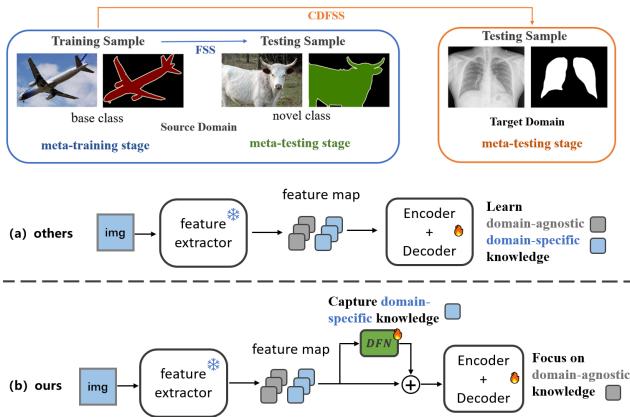
The Background: What is CD-FSS?
Before understanding the solution, we need to solidify the problem.
Few-Shot Segmentation (FSS) is a task where a model must segment a new class of objects given only a few reference images (support set) and an image to segment (query set). In standard FSS, the training and testing images come from the same dataset (e.g., all natural images).
Cross-Domain FSS (CD-FSS) adds a layer of difficulty. We pre-train the model on a “Source Domain” (like PASCAL VOC, containing common objects) and test it on a “Target Domain” (like medical or satellite imagery).
The standard approach uses a backbone (usually a fixed, pre-trained feature extractor like ResNet) followed by an Encoder-Decoder architecture. The Encoder-Decoder is supposed to learn how to match the support image to the query image. However, because of the massive domain gap, the Encoder often gets distracted by the specific “style” of the source domain, failing to generalize to the target.
The Core Insight: The Adapter as a Decoupler
The authors of this paper revisited Adapters. In deep learning, an adapter is usually a small, learnable module inserted into a large, frozen pre-trained network. They are typically used for parameter-efficient fine-tuning (PEFT)—allowing a huge model to learn a new task without retraining every single weight.
However, the researchers noticed something peculiar. When they inserted adapters into their CD-FSS framework, the adapters didn’t just help with fine-tuning; they fundamentally changed what the rest of the network was learning.
The Phenomenon
To test this, the researchers set up an experiment measuring CKA (Centered Kernel Alignment) similarity. CKA is a metric used to compare the representations (features) of neural networks.
- Low CKA: Indicates the features contain a lot of domain-specific information (the domains look different to the model).
- High CKA: Indicates domain-agnostic information (the model sees the underlying structure regardless of the domain).
They looked at two specific points in the network, as shown in the figure below: the output of the fixed backbone (Stage-4) and the output of the learnable Encoder.
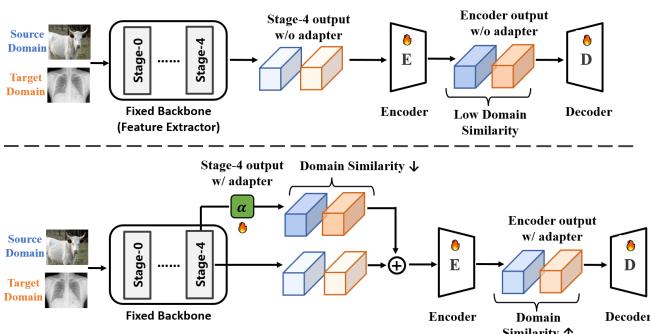
The results were striking. When they attached an adapter to the backbone:
- The similarity at the backbone level decreased. This means the adapter was aggressively capturing the specific “style” or domain information of the source data.
- Crucially, the similarity at the Encoder output increased. Because the adapter “absorbed” the specific domain noise, the subsequent Encoder was free to learn general, domain-agnostic patterns.
This leads to the paper’s primary contribution: The adapter naturally serves as a domain information decoupler.
Why Does This Happen?
Is it magic? Not quite. The researchers break down the two factors that enable this behavior: Position and Structure.
1. Position Matters
The researchers found that this decoupling effect only happens when the adapter is inserted into the deeper layers of the backbone.
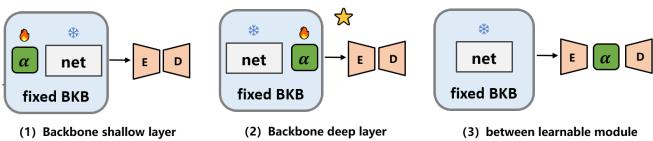
In deep neural networks, shallow layers (early in the network) capture simple features like edges and textures. Deep layers capture complex, semantic information. For cross-domain tasks, the “domain style” often resides in these complex, high-level semantic features.
By placing the adapter deep in the backbone (Position 2 in Figure 3), the adapter is positioned perfectly to capture these high-level domain-specific features. If placed in shallow layers, it fails to act as a decoupler because the features aren’t semantic enough yet.
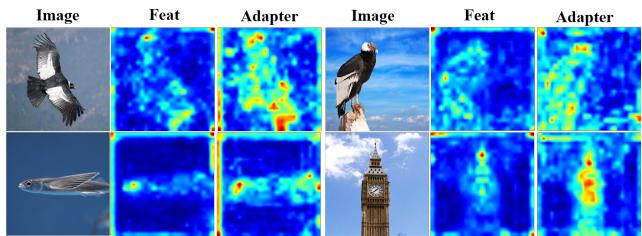
The visualizations below confirm this. Look at the “Adapter” column. The heatmaps show the adapter focusing on highly specific, complex features (like the texture of the eagle’s wings or the clock face), essentially “subtracting” this complexity so the rest of the model doesn’t have to worry about it.
2. Structure Matters: The Residual Connection
The second requirement is the connection type. The researchers compared “Serial” connections (passing data through the adapter) vs. “Residual” connections (adding the adapter’s output to the original data).
They found that the Residual Connection is essential. It explicitly separates the signal into two paths:
- Path A (Backbone): Carries general information.
- Path B (Adapter): Learns the “delta” or the specific domain deviations.
When these are added together, the adapter effectively “grabs” the domain-specific signal, leaving the parallel path (and subsequent modules) cleaner.
The Proposed Method: Domain Feature Navigator (DFN)
Building on these insights, the authors propose a specific architecture called the Domain Feature Navigator (DFN).
The DFN is essentially a strategically placed adapter designed to scrub domain-specific information from the features before they reach the correlation and decoding stages.
How DFN Works
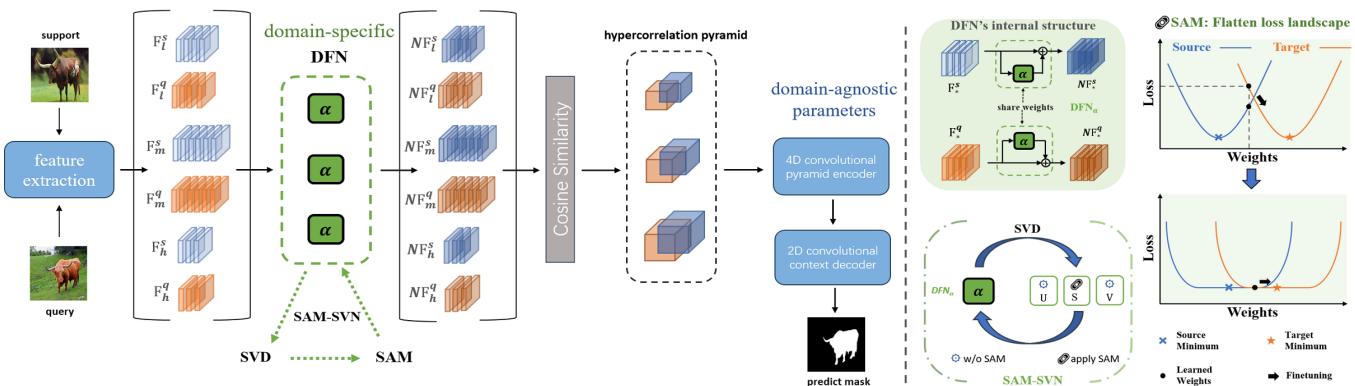
The workflow is illustrated in the detailed architecture diagram below:
- Input: Support and Query images are fed into a fixed Feature Extractor (Backbone).
- Navigation: The features pass through the DFN (highlighted in green). The DFN absorbs the domain-specific quirks.
- Correlation: The “cleaned” features (Navigated Features) are compared using cosine similarity to create a correlation tensor.
- Prediction: An Encoder-Decoder creates the final mask based on these clean correlations.
Mathematically, the DFN operation is a residual addition. If \(F\) is the feature map, the Navigated Feature (\(NF\)) is:
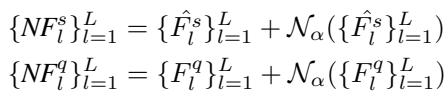
Here, \(\mathcal{N}_{\alpha}\) represents the DFN module. By training this on the source domain, the DFN learns to capture source-specific noise. The Encoder-Decoder is then forced to learn parameters that work on the “clean” data, making it much better at generalizing to new target domains later.
The Refinement: SAM-SVN
There is a risk with this approach. If the DFN becomes too good at absorbing information during source training, it might overfit. Specifically, it might memorize specific samples rather than just the general domain style.
If the DFN overfits to specific source images, it becomes rigid. When we try to fine-tune it on the target domain (where we have very few images), it won’t adapt well.
To solve this, the authors introduce SAM-SVN.
What is SAM?
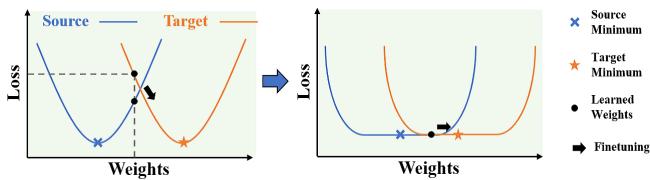
SAM (Sharpness-Aware Minimization) is an optimization technique. In standard training, we just want to find the lowest point on the loss curve (minimum error). However, some low points are “sharp valleys”—if the data shifts slightly (like moving to a new domain), the error skyrockets. SAM looks for “flat valleys”—areas where the error is low and stays low even if you perturb the weights slightly.
Why SVN (Singular Value Navigator)?
Applying SAM to the whole network is computationally expensive and might prevent the DFN from doing its main job (absorbing domain info).
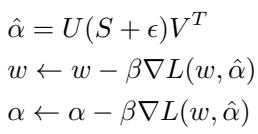
The authors realized that Singular Values in a matrix often control the “energy” or importance of different features. By performing Singular Value Decomposition (SVD) on the DFN weights:
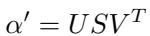
They apply SAM only to the singular value matrix (\(S\)). This constrains the complexity of the features the DFN can learn, preventing it from memorizing specific samples (overfitting) while still allowing it to capture the broader domain style.
The update rule looks like this, where they perturb \(S\) to find a robust configuration:
This creates a flattened loss landscape, ensuring the DFN is robust and ready for efficient fine-tuning on the target domain.
Experiments and Results
The authors evaluated their method on the standard CD-FSS benchmark. They trained on Pascal VOC (Source) and tested on four radically different target datasets:
- FSS-1000 (General objects)
- DeepGlobe (Satellite imagery)
- ISIC (Skin lesions)
- Chest X-ray (Medical imaging)
Quantitative Performance
The results were impressive. The proposed method (DFN + SAM-SVN) outperformed state-of-the-art methods like PATNet and APSeg.
For example, in the 1-shot scenario (where the model sees only ONE example of the new class), the method achieved significant gains.
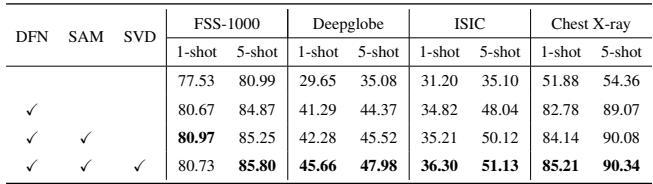
(Note: While the table above shows the ablation study confirming that both DFN and SAM-SVN contribute to success, the main comparison in the paper shows a 2.69% improvement over the previous best method).
Qualitative Results
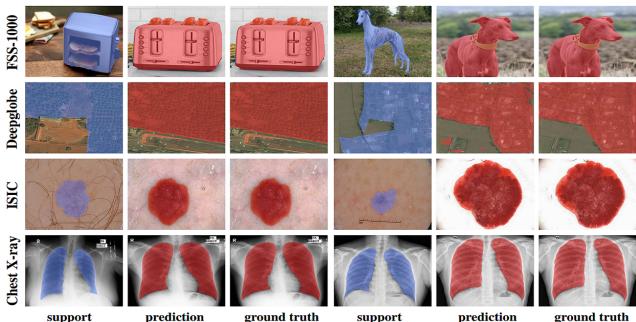
Numbers are great, but visual segmentation masks tell the real story. In the figure below, you can see the model’s predictions (Red) versus the Ground Truth (White/Blue outlines).
Even in difficult domains like satellite imagery (Row 2) or X-rays (Row 4), the model accurately segments the target areas using just a single support example.
Visualizing the Decoupling
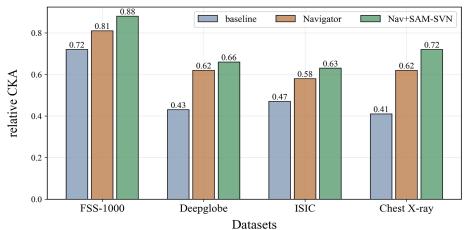
To prove that their method truly creates “domain-agnostic” features, the researchers measured the Relative CKA of the encoder output. A higher bar means the features are less tied to the specific domain and more universal.
As shown in the chart below, adding the Navigator (DFN) significantly increases this metric compared to the baseline, and adding SAM-SVN improves it further. This confirms that the Encoder is learning more generalized representations.
Stability and Robustness
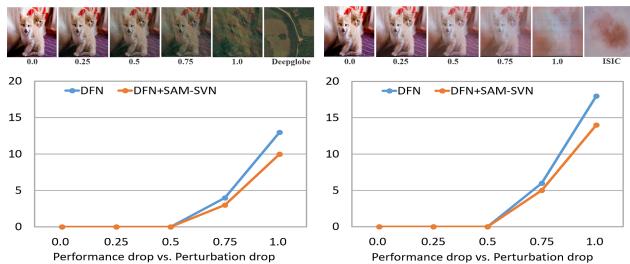
Finally, the authors showed that SAM-SVN makes the model more stable. By flattening the loss landscape, the model is less sensitive to the learning rate during fine-tuning and less sensitive to perturbations in the input images.
Conclusion
The paper Adapter Naturally Serves as Decoupler offers a refreshing perspective on neural network architecture. Rather than relying solely on complex mathematical loss functions to force domain adaptation, the authors show that structure dictates function.
By simply placing a residual adapter (the DFN) in the deep layers of a backbone, the network naturally splits into two paths: one that absorbs the specific “style” of the domain, and one that learns the universal “content.”
Key takeaways:
- Adapters are Decouplers: When placed deep with residual connections, they absorb domain-specific noise.
- DFN Architecture: Explicitly leverages this to clean features before they reach the classifier.
- SAM-SVN: A clever optimization trick using SVD to prevent the adapter from overfitting to specific samples, ensuring it remains a generalizable tool.
This work suggests that as we move toward more general-purpose AI, the layout of our networks might be just as important as the data we feed them. For students and researchers in computer vision, it highlights the importance of looking at where modules are placed, not just what they are.