](https://deep-paper.org/en/paper/2506.08371/images/cover.png)
Unlocking the Vault: How Positional Contrastive Decoding Fixes Long-Context Amnesia in LLMs
If you have played with the latest Large Language Models (LLMs) like Llama-3 or GPT-4, you have likely noticed the massive context windows they advertise—128k, 200k, or even a million tokens. Theoretically, you could paste an entire Harry Potter book into the prompt and ask a specific question about a minor character in Chapter 3.
But in practice, reality often falls short of the marketing. As the text gets longer, the model’s ability to retrieve specific details degrades. It might hallucinate, give vague answers, or simply fixate on the most recent text it saw, ignoring the critical information buried in the middle of the document.
This phenomenon is a major bottleneck in deploying LLMs for legal analysis, long-form summarization, and complex reasoning. While many researchers try to fix this by retraining models (which is incredibly expensive), a new paper titled “Mitigating Posterior Salience Attenuation in Long-Context LLMs with Positional Contrastive Decoding” proposes a clever, training-free solution.
In this post, we will break down their discovery of Posterior Salience Attenuation (PSA) and their solution, Positional Contrastive Decoding (PCD). We will explore how subtracting “local noise” from the model’s decision-making process can significantly boost its long-term memory.
The Problem: The “Lost in the Middle” Phenomenon
To understand the solution, we first need to understand specifically how models fail when the context gets long.
Common wisdom suggests that models just “forget.” However, the researchers found something more nuanced. They analyzed the internal probabilities (logits) of the model as it tried to answer questions based on long texts.
They discovered that the model often does encode the correct answer. The correct token (the “gold token”) is usually hovering near the top of the probability list. However, as the context length increases, the model becomes less confident in that gold token compared to other, irrelevant tokens that appear closer to the end of the prompt.
Posterior Salience Attenuation (PSA)
The authors coined the term Posterior Salience Attenuation (PSA) to describe this behavior.
Mathematically, they define a “Salience Score” (\(S(L)\)) which essentially measures how highly ranked the correct answer is among all possible words in the vocabulary.

Here is what happens to that score as context length grows:
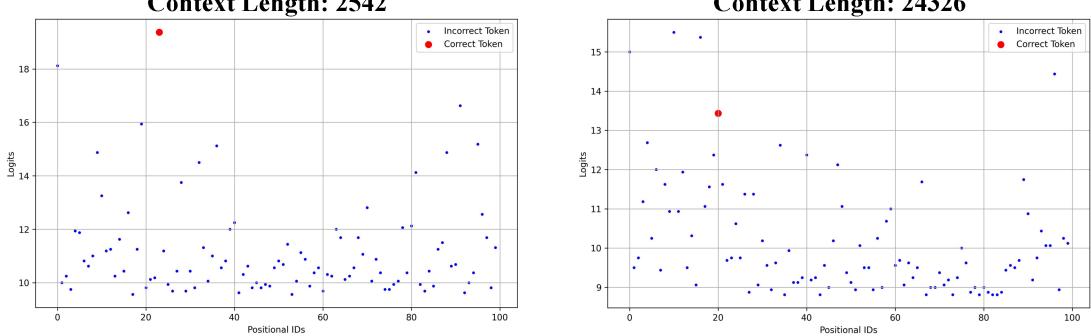
In the visualization above, look at the red dots (the correct tokens). In a short context (left), the red dot is high up on the Y-axis (high logit value), meaning the model is confident. In a long context (right), the red dot sinks. It is still there, but it is drowning in a sea of blue dots (incorrect tokens).
The researchers found that despite this attenuation, the gold token rarely falls off the map completely. It usually remains in the top 0.006% of the vocabulary rankings. The model knows the answer is a candidate, but it gets distracted by “proximal bias”—the tendency to prefer tokens that are structurally or spatially closer to the query.
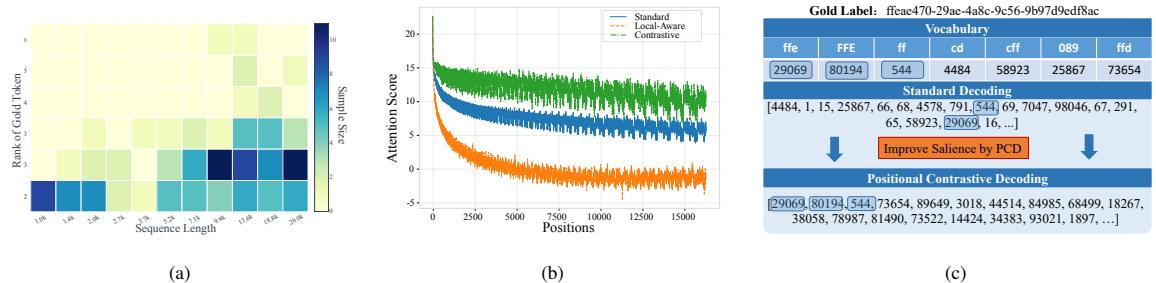
As shown in Figure 3(a) above, the darker blue areas show that for most samples, the gold token is ranked very high (ranks 1-6), even at long sequences. The information is there; the decoding strategy just isn’t picking it.
The Solution: Positional Contrastive Decoding (PCD)
If the model is distracted by “local” noise (information near the query) and is suppressing the “distant” signal (the actual answer from 20,000 tokens ago), how do we fix it?
The researchers propose Positional Contrastive Decoding (PCD). The intuition is simple:
- Calculate the model’s standard prediction (which contains both long-term signal and short-term noise).
- Calculate a “Local-Aware” prediction (which captures only the short-term noise).
- Subtract the second from the first.
By subtracting the “local-only” view from the “standard” view, you theoretically cancel out the recency bias, leaving behind a cleaner signal that highlights the long-range dependencies.
Step 1: Standard Attention (The Long-Aware View)
Most modern LLMs use Rotary Position Embeddings (RoPE). RoPE encodes the position of a token by rotating its vector in the embedding space. The “frequency” of this rotation determines how the model perceives distance.
The standard attention computation looks like this:

Here, \(\mathbf{q}\) and \(\mathbf{k}\) are the query and key vectors rotated by matrix \(R\). This matrix uses specific frequencies \(\theta\) to help the model understand that token A is far away from token B.
Step 2: Designing the “Local-Aware” Attention
This is the clever part of the paper. To perform contrastive decoding, we need a version of the model that sucks at long-term memory but is great at short-term memory.
The authors achieve this by “over-rotating” the RoPE frequencies.
In RoPE, lower frequencies handle global (long-distance) patterns, while high frequencies capture local details. The authors create a Local-Aware attention mechanism by forcing the low-frequency components to rotate much faster than they usually would.
They use a transition function \(T\) to modify the angles \(\theta\):

By lowering the base frequency and applying this transition, they create a set of logits (\(\mathbf{L}^*\)) that are hypersensitive to local context but oblivious to long-range context.

Step 3: The Contrastive Subtraction
Now we have two sets of predictions:
- \(\mathbf{L}\) (Standard): “I think the answer is X, but I’m distracted by recent text Y.”
- \(\mathbf{L}^*\) (Local-Aware): “I definitely think the answer is Y because it’s right next to me.”
PCD combines them using this formula:

Here, \(\beta\) is a hyperparameter (usually around 2.5).
- We take the standard logits (\(L\)).
- We subtract the local-aware logits (\(L^*\)) weighted by \(\beta\).
- We add back a scaling factor \((1+\beta)\) to keep the numbers normalized.
This operation effectively penalizes tokens that are only high-probability because of local bias. If a token is favored by both the standard and local views, its score drops. If a token is favored by the standard view but ignored by the local view (typical of a long-distance answer), its score shoots up.
Visualizing the Process
Let’s look at the architectural diagram to see this flow in action.
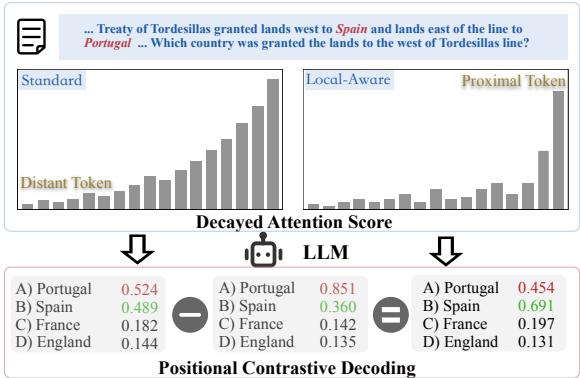
In Figure 1, look at the bar charts:
- Standard: The correct answer (Portugal) has a probability of 0.524. It’s winning, but barely.
- Proximal Token (Local-Aware): This view focuses heavily on recent tokens, likely distractors.
- PCD (Result): After the subtraction, the confidence for the correct answer jumps to 0.851.
By contrasting the “Standard” attention with the “Local-Aware” attention, the model amplifies the gain of the long-distance training signals.
Why This Works: The Math of Decay
Why does subtracting logits physically result in better long-range attention? The paper provides a spectral analysis to explain this.
In standard Transformers, attention scores decay as the distance between tokens increases. This is why models struggle with long contexts—the signal essentially fades out.
PCD alters this decay curve.
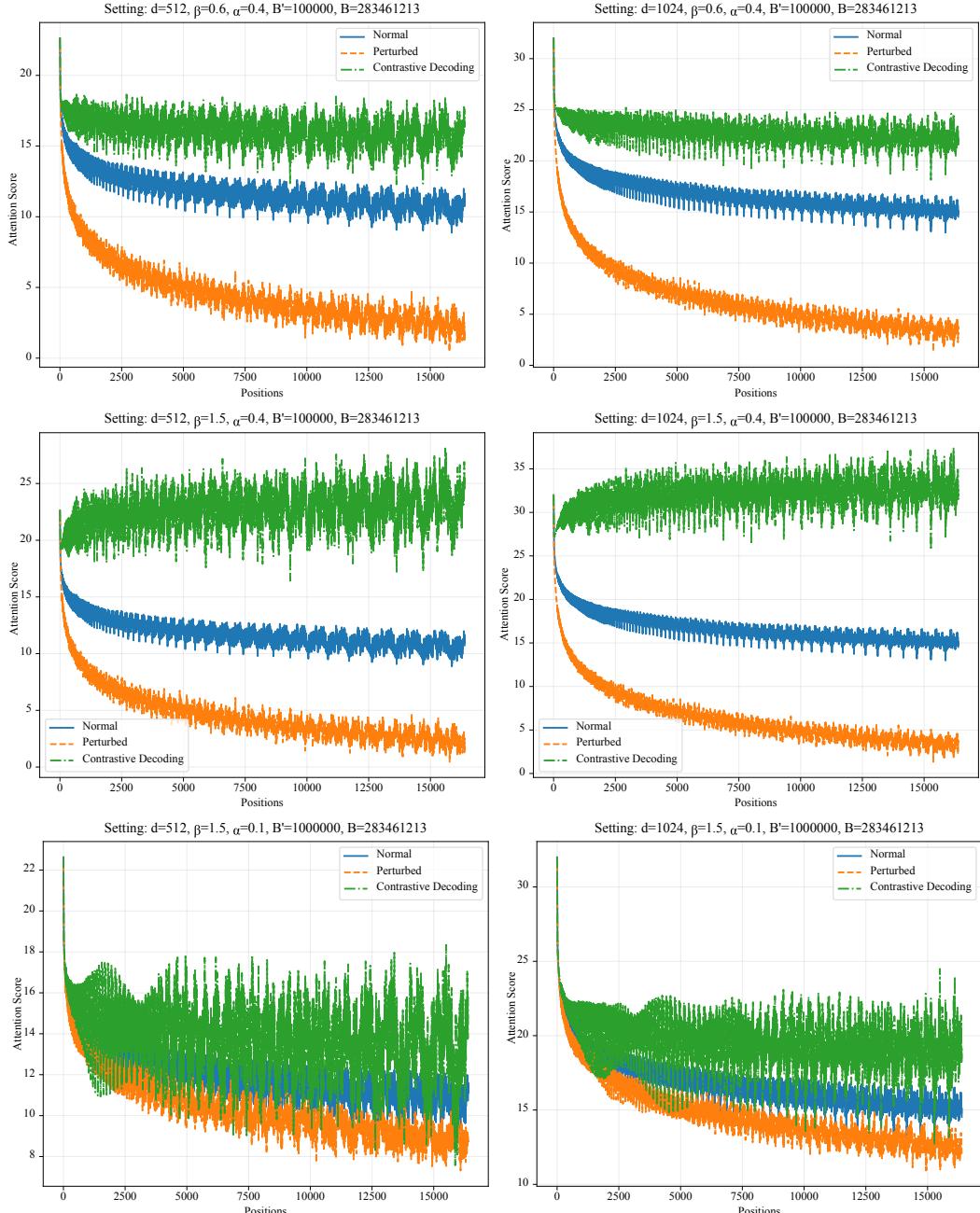
Figure 4 illustrates simulations of attention score decay over distance (up to 15,000 positions).
- Blue Line (Normal): Shows the standard rapid decay. The attention score drops quickly as distance increases.
- Orange Line (Perturbed/Local): This is the “Local-Aware” version. Notice it drops extremely fast, effectively becoming zero for long distances.
- Green Line (Contrastive/PCD): This is the magic. Because we are subtracting the steep orange curve from the blue curve, the resulting green curve stays flat and high.
This means that mathematically, PCD prevents the attention mechanism from “giving up” on tokens simply because they are far away.
Experimental Results
The theory is sound, but does it work on benchmarks? The authors tested PCD on Llama-3-8B (standard and long-context versions) using datasets like RULER, InfiniteBench, and LongBench.
Comparison with Baselines
They compared PCD against standard Greedy Decoding, Beam Search, and other specialized methods like MsPoE and Segment Reranking (SegR).
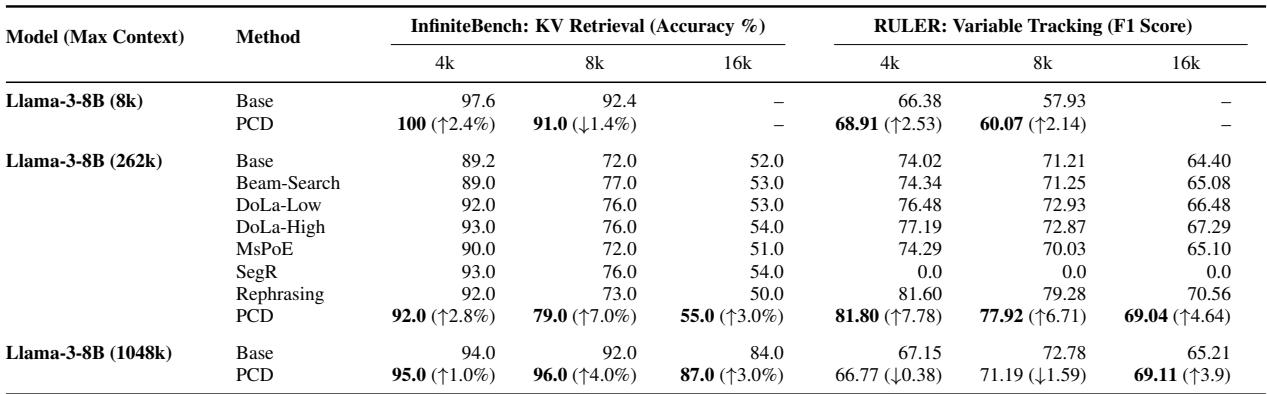
Table 2 shows results on Key-Value Retrieval and Variable Tracking—classic “needle in a haystack” tasks.
- Llama-3-8B (262k context): On the 16k length retrieval task, the base model gets 52.0% accuracy.
- With PCD: The accuracy jumps to 55.0%.
- Trends: You can see green arrows (improvements) across almost every metric. Importantly, PCD outperforms methods like Segment Reranking (SegR), which completely failed (0.0%) on Variable Tracking because that task relies on the order of tokens, which reranking destroys.
Real-World QA Tasks
Synthetic benchmarks are one thing, but what about actual questions?

Table 3 details performance on LongBench, which includes tasks like NarrativeQA (answering questions about books) and HotpotQA (multi-hop reasoning).
- Average Score: PCD achieves the highest average score (26.87), beating the Base model (25.98) and MsPoE (26.27).
- NarrativeQA: PCD bumps performance from 20.03 to 20.31.
While the percentage gains might seem small (1-3%), in the world of LLM benchmarks, consistent improvements across varying tasks without any retraining are significant.
Mitigating Salience Decay
Finally, let’s confirm that PCD actually solved the problem defined in the introduction: Salience Attenuation.
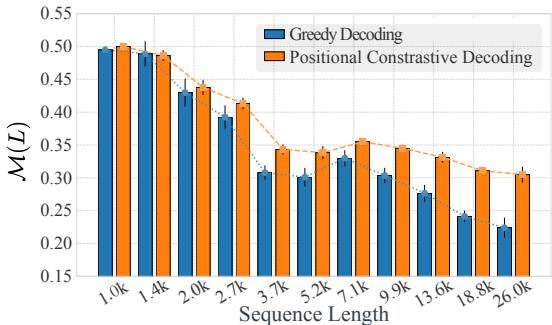
Figure 2 compares Greedy Decoding (Blue) vs. PCD (Orange).
- The Y-axis is the rank metric (higher is better).
- As the sequence length (X-axis) goes from 1k to 26k, the Blue bars drop significantly—the standard model is losing track of the answer.
- The Orange bars (PCD) decay much slower. At 26k context, PCD maintains a much higher salience score than the baseline.
Conclusion
The “Lost in the Middle” phenomenon has been a persistent thorn in the side of long-context LLMs. The paper “Mitigating Posterior Salience Attenuation in Long-Context LLMs with Positional Contrastive Decoding” offers a compelling explanation and solution.
The key takeaways are:
- It’s not memory loss, it’s confidence loss. Models often know the answer (high rank) but get drowned out by local noise (Posterior Salience Attenuation).
- Contrast is key. By artificially creating a “short-sighted” version of the model and subtracting it from the standard model, we can isolate and amplify long-range signals.
- No training required. PCD is a decoding-time strategy. You can apply it to existing models like Llama-3 immediately without spending a dime on GPUs for retraining.
For students and researchers, this paper is a masterclass in analyzing the internal behaviors of LLMs (logits and attention spectra) rather than just treating them as black boxes. It reminds us that sometimes, the information we need is already there; we just need to tune out the noise to hear it.