](https://deep-paper.org/en/paper/2506.09383/images/cover.png)
Decoding Human Balance: How Muscle Simulations Reveal the Secrets of Standing and Falling
If you are reading this while standing up, you are performing a miracle of mechanical engineering. You are, effectively, an inverted pendulum—a heavy weight balanced precariously on top of two narrow supports. To stay upright, your brain is processing a torrent of sensory data and firing precise electrical signals to hundreds of individual muscles, making micro-adjustments every millisecond.
In the world of robotics, replicating this “simple” act of standing is notoriously difficult. While we have robots that can do backflips, understanding the subtle, static balance of the human body—and crucially, how and why we fall—remains a complex puzzle.
Why is this hard to study? Because we can’t exactly push people over in a lab to see which bones they break. This leads to a significant data gap in understanding fall dynamics and designing assistive devices like exoskeletons.
In this post, we are diving deep into a fascinating paper titled “Bipedal Balance Control with Whole-body Musculoskeletal Standing and Falling Simulations” by researchers from Tsinghua University. They have developed a system to simulate a full-body, biologically accurate human musculoskeletal model. By doing so, they can generate realistic data on standing, balancing, and falling without ever putting a human volunteer at risk.
Let’s unpack how they bridged the gap between robotic control theory and human biology.
The Problem: The Complexity Gap
To understand why this research is necessary, we first need to look at how we traditionally model walking and standing.
In robotics, we often use simplified models. You might be familiar with the Linear Inverted Pendulum model. It treats the robot as a single mass on a stick. It’s great for getting a robot to walk without falling over, but it ignores the biological reality of humans. We aren’t rigid sticks; we are soft, wobbly, multi-segmented systems.
The human body has:
- High Degrees of Freedom: Dozens of joints moving independently.
- Over-actuation: We have far more muscles than we strictly need to move a joint, allowing for complex synergies.
- Non-linearity: Muscles don’t pull linearly; their force depends on their length and velocity.
Previous attempts to control full-body musculoskeletal models often relied on Deep Reinforcement Learning (DRL). While powerful, DRL is “data-hungry” and computationally expensive. Training a neural network to control 700 muscles to stand still can take days of simulation time, and often results in unnatural, jittery movements.
The researchers in this paper propose a different approach: a Hierarchical Balance Control (HBC) framework. It’s a training-free method that can control a complex human model immediately, allowing for the rapid collection of data on balance and falls.
The Solution: Hierarchical Balance Control (HBC)
The core innovation here is how the researchers manage the complexity of the human body. Instead of trying to control every single muscle fiber simultaneously with one giant brain, they split the problem into two levels: a High-Level Planner and a Low-Level Controller.
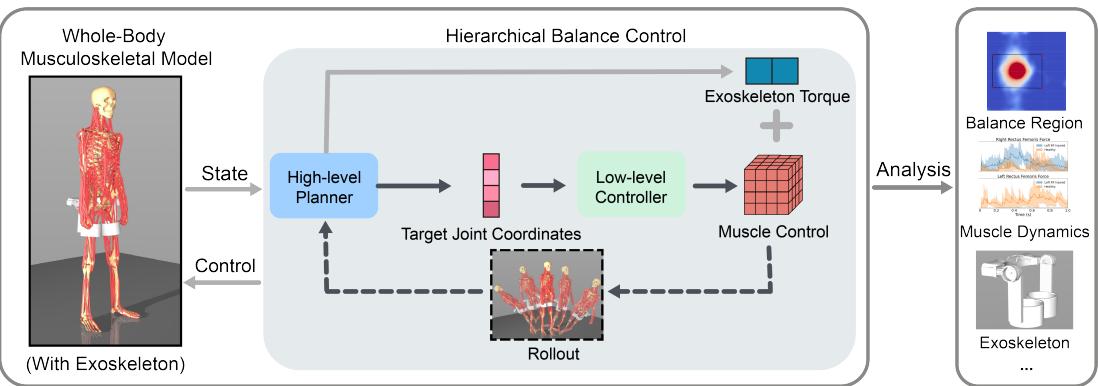
As shown in Figure 1 above, the system works in a loop. The high-level planner decides where the body parts should go (joint angles), and the low-level controller figures out how to get them there using muscles.
Let’s break down these two layers.
1. The High-Level Planner (The Strategist)
The High-Level Planner doesn’t worry about muscles. Its job is to determine the ideal posture to maintain balance. To do this, it uses a technique called Model Predictive Path Integral (MPPI) control.
Think of MPPI as Dr. Strange looking into the future. It simulates thousands of parallel timelines (rollouts). In each timeline, it tries slightly different random movements. It then looks at which timelines resulted in the character staying upright and which ended in a fall.
It scores these timelines based on a Cost Function. If a timeline has a low cost (stable standing), the planner adopts that strategy.
The cost function considers several factors to define what “good balance” looks like:

Here is what these terms mean intuitively:
- \(C_H\) (Height): Keeps the head up. If the head drops, the cost goes up.
- \(C_R\) (Rotation): Keeps the torso upright.
- \(C_{P_c}\) (Center of Mass Position): Tries to keep the center of gravity directly over the feet.
- \(C_{V_c}\) (Velocity): Penalizes moving too fast (we want static standing, not running).
- \(C_I\) (Imitation): A reference term to ensure the pose looks natural, not like a contorted alien.
By optimizing for these costs, the High-Level Planner outputs a target set of joint coordinates (\(z^*\)).
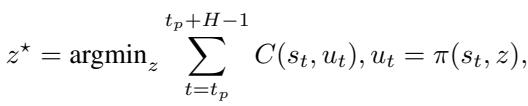
This equation essentially says: “Find the target joint angles (\(z\)) that minimize the total cost (\(C\)) over the near future (\(t\) to \(t+H\)).”
2. The Low-Level Controller (The Muscle Master)
Once the planner decides where the joints should be, the Low-Level Controller takes over. Its job is to fire the muscles to achieve those angles.
This is difficult because muscles are not motors. You can’t just tell a muscle to “be at 30 degrees.” You have to stimulate it, which causes it to contract based on biological dynamics.
The researchers use a model based on Hill-type muscle mechanics. The force a muscle can produce depends on its activation, its current length, and how fast it’s contracting.

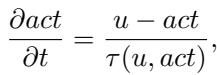
In these equations:
- \(f_m(act)\) is the muscle force.
- \(F_l\) and \(F_v\) represent the force-length and force-velocity relationships (biological constraints).
- The derivative equation shows that muscle activation doesn’t happen instantly; there is a time delay (\(\tau\)), just like in real biology.
To bridge the gap between the target joint angles and these complex muscle forces, the researchers use a Proportional-Derivative (PD) control logic adapted for muscles:

This controller calculates the necessary muscle force by looking at the difference between the target muscle length (\(l_m^*\)) and the actual muscle length (\(l_m\)). If the muscle is too long, the controller applies force to shorten it.
Does It Work? Validation and Performance
Before analyzing falls, the researchers had to prove their digital human acts like a real human.
1. Beating the Baselines
They compared their HBC method against two state-of-the-art Reinforcement Learning methods: DynSyn and SAC (Soft Actor-Critic).
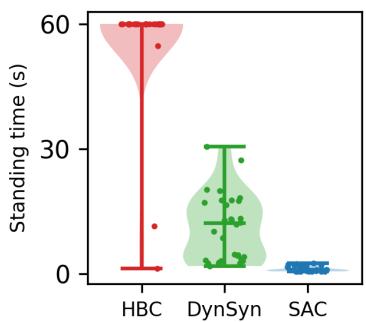
The results in Figure 2 are stark. The red violin plot represents the HBC method. It consistently achieves longer standing durations (often reaching the 60-second cap) compared to the deep learning methods, which struggled to maintain balance for long periods in this high-dimensional space. Because HBC doesn’t require training, it is also much faster to deploy.
2. Biological Fidelity
But does it move like a human? To check this, they compared the simulated muscle activation levels against real-world Electromyography (EMG) data from human subjects.
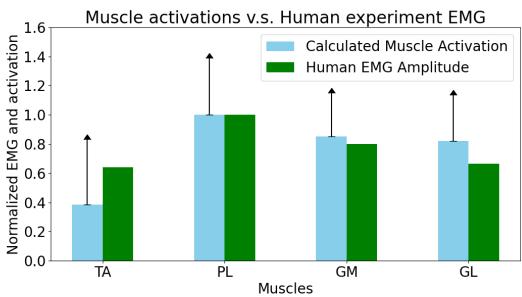
Figure 3 shows the comparison. The blue bars (simulation) closely track the trends of the green bars (real human data) across key leg muscles like the Tibialis Anterior (TA) and Gastrocnemius (GM/GL). This suggests that the model isn’t just “cheating” to stay upright; it’s using muscle strategies similar to actual humans.
Analyzing the Data: The Dynamics of Balance and Falls
With a validated model, the researchers generated a massive dataset: 2,800 falling trajectories and extensive data on stable standing. Collecting this amount of fall data with real people would be impossible.
The Micro-Movements of Standing
Standing isn’t perfectly still. It involves constant swaying. The simulation captured this beautifully.
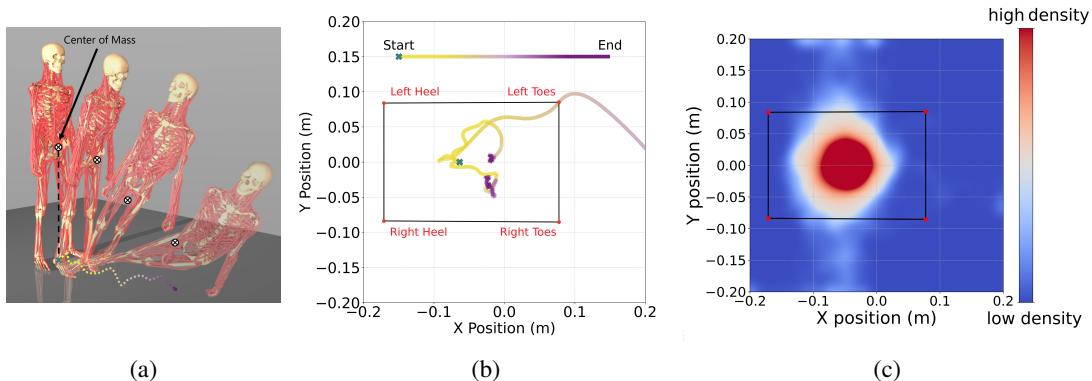
In Figure 4b, you can see the trajectories of the Center of Mass (CoM). The yellow-to-purple lines show how the CoM wanders. In successful trials, it spirals inward or stays contained. In failures, it drifts past the point of no return.
Figure 4c is a density plot. The red “hotspot” represents the “Balance Region”—the sweet spot where the body is most stable. This visualization helps quantify exactly how much margin for error a human has before they lose stability.
The Anatomy of a Fall
When the model failed to balance, the researchers tracked where it landed. This is crucial for designing protective gear or safer environments for the elderly.
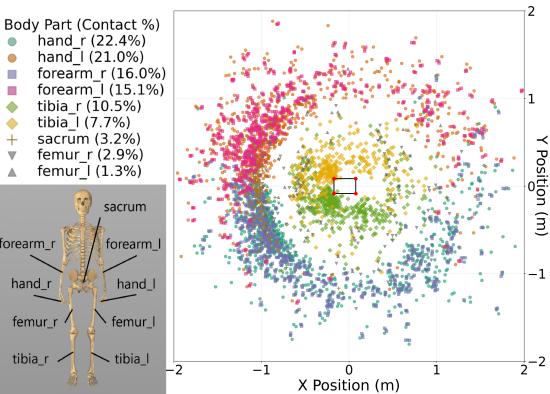
Figure 5 maps the impact points. The results align perfectly with clinical injury data:
- Hands and Wrists (43.4%): The primary defensive reaction.
- Knees and Forearms: Secondary impact points.
- Pelvis/Sacrum: A major danger zone for hip fractures in the elderly.
The simulation accurately predicts that when humans fall, we instinctively try to break the fall with our upper extremities, followed by impact on the lower body.
Simulation Applications: Injury and Assistance
The power of this system lies in “what if” scenarios. The researchers tested two specific use cases: Muscle Injury and Exoskeleton Assistance.
Scenario 1: Muscle Injury
What happens to your balance if you tear a muscle? The researchers simulated an injury to the Left Rectus Femoris (a major thigh muscle) by reducing its force-generating capacity.
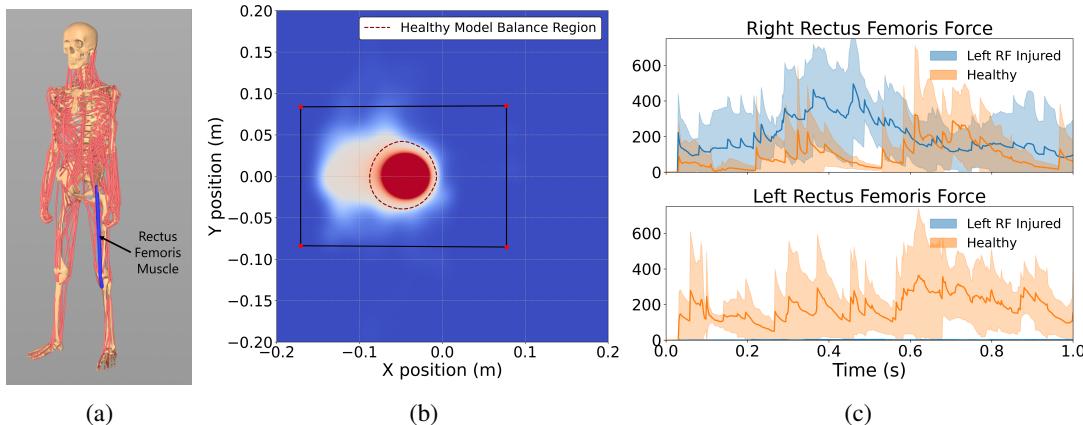
The results were fascinating (Figure 6):
- Shrinking Stability: The “Balance Region” (the red hotspot in Fig 6b) became significantly smaller and more concentrated compared to the healthy model (dashed line). The injured virtual human had to be much more careful to stay upright.
- Compensatory Mechanics: Figure 6c shows the muscle forces. The Right Rectus Femoris (the healthy leg) had to work much harder (orange line) to compensate for the injured left leg. This asymmetry is exactly what physiotherapists observe in patients.
Scenario 2: Exoskeleton Assistance
Can a robot help you stand? The researchers simulated a hip exoskeleton that applies torque to assist with balance. They even used Bayesian Optimization to fine-tune the exoskeleton’s control parameters.
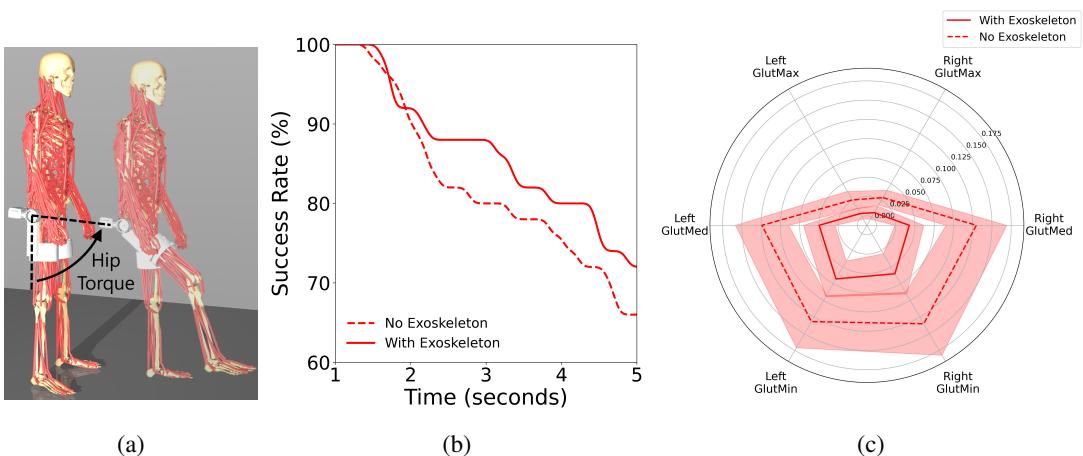
The simulation proved the device’s efficacy:
- Higher Success Rate: Figure 7b shows that the model with the exoskeleton (solid red line) was much harder to push over than the unassisted model (dashed line).
- Reduced Effort: Perhaps most importantly, Figure 7c shows a radar chart of muscle activation. The exoskeleton (solid area) drastically reduced the effort required from the gluteal muscles compared to natural standing (dashed area).
This implies that such simulations can be used to optimize exoskeleton hardware before a physical prototype is ever built.
Conclusion and Future Implications
The paper “Bipedal Balance Control with Whole-body Musculoskeletal Standing and Falling Simulations” represents a significant step forward in biomechanics and robotics. By successfully coupling a high-level strategic planner with a biologically realistic low-level muscle controller, the authors have created a powerful “digital twin” for human movement.
Key Takeaways:
- Simulation is Safer: We can study dangerous falls and injuries without risking human health.
- Training-Free Control: Hierarchical control (HBC) offers a robust alternative to “black box” machine learning methods, providing immediate, interpretable results.
- Clinical Relevance: The model predicts real-world phenomena, from fall impact sites to compensatory muscle patterns after injury.
- Design Tool: It serves as a virtual testbed for optimizing assistive devices like exoskeletons.
As we move forward, tools like this will be essential. They will help us design safer robots that can coexist with us, create better prosthetics and exoskeletons for those with mobility impairments, and deepen our understanding of the incredibly complex machine that is the human body. The next time you stand up, take a moment to appreciate the thousands of calculations your brain just performed—and the scientists working to decode them.