](https://deep-paper.org/en/paper/2506.10031/images/cover.png)
Cracking the Cellular Code: A Deep Dive into Self-Supervised Learning for Single-Cell Genomics
Imagine trying to understand a complex city by looking at a satellite photo of the whole metropolitan area. You see the general layout, the highways, and the density, but you miss the individual people who make the city function. For a long time, this was the state of genomics. “Bulk sequencing” gave us an average view of millions of cells mashed together—a biological smoothie.
Enter Single-Cell RNA Sequencing (scRNA-seq). This technology is the equivalent of zooming in to track every single person in that city. It allows scientists to profile molecular data at the resolution of individual cells, revealing a massive amount of heterogeneity. We can now identify rare cell types, track disease progression, and see how individual cells react to drugs.
However, great resolution comes with great noise. Single-cell data is high-dimensional, sparse (lots of zeros), and incredibly susceptible to “batch effects”—technical variations caused by different experiments, days, or lab technicians.
To solve this, computational biologists are turning to Self-Supervised Learning (SSL), the same machine learning paradigm behind the success of models like ChatGPT and computer vision systems. But biology isn’t text or images. Which SSL methods work best for cells? Do we use models built for images (like SimCLR) or specialized biological models (like scVI)?
In this post, we break down scSSL-Bench, a comprehensive study that benchmarks nineteen SSL methods across nine datasets to find out how to best learn representations of cellular data.
The Problem: Signal vs. Noise in Single-Cell Data
Before diving into the algorithms, we need to understand the data. A single-cell dataset is usually a matrix where rows are cells and columns are genes (often 20,000+). The values represent how active a gene is.
The biggest hurdle in analyzing this data is the batch effect. If you process patient A’s blood on Monday and patient B’s blood on Tuesday, the cells might look different just because of the timing, chemicals, or machine calibration. If you visualize this data, cells often cluster by experiment rather than by cell type.
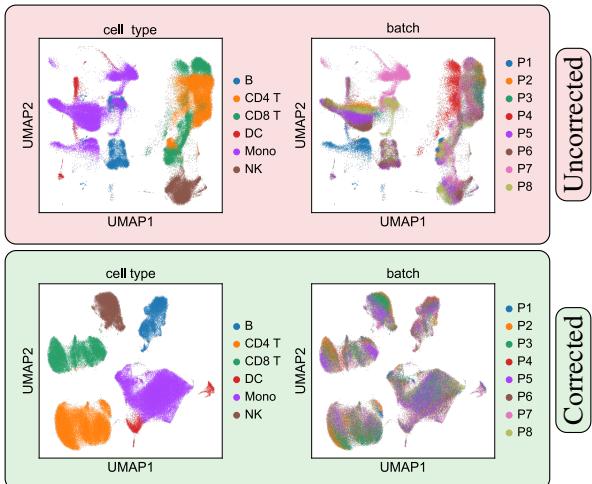
As shown in Figure G2 above, uncorrected data (red) shows distinct clusters for different batches (P1-P8). This is bad; it means technical noise is drowning out biological signal. The goal of SSL in this context is to learn a “batch-corrected” embedding (green) where cells cluster by their actual type (e.g., T-cells with T-cells), regardless of when they were sequenced.
The Contenders: Generic vs. Specialized SSL
The authors of scSSL-Bench categorized the methods into two main camps:
- Generic SSL Methods: These are famous architectures adapted from computer vision. They mostly rely on Contrastive Learning, where the model learns to pull two augmented views of the same image (or cell) together while pushing different images apart. Examples include SimCLR, MoCo, BYOL, and VICReg.
- Specialized Single-Cell Methods: These are designed specifically for genomics.
- Specialized Contrastive: Methods like CLEAR and CLAIRE that use biology-specific augmentations.
- Specialized Generative: Methods like scVI (a Variational Autoencoder) and foundation models like scGPT and Geneformer (Transformers trained on massive cell atlases).
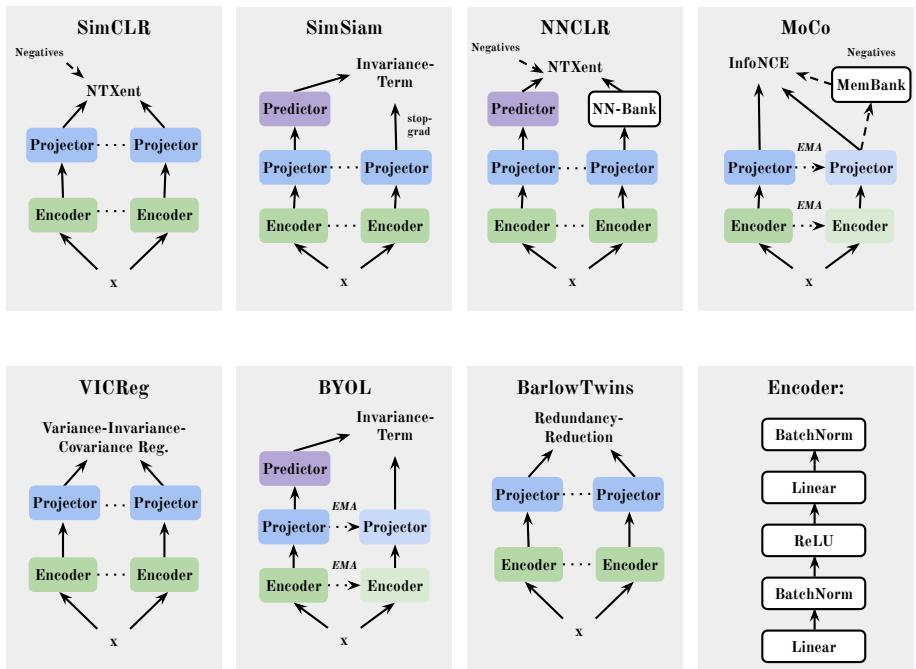
Figure G1 illustrates the architectures of the generic methods. While they differ in their loss functions (e.g., SimCLR uses contrastive loss, BYOL uses prediction consistency), they all share a common goal: learning a robust representation of the input data without needing human labels.
The scSSL-Bench Framework
How do we fairly compare a computer vision model like SimCLR against a biological foundation model like scGPT? The researchers built a standardized pipeline called scSSL-Bench.
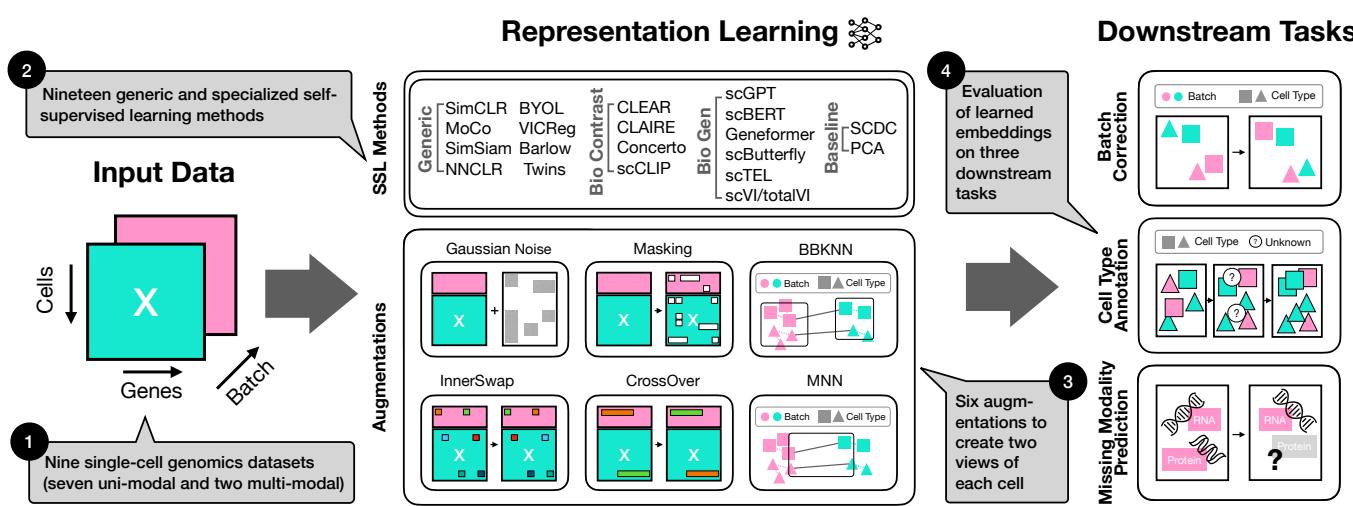
The workflow, shown in Figure 1, operates in four steps:
- Input: The raw cell-by-gene count matrices.
- Augmentation: For contrastive methods, we need to create “views” of a cell. Since we can’t rotate or crop a gene matrix like an image, the researchers use techniques like Masking (hiding some gene counts) or Gaussian Noise.
- Training: The models (Generic, Bio Contrast, or Bio Gen) are trained to learn low-dimensional embeddings of the cells.
- Evaluation: The learned embeddings are tested on three critical downstream tasks:
- Batch Correction: Can the model mix batches while keeping cell types distinct?
- Cell Type Annotation: Can we use the embeddings to label unknown cells based on a reference?
- Missing Modality Prediction: In multi-omics data (e.g., RNA + Proteins), can we predict protein levels given only the RNA?
Understanding the Tasks
While batch correction is about cleaning the data, Cell Type Annotation is about utility. It simulates a “Query-to-Reference” scenario. Imagine a doctor sequences a tumor (Query) and wants to map those cells onto a healthy atlas (Reference) to identify them.
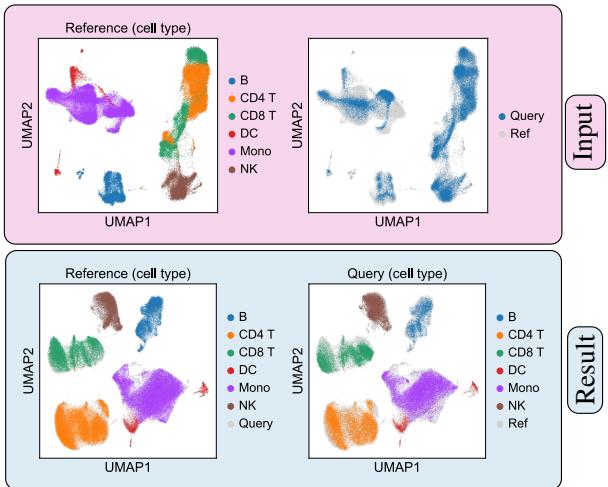
As visualized in Figure G3, the model must align the Query and Reference in the same latent space so a classifier can accurately transfer labels from the reference to the query.
Key Experiments and Results
The benchmark yielded some surprising results that challenge the assumption that “specialized is always better.”
1. Uni-Modal Data (RNA Only): Specialized Methods Win
When dealing with standard scRNA-seq data, the models designed specifically for biology reigned supreme.
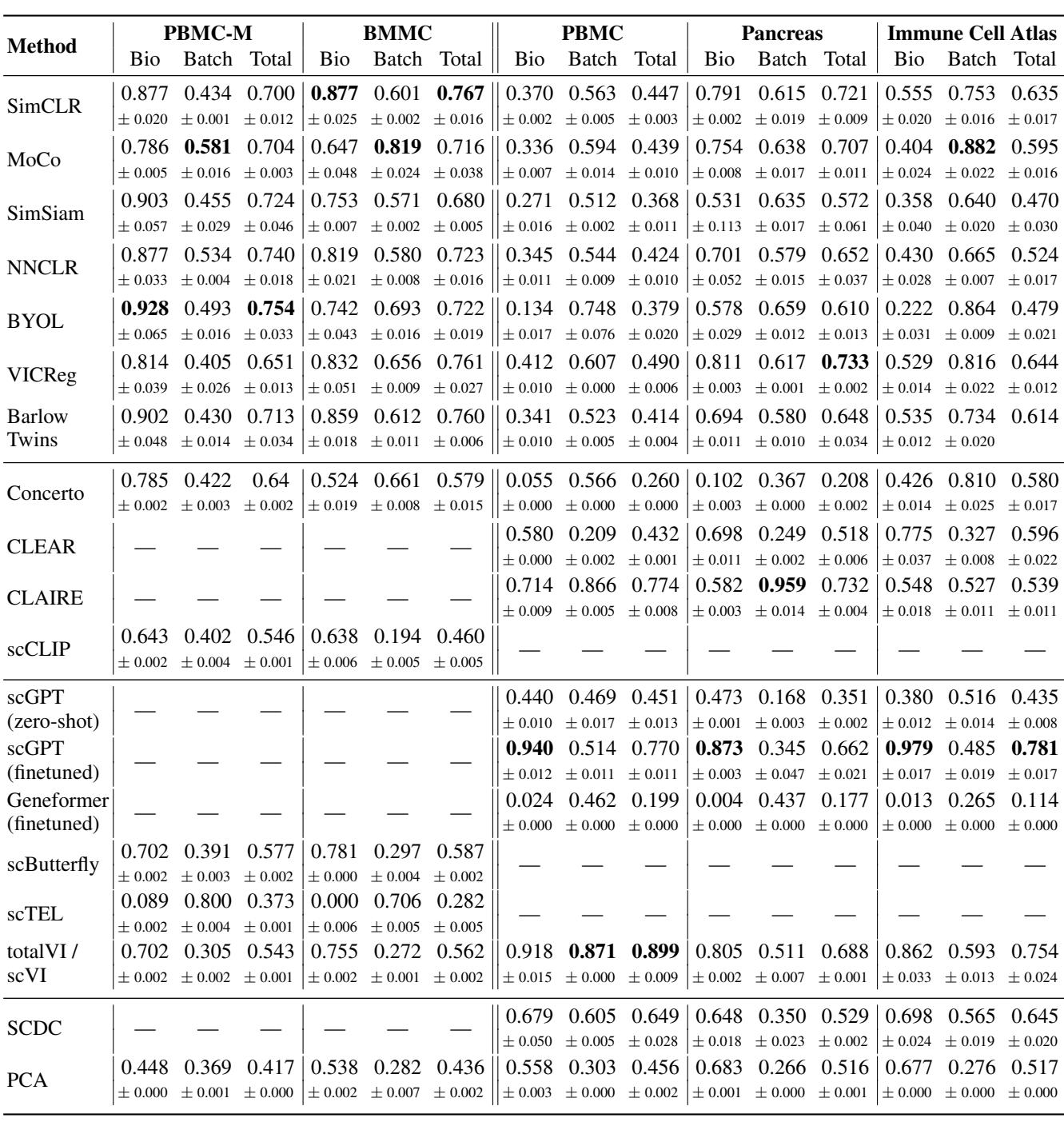
Table 1 shows the performance across several datasets. The metric “Total” combines how well biological signal is conserved (“Bio”) and how well batch effects are removed (“Batch”).
- The Winner: scVI (a generative model) consistently achieved the best balance. It explicitly models the statistical distribution of gene counts (negative binomial), giving it a huge advantage.
- The Runner-Up: CLAIRE, a specialized contrastive method, also performed very well, particularly in batch correction.
- The Foundation Model: scGPT (fine-tuned) showed promise on large datasets like the Immune Cell Atlas but struggled with batch correction on smaller ones compared to scVI.
Generic methods like SimCLR and MoCo performed adequately but often sacrificed biological detail to achieve batch mixing (over-correction).
2. Multi-Modal Data: Generic Methods Strike Back
The story changes completely when we look at Multi-Omics data, specifically CITE-seq, which measures both RNA (gene expression) and Proteins simultaneously.
In this more complex setting, Generic SSL methods (SimCLR, VICReg) outperformed the specialized biological models.
Take a look at the Missing Modality Prediction task below. The goal is to predict protein levels knowing only the RNA expression.
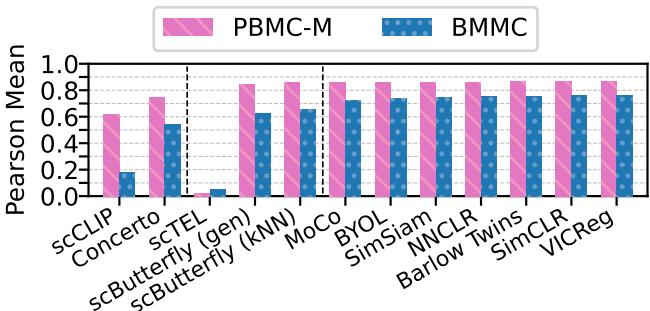
Figure 3 shows the Pearson correlation between predicted and actual protein levels. The generic methods (on the right, in pink/purple/green) consistently achieve higher correlations than specialized multi-modal methods like scCLIP or Concerto.
Why? The authors suggest that current specialized methods might not be effectively capturing the complex non-linear relationships between different modalities (RNA and Protein), whereas generic contrastive learning is incredibly robust at finding shared information between different “views” (in this case, modalities) of the data.
3. Cell Typing Performance
For assigning types to cells, the landscape is competitive.
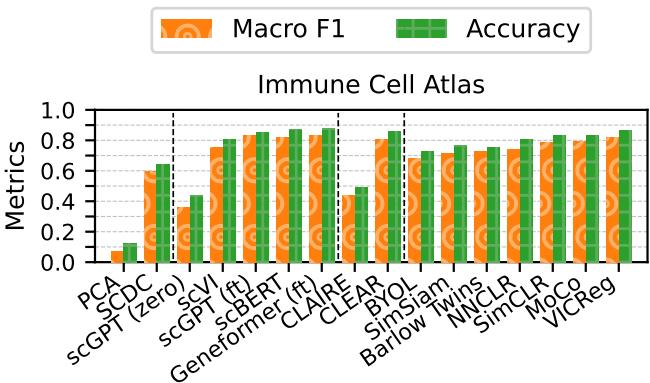
As seen in Figure 2, while the fine-tuned foundation models (scGPT, Geneformer) take the top spots for cell typing accuracy, the generic model VICReg is a very close third, outperforming many other specialized methods. This suggests that if you don’t have the compute power to run a massive Transformer model like scGPT, a lightweight generic SSL model like VICReg is a fantastic alternative.
Ablation Studies: Tuning the Machine
For students and practitioners, the most valuable part of this paper is the “Ablation Study”—a systematic analysis of why things work.
Temperature Matters
In contrastive learning (like SimCLR), there is a hyperparameter called “temperature” (\(\tau\)) that controls how sharp the distinction between positive and negative pairs is.
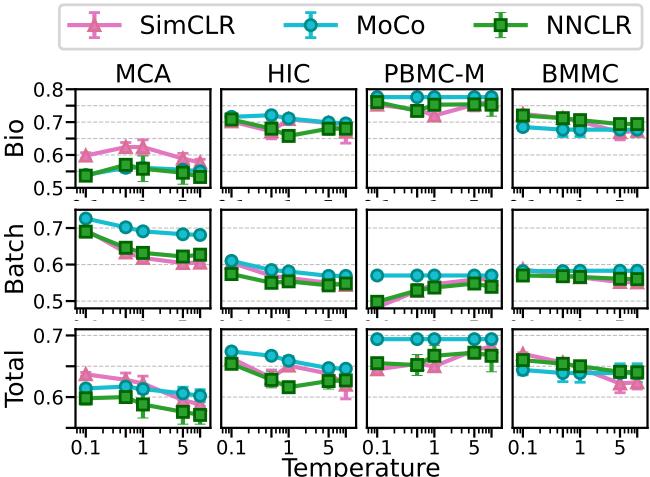
Figure 4 demonstrates a clear trend: Lower temperatures (0.1 - 0.5) generally lead to better integration. As temperature increases (moving right on the x-axis), the performance metrics (Bio, Batch, and Total) tend to drop. A lower temperature forces the model to be more discriminative, learning finer details about the cell states.
The Best Augmentation Strategy
Contrastive learning requires “augmentations”—modifying a sample to create a new view. In images, we crop and rotate. In cells, we have different options:
- Gaussian Noise: Adding random noise to values.
- Masking: Randomly setting gene counts to zero.
- InnerSwap: Swapping gene values within a cell.
- BBKNN/MNN: Using nearest neighbors to simulate a related cell.
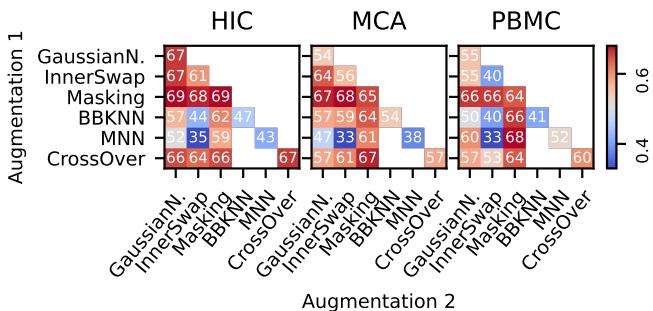
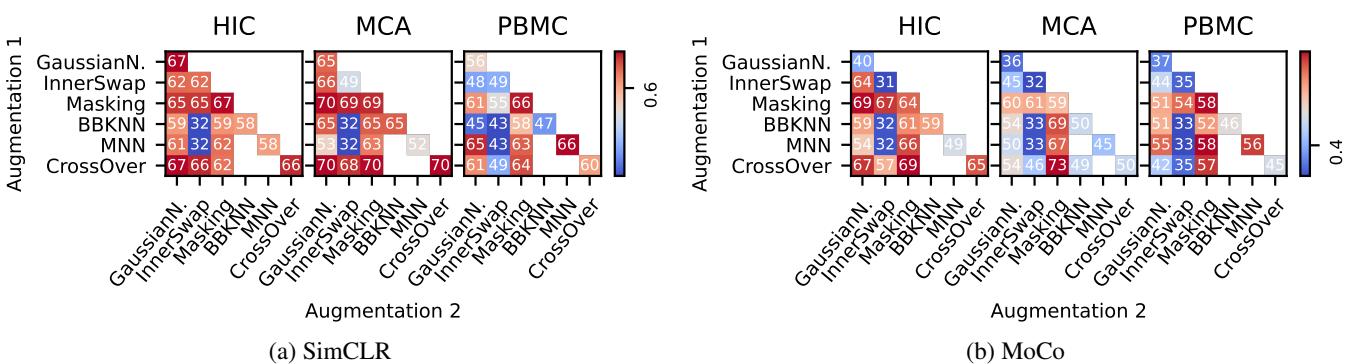
The heatmaps in Figure 5 (and supplementary Figure G7) reveal a champion: Random Masking.
Looking at the red/warm zones in the heatmaps (indicating high performance), strategies involving Masking consistently score high. This mimics the “Masked Language Modeling” objective of BERT in NLP. By hiding genes, the model is forced to learn the context and relationships between genes (e.g., “if Gene A and Gene B are high, Gene C must also be high”). Surprisingly, complex biology-specific augmentations like MNN did not consistently outperform simple masking.
Conclusion and Recommendations
The scSSL-Bench paper provides a roadmap for using Self-Supervised Learning in genomics. Here are the key takeaways for students and researchers:
- Use the Right Tool for the Job:
- If you have Uni-modal (RNA) data and need to correct batch effects: Use scVI. It remains the gold standard.
- If you have Multi-modal data or need to predict missing modalities: Use Generic SSL methods like VICReg or SimCLR. They currently beat the specialized models.
- If you have massive compute and need Cell Typing: Fine-tuned foundation models like scGPT are powerful, but VICReg is a computationally cheaper and competitive alternative.
- Keep it Simple:
- Use Masking as your primary augmentation.
- Use a moderate embedding dimension (64 to 128). Larger isn’t always better and costs more memory.
- Stick to lower temperatures for contrastive loss.
- Future Directions: The fact that generic computer vision models outperform specialized biological models on multi-omics data is a “wake-up call.” It highlights a massive opportunity for researchers to develop better, specialized architectures that can handle the nuances of multi-modal biological data.
As deep learning and biology continue to converge, benchmarks like this are essential. They stop us from blindly applying the latest hype and help us understand exactly which algorithms unlock the secrets hidden inside our cells.