](https://deep-paper.org/en/paper/2506.11381/images/cover.png)
Introduction
Imagine you are reading a financial news headline: “Microsoft invests $10 billion in…”
Before you even finish the sentence, your brain probably fills in the blank with “OpenAI.” You didn’t need to read the rest of the text because you relied on your prior knowledge of the entities involved. While this heuristic is useful for humans, it is a significant problem for Artificial Intelligence.
In the field of Natural Language Processing (NLP), this phenomenon is known as Entity Bias. Models like BERT or RoBERTa often memorize connections between specific entities (e.g., “Microsoft” and “invest”) rather than understanding the context of the sentence. If the sentence actually read “Microsoft sues OpenAI,” a biased model might still predict an “investment” relationship simply because it over-relies on the names.
This blog post explores a fascinating research paper, “A Variational Approach for Mitigating Entity Bias in Relation Extraction,” which proposes a sophisticated mathematical solution to this problem. The researchers introduce a method using Variational Information Bottleneck (VIB) to force models to stop “cheating” with entity names and start reading the context.
The Problem: Relation Extraction and Bias
Relation Extraction (RE) is the task of identifying the semantic relationship between two entities in a text. For instance, in the sentence “Steve Jobs founded Apple,” the model must extract the triplet (Steve Jobs, Founder Of, Apple).
Current State-of-the-Art (SOTA) approaches rely on fine-tuning Pre-trained Language Models (PLMs). However, these models are prone to overfitting on the entities themselves. They learn that “Paris” is usually the location of “France,” ignoring the sentence structure. When these models encounter new entities or scenarios where the relationship has changed (Out-of-Domain settings), their performance crumbles.
Previous attempts to fix this included:
- Entity Masking: Replacing names with generic tags like
[SUBJ-PERSON]. This removes bias but also throws away valuable information. - Structured Causal Models (SCM): The current leading method, which uses geometric manipulation of vector spaces to “clean” the entity representation.
The authors of this paper propose a whitebox, probabilistic framework that offers a better balance: compressing entity information just enough to reduce bias while keeping it useful.
The Core Method: The Variational Approach
The heart of this research is the application of the Variational Information Bottleneck (VIB).
From Points to Distributions
In a standard neural network, an entity like “Microsoft” is represented as a single, fixed point (vector) in high-dimensional space. The researchers argue that this fixed representation makes it too easy for the model to memorize specific attributes.
Instead, they propose mapping entities to a probability distribution—specifically, a Gaussian distribution defined by a mean (\(\mu\)) and a variance (\(\sigma\)).
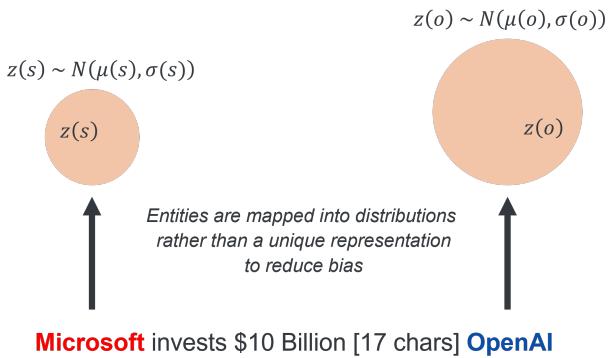
As shown in Figure 1, the entity “Microsoft” is mapped to a tighter distribution (smaller circle), while “OpenAI” has a wider distribution.
Here is the intuition: Variance represents uncertainty or “blur.”
- Low Variance: The model relies heavily on the entity itself.
- High Variance: The entity representation is “noisy” or “blurred.” To make a correct prediction, the model is forced to look at the surrounding context words because it can’t rely solely on the entity.
The Mathematical Foundation
The goal is to learn a representation \(Z\) that keeps semantic meaning from the input \(X\) but minimizes specific entity information \(E\). This is an optimization problem utilizing Mutual Information.
The objective is to minimize the mutual information between the representation and the entity, \(I(X; Z | E)\). The paper derives an upper bound for this using the VIB framework:
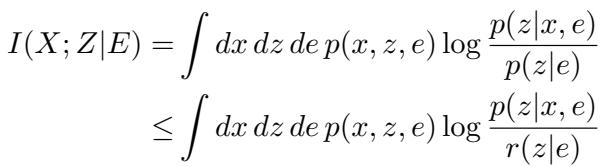
This integral might look intimidating, but it simplifies into a loss function involving KL Divergence. KL Divergence measures how different two probability distributions are from each other.

Here, \(p(z|x,e)\) is the distribution our model learns, and \(r(z|e)\) is a standard normal distribution. By minimizing this “VIB Loss,” the model attempts to compress the entity information, filtering out the “shortcut” features that lead to bias.
Blending Entity and Context
The researchers don’t just replace the entity with noise. They use a smart blending strategy. They create a new embedding \(x'\) that is a mix of the original word embedding \(x\) and the sampled latent variable \(z\).
The blending equation is:

Let’s break this down:
- \(M\) is a mask (1 for entity tokens, 0 for context tokens). Context words are left untouched.
- \(\beta\) (beta) is a hyperparameter. It acts as a “slider.”
- If \(\beta\) is 0, we use the original, potentially biased embedding.
- If \(\beta\) is 1, we purely use the variational (noisy) representation.
- The researchers found that a mix (e.g., \(\beta = 0.5\)) works best.
The Final Training Objective
To train the model, the researchers combine the standard classification loss (Cross-Entropy) with the new VIB loss.

\(\alpha\) is an adaptive weight that balances the two goals: making accurate predictions (\(L_{CE}\)) and reducing entity bias (\(L_{VIB}\)).
Experiments and Results
The team tested their method on three datasets covering different domains:
- TACRED: General domain news.
- REFinD: Financial domain.
- BioRED: Biomedical domain.
They evaluated the model in two settings:
- In-Domain (ID): The test set has similar entities to the training set.
- Out-of-Domain (OOD): The ultimate test of bias. Entities in the test set are replaced with others, ensuring no overlap with training data. If the model memorized names, it will fail here.
Main Performance
The results, shown below, compare their VIB method against the previous best method (SCM) and older baselines (Entity Masking, Substitution) using two backbone models (LUKE-Large and RoBERTa-Large).
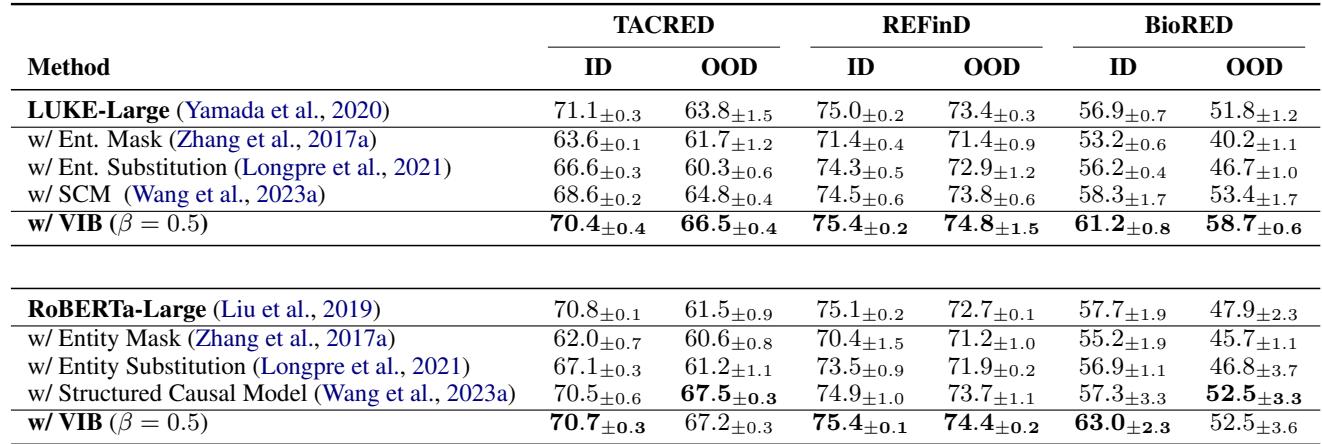
Key Takeaways from the Results:
- VIB outperforms classic methods: Simple masking or substitution (the first few rows) performs poorly because it removes too much information.
- VIB is SOTA or Competitive: In the REFinD (Finance) dataset, VIB achieves state-of-the-art results (74.8% F1 in OOD settings vs 73.8% for SCM).
- Consistency: VIB shows robust performance across general, financial, and biomedical domains.
Detailed Relation Analysis
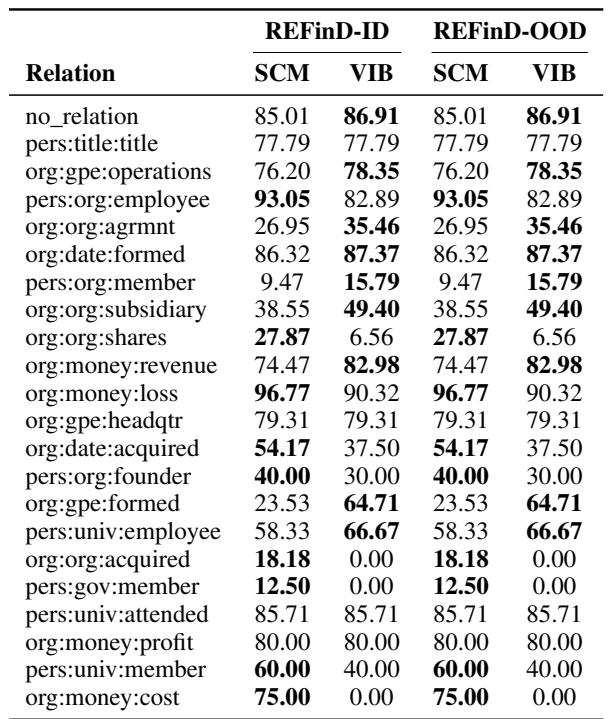
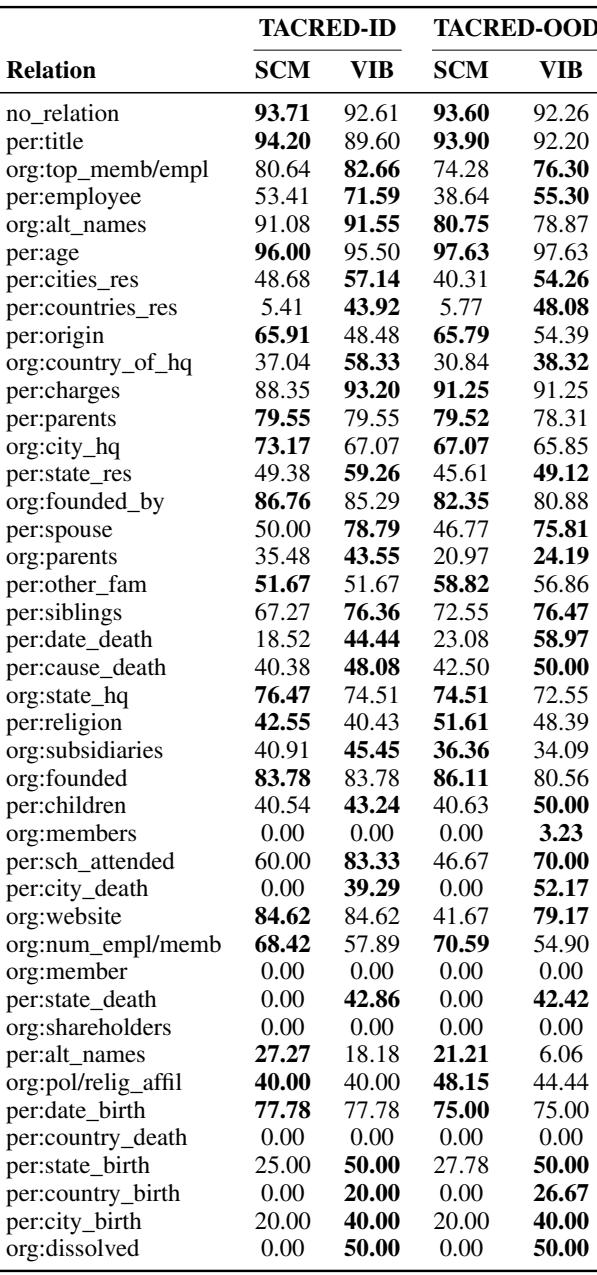
It is helpful to see where the improvements come from. The tables below break down performance by specific relation types.
Financial Domain (REFinD):
In Table 3, we see that VIB outperforms SCM significantly in complex relations like org:org:agreement_with (35.46 vs 26.95). These relations require understanding the sentence structure (who agreed with whom?) rather than just spotting two company names.
General Domain (TACRED):
Similarly, in Table 4, VIB shines in relations like per:employee_of in Out-of-Domain settings (55.30 vs 38.64 for SCM). This is a massive improvement, suggesting that when the model encounters unknown people and companies, VIB helps it rely on the phrase “works for” rather than memorizing famous employees.
Why This Matters: Interpretability via Variance
One of the coolest features of this approach is interpretability. Because the model learns a variance (\(\sigma^2\)) for every entity, we can actually measure how much the model is relying on the entity name versus the context.
- Low Variance: “I know this entity! I’m relying on the name.”
- High Variance: “I don’t know this entity well; I’m relying on the context.”
The researchers analyzed this behavior in the financial dataset (REFinD).
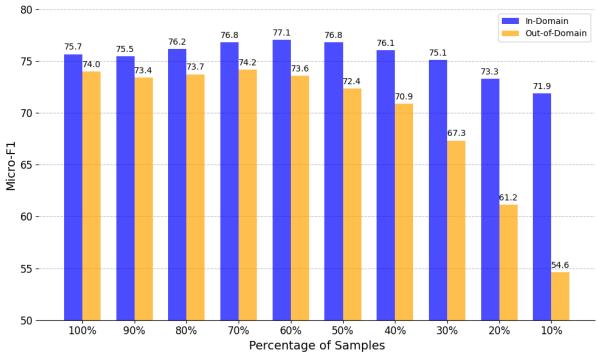
Figure 2 shows something interesting. The samples are sorted by variance. Even in the subsets with the highest variance (where the entity is most “blurred”), the model maintains decent performance in the In-Domain setting (Blue bars). This proves the model has successfully learned to use context cues when the entity information is noisy.
Furthermore, Table 2 below categorizes the data into “Variance Bins.”
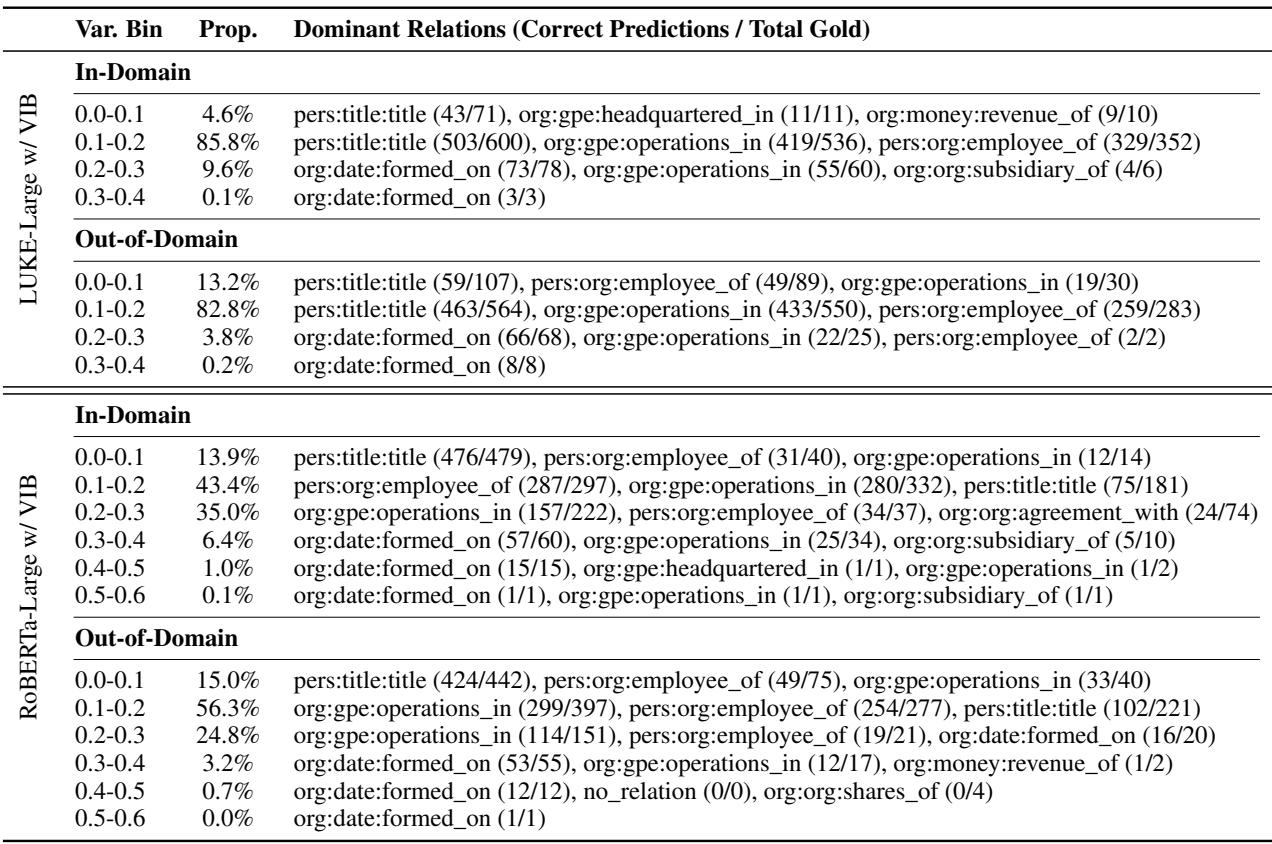
In the Out-of-Domain section, you can see a shift. There are more samples in the lower variance bins (0.0-0.1), suggesting the model struggles to let go of entity bias when seeing new entities. However, by enabling the model to operate in higher variance regimes (the noisy cloud representations), VIB salvages performance that deterministic models would lose.
Conclusion
The paper “A Variational Approach for Mitigating Entity Bias in Relation Extraction” presents a compelling step forward for making NLP models more robust. By treating entities as probabilistic distributions rather than fixed points, the VIB framework forces models to look beyond the names and understand the narrative.
Key Wins:
- Bias Reduction: Successfully prevents models from memorizing entity-relation pairs.
- State-of-the-Art Performance: beats or matches complex causal models across diverse domains (Finance, Bio, General).
- Interpretability: The “variance” metric gives researchers a window into the model’s decision-making process—telling us when the model is confident in an entity and when it is looking at the context.
As AI continues to integrate into high-stakes fields like finance and biomedicine, ensuring models are reading the sentence and not just the names is crucial for safety and accuracy. This variational approach offers a principled, mathematical foundation for doing just that.