](https://deep-paper.org/en/paper/2506.11470/images/cover.png)
Introduction
Imagine if learning to ride a bicycle immediately made you better at walking on stilts or ice skating. In the biological world, this kind of skill transfer happens constantly; animals adapt their motor control strategies to different terrains and physical changes. In robotics, however, this has remained a distant dream. Typically, if you want to train a quadruped (a four-legged robot dog) and a humanoid (a two-legged robot), you need two completely separate training pipelines. Their bodies are different, their motors are different, and the physics governing their movement are distinct.
This “siloed” approach is inefficient. It prevents robots from learning general concepts of locomotion—like balance, momentum, and friction—that should theoretically apply regardless of how many legs the robot has.
In a new paper titled “Multi-Loco: Unifying Multi-Embodiment Legged Locomotion via Reinforcement Learning Augmented Diffusion,” researchers propose a groundbreaking framework to solve this. They have developed a system that uses a single, unified policy to control four completely different types of robots: a point-foot biped, a wheeled biped, a full-sized humanoid, and a quadruped.
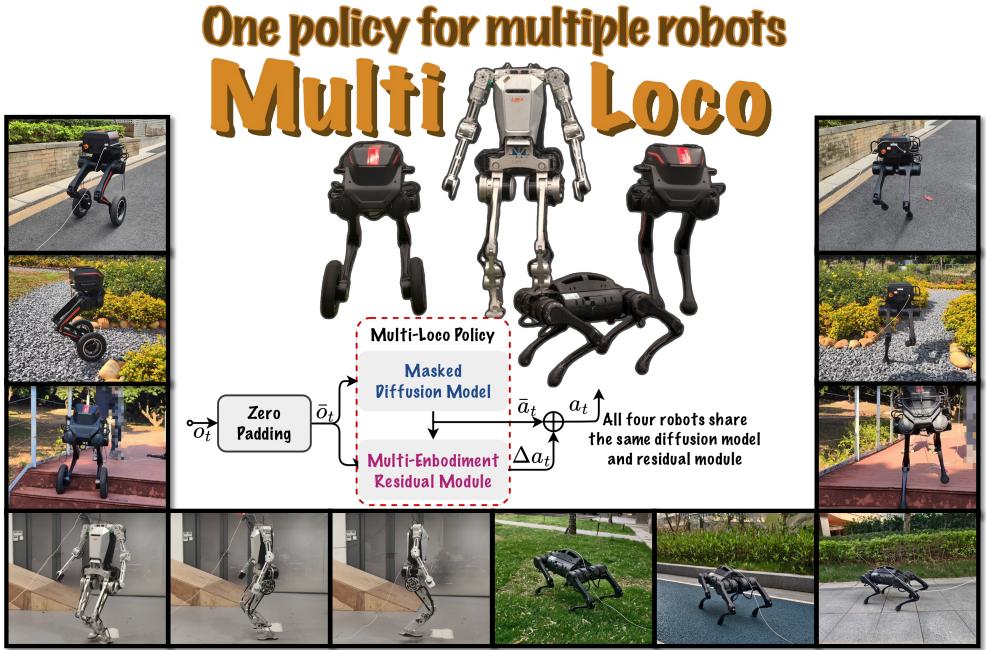
As shown above, the results are impressive. Not only does this unified brain control all these robots, but it also allows them to navigate complex terrains like gravel, grass, and stairs—achieving performance that often beats policies trained specifically for a single robot.
In this deep dive, we will explore how Multi-Loco combines the generative power of Diffusion Models with the precision of Reinforcement Learning (RL) to create a “generalist” locomotion controller.
The Challenge of Cross-Embodiment Learning
Why hasn’t this been done before? The primary hurdle is embodiment mismatch.
- Observation Space: A humanoid robot has many sensors (joint angles, IMUs) resulting in a large stream of data (e.g., 68 dimensions). A simple biped might only have 26 dimensions of data. A neural network usually expects a fixed input size.
- Action Space: Controlling a quadruped involves sending commands to 12 motors. A humanoid might need 20. How do you design one output layer that fits both?
- Dynamics: A wheeled robot drives; a legged robot steps. The physics (dynamics) required to keep them upright are fundamentally different.
Previous attempts often used complex “morphology descriptors” (telling the robot “you have 4 legs”) or specialized encoders. Multi-Loco takes a different approach: it treats locomotion as a generative problem first, and a control problem second.
The Multi-Loco Framework
The researchers devised a three-part system to bridge the gap between these diverse robots:
- Dimension Alignment: Making the data look the same.
- Diffusion Prior: A generative model that understands “movement” in the abstract.
- Residual Policy: A reinforcement learning layer that refines movement for the real world.
Let’s break these down.
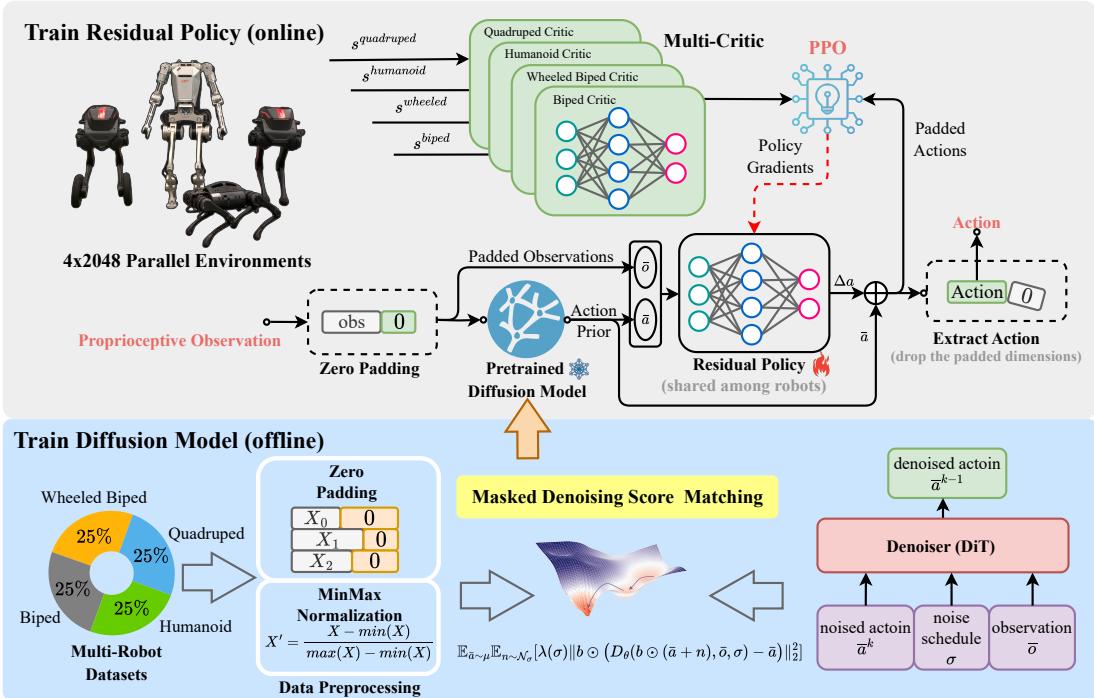
1. Dimension Alignment: The Art of Padding
To feed different robots into one “brain,” the researchers standardized the inputs and outputs. They looked at the robot with the most complexity (the maximum dimension of observations and actions across all robots) and used that as the standard size.
For smaller robots, they simply filled the empty slots with zeros—a technique known as zero-padding.

Here, \(\bar{\mathcal{O}}\) and \(\bar{\mathcal{A}}\) represent the unified observation and action spaces. If a quadruped has 12 motors but the unified space accommodates 20, the system creates a mask (\(b\)). This binary mask acts like a filter, telling the network, “Pay attention to these 12 values, and ignore the 8 zeros at the end.” This simple but effective trick allows a single neural network architecture to process data from any robot in the set.
2. The Diffusion Model: A “Foundation Model” for Movement
The core of Multi-Loco is a Diffusion Model. If you are familiar with AI art generators like DALL-E or Midjourney, you know they work by denoising random static into a coherent image. Multi-Loco applies this same principle to robot actions.
Instead of generating pixels, the model generates action distributions.
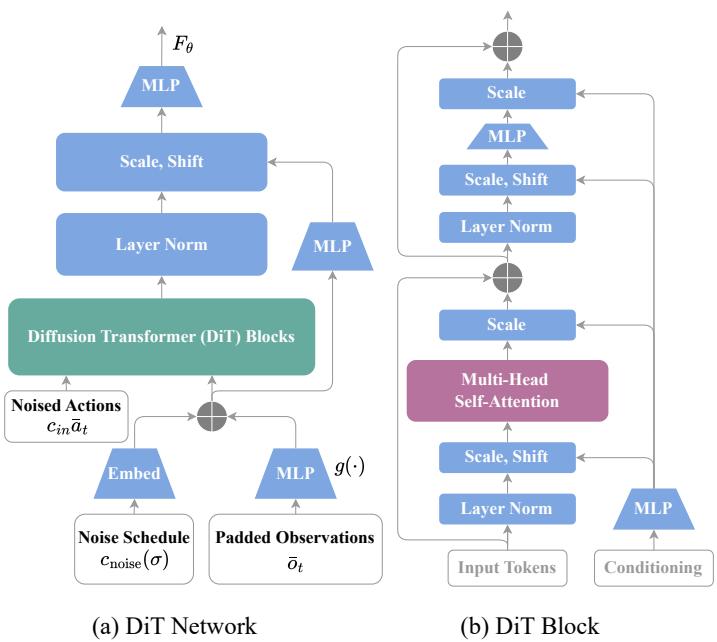
The researchers trained a Diffusion Transformer (DiT) on a massive dataset of offline trajectories collected from all four robots. This model learns the probability distribution of “good actions” given a robot’s current state. Because it is trained on data from all robots simultaneously, it learns a morphology-invariant representation of locomotion. It begins to understand that “balance” requires certain adjustments, regardless of the specific limb configuration.
The architecture of this “Denoiser” network (\(D_{\theta}\)) is illustrated below:
Masked Denoising Score Matching
Standard diffusion training had to be tweaked to handle the zero-padded data. If the model tried to “denoise” the padded zeros, it would get confused. The researchers introduced Masked Denoising Score Matching.

In this objective function, the mask \(b\) ensures that the loss is only calculated on the valid dimensions (the actual motors of the specific robot). The model learns to reconstruct the correct actions for the active joints while ignoring the padded “phantom” joints.
3. The Residual Policy: Bridging Sim-to-Real with RL
Diffusion models are powerful, but they have two weaknesses in robotics:
- Inference Speed: Diffusion is an iterative process (denoising step-by-step), which can be too slow for high-frequency robot control (50Hz+).
- Precision: Generative models are great at capturing the “gist” of a movement, but robots need precise motor torques to handle specific terrain bumps or friction changes.
To solve this, Multi-Loco doesn’t just output the diffusion result. Instead, it uses the diffusion output as a prior (a starting guess) and adds a Residual Policy trained via Reinforcement Learning (PPO).
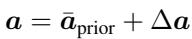
Here:
- \(\bar{a}_{\mathrm{prior}}\) is the action suggested by the diffusion model.
- \(\Delta a\) is the correction (residual) calculated by a lightweight RL policy.
The RL policy is fast and reactive. It takes the “general idea” of the movement from the diffusion model and fine-tunes it for the exact current situation. This allows the system to bridge the Sim-to-Real gap—the difference between a perfect physics simulation and the messy real world.
Multi-Critic Architecture
Training this residual policy is tricky. A “good” state for a wheeled robot might be a “bad” state for a biped. To handle these conflicting definitions of success, the researchers used a Multi-Critic approach.

While the Actor (the policy that decides how to move) is shared across all robots, the Critics (the networks that judge how good a move was) are separate for each robot type. This allows the shared brain to receive specialized feedback: “That was a good move for a quadruped” vs. “That was a bad move for a humanoid.”
Experiments and Results
Does this unified approach actually work? The researchers pitted Multi-Loco (specifically the configuration labeled CR-DP+RA: Cross-Robot Diffusion Policy + Residual Adaptation) against standard RL baselines trained specifically for individual robots.
The results were statistically significant.
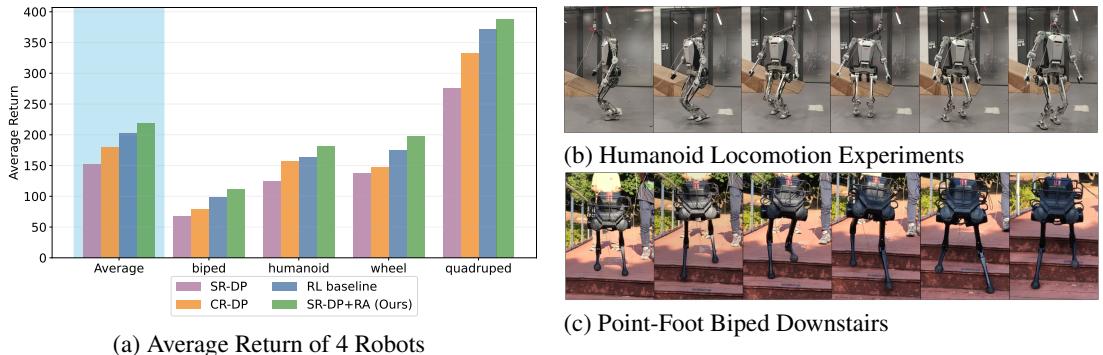
As seen in Figure 3(a) above, the Multi-Loco approach (green bars) consistently outperformed or matched the single-robot RL baselines (blue bars).
- Average Return Improvement: 10.35% overall.
- Wheeled-Biped Improvement: A massive 13.57% gain.
The visuals in Figure 3(b) and (c) show the real-world deployment. The humanoid (top right) is navigating an indoor environment, while the point-foot biped (bottom right) is successfully descending stairs—a notoriously difficult task for such unstable robots.
The Emergence of Shared Skills
One of the most fascinating findings was the “cross-pollination” of skills. The researchers analyzed the wheeled-biped robot, which usually just rolls. However, in the Multi-Loco dataset, the humanoid and quadruped robots frequently lift their legs to step over obstacles.
Remarkably, the wheeled-biped learned to lift its legs to traverse rough terrain, a behavior that was not explicitly present in its own training data but was “learned” from the other robots in the shared diffusion model.
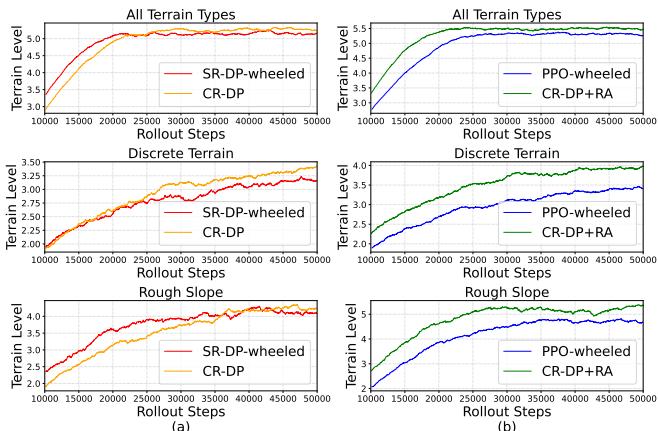
In Figure 4, you can see the performance curves. The unified policy (CR-DP+RA, solid orange line in plot b) learns faster and reaches a higher performance ceiling on rough slopes than the baseline PPO (dashed blue line). This suggests that the “general knowledge” of locomotion acquired from other bodies helped the wheeled robot solve problems it otherwise couldn’t.
Does Dataset Composition Matter?
The researchers performed ablation studies to see how the mix of data affected performance. They found that for the wheeled biped, having access to humanoid data was crucial.
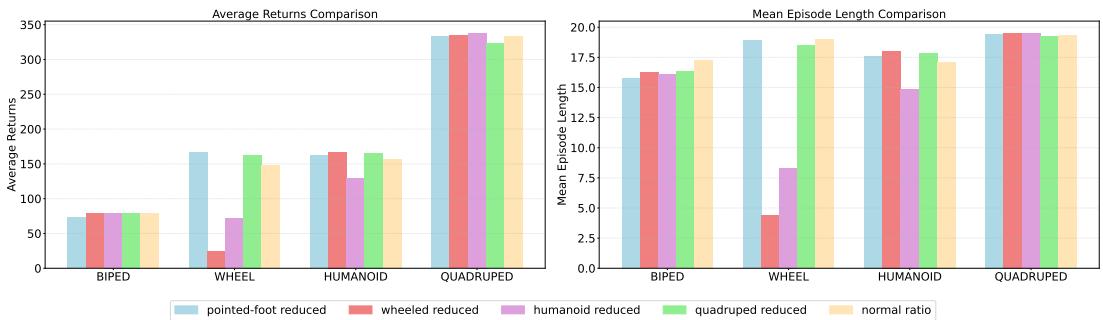
In Figure 8, look at the “WHEEL” cluster. The red bar represents performance when wheeled data is reduced, but the purple bar shows what happens when humanoid data is reduced. The drop in performance indicates that the wheeled robot was heavily relying on the kinematic knowledge transferred from the humanoid data to stabilize itself. This confirms that the model isn’t just memorizing separate robots; it’s synthesizing a shared understanding of physics.
Zero-Shot Transfer: The Ultimate Test
Perhaps the most surprising result came when the researchers tested the policy on a robot that was not in the training set: the Unitree Go2 quadruped.
Usually, transferring a policy to a new robot requires “fine-tuning” (retraining the weights slightly). Multi-Loco, however, achieved Zero-Shot Transfer.
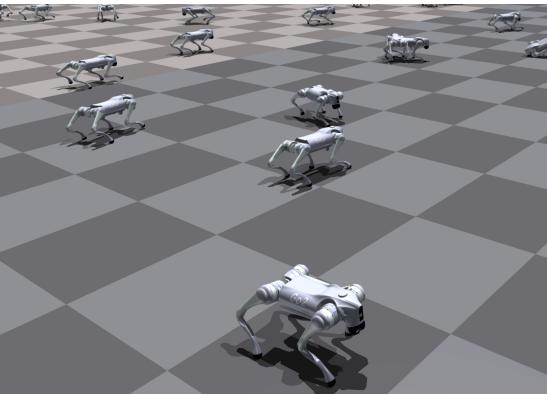
Because the system relies on a masked diffusion prior that understands general locomotion dynamics, it could control the Go2 robot immediately, despite differences in mass and motor properties compared to the training quadruped (Unitree A1).
The results for this transfer were quantified in the table below:
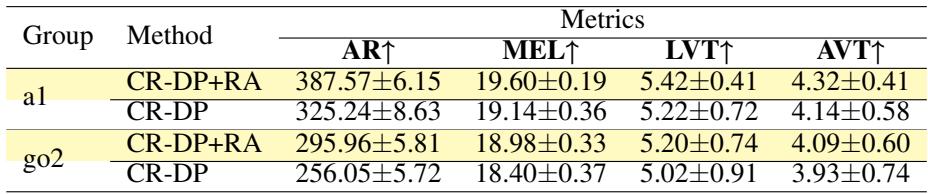
The performance on the unseen Go2 (rows 3 and 4) remains very high, with Mean Episode Length (MEL) and Velocity Tracking (LVT) nearly matching the robot it was actually trained on (A1).
Conclusion and Implications
The “Multi-Loco” paper represents a significant step away from the “one robot, one brain” paradigm that has dominated robotics for years. By combining Diffusion Models to capture the broad, multimodal distribution of “how things move” with Reinforcement Learning to handle the sharp, immediate dynamics of the real world, the authors have created a robust, generalist controller.
Key Takeaways:
- Unification is possible: A single policy can control bipeds, quadrupeds, and hybrids.
- Diffusion facilitates transfer: Generative models act as excellent priors for RL, stabilizing training and improving performance.
- Skills transfer across bodies: Robots can learn strategies (like leg lifting) from morphologically different peers.
- Masking works: Simple zero-padding and masked loss functions are sufficient to handle varying observation/action dimensions.
As we look toward the future, frameworks like Multi-Loco suggest a path toward “Foundation Models for Robotics”—large, pre-trained brains that can be downloaded into any robot, regardless of its shape, allowing it to walk, run, or roll immediately.
This blog post is based on the research paper “Multi-Loco: Unifying Multi-Embodiment Legged Locomotion via Reinforcement Learning Augmented Diffusion” by Shunpeng Yang et al.