](https://deep-paper.org/en/paper/2506.11948/images/cover.png)
Introduction
In the world of robotics, Imitation Learning (IL) has become the go-to method for teaching robots complex manipulation skills. By observing a human perform a task—like folding a shirt or stacking cups—a robot can learn to replicate the behavior using algorithms like Behavior Cloning. It is an elegant, data-driven solution that has shown incredible promise.
But there is a catch: Speed.
Typically, an imitation learning policy is confined to the speed of the demonstration. If a human moves cautiously to ensure safety or precision during data collection, the robot learns to be equally sluggish. In a research lab, this is fine. In industrial automation or logistics, where throughput is king, “slow and steady” is a dealbreaker.
So, why not just press “fast forward”? Why can’t we simply execute the learned actions at \(2\times\) or \(4\times\) speed?
As it turns out, speeding up a robot is not like speeding up a YouTube video. Increasing speed fundamentally alters the physics of the system. The momentum changes, the friction changes, and the robot’s ability to track a trajectory degrades. The robot enters state distributions it never saw during training, leading to jerky motions, missed grasps, and system failures.
In this post, we will dive into SAIL (Speed Adaptation for Imitation Learning), a new full-stack framework presented by researchers at Georgia Tech. SAIL addresses the intertwined challenges of dynamics shifts and latency, enabling robots to execute tasks up to \(4\times\) faster than the human demonstrations they learned from, without sacrificing reliability.

The Problem: Why Faster Execution Breaks Robots
To understand why SAIL is necessary, we first need to understand what happens when we naively speed up a standard visuomotor policy (like Diffusion Policy).
1. Dynamics Shift and Controller Lag
Robots are physical systems governed by inertia. When a human teleoperates a robot to collect data, they usually move slowly. The low-level controller (the PID or impedance controller) can track these slow commands almost perfectly.
However, if you tell the robot to execute that same path in half the time, the required accelerations skyrocket. The controller inevitably lags behind the target. This creates a tracking error. The robot isn’t where the policy thinks it should be, which feeds “out-of-distribution” (OOD) states back into the neural network.
2. The Receding Horizon Problem
Modern policies use Receding Horizon Control. At every timestep, the AI predicts a trajectory of future actions (e.g., the next 16 steps). It executes the first few, then stops, observes the world again, and predicts a new trajectory.
At normal speeds, these consecutive predictions usually overlap nicely. But at high speeds, due to the tracking errors mentioned above, the robot’s state deviates from the plan. When the policy re-plans based on this deviated state, the new trajectory might look completely different from the previous one. This disagreement causes the robot to jitter or jerk violently—a phenomenon known as temporal inconsistency.
3. System Latency
Finally, there is a hard physical limit: Latency. It takes time for the camera to capture an image, time for the GPU to process the neural network, and time for the motor drivers to act. If the robot moves too fast, it might finish its current buffer of actions before the brain has finished computing the next batch, causing the robot to stutter or pause.
The Solution: The SAIL Framework
SAIL tackles these problems not just by training a better neural network, but by optimizing the entire robotic “stack”—from the high-level AI planner down to the low-level motor controller.
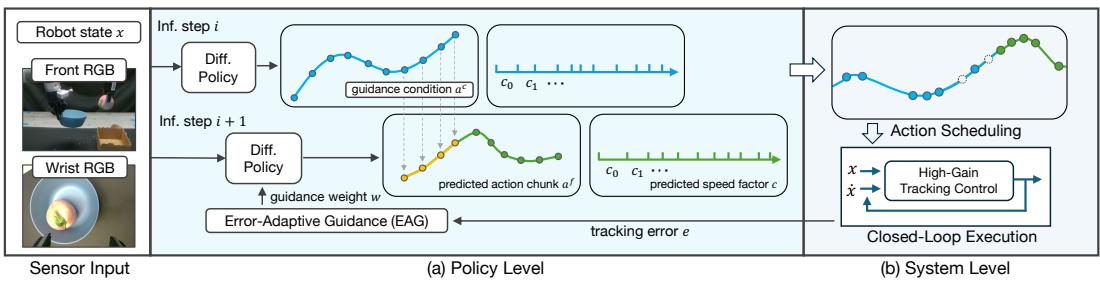
As shown in Figure 2, SAIL consists of four tightly integrated components:
- Error-Adaptive Guidance (EAG): A method to enforce smooth planning.
- Controller-Invariant Targets: A new way to define what the AI should learn.
- Adaptive Speed Modulation: Slowing down only when necessary.
- Action Scheduling: Managing latency to prevent pauses.
Let’s break these down one by one.
1. Error-Adaptive Guidance (EAG)
The first challenge is fixing the “jitter” caused by consecutive policy predictions disagreeing with each other.
A common technique in diffusion models is Classifier-Free Guidance (CFG). In this context, CFG can be used to smooth transitions by conditioning the new plan on the tail end of the old plan. Effectively, you tell the model: “Plan a future path, but make sure it connects smoothly to what you just decided a moment ago.”
However, blind consistency is dangerous. If the robot has been knocked off course (high tracking error), forcing it to follow the old, invalid plan is a recipe for disaster. You don’t want to be consistent with a mistake.
SAIL introduces Error-Adaptive Guidance. The system monitors the current tracking error \(e\).
- If tracking error is low: The system applies guidance to enforce smoothness. It assumes the previous plan is still valid.
- If tracking error is high: The system disables guidance. It recognizes that the robot is off-track and allows the policy to react purely to the current observation, effectively “re-planning” from scratch to correct the error.
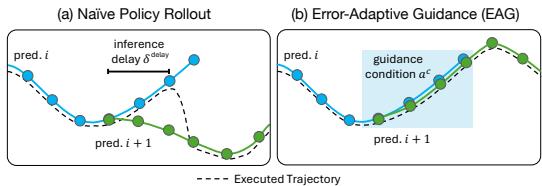
Figure 3 illustrates this difference. In the top row (Naive), two consecutive predictions (blue and green) diverge significantly, causing the executed path (black dashed line) to be jerky. In the bottom row (EAG), the guidance aligns the predictions, resulting in a smooth execution.
Mathematically, the modified noise prediction \(\varepsilon_{\theta}^{\mathrm{guided}}\) blends the unconditional prediction with the conditional prediction based on a weight \(w\):

The weight \(w\) is dynamically set to 0 if the tracking error exceeds a threshold, instantly switching the system from “smoothness mode” to “correction mode.”
2. Reducing Controller Shift
The second major innovation is changing what the robot tries to imitate.
In standard data collection, we record the Commanded Pose (\(x^d\))—where the human operator told the robot to go. Usually, data is collected using a “soft” controller that feels natural to the human hand.
If we speed up execution, we need a “stiff” (high-gain) controller to keep up with the speed. But a stiff controller behaves differently than a soft one. If we feed the stiff controller the targets recorded from a soft controller, the robot mimics the commands but not the motion.
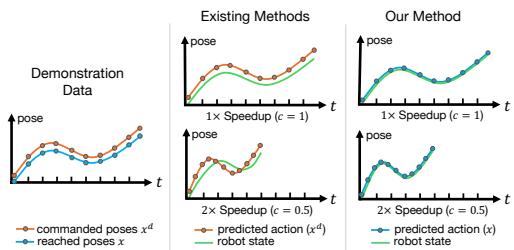
SAIL changes the learning target. Instead of predicting the commanded pose (\(x^d\)), the policy learns to predict the Reached Pose (\(x\))—where the robot actually physically went during the demo.
- Why does this help? The reached pose is the physical reality of the trajectory. It is invariant to the controller used.
- Execution: During high-speed runtime, SAIL uses a dedicated High-Fidelity Tracking Controller (high-gain) that is optimized to aggressively track these reached poses.
By decoupling the target (physical reality) from the controller dynamics (how we get there), SAIL ensures the robot follows the intended path regardless of speed.
3. Adaptive Speed Modulation
Not all parts of a task can be sped up equally. Imagine carrying a cup of coffee to a table. You can move your arm quickly while carrying it, but the moment you set it down on a coaster, you must slow down to be precise.
If we force a global \(4\times\) speedup, the precision parts will fail.
SAIL implements Adaptive Speed Modulation. It analyzes the task to identify “Critical Actions”—phases requiring high precision or complex interaction.
- Offline Analysis: It uses an algorithm (based on waypoint density) to detect complex geometric motions in the demonstrations.
- Online Detection: It watches for gripper events (opening/closing), which usually signal a grasp or release.
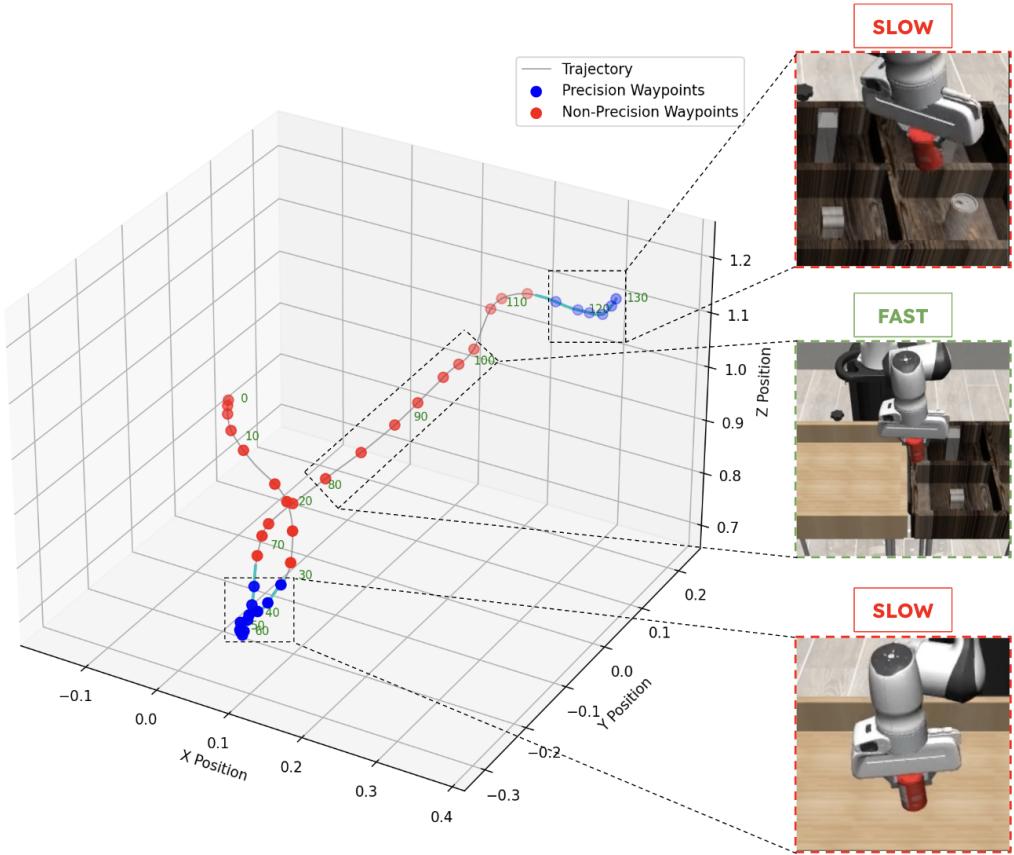
As visualized in Figure F.3, the system dynamically adjusts the speedup factor \(c_t\). The trajectory is colored red for fast movements and blue for slow, precision movements (like the clusters of frames near the object interaction). The equation governing this is simple but effective:

Where \(k_t\) is a binary flag indicating a critical action. This allows the robot to sprint during free-space motion and slow down for the delicate work.
4. Latency-Aware Action Scheduling
The final piece of the puzzle is the physical time limit. Inference on a large Diffusion Policy takes time (e.g., 50ms to 100ms).
If the robot is moving slowly, 100ms is negligible. If the robot is moving at \(4\times\) speed, 100ms represents a massive distance traveled. If the robot finishes its current action queue before the next inference is ready, it freezes.
SAIL calculates a theoretical Speedup Upper Bound (\(\delta^{\mathrm{lb}}\)). This is the fastest the robot is physically allowed to move such that the execution time of a batch of actions is always longer than the inference time plus the conditioning horizon.
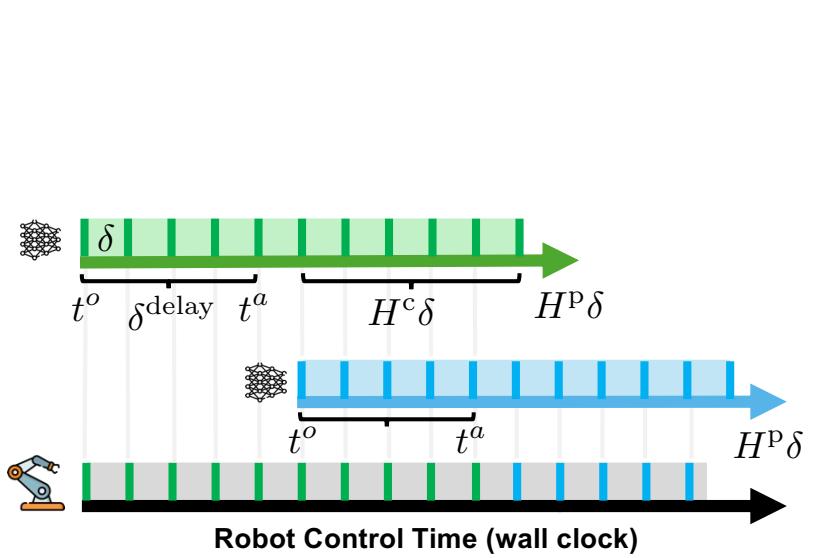
Figure E.2 shows how the schedules overlap. The green block is the current execution. The blue block is the inference happening in the background. SAIL ensures the green block is long enough to cover the gap, ensuring continuous, fluid motion.
Experiments and Results
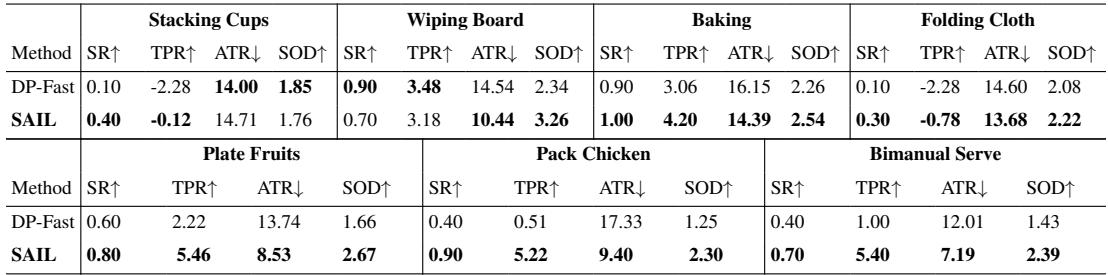
The researchers evaluated SAIL in both simulation (RoboMimic) and the real world (Franka Emika Panda and UR5 robots). The primary metric used was Throughput-with-Regret (TPR), which rewards fast successful completions but penalizes failures.
Simulation Performance
In simulation, comparisons were made against standard Diffusion Policy (DP), sped-up DP, and other baselines.
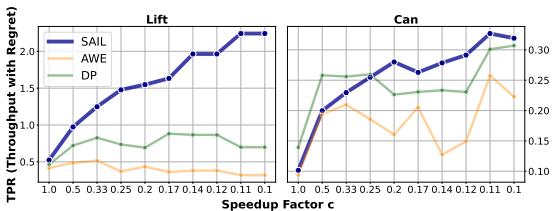
Figure 6 shows the results for the “Lift” and “Can” tasks.
- The Green line (DP) represents standard Diffusion Policy. As you try to speed it up (moving left on the X-axis), performance doesn’t improve much or degrades.
- The Blue line (SAIL) shows massive gains. As the speedup factor \(c\) decreases (meaning higher speed), the throughput skyrockets.
The quantitative results in Table 1 highlight the magnitude of improvement:
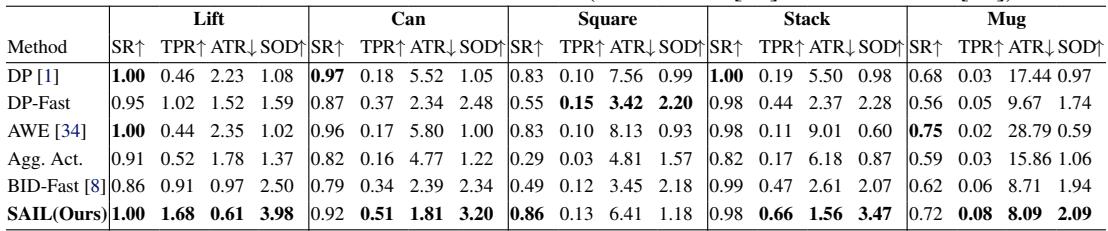
On the Can task, SAIL achieves a Success Rate (SR) of 0.92 with a Speedup-Over-Demo (SOD) of 3.20x. Compare this to the naive DP-Fast baseline, which drops to 0.87 SR. In the Lift task, SAIL reaches nearly 4x speedup (3.98) with 100% success.
Real-World Evaluation
The real-world tests were even more impressive, involving tasks like wiping a whiteboard, folding a cloth, and bimanual serving.
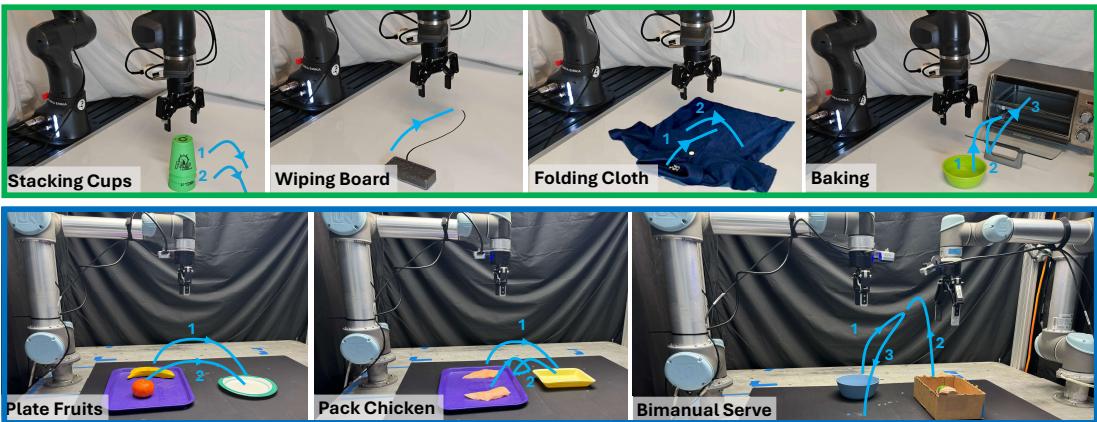
The team pushed the system to achieve a 5x target speedup, resulting in effective speedups of up to 3.2x (after accounting for slowdowns during critical phases).

Figure 8 illustrates why baselines failed in the real world:
- Imprecise Grasping: Moving too fast caused the gripper to miss the object (Frames 1, 5, 7).
- Low-Fidelity Tracking: The robot collided with other objects because it drifted off path (Frames 2, 3).
- Jerky Motion: Sudden accelerations caused objects to fly out of the gripper (Frame 8).
SAIL mitigated these issues. For example, in the “Plate Fruits” task, SAIL achieved a 5.46 TPR score compared to 2.22 for the sped-up baseline, effectively doubling the efficiency of the robotic cell.
Conclusion
The SAIL framework demonstrates that we don’t need to retrain our robots from scratch to make them faster. By carefully considering the full robotic stack—acknowledging that a neural network is driving a physical machine with mass, latency, and momentum—we can unlock significant performance gains.
Key takeaways from this work:
- Don’t trust history blindly: Use Error-Adaptive Guidance to balance consistency with error correction.
- Learn the destination, not the command: Predicting “Reached Poses” makes policies robust to controller changes.
- Speed is contextual: Adaptive modulation allows robots to be fast and precise.
For students and researchers entering the field, SAIL serves as a reminder: Solving the “AI part” (the policy) is often only half the battle. The interface between the AI and the physical control system is where some of the most critical challenges—and solutions—lie.