](https://deep-paper.org/en/paper/2506.12278/images/cover.png)
The rise of Large Language Models (LLMs) like GPT-4 and Qwen has revolutionized how we write code. We can now prompt a model to generate complex algorithms, solve competitive programming problems, and scaffold entire applications. But any experienced software engineer knows that writing code is only half the battle. The other half—often the harder half—is testing it.
If an AI generates a sorting algorithm, how do we know it works for every edge case? Can the AI itself generate the test cases needed to verify that code?
A new research paper titled “Can LLMs Generate High-Quality Test Cases for Algorithm Problems? TestCase-Eval: A Systematic Evaluation of Fault Coverage and Exposure” dives deep into this question. The researchers introduce a rigorous benchmark to see if LLMs can act not just as coders, but as Quality Assurance experts. The results are surprising: while models are getting smarter, they still struggle significantly when pitted against human experts in finding subtle bugs.
In this deep dive, we’ll explore how this benchmark works, the unique “hacking” tasks it proposes, and why even the most advanced reasoning models have a long way to go.
The Problem with Current Testing
Before understanding the new method, we need to understand why previous benchmarks weren’t cutting it. Traditionally, evaluating test generation has relied on metrics like Line Coverage or Branch Coverage.
If you ask an AI to write a test suite for a function, and that test suite executes 100% of the lines in the function, traditional metrics say you did a great job. However, in algorithmic problems, coverage is deceptive. You can execute every line of a program and still fail to catch a logical bug that only appears with specific, massive inputs or tricky boundary conditions (like an empty array or negative numbers).
Algorithmic correctness hinges on edge cases, not just code execution. To truly test an LLM’s ability to verify code, we need to see if it can catch broken code, not just run lines of text.
Enter TestCase-Eval
To solve this, the researchers created TestCase-Eval. This isn’t just a collection of problems; it’s a massive dataset derived from Codeforces, one of the most popular competitive programming platforms in the world.
The dataset is built to be realistic and challenging. It includes:
- 500 Algorithm Problems: Sourced from contests in 2024 (ensuring models haven’t memorized them during pre-training).
- 100,000 Human-Crafted Solutions: Crucially, these aren’t just correct solutions. The researchers mined thousands of incorrect submissions—code that real humans wrote that failed on specific test cases.
The logic is simple: If an LLM is good at generating test cases, it should be able to create inputs that cause these incorrect solutions to fail.
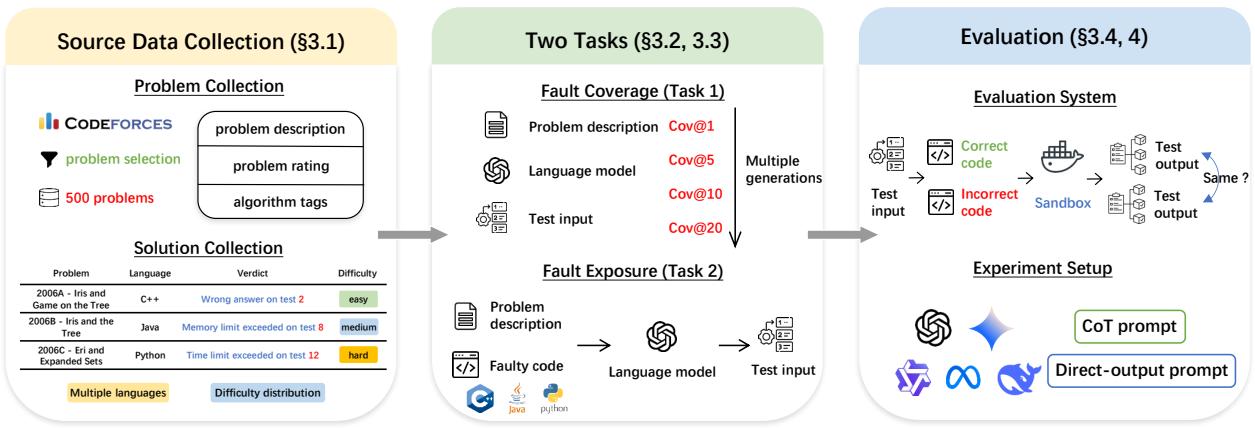
As shown in Figure 1, the pipeline begins with collecting problems and their corresponding solutions (both correct and buggy). The evaluation is then split into two distinct tasks that measure different aspects of testing ability.
The Two Core Tasks
The heart of this paper lies in its two evaluation tasks: Fault Coverage and Fault Exposure.
Task 1: Fault Coverage (The Broad Net)
Imagine you are given a problem description (e.g., “Sort this list of integers”). You don’t see anyone’s code yet. Your job is to generate a set of test inputs that are diverse and tricky enough to catch potential bugs in anyone’s code.
This is the Fault Coverage task. The LLM is given the problem description and asked to generate \(N\) test cases. We then run a massive database of known incorrect human solutions against these generated tests.
The metric, Cov@N, is calculated as follows:

Here, \(\mathcal{T}_N\) is the set of test inputs generated by the LLM. \(\mathcal{F}(t_i)\) represents the subset of buggy solutions that failed when run against test case \(t_i\). The score is essentially the percentage of all known buggy solutions that were caught by the LLM’s generated test suite.
This measures the robustness of the tests. A high score means the LLM understands the problem well enough to predict where programmers usually make mistakes (e.g., forgetting to handle \(N=0\)).
Task 2: Fault Exposure (The Targeted Hack)
This task is inspired by the “hacking” phase in Codeforces competitions. Here, the LLM is given two things:
- The problem description.
- A specific piece of buggy code (a solution that is known to be incorrect).
The LLM’s goal is to act as a precision sniper. It must generate a single test input that specifically triggers the bug in that code. The model has to analyze the logic of the buggy implementation, identify the flaw, and construct an input that exploits it.
The Fault Exposure Rate is calculated by averaging how often the LLM succeeds in breaking the code:

Where the success function \(e(f_i, t_i)\) is defined as:

If the generated test case \(t_i\) causes the faulty code \(f_i\) to fail (produce the wrong output or crash), the LLM gets a point. If the buggy code somehow passes the test, the LLM fails. This is a much harder task because it requires deep code comprehension and reasoning.
Experimental Setup
The researchers pitted 19 state-of-the-art models against this benchmark. The lineup included:
- Proprietary Models: GPT-4.1, GPT-4o, GPT-4.1-mini.
- Open Source Models: Qwen2.5, Qwen3, Llama-3.1, DeepSeek-R1 (distilled), and others.
- Human Baseline: To see how hard this really is, two human experts (Codeforces rating ~2100, which is very high) performed the tasks on a subset of problems.
They evaluated the models using two prompting strategies:
- Direct Output: Asking the model to just give the test case.
- Chain-of-Thought (CoT): Asking the model to “think step by step” before generating the test case.
Results: The Gap Between AI and Humans
The results highlight a significant reality check for AI programming capabilities. While models are impressive, they are not yet expert testers.
Overall Performance
Let’s look at the main leaderboard.
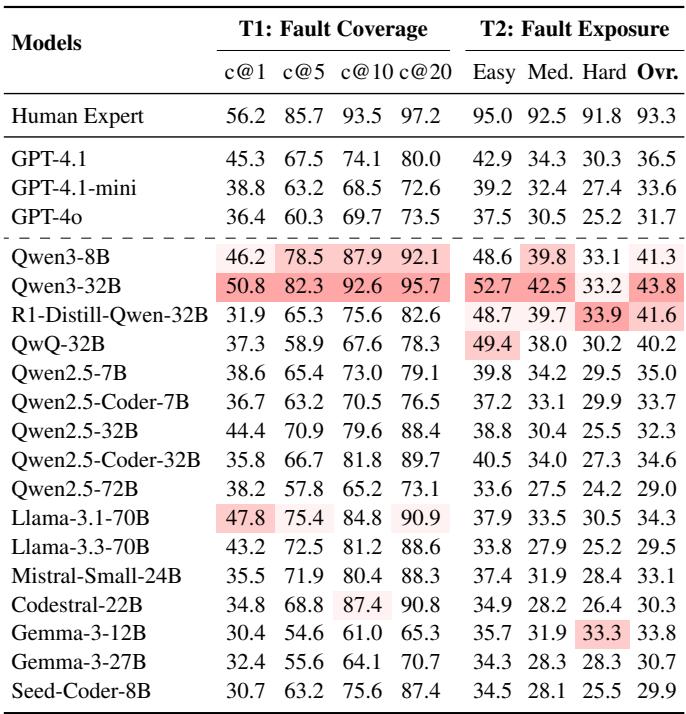
Table 1 reveals several critical insights:
- Humans are still supreme: Look at the “Human Expert” row. On Task 2 (Fault Exposure), humans achieved a 93.3% success rate. They almost never missed a bug.
- The AI ceiling: The best performing model, Qwen3-32B, achieved only 43.8% on Task 2. That is a massive gap. Even the powerful GPT-4.1 only reached 36.5%.
- Reasoning matters: The top performers weren’t necessarily the largest models, but the ones tuned for reasoning (Qwen3, R1-Distill, QwQ). This suggests that generating test cases isn’t about language patterns; it’s about logical deduction.
- Coverage vs. Exposure: Models were generally better at Task 1 (generating a broad set of tests) than Task 2 (targeted hacking). It’s easier to cast a wide net than to find a specific needle in a haystack.
The Power of Reasoning (CoT)
One of the most actionable findings for students and engineers is the impact of prompting strategies.
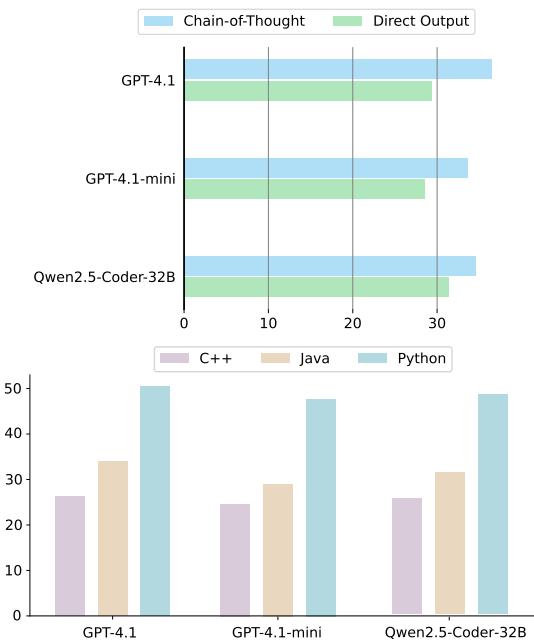
The top chart in Figure 2 shows the difference between Chain-of-Thought (CoT) (light blue) and Direct Output (green).
Across the board, CoT prompting boosts performance. When the model is forced to explain its logic—“I need to check for an array of size 1 because the loop condition might be off”—it generates significantly higher-quality test cases. For Qwen2.5-Coder, the difference is negligible, but for GPT-4.1, the reasoning step provides a clear advantage.
Language and Error Types
The bottom chart in Figure 2 highlights an interesting quirk: Language bias.
- Python (Light Blue): Models are much better at breaking Python code (~45 score).
- C++ (Purple) & Java (Beige): Models struggle more here (~26-33 score).
The authors hypothesize this is due to the nature of the languages. Python is dynamically typed and interpreted, often leading to different classes of bugs that might be easier for LLMs to conceptualize or simulate. C++ and Java have strict typing and compilation steps that might obscure the kind of runtime logic errors LLMs are good at predicting.
We can dig deeper into what kind of bugs the models found by looking at the error type breakdown.
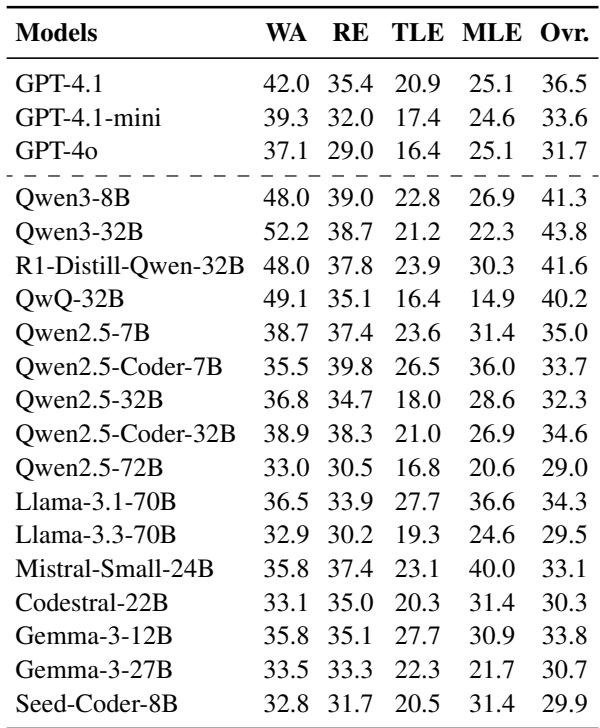
Table 2 categorizes bugs into four types:
- WA (Wrong Answer): The logic is flawed.
- RE (Runtime Error): The code crashes (e.g., divide by zero).
- TLE (Time Limit Exceeded): The code is too slow.
- MLE (Memory Limit Exceeded): The code uses too much RAM.
The data shows a clear trend: Models are decent at catching Wrong Answers (WA) and Runtime Errors (RE). However, they are terrible at catching resource errors like TLE and MLE.
This makes intuitive sense. An LLM understands logic and syntax, so it can spot an “off-by-one” error. But an LLM has no internal clock or memory manager. It struggles to intuitively grasp that a nested loop will time out when \(N=10^5\). It cannot “feel” the computational complexity in the same way a human competitor does.
Conclusion and Implications
The TestCase-Eval benchmark serves as a reality check for the AI coding hype. While LLMs can generate code that looks correct, their ability to rigorously verify that code through test case generation is still lagging behind human experts.
Here are the key takeaways:
- Testing is harder than coding: Generating a solution is often a pattern-matching task. Generating a test case that breaks a subtle solution requires deep adversarial reasoning.
- Reasoning models are the future of QA: The strong performance of Qwen3 and reasoning-distilled models suggests that standard LLMs aren’t enough. We need models that can “think” through execution paths to be effective testers.
- The “Efficiency Blindspot”: Until LLMs develop a better understanding of computational complexity, they will struggle to optimize code for performance (Time/Memory limits), which is a critical aspect of real-world software engineering.
For students and developers, this means AI is a helpful assistant for writing unit tests, but it cannot yet replace a human’s intuition for edge cases and system constraints. When you use an LLM to write tests, always review them, and remember: if the AI says your code is bug-free, it might just be because the AI isn’t smart enough to break it yet.