](https://deep-paper.org/en/paper/2506.13867/images/cover.png)
Introduction
Imagine you are teaching a robot to pick up a transparent glass pot. In a sterile lab environment or a computer simulation, this is relatively easy. The lighting is perfect, the background is a solid color, and the object’s position is known precisely.
Now, move that robot into a real kitchen. Sunlight is streaming through the window, casting moving shadows. There is a patterned tablecloth. A bright blue coffee mug is sitting next to the pot. Suddenly, the robot fails. It gets confused by the mug, it can’t “see” the clear glass correctly because its depth sensors struggle with transparency, or the new lighting changes the pixel values so much that the robot’s neural network thinks it’s looking at a completely different scene.
This is the perceptual gap—one of the biggest hurdles in robotics today. Visuomotor policies (algorithms that map what the robot sees to how it moves) are notoriously brittle. They struggle to transfer from simulation to reality (“Sim2Real”) or to generalize outside their training data.
In this deep dive, we explore a fascinating solution proposed by researchers from the University of Washington: ATK (Automatic Task-driven Keypoint Selection). Their insight? Robots don’t need to process every pixel of an image, nor do they need rigid, hard-to-calculate pose estimates. Instead, they should focus on specific, relevant 2D points—keypoints—that matter for the task at hand.
But out of thousands of potential points in an image, which ones matter? ATK proposes a method to let the robot figure that out for itself.
The Problem with Pixels and Poses
To understand why ATK is necessary, we first need to look at why current methods fall short.
1. The Brittle Nature of Pixels
The most common approach in modern deep learning is to feed the entire RGB image into a Convolutional Neural Network (CNN) or a Transformer. While powerful, these models often learn correlations that don’t matter. They might learn that “table with wood grain texture = move arm forward.” If you swap the table for a white one, the policy breaks. This lack of robustness makes deployment in the chaotic real world difficult.
2. The Rigidity of Pose Estimation
Another approach is to explicitly calculate the 6D pose (position and orientation) of the object. This works for rigid items like boxes, but it fails in many scenarios:
- Deformable Objects: How do you define the “pose” of a crumpled towel or a blanket?
- Transparent/Reflective Objects: Depth sensors (like LiDAR or RealSense) often shoot right through glass or bounce off reflective surfaces, resulting in noisy or missing data.
- Scaling: You need a specific pose estimator for every new object you want to manipulate.
The Case for Keypoints
Keypoints offer a “Goldilocks” solution. A keypoint is simply a 2D coordinate \((x, y)\) in an image that corresponds to a semantic part of a scene (e.g., the handle of a mug, the corner of a cloth).
Keypoints are surprisingly robust. Thanks to recent advances in computer vision (trained on massive web-scale datasets), we can now track specific points on an object even as it moves, rotates, or gets partially occluded. Because keypoints don’t rely on the object being a rigid solid, they work beautifully for deformable objects like cloth.
However, using keypoints introduces a new problem: Selection.
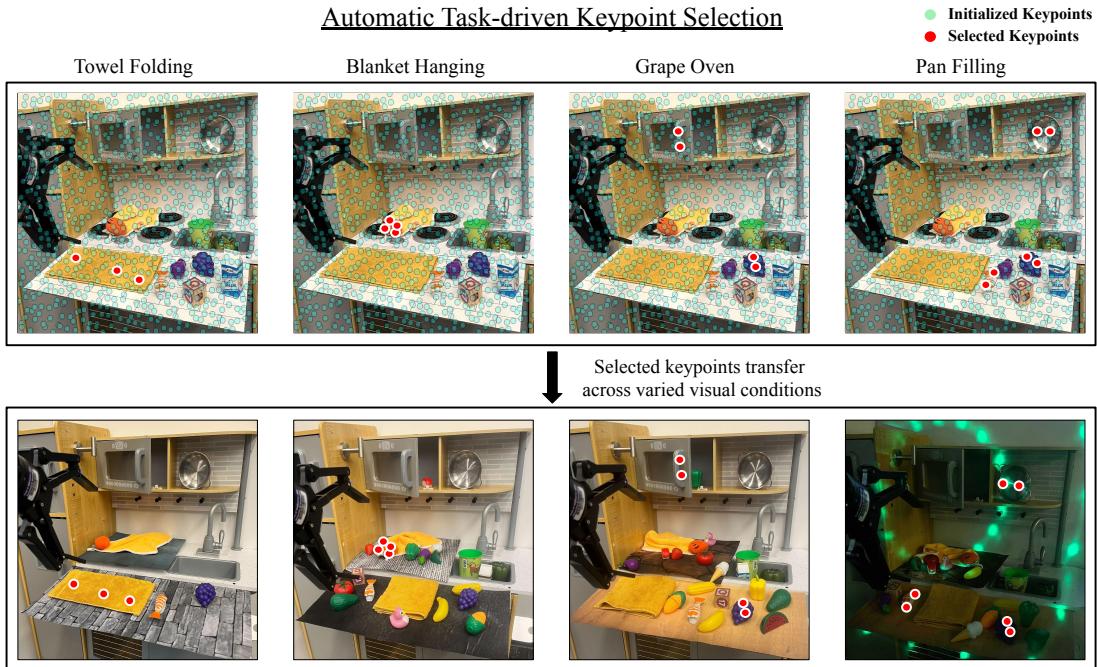
As illustrated in Figure 1, different tasks require looking at different things.
- Blanket Hanging: The robot needs to track the edges of the fabric.
- Pan Filling: The robot cares about the pan handle and the stove burner.
- Grape Oven: The focus shifts to the small grape and the oven door.
If you simply use all possible keypoints, you flood the robot with noise. If you pick them randomly, you might miss the handle it needs to grasp. The “minimal set” of keypoints must be task-driven.
Core Method: Automatic Task-driven Keypoint Selection (ATK)
The researchers propose ATK, a pipeline that automates the selection process. The goal is to identify a minimal set of keypoints that are predictive of the optimal behavior for a specific task.
This creates a “chicken-and-egg” problem: you need the right keypoints to learn the policy, but you need the optimal policy to know which keypoints are important. ATK solves this by learning both simultaneously through distillation.
The Architecture
The ATK process assumes we have access to an “expert.” This could be a privileged agent in a simulation (which knows everything about the world) or a human demonstrator providing ground-truth actions.
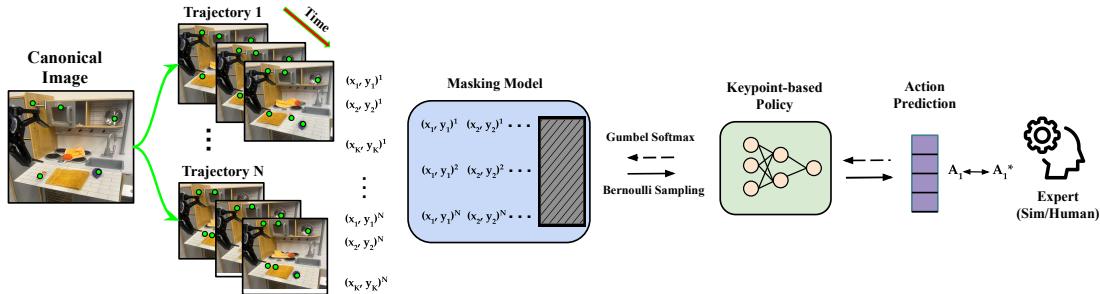
Let’s break down the pipeline shown in Figure 2:
- Candidate Generation: The system starts with a “Canonical Image”—a single frame representing the task setup. It samples a large number of candidate keypoints across this image (e.g., a uniform grid).
- Tracking: Using a correspondence function (a visual tracker), these candidate points are tracked across all the expert demonstration videos. This creates a history of how every candidate point moves over time.
- The Masking Network (\(\mathbb{M}_{\phi}\)): This is the brain of the selector. It takes the tracked candidates as input and outputs a probability mask. Essentially, it assigns a score to each point: “Keep” or “Discard.”
- The Policy Network (\(\pi_{\theta}\)): The selected (kept) keypoints are passed to the policy network, which tries to predict the expert’s action (e.g., “move arm to coordinates X, Y, Z”).
The Optimization Game
The system is trained end-to-end using a specific loss function that balances two competing goals: accuracy and simplicity.

The objective function has two parts:
- Action Prediction (Log Likelihood): The first term (\(\log \pi...\)) tries to maximize the probability of taking the expert’s action. This forces the model to keep keypoints that contain critical information.
- Sparsity Penalty (\(\alpha ||...||_1\)): The second term penalizes the model for using too many keypoints. This forces the model to be efficient and discard irrelevant background points.
The Technical Challenge: Differentiating a Choice Selecting a keypoint is a binary decision (Yes/No). Standard backpropagation (the way neural networks learn) cannot handle discrete binary choices because they aren’t differentiable. To solve this, the authors use the Gumbel-Softmax relaxation. This is a mathematical trick that allows the network to make “soft” decisions during training (allowing gradients to flow) while converging toward hard binary choices.
Inference: The Real-World Transfer
Once the model is trained, we have a learned “Mask” that tells us exactly which points on the canonical image are important.
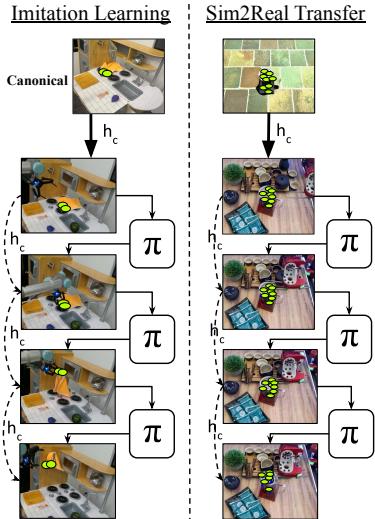
At test time (deployment), the process is efficient (see Figure 3):
- Transfer: The system looks at the new scene and uses the visual tracker to find the specific keypoints identified during training.
- Tracking: As the robot moves, the tracker updates the positions of these specific keypoints.
- Action: The policy receives just these 2D coordinates and outputs the motor commands.
Because the policy only sees the coordinates of relevant items (like the handle or the object), it becomes “blind” to changes in lighting, table texture, or unrelated clutter.
Experiments and Results
The researchers evaluated ATK in two difficult settings: Sim-to-Real Transfer (training in a physics simulator and testing on a real robot) and Robust Imitation Learning (learning from human demos).
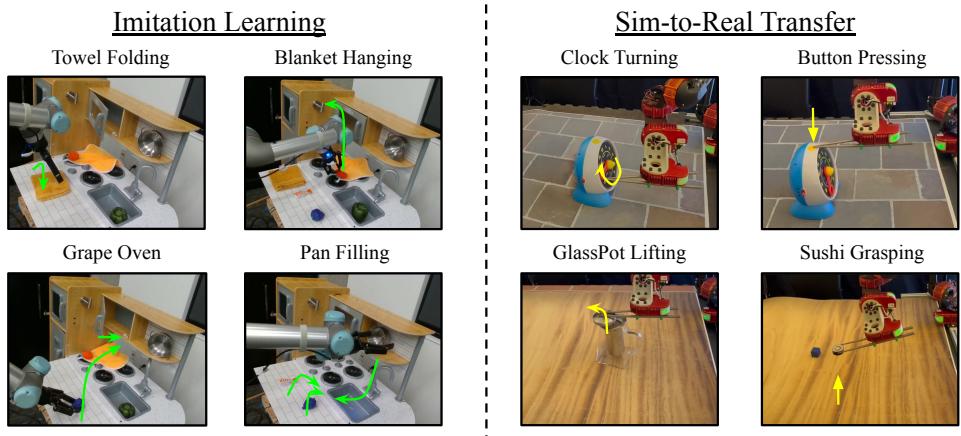
They tested across a variety of tasks involving rigid bodies, articulated objects (like clocks), and deformable objects (towels), as shown in Figure 4.
Robustness “Torture Tests”
To prove the method works, the researchers didn’t just run the robot in a clean lab. They introduced significant visual disturbances:
- RP: Random Object Poses.
- RB: Randomized Backgrounds (swapping textures).
- RO: Random Distractor Objects (throwing toys and junk on the table).
- Light: Extreme lighting changes (colored disco lights, shadows).
Result 1: Sim-to-Real Transfer
In Sim-to-Real scenarios, the visual gap is usually the policy killer. Simulation images look “perfect,” while reality is messy.
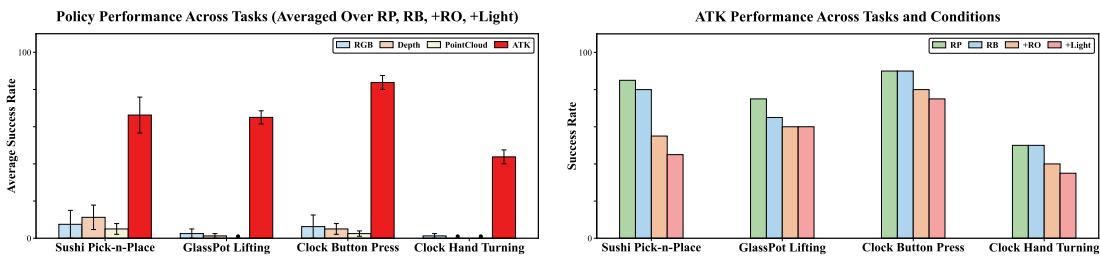
As Figure 5 demonstrates, ATK (Red bars) achieved significantly higher success rates than policies based on RGB images, Depth maps, or Point Clouds.
- Sushi Task: ATK achieved nearly 90% success, while RGB and Depth baselines hovered below 45% or failed completely under disturbances.
- Glass Pot: This was a standout victory. Depth sensors failed on the transparent glass, but ATK’s visual keypoints tracked the glass rim perfectly, maintaining high success rates.
Result 2: Robust Imitation Learning
In the imitation learning setting, the robot learned from real-world demos. The challenge here was generalization. Could the robot fold a towel if the lighting changed or if someone put a banana on the table?
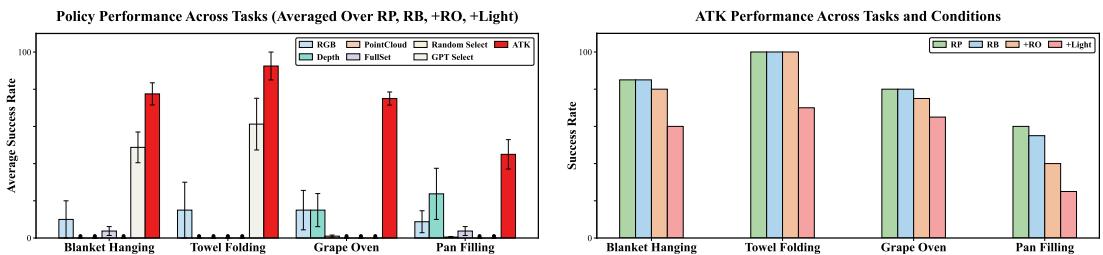
Figure 6 shows that ATK again outperformed the baselines. Crucially, it compared ATK against other keypoint strategies:
- FullSet: Using all keypoints. This failed because it included too much noise (distractors).
- RandomSelect: Picking random points. This failed because it often missed the critical interaction points.
- GPTSelect: They even asked GPT-4 to pick keypoints! ATK outperformed GPT-4 because the LLM often halluncinated points or picked semantically relevant but visually unstable features (see Figure 15 in the deck).
Qualitative Analysis: What did it learn?
The most convincing evidence comes from looking at what the model decided to track.
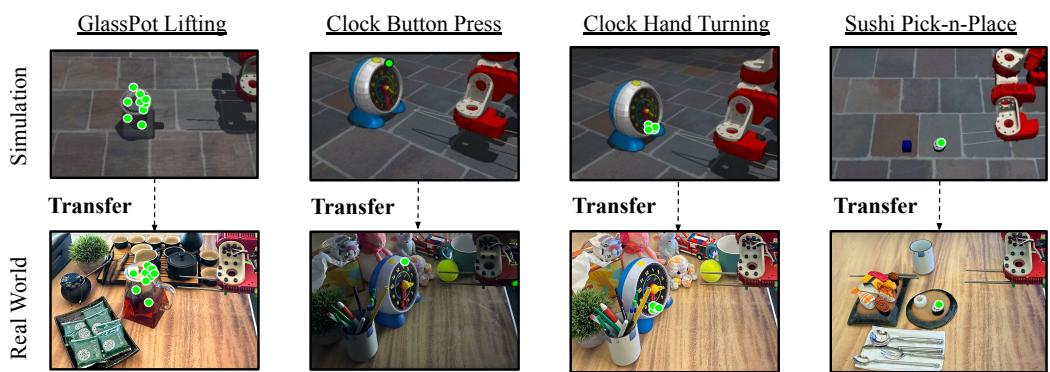
In Figure 7, we can see the logic of the algorithm:
- For the Glass Pot, it ignored the background and focused on the pot’s rim and the lid handle.
- For the Clock, it tracked the specific buttons and the tips of the clock hands.
- Crucially, even when the real-world scene was cluttered with random objects (bottom row), the tracker locked onto the correct features, ignoring the noise.
High-Precision Capabilities
The researchers also pushed the limits with a Shoe Lacing task—a problem requiring millimeter-level precision.
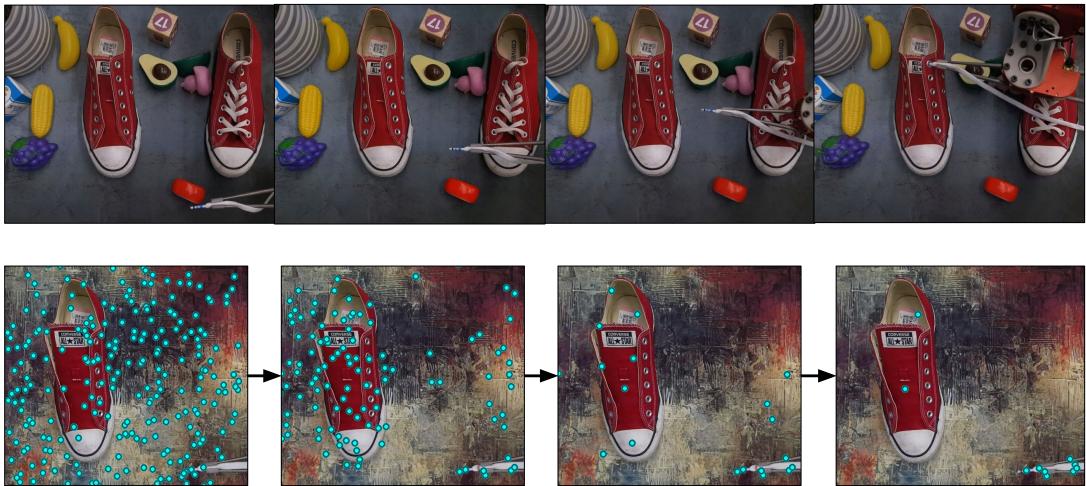
As shown in Figure 10, the tolerance for inserting a lace into an eyelet is tiny (roughly 1.7mm). ATK successfully identified the eyelets and the lace tip (aglets), allowing the policy to perform this fine motor skill even when the background changed or distractors were present. This proves that keypoints aren’t just for “gross” motor skills; they can handle high-fidelity manipulation.
Conclusion & Implications
The ATK paper presents a compelling argument: Less is more. By stripping away the visual complexity of the world and focusing only on the specific geometric points required to solve a task, we can build robot policies that are incredibly robust.
Key Takeaways:
- Task-Driven Selection: There is no “universal” set of keypoints. A robot hanging a blanket needs to look at different things than a robot frying an egg. The task must dictate the vision.
- Robustness via Sparsity: By forcing the model to select a minimal set of points, ATK naturally filters out visual distractors, lighting changes, and background noise.
- Bridge the Gap: Keypoints serve as a common language between simulation and reality. A “corner of a table” is a corner of a table, whether it’s rendered in Unity or seen through a camera lens.
This work paves the way for robots that are less “fussy” about their environment. Instead of needing a perfectly lit, organized factory floor, methods like ATK could enable robots to work in our messy, changing, chaotic homes—ignoring the clutter and focusing on what truly matters.
This blog post summarizes the research paper “ATK: Automatic Task-driven Keypoint Selection for Robust Policy Learning” by Yunchu Zhang et al. from the University of Washington.