](https://deep-paper.org/en/paper/2506.13915/images/cover.png)
Introduction
In the world of autonomous systems, speed often competes with safety. Nowhere is this clearer than in the domain of agile micro aerial vehicles (MAVs), or quadrotors. Whether it is for high-stakes search and rescue missions, disaster response, or competitive drone racing, we want robots that can move from point A to point B in the absolute minimum amount of time.
However, flying at the limit of physics is not just about pushing the throttle to the max. It requires solving a complex “Time-Optimal Path Parameterization” (TOPP) problem. The drone must calculate exactly how fast it can travel along a curve without violating its motor limits or drifting off course due to momentum. Traditionally, this involves solving non-convex optimization problems—heavy mathematical lifting that taxes the onboard computers and takes precious time.
If a drone takes seconds to calculate a trajectory that only lasts a few seconds, it cannot react to dynamic changes in real-time. This bottleneck has led researchers to ask: Can a neural network learn to imitate a slow, perfect optimizer, but do it instantly?
In the paper “Sequence Modeling for Time-Optimal Quadrotor Trajectory Optimization with Sampling-based Robustness Analysis,” researchers from the University of Pennsylvania and UC San Diego propose a novel learning-based framework. They demonstrate that by treating trajectory generation as a sequence-to-sequence modeling problem, they can achieve near-optimal flight times with a fraction of the computational cost, all while maintaining rigorous robustness guarantees.
The Challenge: Why Optimization is Slow
To understand the solution, we must first appreciate the problem. A quadrotor is an “underactuated” system—it has four motors but six degrees of freedom (position and orientation). It cannot simply slide sideways; it must tilt.
When planning a time-optimal trajectory, the system must consider:
- The Geometric Path: Where do we want to go?
- Dynamics: How does the robot move? (Newton-Euler equations).
- Constraints: Motor thrust limits (you can’t spin a propeller infinitey fast) and safety bounds.
An optimization-based solver, such as TOPPQuad, iterates through these variables to find the mathematical minimum time. While highly accurate, this process is computationally expensive because the constraints are non-linear and non-convex. It’s like trying to navigate a maze in the dark by feeling every wall—you’ll get out eventually, and you’ll find the shortest path, but it takes time to map it.
The researchers propose a shift in perspective. Instead of solving the maze every time, what if we trained a “guide” (a neural network) that has memorized the solutions to thousands of similar mazes?
Methodology: Learning to Fly
The core of this research is Imitation Learning. The goal is to train a neural network to mimic the output of the high-fidelity TOPPQuad planner but run orders of magnitude faster.
The Architecture
The problem is framed as a sequence-to-sequence translation task. You might recognize this structure from Natural Language Processing (NLP)—translating a sentence from English to French. Here, the “English sentence” is the geometric path the drone needs to fly, and the “French translation” is the profile of speed and orientation required to fly it optimally.
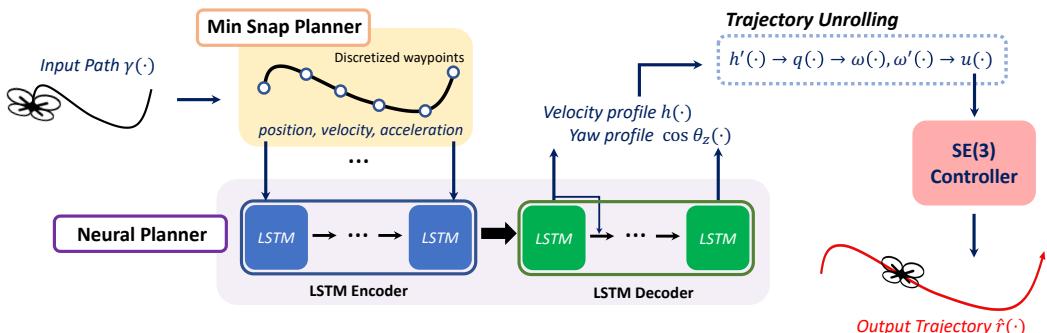
As shown in the architecture diagram above, the pipeline works in several stages:
- Input: A geometric path \(\gamma(\cdot)\) is discretized into waypoints.
- Encoder-Decoder: An LSTM (Long Short-Term Memory) network processes the path and predicts the optimal behavior.
- Unrolling: The predictions are converted into full robot state commands (position, velocity, acceleration, orientation).
- Control: A low-level controller executes the motor commands.
The Minimal Set: What to Learn?
One of the paper’s key insights is determining exactly what the network should predict. Trying to predict every single state variable (position x, y, z, velocity x, y, z, orientation, etc.) is inefficient and prone to errors.
Instead, the authors utilize the concept of Differential Flatness. For a quadrotor, if you know the position and the yaw (heading), you can mathematically derive all other states (velocity, acceleration, tilt angle, motor thrusts).
To reduce dimensionality further, the researchers realized they didn’t even need to predict the position—that’s given by the input path. They only need to predict how fast to move along that path and where to look.
The network inputs are the path’s geometry (\(\gamma\)), its curvature (\(\gamma'\)), and change in curvature (\(\gamma''\)). The outputs are the squared speed profile (\(h\)) and the cosine of the yaw (\(\cos \theta_z\)).

This compact input-output design mitigates overfitting. By predicting cos(theta) instead of raw theta, they also avoid issues with angle wrapping (the fact that 359° is close to 1°).
Trajectory Recovery
Once the network predicts the speed profile \(h(\cdot)\) and yaw, the system “unrolls” the trajectory.
- Velocity is recovered by combining the speed profile with the path’s tangent.
- Acceleration is derived from the change in speed and the path’s curvature.
- Orientation (Quaternion) is calculated by aligning the drone’s thrust vector with the required acceleration (plus gravity).
Crucially, while the original optimization (TOPPQuad) enforces motor limits during calculation, the neural network approximates them. This means the network might predict a move that requires 101% thrust. To handle this, the pipeline relies on the low-level geometric controller to do its best to track the trajectory, and the researchers introduce a robustness framework to ensure these violations don’t cause crashes.
Robustness Analysis: Will it Crash?
In robotics, “it works 99% of the time” means “it crashes 1% of the time,” which is unacceptable. When replacing a rigorous mathematical solver with a neural network approximation, we need a way to verify safety.
The authors introduce a framework linked to Backward Reachable Tubes (BRT).
The Concept of Reachability
Imagine a “tube” of safe space around a perfect trajectory. If the drone is inside this tube at time \(t\), we guarantee there is a control action that keeps it safe at time \(t+1\).
Let \(r(\cdot)\) be the planned trajectory and \(\hat{r}(\cdot)\) be the actual flown trajectory (simulated). The authors define a condition to check if the controller \(U\) can successfully track the plan.

The robustness depends on whether the actual state \(\hat{r}\) lands within the set of states from which the target \(r\) is reachable.

Specifically, the planner is considered robust with respect to dynamic feasibility if, at every step, the simulated drone state falls inside the reachable set of the next planned waypoint within the allotted time.

Because calculating exact BRTs for non-linear quadrotor dynamics is incredibly hard, the researchers use a sampling-based approach. They run thousands of simulations (Monte Carlo method) to estimate the probability that the network’s output is feasible.

Data Augmentation: Training for Chaos
To improve this robustness, the researchers didn’t just train on perfect paths. They introduced noise injection. By training the model on paths that were slightly perturbed (wobbly or imperfect), the LSTM learned to generalize better. It learned that small deviations in geometry shouldn’t lead to wild changes in speed or yaw. This is akin to a pilot practicing in windy conditions so they are rock-steady in calm weather.
Experimental Results
The team validated their approach through extensive simulation and hardware tests using the RotorPy simulator and CrazyFlie 2.0 drones.
1. Architecture Ablation: LSTM vs. Transformers
Interestingly, while Transformers are currently the “king” of sequence modeling (powering things like ChatGPT), they didn’t win here.
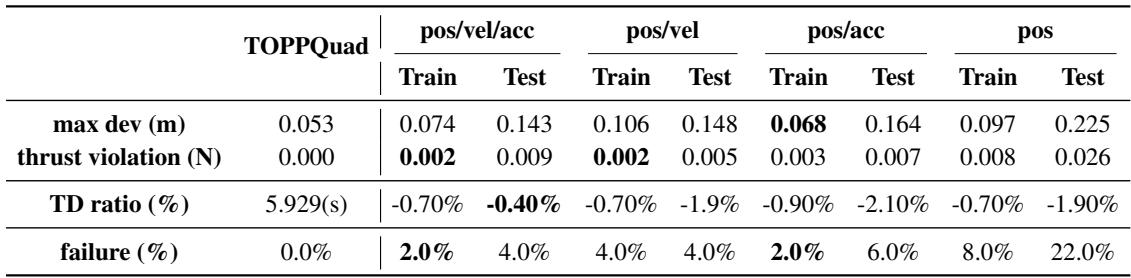
As Table 1 shows, the LSTM Encoder-Decoder achieved the lowest failure rate (0.0% in this specific batch) and tracked the TOPPQuad reference almost perfectly (Max Deviation 0.074m). The Transformer model struggled, likely due to the size of the dataset and the specific nature of continuous trajectory regression compared to discrete token prediction in NLP. The “Per-Step MLP” failed significantly because it lacked the context of the full sequence—it couldn’t “look ahead” to see a sharp turn coming.
2. Robustness and Noise
The robustness analysis confirmed the value of data augmentation.
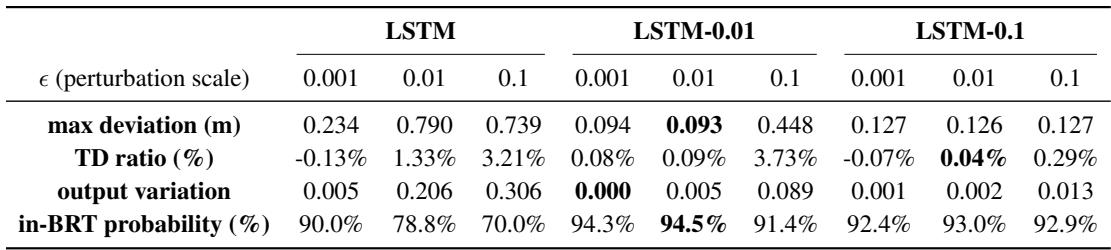
Table 2 illustrates that the model trained with noise (LSTM-0.1) maintained a high “in-BRT probability” even when the input paths were perturbed. This confirms that the augmented training creates a “buffer” of safety, allowing the drone to handle imperfect conditions without losing stability.
3. Comparison with Baselines
The method was compared against two other state-of-the-art learning approaches: AllocNet and MFBOTrajectory.
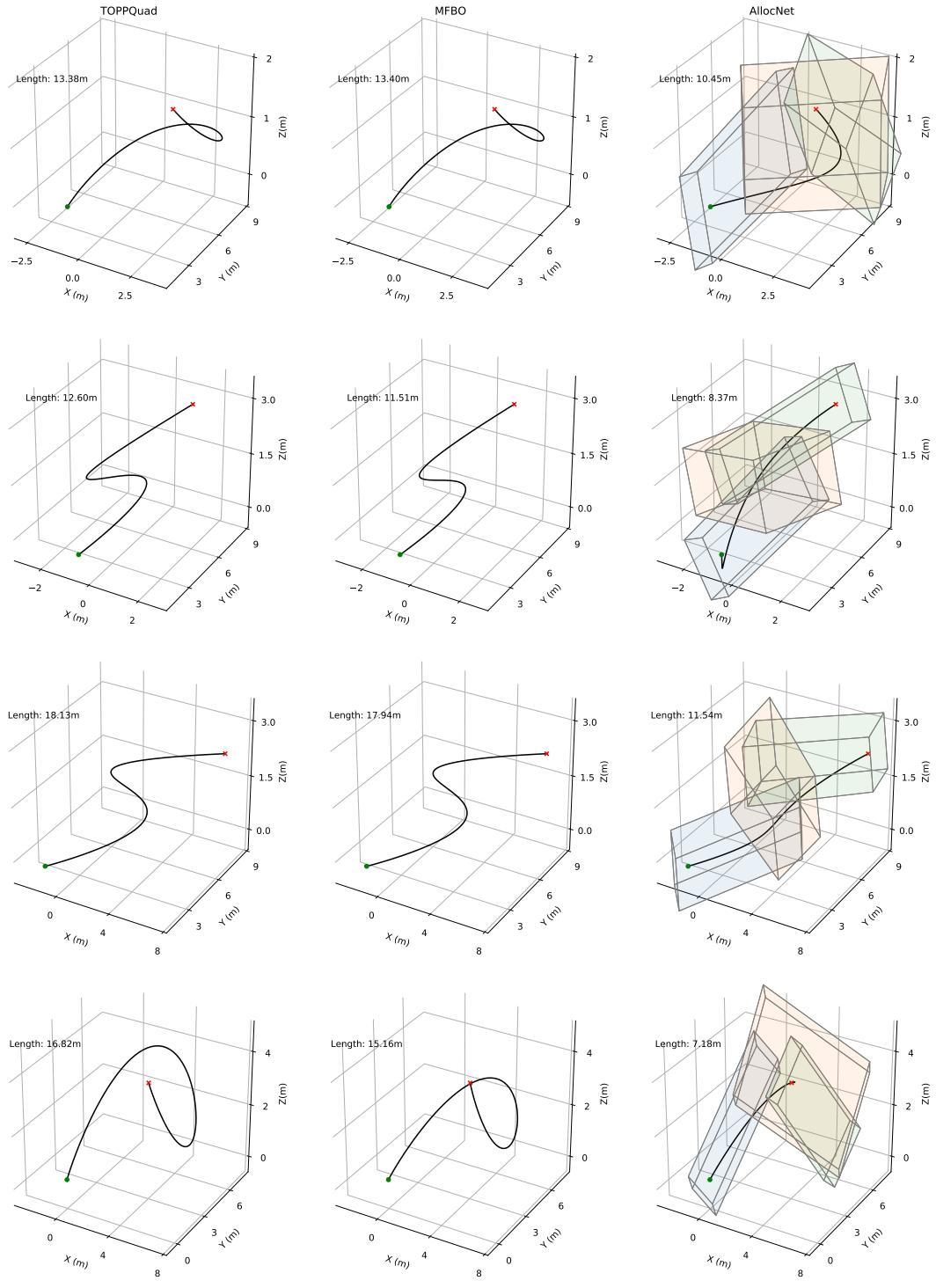
- AllocNet (Right column in Figure 2) generates convex corridors but often results in slower speeds or failure if the corridor mismatch is too high.
- MFBO (Middle column) is robust but extremely slow because it requires online retraining/optimization for new environments.
- The Proposed LSTM (Left column) closely mimics the smooth, aggressive curves of the optimal solver but generates them instantly.
4. Hardware Validation
Simulations are useful, but reality is the ultimate test. The authors deployed the trained policy on a physical CrazyFlie 2.0 in a motion capture arena.
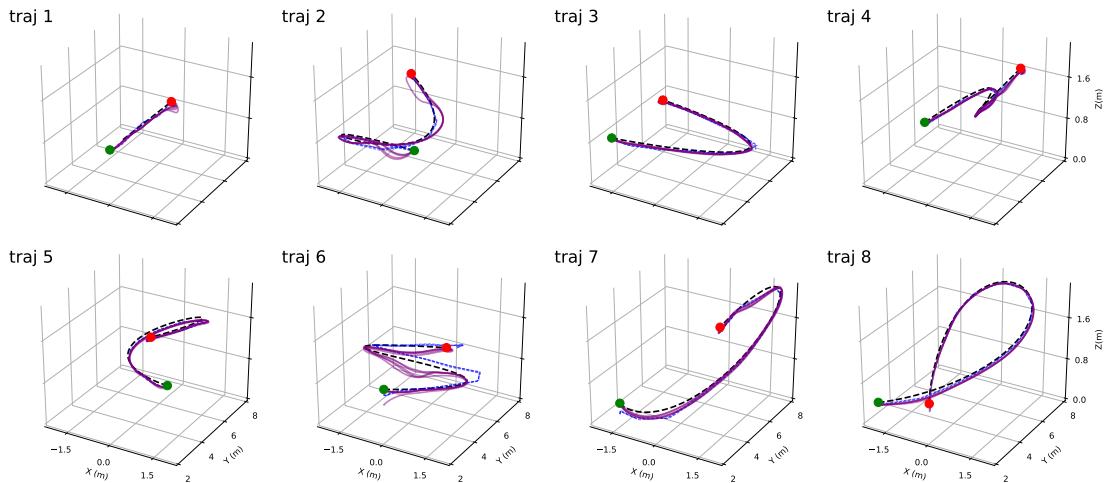
The hardware experiments (Figure 2 above) showed that the drone could successfully track the aggressive time-optimal trajectories. The “Learning-based TOPPQuad” achieved flight times nearly identical to the mathematical solver.
Furthermore, the model showed impressive generalization. It could successfully fly paths that were significantly longer than anything it saw during training.
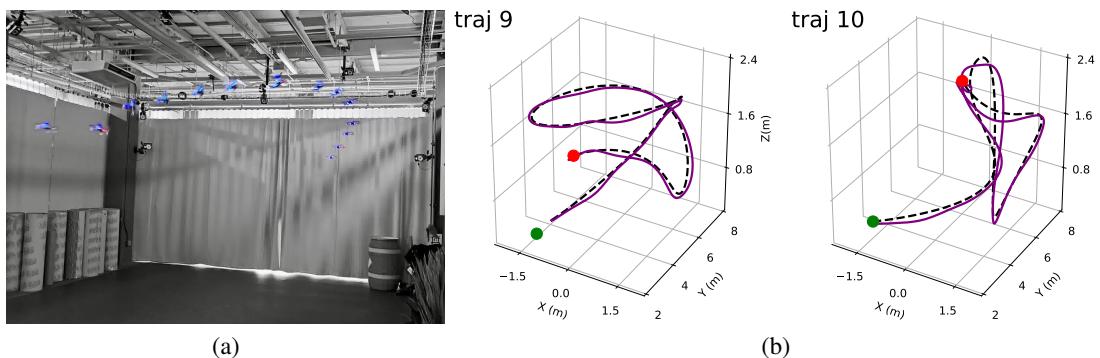
By breaking longer paths into segments and conditioning the network on the initial state of each segment, the LSTM could stitch together a continuous, high-speed flight plan for complex geometries (as seen in Figure 3).
Conclusion and Implications
This paper represents a significant step forward for agile robotics. By successfully imitating a computationally expensive optimizer using an LSTM, the authors have unlocked the potential for real-time time-optimal planning.
Key takeaways:
- Speed: The neural network generates trajectories in milliseconds, whereas optimization takes seconds. This speed enables reactive autonomy—drones that can replan instantly when an obstacle moves.
- Feasibility: By intelligently selecting inputs/outputs and verifying with Reachable Tubes, learning-based methods can be made safe enough for physical hardware.
- Simplicity: You don’t always need a Transformer. For continuous dynamic systems, LSTM architectures remain highly effective and efficient.
As battery technology improves and onboard computers get faster, algorithms like this will be the “brains” that allow delivery drones to zip through cities or search-and-rescue robots to navigate collapsing buildings with superhuman agility. The future of flight isn’t just about powerful motors; it’s about smarter, faster planning.