](https://deep-paper.org/en/paper/2506.14317/images/cover.png)
Introduction
Imagine reaching into a messy “junk drawer” to find a specific battery buried under tangled cables, loose change, and old receipts. As a human, you do this effortlessly. You don’t just grab; you nudge obstacles aside, slide your fingers into gaps, and carefully extract the target without breaking anything.
For robots, however, this is a nightmare.
While robotic grasping has seen massive improvements recently, most success stories involve simple, two-fingered grippers picking up isolated objects on clean tables. Dexterous grasping—using multi-fingered hands that mimic human physiology—offers the versatility needed for the real world, but it introduces a massive spike in complexity. When you add a cluttered environment into the mix, with objects blocking the target and the risk of collision everywhere, the difficulty skyrockets.
Training a robot to handle this chaos usually requires expensive human demonstrations or rigorous coding. But what if a robot could learn these skills entirely in a simulation and then apply them to the real world without ever seeing it before?
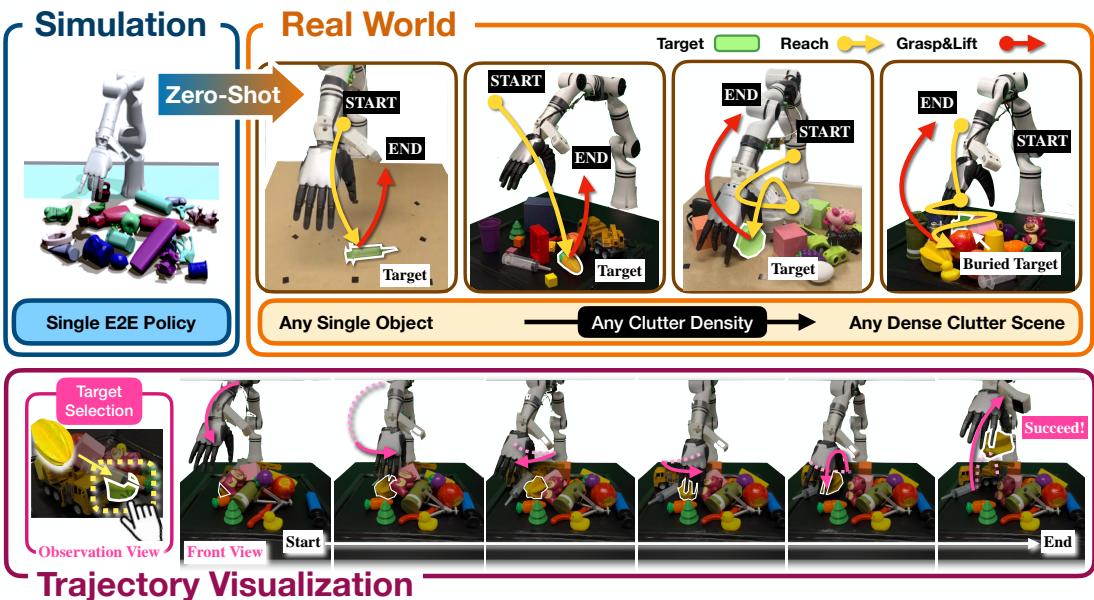
This is the promise of ClutterDexGrasp, a new research paper that introduces a robust system for closed-loop, target-oriented dexterous grasping in cluttered scenes. By using a clever teacher-student training framework, the researchers have developed a system that achieves zero-shot sim-to-real transfer. This means the robot learns in a virtual world and works in the real world immediately, handling dense clutter and occlusions with a human-like touch.
The Challenge of Clutter
Why is grasping in clutter so difficult?
- Occlusion: The robot often cannot see the entire target object because other items are in the way.
- Collision: A multi-fingered hand has many moving parts (Degrees of Freedom, or DoF). Moving closer to a target risks bumping into surrounding objects, potentially knocking them over or damaging the hand.
- Physics: Interacting with a pile of objects creates complex physical dynamics. Pushing one object might cause an avalanche that shifts the target.
Existing solutions usually fall into two camps. Open-loop methods plan a grasp pose beforehand and execute it blindly. If the scene changes (e.g., an object slips), the grasp fails. Closed-loop methods (like Reinforcement Learning or Imitation Learning) can react in real-time. However, training them requires massive amounts of data. Gathering this data in the real world is slow and costly, while training in simulation is difficult due to the “sim-to-real gap”—the difference between perfect physics engines and the messy real world.
The Solution: A Teacher-Student Framework
The core innovation of ClutterDexGrasp is a two-stage Teacher-Student framework.
The logic is straightforward:
- The Teacher (Simulation Only): A “privileged” agent that has access to “god-mode” information—exact object positions, weights, and perfect physics. It learns how to grasp effectively using Reinforcement Learning (RL).
- The Student (Real World Ready): A “sensor-based” agent that only sees what a robot would actually see (point clouds from a camera). It learns by watching the Teacher and imitating its behavior.
This separation allows the researchers to solve the difficult physics and strategy problems first (Teacher) and then solve the perception problem second (Student).
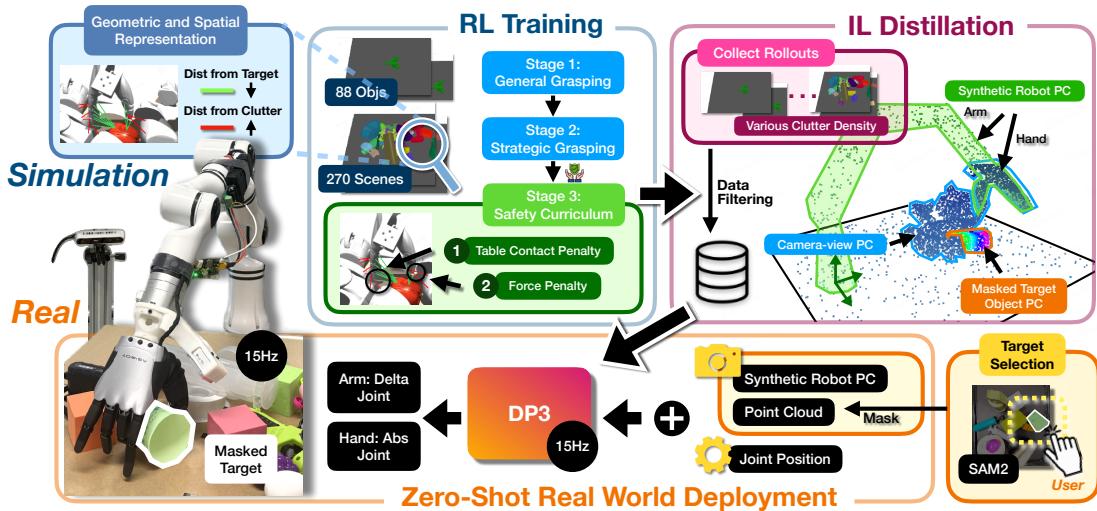
As shown in the framework diagram above, the process moves from simulation-heavy RL training (left) to Imitation Learning distillation (center), finally deploying the student policy to the real robot (right).
Step 1: Training the Teacher Policy
The Teacher policy is trained using Reinforcement Learning (RL). In RL, an agent explores an environment and receives rewards for good actions and penalties for bad ones. The goal is to maximize the cumulative reward.
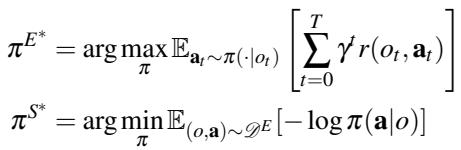
The objective function for the teacher (\(\pi^{E}\)) is to find the policy that maximizes expected returns, as seen in the first equation below:
However, training a dexterous hand in clutter is computationally heavy. Standard RL approaches that rely on visual inputs (like rendering images at every step) are too slow. To solve this, the authors introduce a novel Geometry and Spatial (GS) Representation.
The Geometry and Spatial Representation
Instead of rendering a picture of the scene for the Teacher, the system calculates precise geometric data. It computes the 3D distance vectors from the robot’s finger links to:
- The Target Object (Positive interaction)
- The Surrounding Clutter (Negative interaction)
This allows the Teacher to “feel” the scene geometry directly. It knows exactly how far its pinky is from a collision and how close its thumb is to the target.
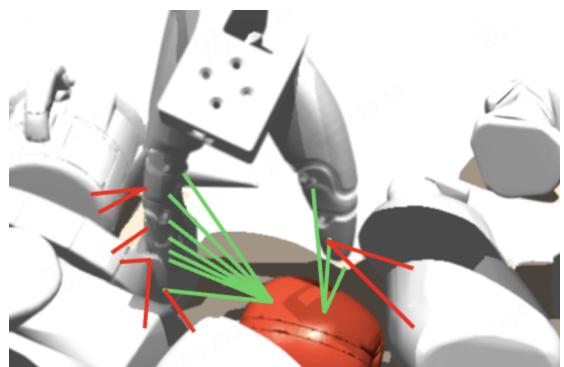
This representation is embedded directly into the reward function. The robot gets points for minimizing the distance to the target (\(r_{pos}\)) and loses points (or gets a penalty factor) for getting too close to non-target objects (\(r_{neg}\)).
The core reward function looks like this:

Here, \(r_{grasp}\) is the success reward (lifting the object), \(r_{pos}\) encourages approaching the target, and \(r_{neg}\) acts as a penalty for risky collisions with clutter. The explicit definitions for these distance-based rewards are:


By using these mathematical representations of distance rather than pixels, the RL training becomes significantly more efficient and stable.
The Curriculum: Learning to Walk Before Running
If you drop a robot hand into a pile of 20 objects and tell it to “grasp,” it will flail and fail. The learning curve is too steep. The authors solved this with a Clutter-Density Curriculum.
- Stage 1 (General Grasping): The agent first learns to grasp a single object on an empty table.
- Stage 2 (Strategic Grasping): Once the basics are mastered, clutter is introduced. The agent learns to navigate around obstacles.
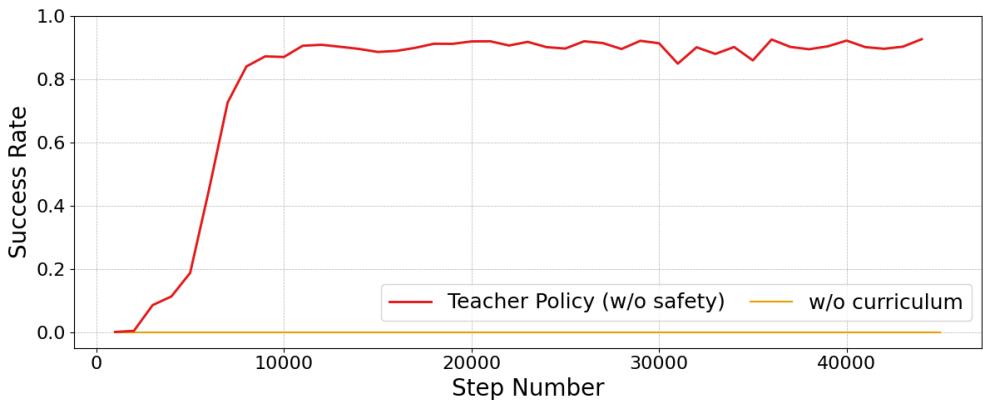
Figure 8 below demonstrates why this is necessary. The yellow line shows a policy trained directly in clutter—it never learns (0% success). The red line shows the curriculum-based teacher, which achieves high success rates.
The Safety Curriculum
A robot that grasps successfully but smashes everything in the process is useless. To ensure the robot behaves gently—a requirement for the real world—the authors implemented a Safety Curriculum.
They introduced a force penalty term, \(r_{force}\), into the reward function.

The penalty triggers if the contact force on the fingertips exceeds a certain threshold (\(f\)).
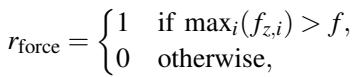
During training, as the robot’s success rate improves, the system progressively tightens this threshold, forcing the robot to learn gentler and gentler strategies to maintain its high score. This results in a policy that doesn’t just grab; it interacts delicately.
Step 2: Distilling to the Student
The Teacher is great, but it cheats. It uses “privileged information” (exact distances) that a real robot doesn’t have. To fix this, the researchers train a Student Policy using Imitation Learning (IL).
The Student watches the Teacher’s successful demonstrations and learns to predict the same actions using only Partial Point Clouds—3D data generated from a simulated camera depth sensor. This mimics what the real robot will actually see.
The Student uses a state-of-the-art algorithm called 3D Diffusion Policy (DP3). Diffusion policies are excellent at modeling complex, multi-modal distributions, which helps the robot handle the ambiguity of cluttered scenes.
Bridging the Sim-to-Real Gap
To ensure the Student works in reality, the team used distinct techniques:
- Point Cloud Alignment: They augmented the observation with synthetic robot points to match the real camera setup.
- System Identification: They tuned the simulation’s physics parameters (friction, damping) to match the real hardware as closely as possible.
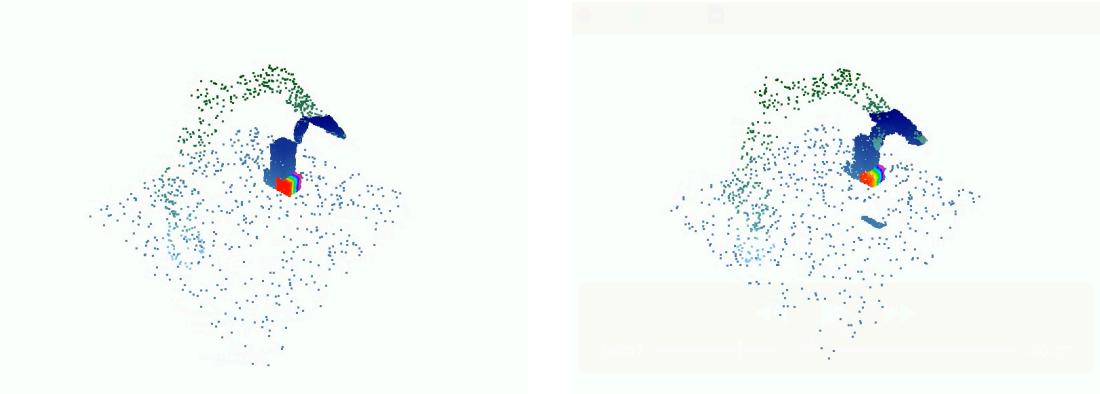
As seen in Figure 10, the processed point clouds in simulation (left) are designed to look nearly identical to the real-world data (right), minimizing the shock when the brain is transferred to the physical body.
Experiments and Results
The researchers put ClutterDexGrasp through rigorous testing in both simulation and the real world.
Simulation Performance
In simulation, they tested the robot on “unseen” objects (shapes the robot never saw during training) and “unseen” layouts (new random piles).
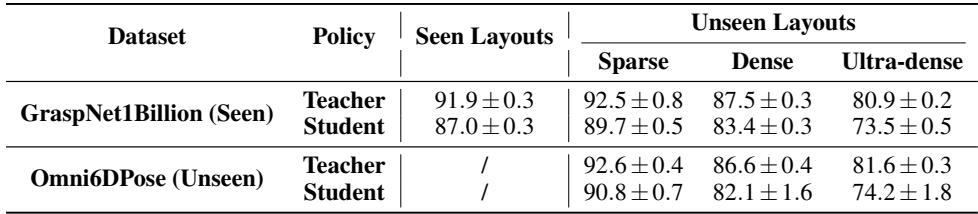
The results (Table 1) are impressive. The Teacher achieves over 90% success on sparse scenes and maintains high performance even in ultra-dense clutter. Crucially, the Student (which uses only visual data) retains most of that performance, dropping only a few percentage points. This proves the distillation process works.
Qualitative Analysis: Acting Human
One of the most fascinating results is the strategy the robot developed. It didn’t just learn to move to coordinates; it learned behavior.
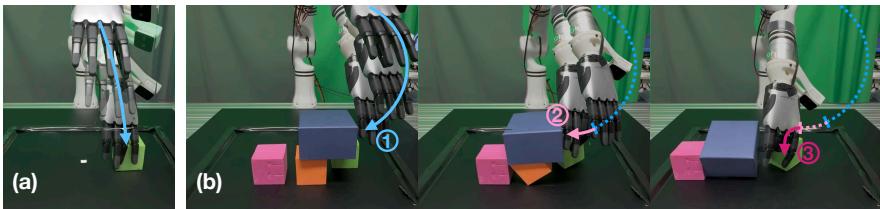
In Figure 3(b), you can see the robot performing “Clutter-aware grasping.” Instead of diving straight down (which would cause a collision), it approaches from the side, effectively nudging obstacles out of the way to reach the target blue block. This behavior wasn’t hard-coded; it emerged naturally from the RL training and the geometry-aware rewards.
Conversely, look at what happens when you remove the novel components of the system:
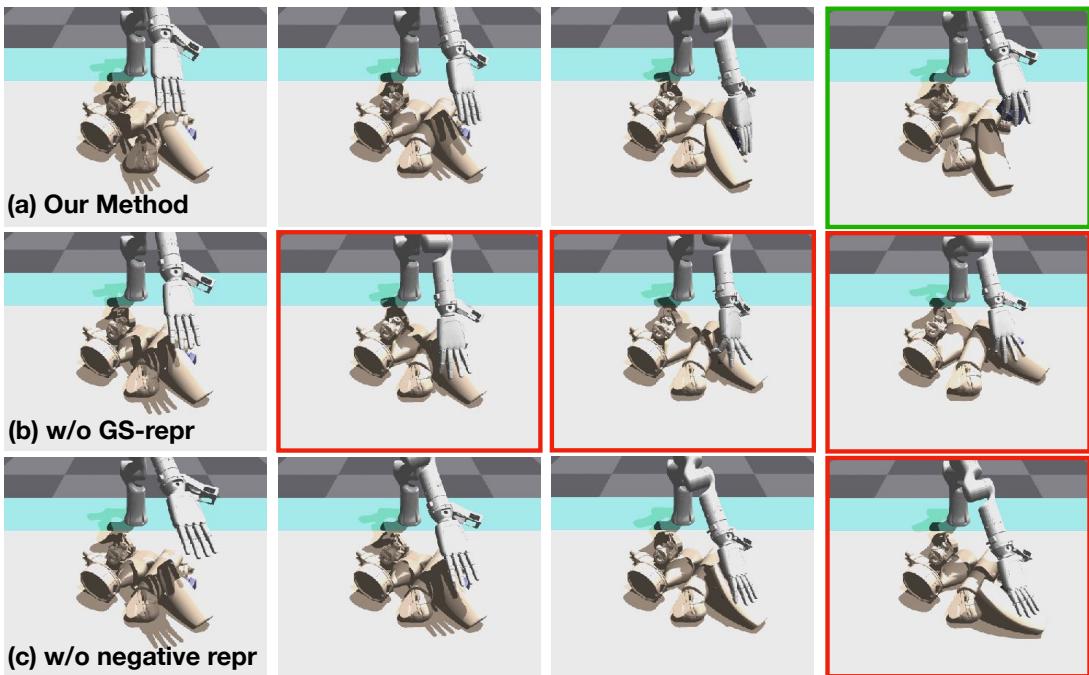
In Figure 7, the top row (Our Method) succeeds. Row (b) shows a policy trained without the Geometry/Spatial representation—it clumsily drops the object. Row (c) shows a policy without the “negative” representation (ignoring clutter penalties), leading to unsafe collisions.
Real-World Zero-Shot Transfer
The ultimate test is the physical world. The researchers set up a RealMan robotic arm with an AgiBot dexterous hand and a camera. They tossed random objects onto the table, ranging from toys to tools.
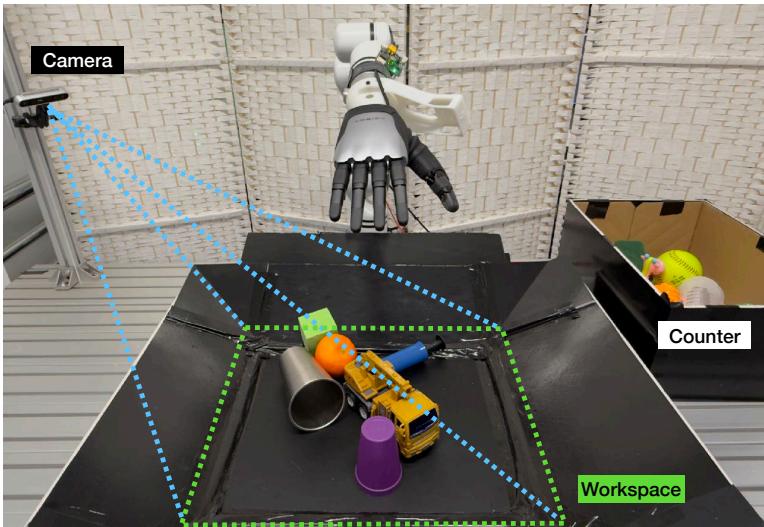
The system achieved an 83.9% success rate in the real world on unseen layouts. This is a remarkable figure for a zero-shot transfer method (meaning no real-world training data was used).
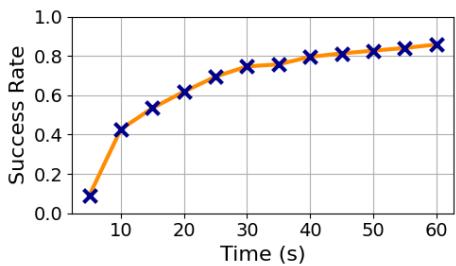
Figure 5 shows the cumulative success rate over time. Most successful grasps happen within 20 to 40 seconds. The robot is deliberate, careful, and effective.
The system was also tested across different densities of clutter, from sparse to ultra-dense (see Figure 4 below), and handled objects as varied as pliers, balls, and plastic blocks.

Conclusion
ClutterDexGrasp represents a significant step forward in robotic manipulation. By creatively combining Reinforcement Learning with a specialized curriculum and a Teacher-Student distillation process, the authors managed to bridge the gap between simulation and reality for a very difficult task.
Key Takeaways:
- Representations Matter: Giving the RL teacher geometric awareness (distances) instead of just visual data made learning efficient and collision-aware.
- Curriculum is Key: You can’t teach a robot to handle chaos on day one. Starting simple and gradually increasing clutter and safety constraints is essential.
- Zero-Shot is Possible: With the right training pipeline, robots can learn complex, contact-rich tasks in simulation and execute them in the real world without needing expensive human demonstrations.
This work paves the way for robots that can truly help in unstructured human environments—whether that’s sorting through a recycling bin, organizing a messy desk, or finding that lost battery in your junk drawer.