](https://deep-paper.org/en/paper/2506.14754/images/cover.png)
Introduction
Imagine you are reaching into a dark bag to find a specific set of keys. You can’t see them, but your fingers instantly provide a flood of data. You feel the cold metal (temperature), the jagged edges (texture), the weight as you lift them (proprioception), and perhaps you hear the “clink” as they hit other objects (audio).
Human dexterity relies on this symphony of signals. We don’t just “touch” by sensing skin deformation; we integrate vibrations, thermal cues, motion, and pressure into a cohesive understanding of the physical world.
In robotics, however, tactile sensing has historically been much more limited. The gold standard has often been “vision-based tactile sensing”—essentially putting a camera behind a piece of rubber to see how it deforms. While effective for geometry, this approach misses the rich vibrations, shear forces, and auditory cues that define complex manipulation.
Enter Sparsh-X, a new research contribution that aims to close this gap. It is a multisensory touch representation model that doesn’t just look at tactile images; it listens to contact, feels the acceleration of movement, and measures pressure, all simultaneously.
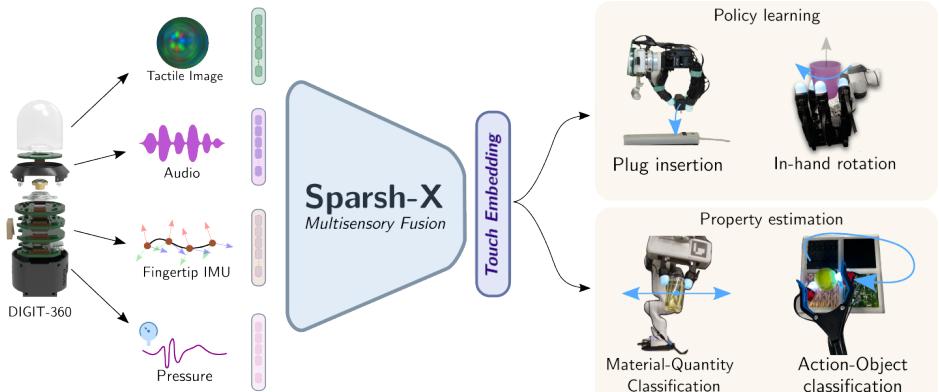
In this post, we will tear down the Sparsh-X paper. We will explore how it fuses four distinct modalities into a single “touch embedding,” how it was trained on nearly a million interactions without human labels, and how it enables robots to perform delicate tasks like inserting plugs and rotating objects in-hand with superhuman reliability.
The Hardware: Beyond Simple Deformation
To understand the software, we first need to understand the hardware. Most tactile research in recent years has utilized sensors like the GelSight. These are brilliant in their simplicity: a camera looks at a backlit, deformable gel. When the gel presses against an object, the camera captures the imprint.
However, contact is a dynamic event. A camera running at 30Hz might miss the high-frequency vibration of a tool slipping or the micro-impact of a probe touching a surface.
Sparsh-X is built for the Digit 360 sensor. This sensor is an evolution of the standard tactile finger. It packs a “human-like” suite of sensors into a single fingertip:
- Vision: A hyper-fisheye camera capturing the deformation of the elastomer.
- Audio: Two contact microphones sampled at high frequencies (48kHz) to hear vibrations.
- Motion (IMU): A 3-axis accelerometer to detect motion and gravity.
- Pressure: A barometer-style sensor to measure the overall air pressure inside the dome, which correlates to normal force.
The challenge for the researchers was significant: How do you feed a neural network high-resolution video, high-frequency audio, and simple scalar pressure readings all at once, and make sense of them in real-time?
The Core Method: Sparsh-X Architecture
The core contribution of this paper is a backbone architecture capable of fusing these heterogeneous signals. The authors propose a Transformer-based model trained via Self-Supervised Learning (SSL). Let’s break down the architecture step-by-step.
1. Input Tokenization
Transformers, originally designed for text, operate on sequences of “tokens.” The first hurdle is converting radically different sensor data into a uniform token format.
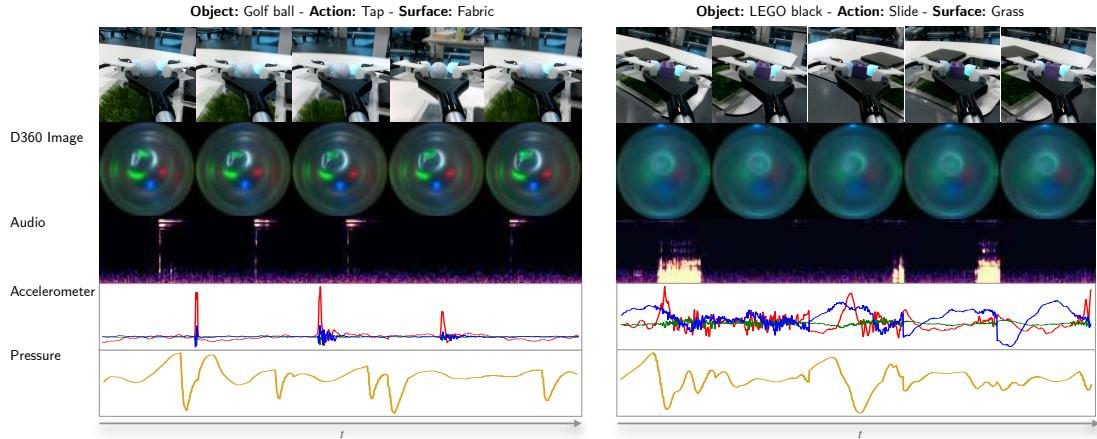
- Tactile Images: The camera feed is cropped to the center (the fisheye view), resized, and split into \(16 \times 16\) patches. These patches are flattened into vectors.
- Audio: The high-frequency sound waves are converted into Log-Mel spectrograms (a visual representation of the sound spectrum). These spectrograms are then treated like images and patched.
- IMU & Pressure: These time-series signals are windowed (e.g., taking the last 0.5 seconds of data) and projected into tokens.
Visualizing these inputs helps clarify just how different the data streams are:
2. Independent Processing
Once tokenized, the data enters the Transformer. However, simply throwing all tokens from all modalities into a single massive attention mechanism would be computationally expensive and difficult to train.
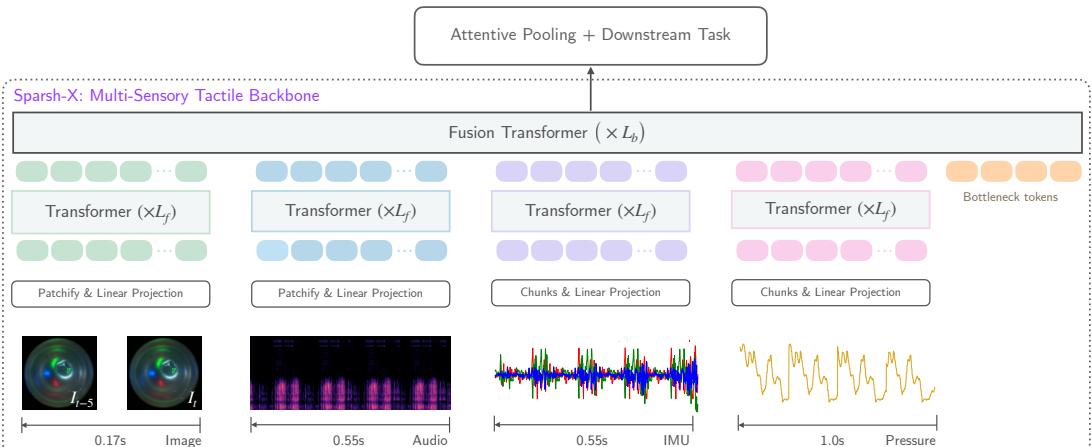
Instead, Sparsh-X uses a two-stage approach. In the first \(L_f\) layers (the “Unimodal Layers”), each modality is processed independently. The image tokens attend only to other image tokens; audio tokens attend only to audio. This allows the network to build a strong understanding of each specific sense—learning to recognize edges in images or specific frequency patterns in audio—before trying to integrate them.
3. Bottleneck Fusion
This is the clever part of the architecture. In the final \(L_b\) layers (the “Fusion Layers”), the modalities need to talk to each other. A standard transformer approach would calculate attention between every token and every other token (quadratic complexity).
Sparsh-X uses Bottleneck Attention. The model introduces a small set of “fusion tokens” (bottleneck tokens).
- The tokens from a specific modality (e.g., Image) pass information to the fusion tokens.
- The fusion tokens are then averaged or shared across all modalities.
- The fusion tokens pass this aggregated context back to the modality-specific tokens.
This acts as a central switchboard. The image doesn’t talk to the audio directly; it talks to the bottleneck, which summarizes the state of the world and updates the audio stream. This keeps the model efficient while ensuring deep integration of the senses.
4. Self-Supervised Pretraining
To train this beast, the authors didn’t want to manually label millions of frames with “this is a cup” or “this is a slip.” Instead, they used Self-Supervised Learning (SSL).
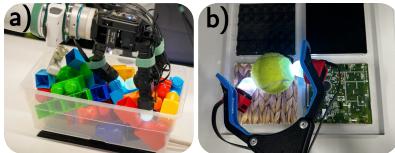
They collected a massive dataset of ~1 million interactions (about 18 hours of continuous data). They used two setups: a robotic hand (Allegro) rummaging through bins of objects, and a “manual picker” tool used by humans to poke, scrape, and tap various surfaces.
The training objective is Student-Teacher Distillation (similar to DINO).
- The Game: You take the multisensory input and mask out (hide) chunks of it. You feed the masked view to a “Student” network and the full view to a “Teacher” network.
- The Goal: The Student must predict the representation that the Teacher outputs.
To succeed, the Student must understand the underlying physics. If the visual input is masked but the audio shows a loud “thud,” the Student must infer that a collision occurred and update the representation accordingly. This forces the model to learn how the different senses correlate.
Does it actually understand physics?
Before putting the model on a robot, the researchers wanted to verify that the learned representations actually encoded meaningful physical properties. They set up a series of supervised benchmarks where they froze the Sparsh-X weights and just trained a small decoder on top.
The Shaking Test
One of the most interesting experiments involved estimating the material and quantity of items inside opaque bottles. Imagine holding a water bottle and a bottle of sand. They look identical from the outside. You only know the difference when you shake them.
The researchers set up a robot to shake bottles containing pills, rice, lentils, water, and oil.

The Results: The multimodal approach crushed the baselines.
- E2E (End-to-End Image only): Struggles because visual deformation alone doesn’t capture the internal dynamics of fluids vs. grains.
- Sparsh-X (All modalities): Achieved significantly higher accuracy, even with very little training data.
The chart below (center panel) shows this clearly. The purple line (Multimodal Sparsh-X) consistently outperforms the green line (Image only).
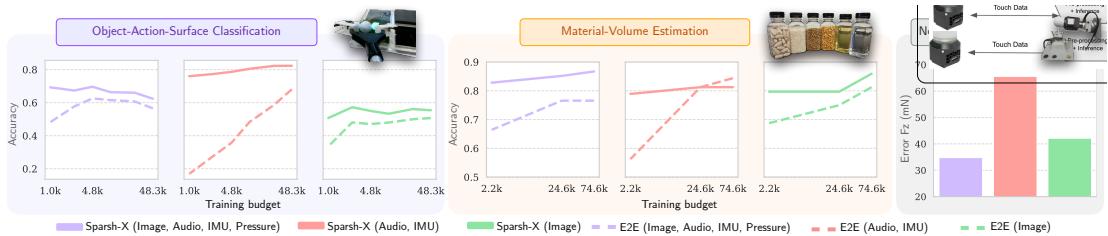
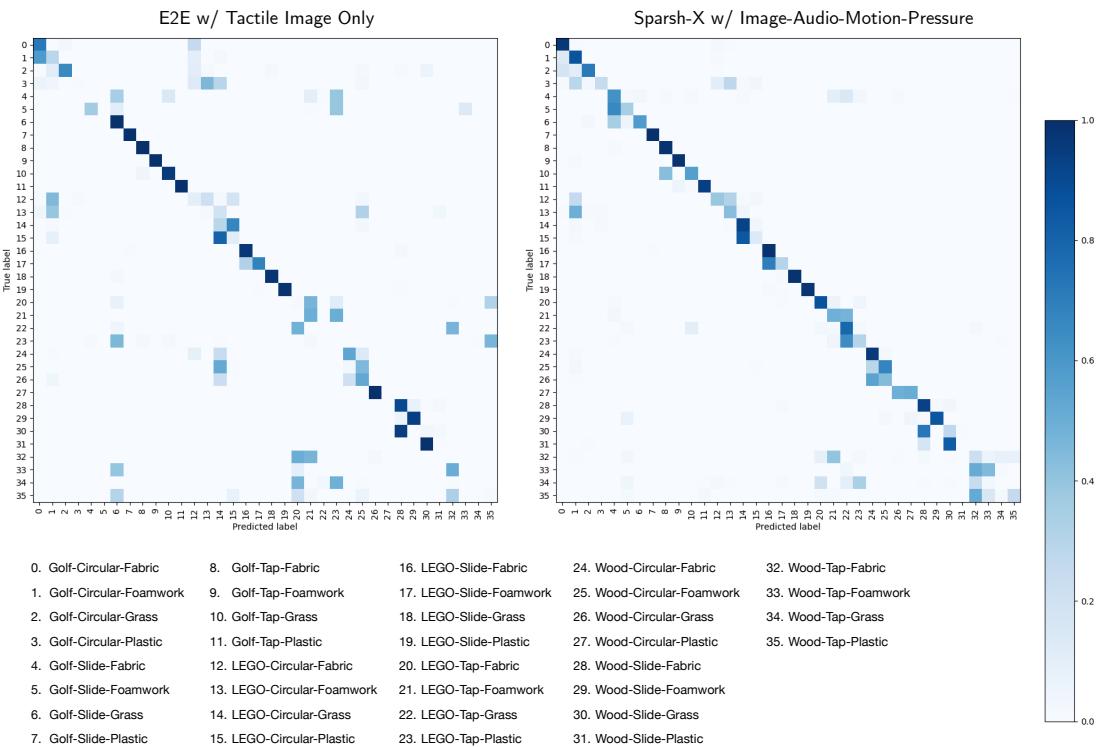
They also tested Object-Action-Surface classification (identifying what is being touched and how). The confusion matrices below tell the story. On the left (Image only), the model is confused, scattering predictions all over the place. On the right (Sparsh-X Multimodal), the diagonal is strong, meaning the model correctly identifies the complex combinations of actions and surfaces.
Real-World Robotics: Policy Learning
Understanding physics is great, but can it help a robot perform useful work? The authors integrated Sparsh-X into two distinct robotic control pipelines.
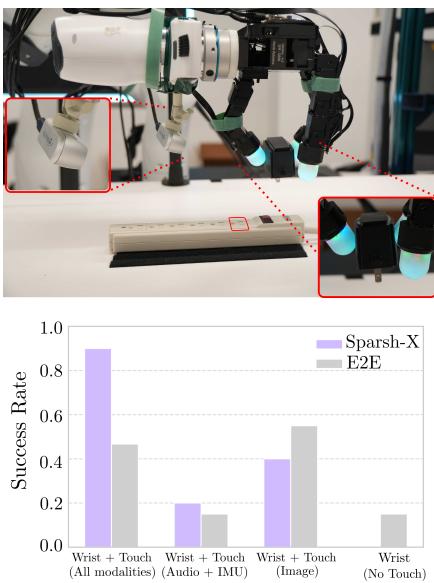
1. Precision Insertion (Imitation Learning)
Inserting a plug into a socket is a classic “hard” robotics problem. The tolerances are tight. If you are off by a millimeter, you jam.
The team collected demonstrations of a robot hand inserting a plug and trained a policy to copy these movements (Imitation Learning). They fed the policy the wrist camera view and the Sparsh-X touch embeddings.
Why Multimodality Matters Here:
- Audio: Detects the initial contact between the pins and the socket face.
- Pressure/Image: Feels the resistance if the alignment is wrong.
The results were stark. A vision-only policy failed almost every time because of “visual aliasing”—from the camera’s perspective, the plug looked aligned even when it wasn’t. The Image-only tactile policy did okay (55% success), but the full Multimodal Sparsh-X policy achieved 90% success.
2. In-Hand Rotation (Sim-to-Real Adaptation)
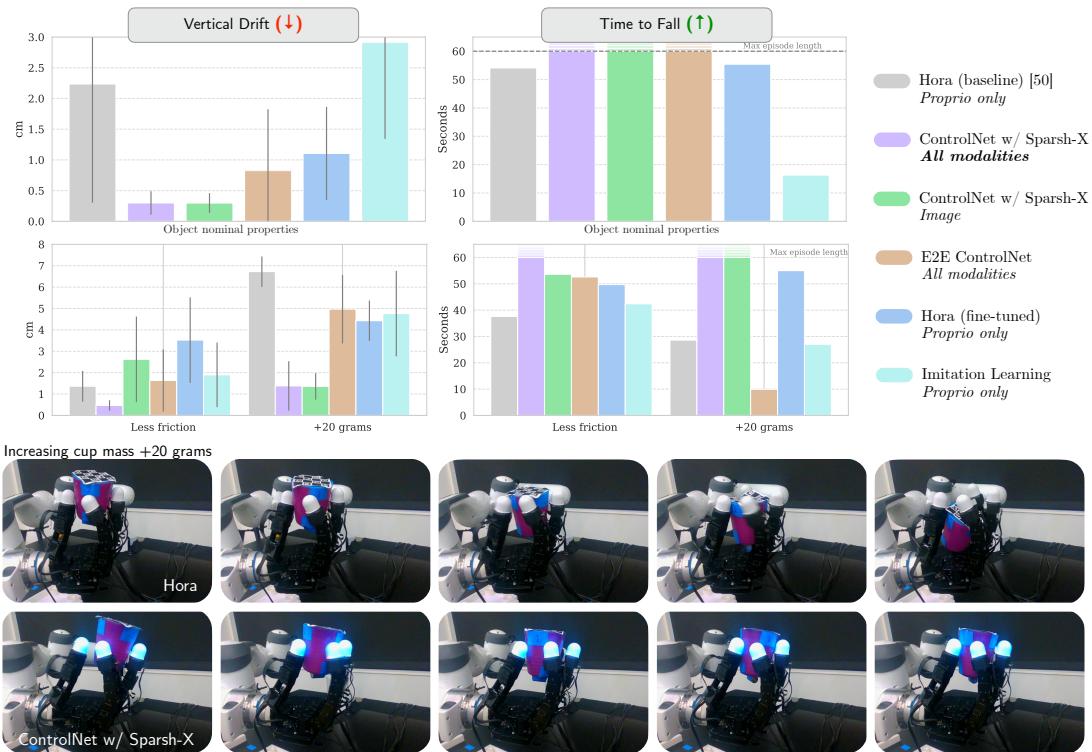
This is perhaps the most technically impressive application in the paper. The task is to rotate a cup using a robotic hand without dropping it.
The robot is trained in a simulator (Sim). In a simulator, the robot has “Privileged Information”—it knows the exact friction coefficient of the cup, its mass, and its center of gravity. It uses this to rotate the object perfectly.
However, when you move to the real world (Real), the robot doesn’t know the friction or mass. This is the “Sim-to-Real” gap.
The researchers used Sparsh-X to perform Tactile Adaptation. They trained a small adapter network (using ControlNet) that takes the real-world Sparsh-X embeddings and tries to estimate that “Privileged Information” that the robot had in the simulator. Essentially, the robot feels the object to guess its friction and mass in real-time.
![Figure 6: We introduce real-world tactile adaptation of sim-trained policies via ControlNet [52], where the zero-convolution layer enables gradual fine-tuning of the embedding \\hat{z}_t using Sparsh-X representations.](/en/paper/2506.14754/images/006.jpg#center)
The system proved incredibly robust. They tested it by:
- Reducing Friction: Coating the object to make it slippery.
- Adding Mass: Putting weights inside the cup.
In both cases, the Sparsh-X equipped robot detected the change (e.g., feeling micro-slips via the IMU/Audio or increased deformation via the Image) and adjusted its grip to prevent the object from falling.
Conclusion and Implications
The “Sparsh-X” paper makes a compelling argument that for robots to achieve human-level dexterity, they need human-level senses. Relying on vision—even tactile vision—is not enough.
By combining image, audio, motion, and pressure, and pretraining on a massive dataset of unlabelled interactions, Sparsh-X creates a “Foundation Model” for touch. It provides a dense, rich representation of contact that makes downstream tasks easier to learn and more robust to the chaos of the real world.
Key takeaways for students and researchers:
- Multimodality is a Multiplier: Adding audio and IMU isn’t just an incremental improvement; it allows the robot to perceive entirely new classes of physical events (like granular flow or micro-slips).
- Self-Supervision is Key: Collecting labelled tactile data is agonizingly slow. SSL allows robots to learn from “play” (random interaction), which is scalable.
- Architecture Matters: The bottleneck fusion technique is a smart way to handle diverse data streams without exploding computational costs.
As sensors like Digit 360 become more available, we can expect the standard for robotic manipulation to shift from “looking at contact” to truly “feeling” it.