](https://deep-paper.org/en/paper/2506.14769/images/cover.png)
Introduction
Imagine trying to pour a cup of coffee. You pick up the kettle, align the spout, and tilt. Now, imagine your eyes momentarily lose focus or the lights flicker out for a split second. Do you drop the kettle? Probably not. You rely on your muscle memory and the context of what you were doing just a moment ago—you know you were in the middle of a pouring motion, so you continue smoothly.
For robots, however, this kind of continuity is surprisingly difficult. Modern robotic manipulation relies heavily on Imitation Learning (IL), where robots learn skills by mimicking human demonstrations. A popular approach within this field is Diffusion Policy (DP), which treats robot action generation as a denoising process. While powerful, standard DP often treats actions somewhat independently or relies excessively on the instantaneous state of the world.
But here is the catch: in the real world, sensors are noisy. Cameras get occluded. Hardware has limitations. When the visual input degrades, a robot that relies solely on “what I see right now” is prone to failure. It lacks the temporal context—the “history” of its own movements—to bridge the gap.
In this post, we will dive deep into a paper titled “CDP: Towards Robust Autoregressive Visuomotor Policy Learning via Causal Diffusion.” The researchers propose a novel framework, Causal Diffusion Policy (CDP), that explicitly conditions action predictions on historical action sequences. By doing so, the robot learns to reason about temporal continuity, making it robust against bad sensor data. Furthermore, to make this computationally heavy process fast enough for real-time control, they introduce a clever Cache Sharing Mechanism.
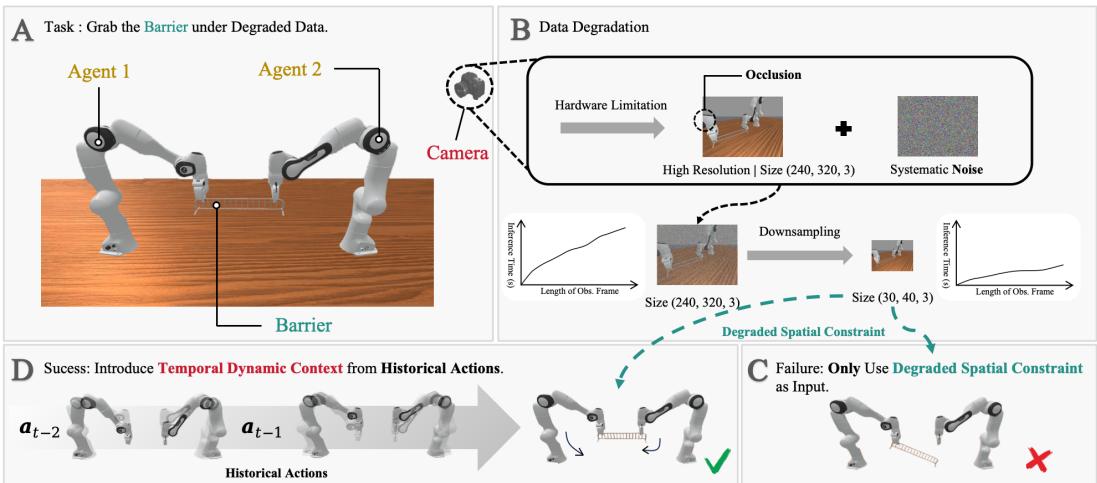
As shown in Figure 1 above, when visual observations are degraded (like the low-resolution input in panel B), a standard robot (Panel C) fails to grasp the barrier. However, by leveraging Temporal Dynamic Context—specifically, the history of previous actions—the CDP agent (Panel D) successfully completes the task.
Background: The Challenge of Consistency
Before dissecting the solution, let’s establish the baseline.
Diffusion Models in Robotics Diffusion models work by learning to reverse a noise process. In image generation, you start with static noise and denoise it into a picture. In robotics, specifically Diffusion Policy (DP), the model starts with a noisy trajectory of actions and refines it into a smooth, expert-like motion plan, conditioned on the robot’s observations (like camera images).
The Problem: Distributional Shift and Independence Standard DP typically employs a naive behavior cloning approach. It often models actions based on the current observation. While it might generate a chunk of actions, it doesn’t always rigorously account for the sequential structure of decision-making.
This leads to two main issues:
- Distributional Shift: Small prediction errors at one timestep can push the robot into a slightly unfamiliar state. If the model doesn’t account for how it got there (history), it might make another error. These errors accumulate, eventually causing the robot to drift off course and fail.
- Sensitivity to Observation Quality: If the camera feed becomes noisy or the resolution drops (common in real-time hardware constraints), the “spatial constraints” needed to plan the grasp disappear. Without a memory of “I was moving left,” the robot is lost.
The authors of CDP argue that robot actions are inherently continuous and temporally correlated. To fix the robustness issue, the policy must look backward to move forward.
The Core Method: Causal Diffusion Policy (CDP)
The Causal Diffusion Policy (CDP) is a transformer-based diffusion framework. The “Causal” in the name refers to the strict adherence to temporal order: future predictions are conditioned on past events, and future events cannot influence the past.
The method consists of three major innovations:
- Causal Action Generation: A transformer architecture that conditions new actions on historical ones.
- Historical Actions Re-Denoising: A training trick to make the robot robust to its own past mistakes.
- Chunk-wise Autoregressive Inference with Cache Sharing: An efficiency mechanism to allow these heavy computations to run in real-time.
Let’s break these down step-by-step.
1. Causal Action Generation
At the heart of CDP is a transformer model that takes two primary inputs: the Historical Actions (what the robot just did) and Denoising Targets (the noisy guess of what the robot should do next).
During training, the model looks at a sequence of actions. It splits them into a “past” segment (Historical Actions, \(\tilde{A}\)) and a “future” segment (Target Actions, \(A\)).
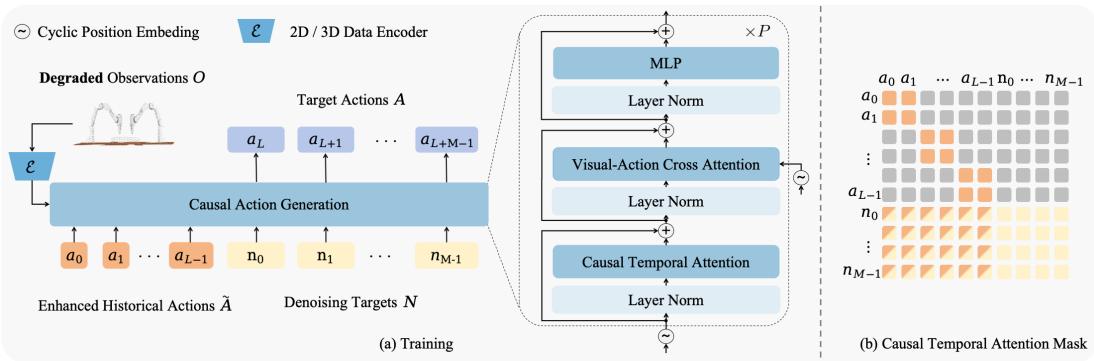
As illustrated in Figure 2(a), the process flows as follows:
- Inputs: You have degraded observations (\(O\)), Enhanced Historical Actions (\(\tilde{A}\)), and random noise (\(N\)) that acts as the canvas for the Denoising Targets.
- The Generation Module: This is a stack of \(P\) blocks. Each block refines the features.
- Output: The model predicts the clean Target Actions (\(A\)).
The objective function is a standard diffusion loss—minimizing the difference between the predicted actions and the ground truth actions:

The Transformer Block Structure
Inside the “Causal Action Generation” module, the architecture is designed to carefully mix time and vision. Each block consists of three stages:
- Causal Temporal Attention (CTA): This layer injects the temporal context. It allows the Denoising Targets (\(N\)) to “attend” to the Historical Actions (\(\tilde{A}\)). Crucially, it uses a Causal Mask (Figure 2b). This mask ensures that a specific action can only look at relevant history, maintaining the integrity of time.
- Visual-Action Cross Attention (VACA): Once the temporal context is set, the model looks at the environment. It uses Cross Attention to pull in spatial constraints from the observations (\(O\)).
- MLP: A standard Multi-Layer Perceptron processes the features for the next block.
Mathematically, the flow through one block looks like this:
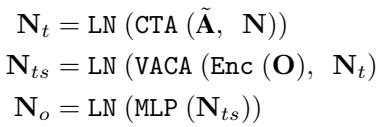
Notice that the visual information (\(\text{Enc}(\mathbf{O})\)) is integrated after the temporal alignment. This effectively says, “First, understand the flow of motion based on history. Second, adjust that motion based on what you see.”
2. Historical Actions Re-Denoising
Here is a subtle but critical problem with autoregressive models (models that feed their own output back in as input). If the robot makes a tiny error at timestep \(t\), that error becomes part of the “Historical Actions” for timestep \(t+1\). Over a long horizon, these errors compound, leading to drift.
To solve this, the authors introduce Historical Actions Re-Denoising.
During training, they don’t just feed the clean, perfect ground-truth history into the model. Instead, they intentionally corrupt the historical actions (\(\tilde{A}\)) with small-scale noise (\(N_{\sigma}\)).

By doing this, the model learns that the history it receives isn’t perfect. It learns to rely on the coarse-grained temporal dynamics (the general trend of movement) rather than the exact, precise values of the previous coordinates. This acts as a regularization technique, simulating the imperfect execution the robot might experience in the real world.
3. Chunk-wise Autoregressive Inference & Cache Sharing
The architecture described above is powerful, but Transformers are notoriously computationally expensive. If the robot has to re-process the entire history of actions every single time it wants to move a millimeter, it will be too slow to catch a falling object or react to a push.
The authors propose a Chunk-wise Autoregressive Inference strategy combined with a Cache Sharing Mechanism.
The Sliding Window (Chunk-wise Inference)
Instead of predicting one single action at a time (which is slow) or the entire trajectory at once (which is rigid), CDP predicts a “chunk” of actions.
- The robot takes the current history.
- It generates a chunk of future actions (Target Actions).
- It executes the valid part of that chunk.
- It updates the history (sliding window) and repeats.

The Cache Sharing Mechanism (The Speed Boost)
This is the engineering breakthrough of the paper. In a standard Transformer, calculating Attention requires Query (\(Q\)), Key (\(K\)), and Value (\(V\)) matrices.
\[ \text{Attention}(Q, K, V) = \text{softmax}(\frac{QK^T}{\sqrt{d_k}})V \]For the Historical Actions, the \(K\) and \(V\) matrices depend only on the past actions. Since the past doesn’t change, why recompute them?
CDP divides history into “Cached” (processed in previous steps) and “Uncached” (newly generated).

As shown in Figure 3(b), the Key (\(K\)) and Value (\(V\)) representations for the cached history are stored in memory. In the current step, the model only needs to compute the \(K\) and \(V\) for the new uncached actions and the \(Q, K, V\) for the denoising targets.
The extraction of these features is handled by a projection layer (QKV_MLP):

These new pieces are then concatenated with the cached pieces to form the full matrices for the current step:
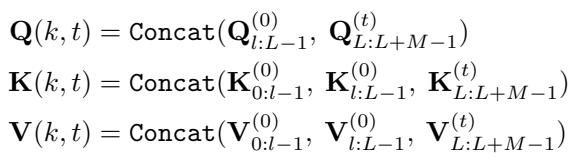
Finally, the attention is computed using the full set, utilizing a mask \(\hat{M}\) to ensure causality (you can’t attend to future chunks):

By reusing the computations from previous steps, the inference speed is drastically increased, making the complex Transformer architecture viable for real-time robotic control.
Experiments and Results
The researchers tested CDP in both simulated environments (Adroit, DexArt, MetaWorld, RoboFactory) and on real-world robots.
Simulation Benchmarks
The primary comparison was against standard Diffusion Policy (DP) and 3D Diffusion Policy (DP3). The results, summarized in Table 1 below, are striking.

On difficult tasks like “Adroit Pen” (manipulating a pen) or “MetaWorld Bin Picking,” CDP achieves significantly higher success rates (e.g., 68% vs 49% for Pen). The consistent improvement across 2D and 3D tasks confirms that the causal generation paradigm is superior to simple behavior cloning.
The Robustness Test
The true claim of this paper is robustness against degradation. To test this, the researchers artificially injected noise into the point cloud data fed to the robot (making the vision “fuzzy”).
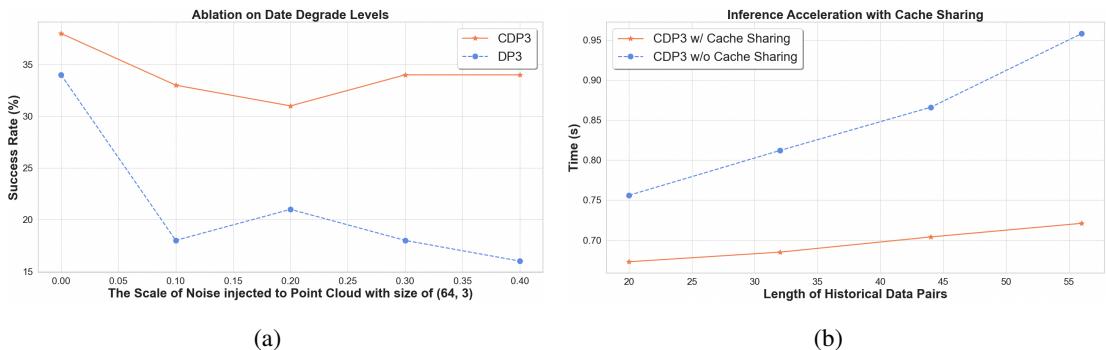
Look at Figure 4(a). As the noise scale increases (moving right on the x-axis), the performance of the baseline DP3 (blue line) plummets to near zero. It relies entirely on seeing the object clearly. In contrast, CDP (orange line) remains nearly flat, maintaining high success rates even with significant noise. This proves that when the eyes fail, the robot successfully relies on its “memory” of the action sequence.
Efficiency Analysis
Figure 4(b) highlights the impact of the Cache Sharing mechanism. Without caching (blue dashed line), inference time grows linearly and steeply as the history length increases. With Cache Sharing (orange solid line), the time remains low and stable. This optimization is what allows CDP to use long historical contexts without lagging.
Real-World Performance
The team validated the approach on a physical RealMan robotic arm. They designed tasks like stacking cubes, collecting objects, and pushing a T-shaped block.

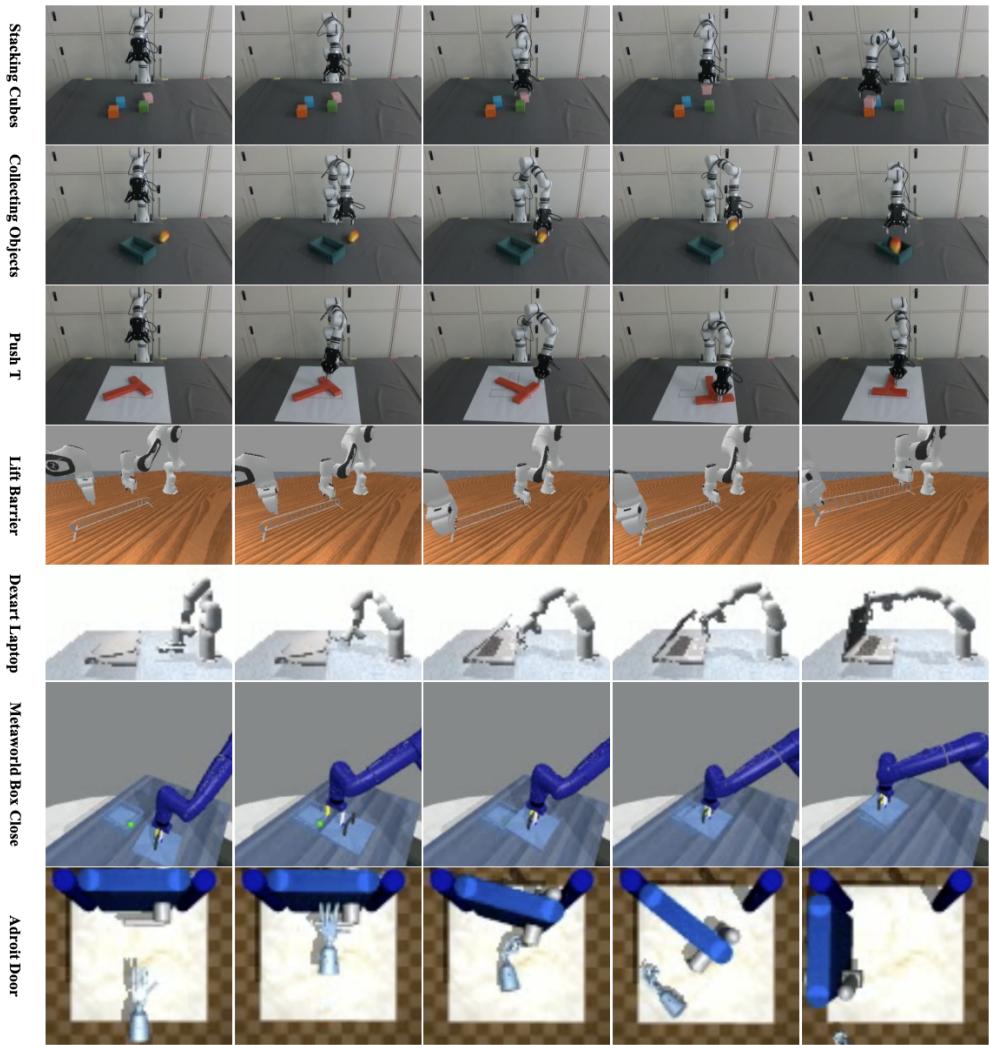
The real-world results mirrored the simulation. As shown in the visualization above (Figure 5), the robot executes smooth, long-horizon tasks. Quantitatively, CDP achieved higher success rates in grasping, placing, and overall task completion compared to standard DP.

Table 2 shows that for “Stacking Cubes,” CDP achieved a 16/20 grasping success rate compared to DP’s 13/20, and a significantly higher final success rate.
Conclusion
The Causal Diffusion Policy (CDP) represents a significant step forward in making robotic imitation learning more reliable. By acknowledging that robot actions are not isolated events but part of a continuous temporal stream, CDP mitigates the fragility of vision-based control.
Here is a summary of why CDP matters:
- Context is Key: By conditioning on Historical Actions, the robot gains a “short-term memory” that stabilizes it against sensor noise and occlusions.
- Robust Training: The Re-Denoising strategy (training on perturbed history) ensures the robot doesn’t panic if it deviates slightly from the perfect path.
- Speed via Caching: The Cache Sharing Mechanism solves the bottleneck of autoregressive Transformers, allowing for smart and fast control.
As robots move out of controlled labs and into the messy real world, where lighting changes and sensors glitch, approaches like CDP that prioritize robustness and temporal consistency will be essential for the next generation of autonomous agents.