](https://deep-paper.org/en/paper/2506.15666/images/cover.png)
Introduction
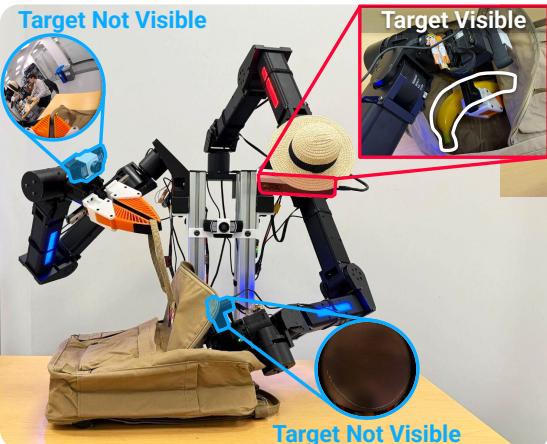
Imagine you are trying to find a specific item—say, a yellow banana—buried at the bottom of a messy grocery bag. How do you do it? You don’t just stick your hand in blindly. You lean forward, tilt your head, maybe pull the bag open with one hand while peering inside with your eyes, and constantly adjust your gaze until you spot the target. Only then do you reach in to grab it.
This process is known as Active Perception. It is the deliberate act of moving your sensor (your eyes) to gather better information about the world. It involves searching, tracking, and focusing attention on critical areas. It is intuitive to humans, but it is surprisingly absent in most modern robotic systems.
In the field of robotic imitation learning, most systems rely on fixed cameras (mounted on a chest or a tripod) or wrist-mounted cameras. While wrist cameras move, they are slaves to the hand’s motion; they look where the hand goes, not necessarily where the robot needs to look to understand the scene. This creates a fundamental limitation: if a robot cannot actively look around obstacles, it cannot manipulate what it cannot see.
In this post, we are diving deep into Vision in Action (ViA), a research paper from Stanford University that proposes a new system for bimanual robot manipulation. ViA enables robots to learn active perception strategies directly from human demonstrations. We will explore how they built a robot with a flexible “neck,” how they solved the nausea-inducing latency problems of VR teleoperation, and how this system outperforms traditional fixed-camera setups.
Background: The Observation Mismatch
To understand why Vision in Action is a breakthrough, we first need to look at how robots are typically taught to handle objects.
The Standard Approach
In Imitation Learning (IL), a human operator controls a robot to perform a task (teleoperation), and the robot records the data to learn a policy. The most common setups use:
- Static Cameras: Fixed third-person views. These are stable but suffer from occlusions. If the robot’s arm moves in front of the object, the camera is blind.
- Wrist Cameras: Cameras mounted on the robot’s hand. These provide close-ups but are constrained by manipulation. If the robot needs to carry a cup upright, the wrist camera is stuck pointing at the wall, unable to look for the coaster on the table.
The Missing Link: The Neck
Humans coordinate their eyes, head, and torso to direct their gaze. We rely on “top-down” (goal-driven) and “bottom-up” (stimulus-driven) attention. Existing robots often lack the hardware to replicate this. Simple robotic necks usually have only 2 Degrees of Freedom (DoF)—pan and tilt—which restricts them from performing complex, human-like head movements such as leaning in or peering around a corner.
Furthermore, there is a data collection problem. If a human operator moves their head to see something better during teleoperation, but the robot has a fixed camera, the robot never captures that crucial visual information. This creates an observation mismatch: the human succeeds because they can see, but the robot fails because it is learning from a blind perspective.
The Vision in Action (ViA) System
The researchers behind ViA tackled these challenges by rethinking three core pillars of the robotic stack: hardware, teleoperation, and policy learning.
1. Hardware: The 6-DoF Neck
Instead of designing a complex biomechanical neck or settling for a stiff 2-DoF servo, the team utilized a simple, clever solution: they used an off-the-shelf 6-DoF robot arm as the neck.
By mounting a camera (specifically, an iPhone 15 Pro) to the end of a small robotic arm, the system gains a massive range of motion. It can mimic the coordinated movements of a human torso and neck—leaning, twisting, and crouching—allowing the camera to reach viewpoints that static or simple pan-tilt mechanisms simply cannot.
2. Teleoperation: Solving the “Motion-to-Photon” Latency
The most technically fascinating part of ViA is how they collect data. To teach a robot active perception, a human needs to control the robot’s “head” naturally. Virtual Reality (VR) is the obvious choice. The operator wears a headset, and when they turn their head, the robot’s head turns.
However, direct VR teleoperation has a major flaw: Motion Sickness.
In a standard setup (Synchronized RGB Teleop), the pipeline looks like this:
- Human turns head.
- Command sent to robot.
- Robot physically moves motors.
- Camera captures image.
- Image streamed back to VR headset.
This loop introduces latency. Even a delay of a few hundred milliseconds causes a disconnect between your inner ear (vestibular system) and your eyes. If you turn your head left, but the world on the screen waits a moment before panning left, your brain thinks you are being poisoned, and you feel nauseous. This makes collecting high-quality training data nearly impossible.
The Solution: Decoupled Rendering with Point Clouds
The ViA system decouples the human’s view from the robot’s physical movement using an intermediate 3D scene representation.
![Figure 2: VR Teleoperation Comparison. [Left] Traditional RGB streaming suffers from motion-to-photon latency. [Right] Our system mitigates this by streaming a 3D point cloud in the world frame, allowing real-time view rendering based on the user’s latest head pose.](/en/paper/2506.15666/images/002.jpg#center)
As shown in Figure 2 above, the process works like this:
- Intermediate Representation: The robot captures RGB-D (color + depth) data. Instead of sending raw video, it transforms this data into a 3D Point Cloud in the world frame.
- Local Rendering: This point cloud is sent to the operator’s workstation. Crucially, the VR headset renders the view from this static point cloud based on the user’s current head pose.
- Asynchronous Updates:
- User side: When the user turns their head, the VR view updates instantly (running at ~150 Hz) because it’s just re-rendering the existing 3D points. There is zero perceived lag.
- Robot side: The robot’s physical neck lags behind, catching up to the user’s aggregated movements (running at ~10 Hz). As the robot moves, it captures new RGB-D data and updates the point cloud asynchronously.
This means the user can look around freely without nausea. The edges of the view might be empty for a split second until the robot catches up, but the central vision remains stable and responsive. This allows operators to collect long, complex demonstrations without discomfort.
3. Learning Policy
With the hardware and teleoperation interface ready, the team collected demonstrations of bimanual tasks where active looking was required.
They used a Diffusion Policy, a state-of-the-art method in robot learning. The policy takes two main inputs:
- Visual: The RGB image from the active head camera (processed by a DINOv2 encoder).
- Proprioception: The position/state of the arms and the neck.
The output is a unified action plan: Where to move the arms AND where to move the head. By learning these jointly, the robot figures out coordination strategies, like “look at the cup while the hand reaches for it.”
![Figure 6: Policy Learning Camera Setup Comparison. [ViA] uses a single active head camera. In contrast, [Wrist & Chest cameras] policy often fails due to visual occlusions.](/en/paper/2506.15666/images/006.jpg#center)
Figure 6 illustrates the difference in visual quality. Notice how the “Head view” (second column) consistently centers the object of interest, whereas the wrist and chest views (right columns) often stare at empty space or occluding shelves.
Experiments and Results
The researchers evaluated ViA on three distinct, multi-stage tasks designed to break traditional fixed-camera systems.
The Tasks
- Bag Task (Interactive Perception): The robot must open a bag, peek inside to find a target object (like a banana), and retrieve it. The object is hidden until the bag is physically opened.
- Cup Task (Viewpoint Switching): The robot retrieves a cup from a cluttered shelf (Shelf A) and places it on a saucer hidden under a lower shelf (Shelf B). This requires looking high to find the cup and looking low to find the saucer.
- Lime & Pot Task (Precision): The robot must find a lime, place it in a pot, lift the heavy pot with two hands, and align it precisely on a trivet. This tests bimanual coordination and precision alignment using gaze.
![Figure 3: Task Definitions. [Left] Third-person view. [Middle] Active head camera views across task stages. [Right] Test scenarios.](/en/paper/2506.15666/images/005.jpg#center)
Result 1: Active Perception Beats Fixed Cameras
The team compared the ViA system against two baselines:
- Active Head & Wrist: ViA + wrist cameras.
- Chest & Wrist: The standard “fixed camera” setup.
The results were striking. ViA achieved significantly higher success rates across all tasks.
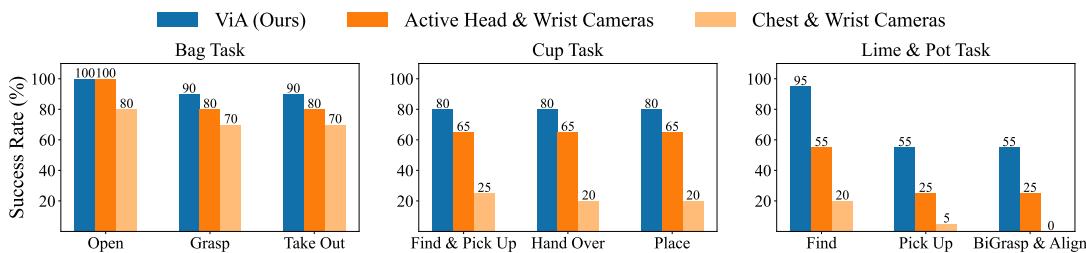
Interesting finding: More cameras isn’t always better. You might expect that adding wrist cameras to the active head setup would help. However, as seen in the orange bars above, performance actually dropped by over 18% when wrist cameras were added. The researchers hypothesize that wrist views are often blocked or noisy during complex manipulation, introducing “distractor” signals that confuse the learning model. The active head camera, because it is intelligently controlled, provides sufficiently rich and stable data on its own.
Result 2: Visual Representations Matter
The team also tested what kind of “brain” the robot needs to process the images. They compared:
- ViA (Ours): Uses DINOv2, a powerful pre-trained vision transformer.
- ResNet-DP: Uses a standard ResNet-18 backbone.
- DP3: Uses raw point clouds as input.
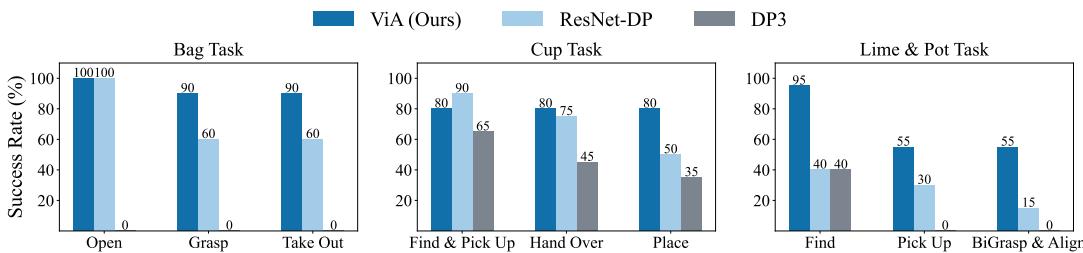
The DINOv2 backbone (ViA) won out. Why? Because tasks like “find the lime” require strong semantic understanding. The robot needs to know what a lime is to look for it. Point cloud methods (DP3) often struggled with “hallucinations,” mistaking empty space for objects, or failing to identify specific items like the bag handle.
Result 3: The Human Factor
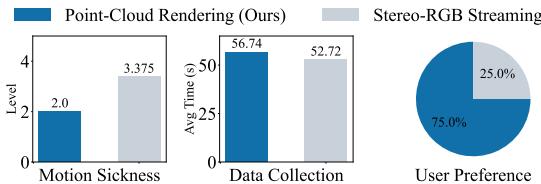
Finally, they validated their teleoperation interface. Did the decoupled point-cloud rendering actually help?
They ran a user study comparing their system against standard Stereo-RGB streaming. The results confirmed the design choice: users reported significantly lower motion sickness and overwhelmingly preferred the ViA interface, even though data collection took slightly longer (likely due to users being more thorough).
Conclusion & Implications
The “Vision in Action” paper makes a compelling case that perception shouldn’t be a passive process. By giving robots a flexible neck and the ability to control it, we allow them to solve problems that are impossible for static systems—specifically, problems involving occlusion and search.
The key takeaways are:
- Active Perception is Learnable: You don’t need to hard-code search patterns. With enough demonstrations, a diffusion policy can learn to “look around” just as it learns to grasp.
- VR Needs Decoupling: To get good data from humans, we must solve the latency problem. Rendering 3D point clouds locally is a viable solution that keeps operators comfortable.
- Quality > Quantity: One actively controlled camera is often better than multiple fixed or obstructed cameras.
This work paves the way for more autonomous household robots. If we want a robot to find our keys or clean a cluttered room, it can’t just stare blankly ahead; it needs to look under the couch, peek behind the door, and actively make sense of its world—just like we do.