](https://deep-paper.org/en/paper/2506.16211/images/cover.png)
If you have ever tried to teach a robotic arm a new skill, you know the struggle: robots are data-hungry. To get a robot to reliably pour water or fold a shirt, you typically need hundreds, if not thousands, of expert demonstrations. This “data barrier” is one of the main reasons we don’t yet have general-purpose robots in our homes.
Recent advances in Vision-Language-Action (VLA) models—essentially “Large Language Models for robots”—have shown promise. These models are pre-trained on massive datasets, giving them a form of robotic “common sense.” However, adapting these giant models to specific, local tasks usually requires expensive fine-tuning that washes away their pre-trained knowledge or requires data we simply don’t have.
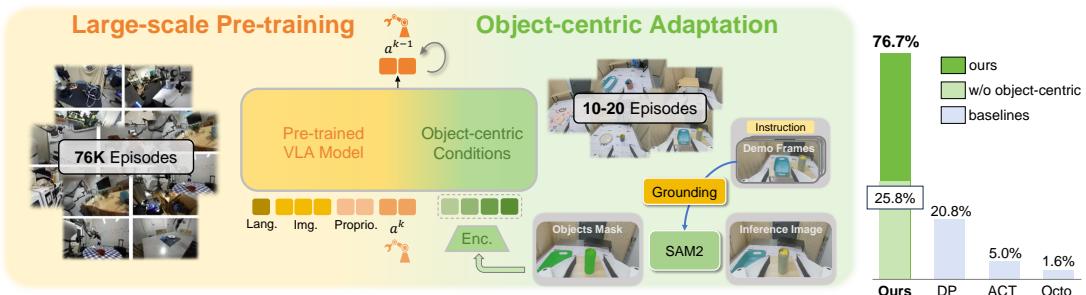
Enter ControlVLA, a new framework proposed by researchers from Tsinghua University and BIGAI. Inspired by image generation techniques, this method allows robots to master complex manipulation tasks with as few as 10 to 20 demonstrations.
In this post, we will deconstruct how ControlVLA bridges the gap between massive pre-trained models and precise, low-data object manipulation.
The Core Problem: Generalization vs. Specificity
To understand why ControlVLA is necessary, we must first look at the current landscape of Robot Learning.
The Two Extremes
- Imitation Learning from Scratch: You train a policy (like a Diffusion Policy) specifically for one task.
- Pros: It can be very precise.
- Cons: It requires a mountain of data (100+ demos) for every single new task. It doesn’t transfer well.
- General-Purpose VLA Models: Models like Octo or RT-2 are trained on internet-scale data.
- Pros: They handle diverse scenes and language instructions well.
- Cons: Fine-tuning them is difficult. They often struggle with the fine-grained precision needed for specific tasks (like picking up a tiny screw).
The Missing Link: Object-Centricity
A major limitation of general VLA models is that they often process scenes as whole images (pixel-level features). Humans, however, think in terms of objects. When you pick up a mug, you focus on the handle and the rim, not the texture of the table underneath it.
Previous attempts to inject “object awareness” into robots existed, but they required precise CAD models or perfectly known 3D poses—luxuries rarely available in the real world. ControlVLA solves this by combining the general reasoning of VLAs with the precision of object-centric representations, without needing thousands of new examples.
The ControlVLA Framework
The researchers devised a three-stage pipeline to achieve this:
- Pre-training: Use a large-scale VLA model.
- Object Representation: Extract specific information about the objects in the scene.
- ControlNet-Style Fine-Tuning: The secret sauce that merges the two.
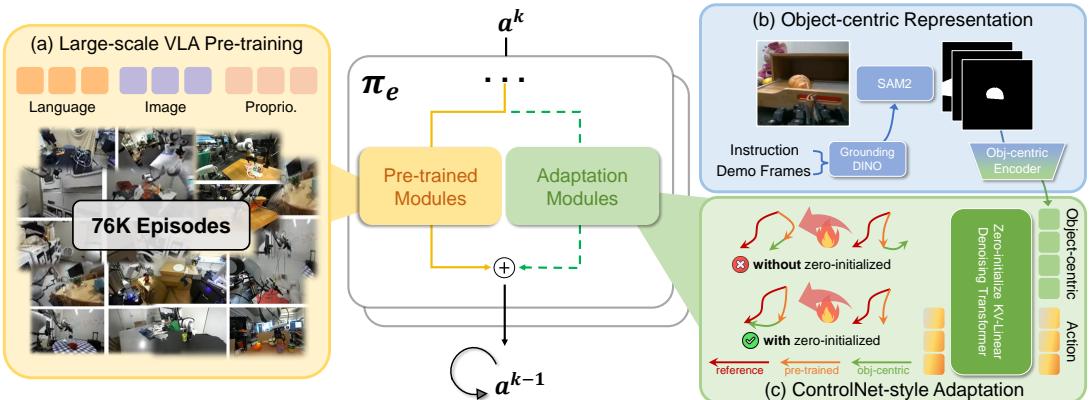
Let’s look at the full architecture:
1. The VLA Backbone (Diffusion Policy)
The foundation of ControlVLA is a pre-trained policy, denoted as \(\pi_g\). The authors utilize a Diffusion Transformer.
If you are familiar with image generators like DALL-E or Stable Diffusion, you know they work by removing noise from a random image to reveal a picture. Diffusion Policy does the same thing, but for robot actions. It starts with random noise and iteratively “denoises” it to produce a smooth trajectory of robot movements.
Mathematically, the denoising process looks like this:

And the training objective minimizes the difference between the predicted noise and the actual noise added to the action:

This pre-trained model provides the robot with a strong “prior”—a basic understanding of how to move and interpret images.
2. Object-Centric Representations
To teach the robot about specific objects without requiring CAD models, the system uses a combination of GroundingDINO (to find objects based on text descriptions) and SAM2 (Segment Anything Model 2, to track them).
Once the object is segmented (masked out from the background), ControlVLA extracts two features:
- Positional Feature (\(z_{pos}\)): Where is the object? (Encoded coordinates).
- Geometrical Feature (\(z_{geo}\)): What shape is it? (Extracted via a small CNN trained from scratch).
These are concatenated into a unified object representation, \(Z\).
3. ControlNet-Style Fine-Tuning
This is the most innovative part of the paper. The challenge is: How do you feed this new Object Representation (\(Z\)) into the massive Pre-trained VLA without breaking it?
If you simply concatenate the object features to the image features and retrain, you risk “catastrophic forgetting”—the robot forgets its general pre-training.
The authors borrowed a technique from ControlNet, a method originally used to control image generation (e.g., forcing Stable Diffusion to generate a cat in a specific pose).
The Dual Cross-Attention Mechanism
In a standard Transformer, the relationship between the robot’s intended Action (\(A\)) and its Observation (\(O\)) is calculated using Cross-Attention:
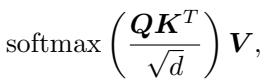
Here, \(Q\) is the Query (from the action), and \(K, V\) are Keys and Values (from the observation).
ControlVLA modifies this by adding a second attention branch specifically for the Object Representation (\(Z\)). The new formula becomes:

The first term preserves the original VLA behavior. The second term injects the specific object guidance.
Zero-Initialization: The Stability Key
Crucially, the researchers employ Zero-Initialization for the new layers associated with the object branch.
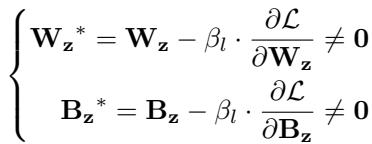
The projection layers for the object features (\(W_z\) and \(B_z\)) are initialized to zero. This means that at the very start of fine-tuning, the Key (\(K_z\)) and Value (\(V_z\)) for the object branch are zero:

Why is this brilliant? At step 0 of fine-tuning, the second term in the dual-attention equation vanishes. The model behaves exactly like the pre-trained VLA. It produces no errors caused by the new, untrained layers.
As training progresses, gradients flow into these zero layers, and they gradually wake up, slowly influencing the policy to pay attention to the specific objects.
(Note for the mathematically curious: A common misconception is that zero weights lead to zero gradients and no learning. However, as shown in the paper’s appendix, the gradients with respect to the weights depend on the loss, which is non-zero, allowing the weights to update immediately after the first step.)
Experimental Results
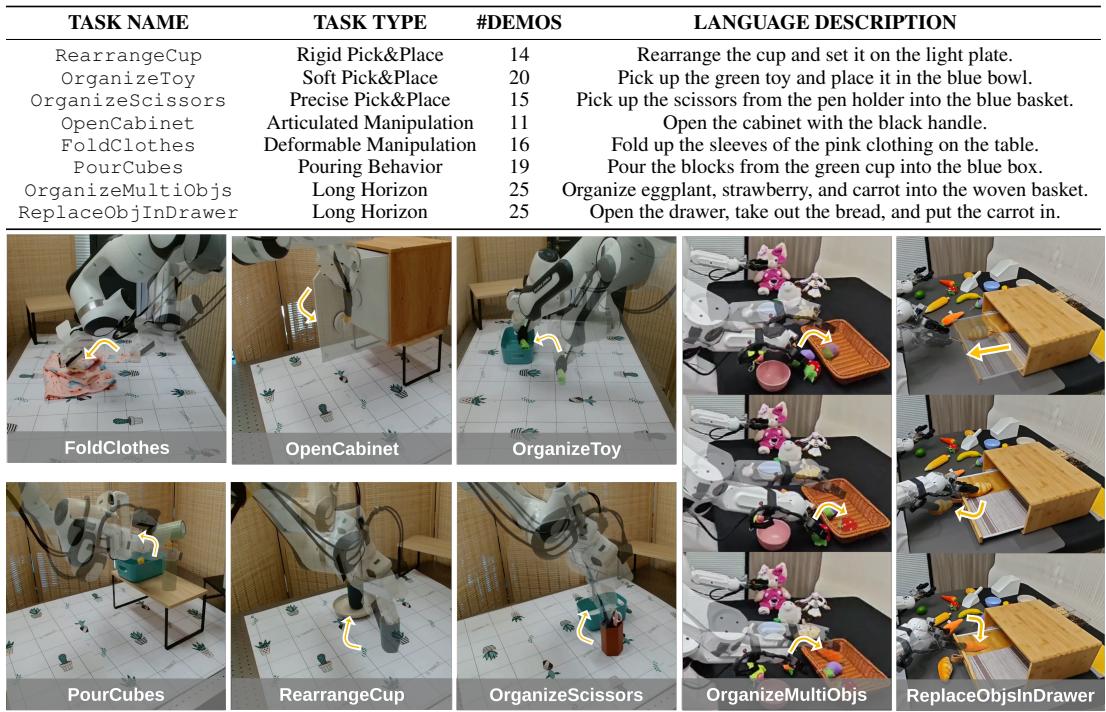
The researchers tested ControlVLA on a suite of 8 real-world tasks, ranging from rigid object manipulation to handling deformable items like clothes.
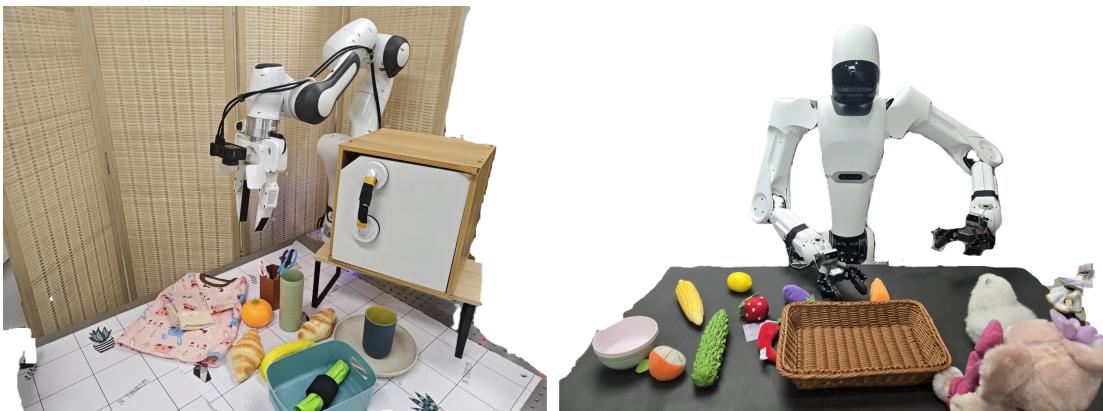
The setup involved two different robot platforms (Franka Panda and AstriBot-S1) to ensure the method wasn’t hardware-dependent.
1. Success Rates vs. Baselines
The results were stark. The authors compared ControlVLA against several state-of-the-art baselines, including:
- Octo: A leading open-source generalist policy.
- ACT: Action Chunking with Transformers.
- Diffusion Policy: The standard for imitation learning (trained from scratch).
With only limited demonstrations (approx. 15-20 per task), the baselines struggled significantly.
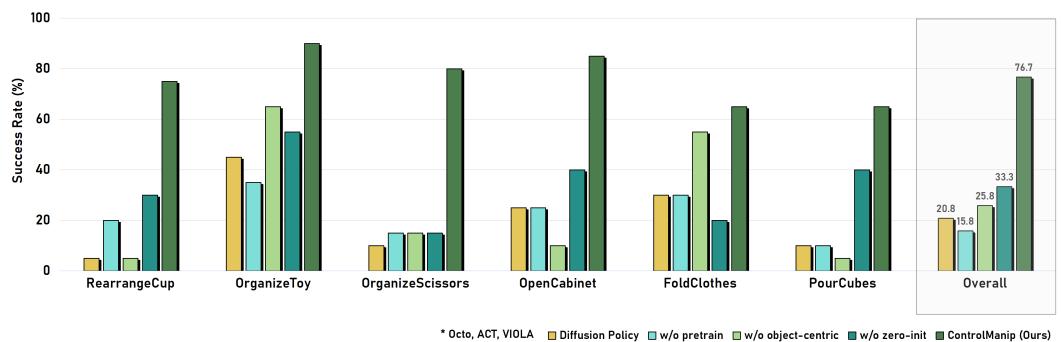
- ControlVLA (ControlManip) achieved an overall success rate of 76.7%.
- Diffusion Policy managed only 20.8%.
- Octo and ACT failed almost completely (1.6% and 5.0%), likely because these large models cannot adapt effectively with such little data without the ControlNet architecture.
2. Data Efficiency
How low can you go? The researchers varied the number of demonstrations for the “OrganizeToy” task.
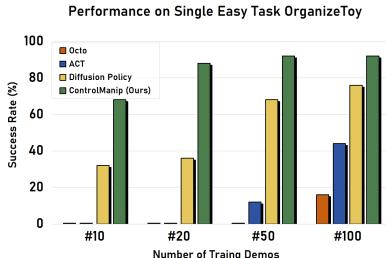
As shown in the chart above, ControlVLA (green bar) hits 80% success with just 20 demonstrations. To get even close to that performance, other methods required over 100 demonstrations, and even then, they often fell short.
3. Long-Horizon Tasks
The method also proved extensible to tasks requiring sequential steps, such as “Organize Multi Objects” (pick three different vegetables and basket them) or “Replace Object in Drawer” (open drawer, remove item, insert new item).
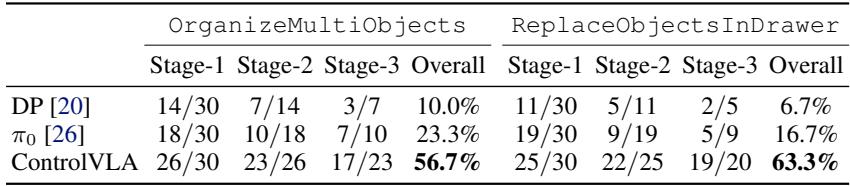
ControlVLA maintained high success rates (approx. 60%) even in these complex scenarios, significantly outperforming the \(\pi_0\) and Diffusion Policy baselines.
4. Robustness and Generalization
Finally, a major promise of object-centric learning is robustness. If the robot understands “cup” rather than “pixels at location x,y,” it should handle different cups or backgrounds.

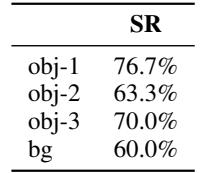
The experiments confirmed this. When tested with unseen objects (e.g., swapping a toy for a piece of bread) or new backgrounds, ControlVLA retained a respectable success rate (70% and 60% respectively), whereas pixel-only methods typically fail when the visual distribution shifts.
Conclusion
ControlVLA represents a significant step forward in robotic manipulation. It successfully identifies that while large pre-trained models provide a necessary foundation of movement, they lack the specific, fine-grained grounding needed for new tasks.
By integrating object-centric representations via a ControlNet-style architecture, the framework offers the best of both worlds:
- High Data Efficiency: Learning from 10-20 demos makes robot training practical for real-world users.
- Stability: Zero-initialization ensures the valuable pre-trained “muscle memory” isn’t destroyed during fine-tuning.
- Precision: Explicitly tracking objects allows for handling complex tasks like pouring or folding.
For students and researchers in robotics, ControlVLA illustrates the power of architectural adaptability—borrowing concepts from generative AI (ControlNet) to solve fundamental control problems. As VLA models continue to grow in size, efficient adaptation methods like this will likely become the standard for deploying robots into the messy, unstructured real world.