](https://deep-paper.org/en/paper/2506.17204/images/cover.png)
Introduction
In the world of Supervised Learning—spanning Large Language Models (LLMs) and Computer Vision—we have grown accustomed to a simple truth: scale wins. If you want a smarter model, you make it bigger. You add more layers, widen the hidden dimensions, and feed it more data. This “scaling law” has driven the AI revolution of the last decade.
However, if you try to apply this same logic to Deep Reinforcement Learning (DRL), you hit a wall.
In DRL, increasing the size of the neural network often leads to worse performance. Instead of becoming more capable, larger agents tend to become unstable, forget what they’ve learned, or fail to learn at all. This phenomenon is known as the “scaling barrier,” and it is one of the primary reasons why we haven’t yet seen a “GPT moment” in robotics or control systems.
Why does this happen? The problem lies in “optimization pathologies”—fundamental issues like plasticity loss and gradient interference that plague Reinforcement Learning specifically.
A recent research paper, “Network Sparsity Unlocks the Scaling Potential of Deep Reinforcement Learning,” proposes a counter-intuitive but powerful solution. The researchers discovered that by removing a massive chunk of the network’s connections before training even begins, we can train much larger models that actually perform better. This concept, known as static network sparsity, might just be the key to unlocking the next generation of DRL agents.
In this post, we will dive deep into why DRL struggles with scale, how simple random pruning fixes it, and the fascinating mechanics of why a sparse brain is often a smarter one.
The Context: Why Big RL Models Fail
To understand the solution, we must first understand the problem. In supervised learning, the data distribution is usually fixed (stationary). A picture of a cat is always a picture of a cat. In Reinforcement Learning, however, the data distribution is non-stationary.
As an agent learns and changes its policy, the data it collects changes. The “ground truth” is a moving target. This instability creates several optimization pathologies, which get significantly worse as the neural network gets bigger:
- Plasticity Loss: The network loses its ability to learn from new experiences. After an initial phase of learning, the weights become “stiff,” and the agent stagnates, unable to adapt to new strategies.
- Dormant Neurons: A large percentage of the neurons in the network eventually output zero for all inputs. They essentially die off, wasting computational resources and reducing the effective capacity of the model.
- Capacity Collapse: Even though the model is huge, the diversity of the features it learns (its “rank”) diminishes. It becomes a large network doing the work of a tiny one.
Current Solutions and Their Limits
The community has tried to patch these holes. Techniques like Periodic Resets (resetting the weights of the network every few million steps) help recover plasticity but are drastic and disruptive. Architectural improvements, such as SimBa (which uses residual connections and layer normalization), have pushed the limit to about 10-20 million parameters.
But what happens if you want to go bigger?
The researchers took the state-of-the-art SimBa architecture and tried to scale it up. As seen in the figure below, the results were discouraging.

In the figure above, look at the dashed lines (Dense Networks). As the model size increases beyond a certain point (around 17M parameters), performance (Episode Return) crashes. This is the scaling barrier in action.
Now, look at the solid lines (Sparse Networks). These networks continue to improve as they get bigger. This is the core contribution of the paper: sparsity turns the scaling curve from negative to positive.
The Core Method: Static Sparse Training
The solution proposed in the paper is elegantly simple. It does not require complex algorithms, dynamic topology adjustments during training, or expensive computation.
The method is Static Sparse Training (SST) with One-Shot Random Pruning.
How It Works
- Initialization: Create a large neural network (e.g., a massive MLP or ResNet).
- Pruning: Before a single step of training occurs, randomly remove a predefined percentage of the weights (e.g., 80% or 90%). These weights are set to zero and frozen.
- Training: Train the remaining weights using standard RL algorithms (like SAC or DDPG). The topology of the network never changes during training.
The Sparsity Distribution
You might wonder: do we remove weights uniformly? The authors use the Erdős-Rényi (ER) kernel formulation. In simple terms, this method adjusts the sparsity level based on layer size. Smaller layers (which are information bottlenecks) are pruned less aggressively, while larger layers are pruned more heavily. This ensures that the flow of information isn’t choked off at narrow points in the network.
The Hypothesis
The researchers hypothesized that the dense connections in standard networks are actually detrimental in RL. They act as “superhighways” for noise and interference, causing the entire network to couple too tightly and lose plasticity. By severing these connections randomly, we force the network to develop distinct, robust sub-networks that are less prone to interference.
Experiments: Breaking the Barrier
To validate this hypothesis, the authors tested their method on the DeepMind Control (DMC) Suite, focusing on the hardest tasks like “Humanoid Run” and “Dog Trot.” They used two standard algorithms: Soft Actor-Critic (SAC) and Deep Deterministic Policy Gradient (DDPG).
1. Scaling Width and Depth
They took the baseline SimBa network and scaled it in two dimensions: Width (more neurons per layer) and Depth (more layers).
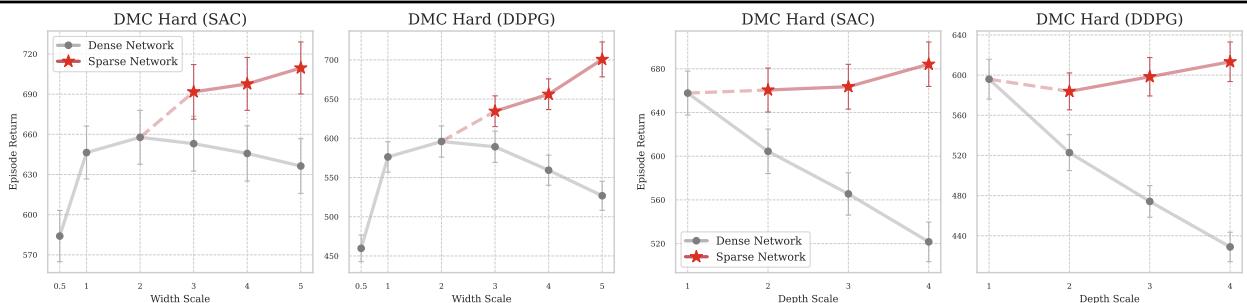
The results in Figure 2 (above) tell a clear story:
- Dense Networks (Gray lines): As width or depth increases, performance peaks early and then degrades.
- Sparse Networks (Red stars): Performance remains stable or improves as the model scales.
Crucially, this isn’t just about parameter efficiency. Even when a sparse network has the same number of active parameters as a dense one (meaning the sparse network is physically much larger but mostly empty), it performs better. This suggests that the topology—the sparse structure itself—provides a benefit that dense connectivity cannot match.
2. Finding the Sweet Spot
How sparse should the network be? The authors conducted a sweep of sparsity ratios ranging from 0.1 (10% pruned) to 0.9 (90% pruned).

Figure 3 (above) reveals an important insight regarding model size:
- Default Networks (Blue lines): For smaller, standard-sized networks, high sparsity hurts performance. You need those parameters.
- Large Networks (Orange lines): For massive networks (~100M parameters), performance increases as sparsity increases.
This confirms the “Lottery Ticket Hypothesis” intuition: inside a massive, randomly initialized network, there exists a highly effective sparse sub-network. By pruning, we isolate that sub-network and prevent the rest of the noisy weights from messing it up.
The Diagnosis: Why Does Sparsity Work?
The paper goes beyond just showing that it works; it performs a deep diagnostic to explain why. They identified four key mechanisms where sparse networks outperform dense ones.
1. Preventing Representational Collapse (Srank)
A common issue in large dense networks is that the representations of different data points become too similar. The network effectively loses its ability to distinguish between subtle differences in states. This is measured by Effective Rank (Srank).
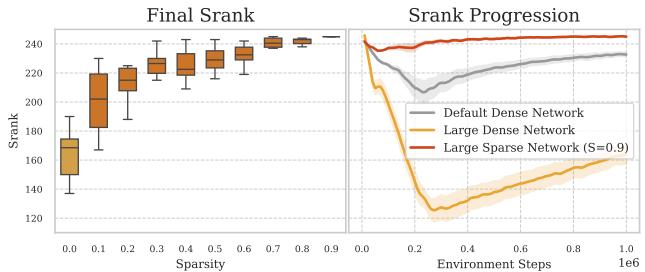
In Figure 4 (above), look at the “Srank Progression” on the right.
- The Large Dense Network (Orange) starts with high rank but quickly collapses (the line drops).
- The Large Sparse Network (Red) maintains a high stable rank throughout training.
- Implication: The sparse network retains a rich, diverse understanding of the environment, whereas the dense network simplifies its understanding too much.
2. Preserving Plasticity (The “Dormant Neuron” Problem)
Plasticity is the lifeblood of an RL agent. If it loses plasticity, it stops learning. A strong indicator of plasticity loss is the Dormant Ratio—the percentage of neurons that stop firing.
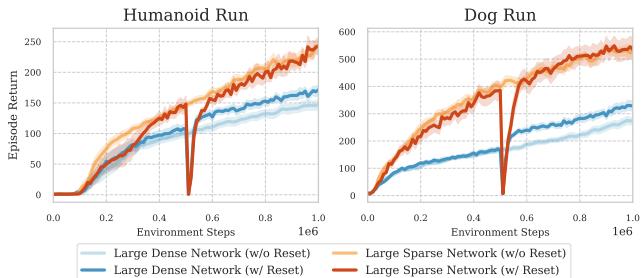
Figure 5 (left side of the image above) is striking.
- Dense Networks (Blue/Gray): The dormant ratio (top row) skyrockets, and gradient norms (bottom row) collapse to near zero. The network is effectively dying.
- Sparse Networks (Orange): The dormant ratio stays low, and gradients remain healthy.
The right side of the image (Figure 6) shows an experiment with Resets. Usually, resetting a dense network (Dark Blue) boosts performance because it artificially restores plasticity. However, the sparse network (Red) performs best without resets. It naturally maintains its plasticity, making external interventions unnecessary.
3. Controlling Parameter Growth
In unstable RL training, the weights of the network can balloon in size (Parameter Norm), leading to arithmetic issues and instability.
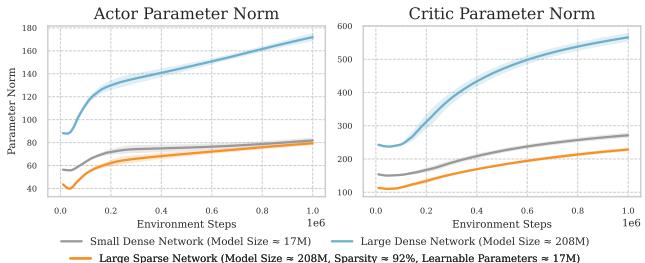
As shown above, the Large Dense Network (Blue) suffers from exploding parameter norms. The Sparse Network (Orange) naturally regularizes the weights, keeping them at a magnitude comparable to much smaller networks. This acts as an implicit form of regularization.
4. Mitigating Gradient Interference
This is perhaps the most visual proof of sparsity’s benefit. Gradient Interference occurs when an update to the network for State A negatively impacts the prediction for State B. In a dense network, everything is connected to everything, so “cross-talk” is inevitable.
The researchers visualized the Gradient Covariance Matrices:
Large Sparse Network (Critic):

Large Dense Network (Critic):
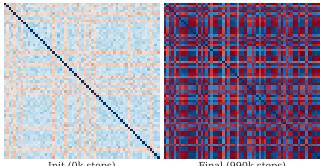
Compare the “Final” heatmaps (bottom row).
- The Dense Network is a wash of dark red and blue, indicating strong, complex correlations and interference across the board.
- The Sparse Network retains a structured, cleaner pattern. The gradients are more orthogonal, meaning the network can learn about one part of the state space without destroying what it knows about another.
Generalization: Visual and Streaming RL
To prove this isn’t just a quirk of state-based control, the authors extended their evaluation to two other challenging domains.
Visual RL
In Visual RL, the agent must learn directly from raw pixels. This usually requires massive Convolutional Neural Networks (CNNs).
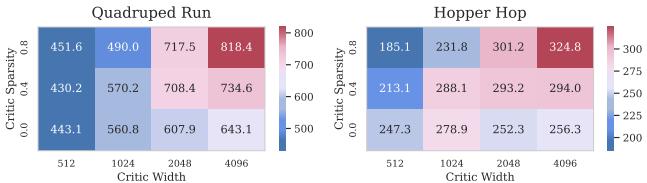
In Figure 10, we see that as the Critic network gets wider (from 512 to 4096), the Sparse setting (bottom rows) achieves significantly higher scores than the narrower or denser counterparts.
Streaming RL
Streaming RL is a setup where the agent learns from a continuous stream of data without a large replay buffer, making plasticity even more critical (since you can’t replay old data to remind the network of what it learned).
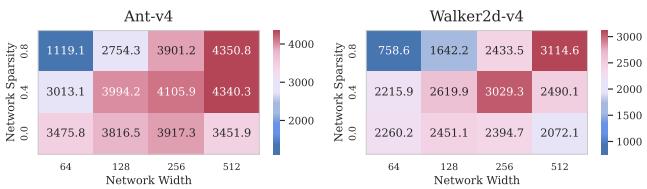
Figure 12 confirms the trend: Sparse networks (red lines in the corresponding learning curves) consistently outperform dense ones, especially in the high-width settings required for complex locomotion.
Conclusion and Implications
The paper “Network Sparsity Unlocks the Scaling Potential of Deep Reinforcement Learning” provides a compelling answer to the scaling crisis in RL. The findings suggest that the density of standard neural networks is actually a liability in the chaotic, non-stationary world of Reinforcement Learning.
Key Takeaways:
- Sparsity is a Feature, Not a Bug: It is not just for saving memory; it is a structural necessity for scaling.
- No More Resets: Appropriate sparsity maintains plasticity naturally, removing the need for complex intervention techniques like periodic resets.
- Simplicity Wins: The method used—One-Shot Random Pruning—is incredibly simple to implement. It requires no new optimizers or complex code, just a mask applied at initialization.
This work suggests a future where DRL agents can finally participate in the “scaling wars” that have advanced other fields of AI. By simply cutting the connections that cause interference and collapse, we might be able to build agents that are orders of magnitude larger—and smarter—than what we have today.
For students and researchers in RL, the message is clear: before you try to invent a complex new architecture to fix your training instability, try simply pruning your network. You might find that less really is more.