](https://deep-paper.org/en/paper/2506.17457/images/cover.png)
Introduction: The Need for Speed in Autonomous Safety
Imagine you are driving down a suburban street. It’s a sunny day, the music is playing, and you are relaxed. Suddenly, from behind a parked truck, a child chases a ball into the middle of the road. Your brain processes this visual information instantly—your foot slams on the brake, and the car screeches to a halt just inches from the child. The difference between a close call and a tragedy was a fraction of a second.
Now, imagine an autonomous vehicle (AV) in that same scenario. For years, computer vision research has focused heavily on accuracy—teaching the car to recognize that the object is indeed a child and not a mailbox. But in the world of autonomous driving, recognizing the object is only half the battle. The other half is time.
If an AV takes 500 milliseconds to process the image and decide to brake, it might be too late.
This brings us to a critical bottleneck in current autonomous driving technology: the trade-off between detection accuracy and response time. Sophisticated Deep Neural Networks (DNNs) are incredibly accurate but computationally heavy, often causing inference latency. On the other hand, lightweight models are fast but prone to errors.
In this post, we are diving deep into a fascinating solution proposed in the paper “When Every Millisecond Counts: Real-Time Anomaly Detection via the Multimodal Asynchronous Hybrid Network.” The researchers propose a novel architecture that doesn’t just rely on standard cameras. Instead, they fuse standard RGB images with Event Cameras—bio-inspired sensors that react to motion in microseconds.

As illustrated in Figure 1, the total response time isn’t just about how fast the computer chip is (\(T_{inference}\)); it’s also about the delay between the anomaly happening and the system realizing something is wrong (\(\Delta T_{detection}\)). The goal of this research is to minimize both.
Background: Why Traditional Cameras Aren’t Enough
To understand the innovation here, we first need to look at the limitations of the “eyes” currently used by most self-driving cars: RGB cameras.
The Frame-Based Limit
Standard cameras operate on a frame-rate basis (e.g., 30 or 60 frames per second). They capture a snapshot of the world, wait, and then capture another. If a fast-moving object appears between two frames, the system is effectively blind to it until the next shutter click. Furthermore, processing these heavy frames takes time. In high-speed scenarios, that tiny gap can be fatal.
Enter the Event Camera
The researchers introduce a “multimodal” approach by adding Event Streams. An event camera (or Dynamic Vision Sensor - DVS) works differently. Instead of taking pictures, each pixel operates independently and asynchronously. A pixel only sends data (an “event”) if it detects a change in brightness.
Mathematically, an event is triggered when the logarithmic brightness change exceeds a threshold \(C\):
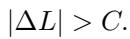
This results in a stream of sparse data points \((x, y, t, p)\)—location, time, and polarity (brightness increase or decrease). The advantages are massive:
- Microsecond Resolution: They capture motion almost instantly.
- No Motion Blur: They handle high speeds perfectly.
- High Dynamic Range: They work well in tunnels or blinding sunlight.
However, event cameras lack the rich texture and color data of RGB cameras. You can see movement perfectly, but you might struggle to tell if the moving object is a person or a cardboard box.
The core contribution of this paper is a Multimodal Asynchronous Hybrid Network that combines the “what” (RGB spatial details) with the “when” (Event temporal speed) to achieve real-time anomaly detection.
The Core Method: A Multimodal Asynchronous Hybrid Network
This is the heart of the system. The researchers have designed a network that processes these two very different types of data in parallel and fuses them to make split-second decisions.
Let’s break down the architecture step-by-step.
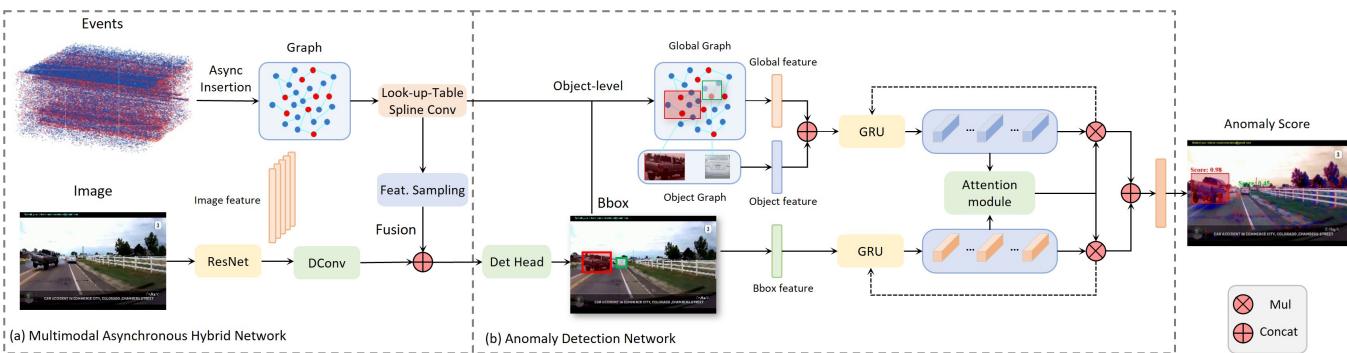
1. Asynchronous Graph Neural Network (Event Branch)
The top branch of Figure 2(a) handles the event stream. Since event data is sparse and unstructured (it’s a cloud of points, not a grid of pixels), standard Convolutional Neural Networks (CNNs) don’t work well.
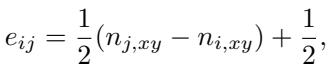
Instead, the authors model the events as a Graph. Each event is a node in the graph, connected to its neighbors in space and time. They define the “edge” (connection) between two events based on their spatial proximity.
The edge features \(e_{ij}\) between two nodes are calculated based on their normalized spatial coordinates (\(n_{x,y}\)):
To process this graph, they use a Deep Asynchronous Graph Neural Network (DAGr). This network uses a special operation called “spline convolution.” It allows the network to aggregate information from neighboring events efficiently.
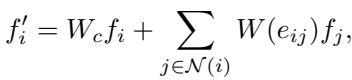
Here, \(f'_i\) is the updated feature for a node, \(W_c\) is a weight matrix, and the summation aggregates information from the neighbors \(\mathcal{N}(i)\). This setup allows the network to “flow” information through the cloud of events, capturing the precise geometry of motion.
2. CNN Feature Extraction (RGB Branch)
The bottom branch of Figure 2(a) is more traditional. It uses a ResNet architecture to process the RGB frames. This extracts rich “appearance features”—the texture, color, and shape of cars, pedestrians, and roads.
3. Feature Fusion
Here lies a clever design choice. The RGB features are injected into the Event Graph. For every node in the event graph (which corresponds to a specific location in the image), the system samples the feature vector from the CNN at that same coordinate.
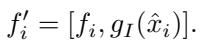
By concatenating the event features \(f_i\) with the image features \(g_I\), the graph nodes now possess both high-speed motion data and rich visual context. This fused data is fed into a detection head to create bounding boxes around objects.
4. Spatio-Temporal Anomaly Detection
Once the system has detected objects (like a car or pedestrian), it needs to decide: Is this object behaving abnormally?
This happens in the Anomaly Detection Network (Figure 2b).
For every detected object, the system extracts two specific feature vectors:
- Event Features (\(o_{t,i}\)): Derived from the events inside the object’s bounding box using the GNN.
- Image Features (\(g_{t,i}\)): Derived from the RGB pixels inside the bounding box.

These are concatenated into a single object representation vector \(p_{t,i}\):

The Memory Module (GRU)
An anomaly is rarely a single static frame; it is a sequence of behaviors. A car swerving, a person running, a sudden stop. To capture this, the authors use Gated Recurrent Units (GRUs).
The GRU acts as the system’s short-term memory. It takes the current features of the object and updates a hidden state vector \(h\). This hidden state carries the “history” of that object’s movement and appearance.
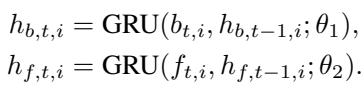
The model actually runs two GRUs in parallel: one tracking the bounding box coordinates (movement history) and one tracking the fused visual features (appearance/motion history).
The Attention Mechanism
Not all objects on the road are relevant. A parked car is less interesting than a moving one. To prioritize, the network applies an Attention Mechanism. It calculates a weight \(\alpha\) for each object, effectively telling the network how much “attention” to pay to it.
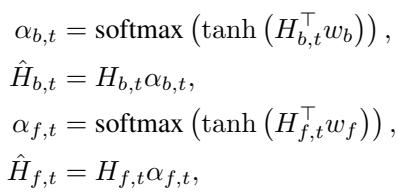
If an object shows erratic movement (captured by the event stream) or looks dangerous (captured by the RGB), the attention weight spikes.
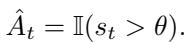
Finally, the weighted features are passed through a classifier to output an Anomaly Score \(s_{t,i}\). If this score crosses a threshold \(\theta\), the system flags an emergency.

Experiments and Results
The researchers validated their model on two major benchmarks: ROL (Risk Object Localization) and DoTA (Detection of Traffic Anomaly). They also created a specific dataset called Rush-Out to test extreme, sudden events (like a kid running out from behind a truck).
Defining Success
They measured success using several metrics, but the most important for this specific paper is Response Time.
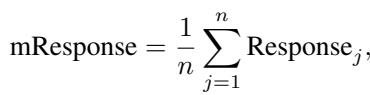
They also looked at AUC (Area Under the Curve) to measure accuracy and mTTA (mean Time-to-Accident)—essentially, how many seconds before the crash did the model predict it?
Quantitative Performance
The results were compelling. As shown in Table 1, the proposed method (labeled “Ours”) outperformed existing state-of-the-art methods like AM-Net and FOL-Ensemble.
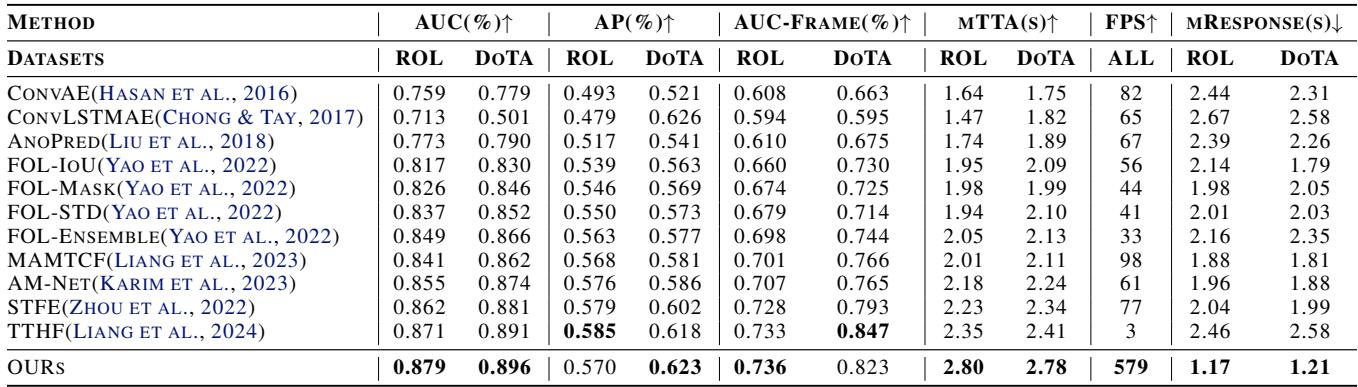
Key takeaways from the data:
- Speed: The model runs at a staggering 579 FPS (Frames Per Second) on the ROL dataset. Compare this to “ConvAE” which runs at 82 FPS. This is “real-time” in the truest sense.
- Latency: The
mResponse(Mean Response Time) dropped to 1.17 seconds, significantly lower than competitors. - Accuracy: Despite being faster, it didn’t lose accuracy. The AUC of 0.879 on ROL is the highest in the table.
Qualitative Analysis: Seeing the Milliseconds
The numbers are impressive, but seeing the detection in action clarifies why the Event stream is so vital.
Consider the “Rush-Out” scenario. In Figure 8(a) below, a boy suddenly runs out from behind a truck.
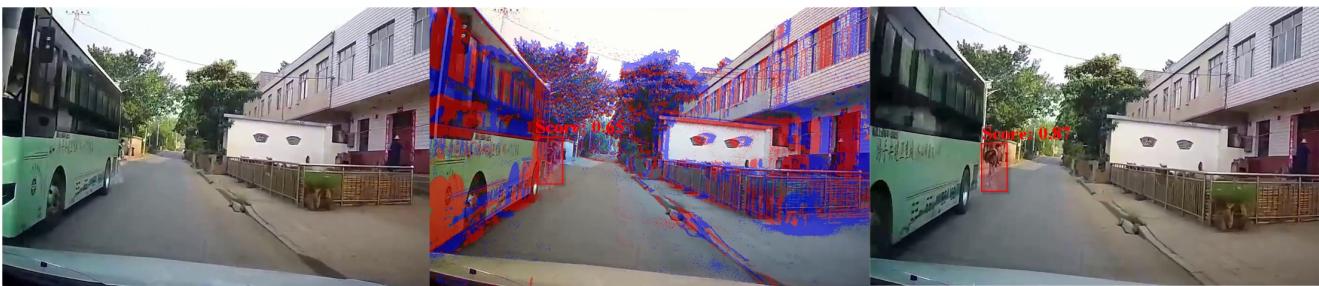
Because the boy is moving fast, the event camera triggers a massive spike of activity between the standard video frames. The RGB camera might see a blur or miss the onset entirely, but the asynchronous GNN catches the sudden cluster of motion events immediately.
The same applies to vehicles cutting in. In Figure 4, we see the attention mechanism in action.
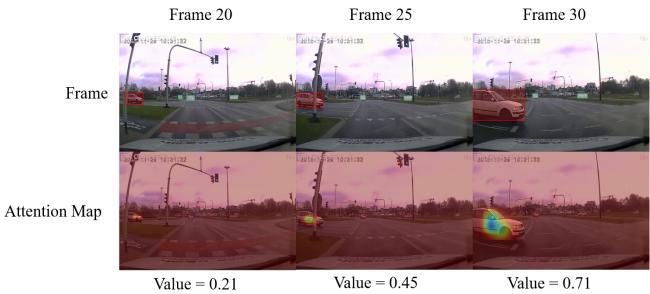
The heatmaps at the bottom show the “Attention Map.” Notice how the attention (the bright yellow spot) locks onto the white SUV the moment it begins to intrude into the lane. The model effectively ignores the background and focuses its computational resources on the threat.
Inter-Frame Detection
One of the most unique capabilities of this model is Inter-Frame Anomaly Detection. Standard models only look at Frame 1, then Frame 2.
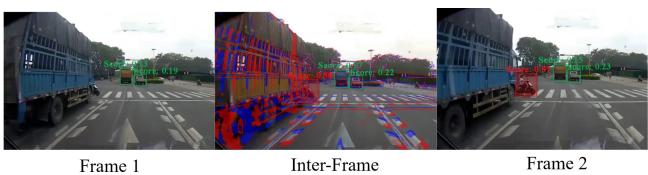
As shown in Figure 5, if an object moves rapidly during the, say, 33 milliseconds between video frames, the event stream (the middle panel) lights up. This allows the model to update its anomaly score continuously, rather than waiting for the next full image. This is the secret sauce behind the ultra-low latency.
Challenging Environments
The event camera also shines in difficult lighting. Figure 7 demonstrates a “tunnel exit” scenario—a classic problem for cameras where the blinding light washes out the image.
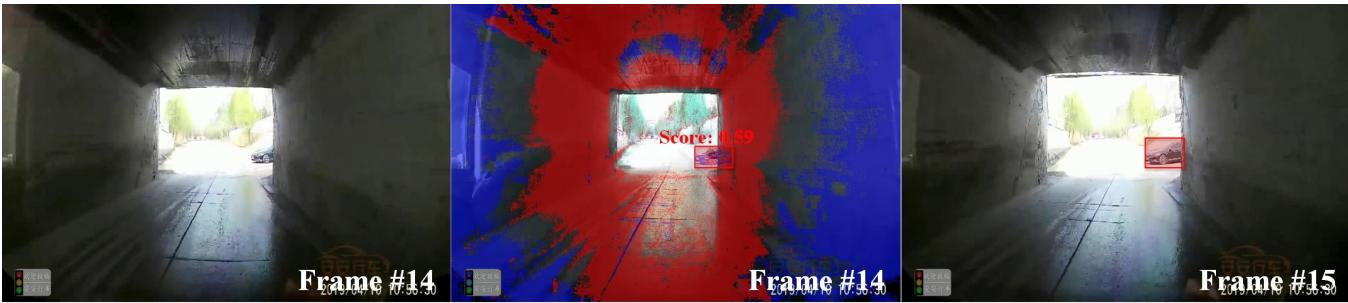
Because event cameras detect changes rather than absolute brightness, they aren’t blinded by the sun. The vehicle emerging from the tunnel is clearly detected (red box) despite the glare that would likely confuse a standard RGB-only system.
Conclusion
The research presented in “When Every Millisecond Counts” offers a convincing argument for the integration of event-based vision in autonomous driving. By moving away from a purely frame-based world and embracing the asynchronous nature of event streams, the authors have built a system that is not only more accurate but, crucially, much faster.
The key takeaways are:
- Safety is Time: Reducing inference latency and detection delay is just as important as detection accuracy.
- Complementary Sensors: RGB provides the context (what is it?), while Event cameras provide the dynamics (how is it moving right now?).
- Asynchronous Processing: Using Graph Neural Networks allows us to process motion data as it happens, rather than waiting for a frame buffer to fill up.
For students of computer vision and robotics, this paper is a prime example of how hardware innovation (event cameras) requires new software architectures (Asynchronous GNNs) to unlock its full potential. As we move toward Level 5 autonomy, hybrid networks like this—which mimic the biological combination of foveal vision (detail) and peripheral vision (motion)—will likely become the standard.