](https://deep-paper.org/en/paper/2506.17486/images/cover.png)
Imagine a robot navigating a disaster zone. It needs to find survivors, assess structural damage, and report back. To do this effectively, it needs to understand complex natural language instructions and reason about its environment in real-time.
For the last few years, the standard solution has been to hook the robot up to a Large Language Model (LLM) like GPT-4. The robot sends a picture or a map to the cloud, the LLM processes it, and sends back a plan. In a perfect world with high-speed internet, this works beautifully.
But robots rarely operate in a perfect world. In a disaster zone, a remote forest, or even a deep basement, internet connections are unreliable or non-existent. Furthermore, relying on the cloud introduces latency—waiting seconds for a server to respond can be dangerous for a moving robot.
So, why not run the model on the robot itself? The problem is size. Models smart enough to plan complex missions are massive (hundreds of billions of parameters). Models small enough to fit on a robot’s onboard computer (Small Language Models, or SLMs) are usually not smart enough to handle complex reasoning.
This is the bottleneck that researchers from the University of Pennsylvania set out to solve. In their paper, “Distilling On-device Language Models for Robot Planning with Minimal Human Intervention,” they introduce PRISM.
PRISM is a framework that takes the “brainpower” of a massive cloud model and transfers it into a tiny, efficient model that lives on the robot. The result? A robot that can plan as well as GPT-4, but runs entirely offline, with zero latency issues, and—crucially—requires almost no human effort to train.
The Problem: The Cloud vs. Edge Dilemma
To understand why PRISM is necessary, we need to look at how LLM-enabled robots currently work.
When you ask a robot to “Find my keys,” it doesn’t just know what keys look like; it needs to plan a search. It might decide: “I should check the table, then the counter, and finally the couch.” This requires contextual reasoning.
State-of-the-art robots achieve this by acting as a puppet for a cloud-based LLM. The robot is the body; the cloud is the brain.
- Pros: The robot is incredibly smart and flexible.
- Cons: The robot is tethered to the internet. If the WiFi drops, the robot freezes. If the server lags, the robot stutters.
Researchers have tried using Small Language Models (SLMs) like Llama-3 (the smaller versions) directly on robots. While these models are efficient, they struggle with spatial reasoning. In experiments, un-tuned SLMs often fail to generate valid plans, achieving success rates as low as 10-20% on complex tasks.
The goal of PRISM is to break this trade-off. The researchers asked: Can we teach a small model to mimic the expert reasoning of a large model, specifically for robotic tasks, without needing a human to manually teach it?
The PRISM Framework
PRISM stands for Planning with Robotic dIstilled Small language Models.
The core concept is Knowledge Distillation. In machine learning, distillation is a teacher-student relationship. You have a “Teacher” model (huge, smart, slow) and a “Student” model (small, fast, less knowledgeable). You run data through the Teacher, record its answers, and train the Student to produce those same answers.
However, standard distillation has a flaw when applied to robots: Grounding. A robot doesn’t just answer questions; it interacts with a physical world. It needs to know that if it moves forward, the view changes. If it picks up an apple, the apple is no longer on the table. Standard text datasets don’t capture this physical cause-and-effect loop.
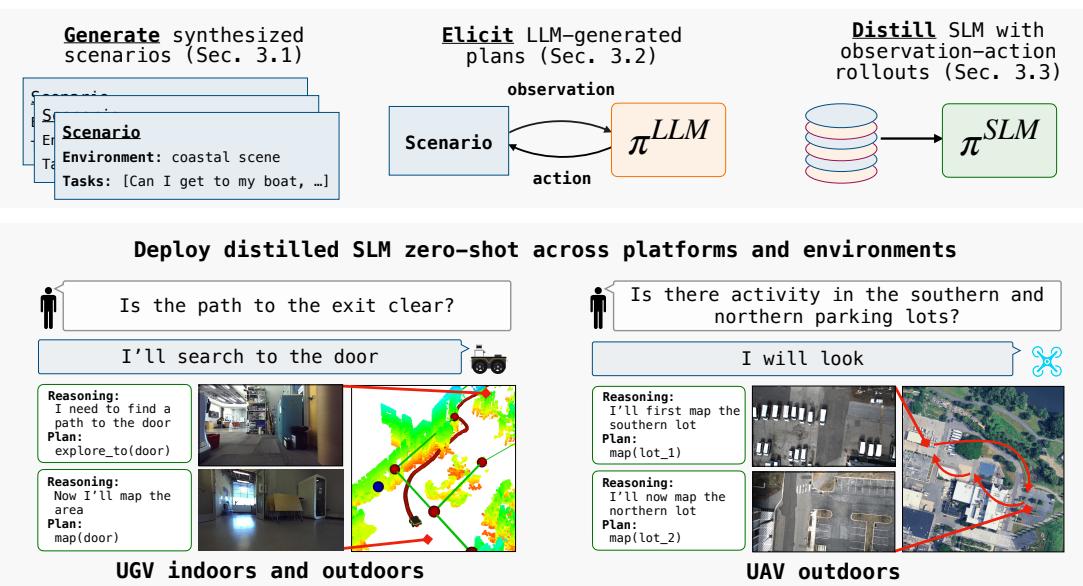
PRISM solves this by creating a synthetic training loop. It doesn’t need real-world data or expensive physical simulators. Instead, it uses the Teacher LLM to hallucinate entire worlds and tasks, play through them, and generate a training manual for the Student.
The framework operates in three distinct phases:
- Scenario Generation
- Plan Elicitation
- Planner Distillation
Let’s break these down.
Phase 1: Scenario Generation
Training a model requires data—lots of it. Gathering real robot data is slow and expensive. PRISM bypasses this by generating synthetic scenarios.
The system prompts a powerful LLM (like GPT-4o) to invent an environment and a task.
- The Environment: This isn’t a 3D video game level. It’s a text-based representation, like a scene graph (“Kitchen contains: Table, Fridge”) or an object list.
- The Task: A semantically coherent instruction, like “Put the apple in the fridge.”
Because the LLM has seen the entire internet, it can generate thousands of diverse, realistic scenarios—from coastal boardwalks to cluttered kitchens—without a human ever needing to write a line of code.
Phase 2: Plan Elicitation
This is the most critical step. We have a fake world and a task. Now, we need to generate a “demonstration” of how to solve it.
PRISM uses the Teacher LLM to solve the task. But it doesn’t just ask for the final answer. It simulates the closed-loop planning process.
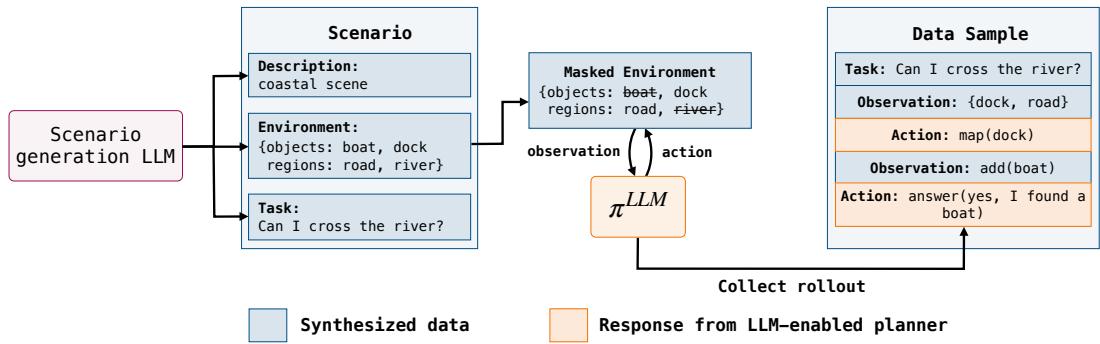
As shown in Figure 2 above, the process mimics a real robot:
- Masking: The system hides parts of the environment. The “robot” (Teacher LLM) can only see what is supposed to be visible from its starting point.
- Action: The Teacher proposes an action (e.g.,
map(dock)). - Update: The system reveals new information based on that action (e.g., “You now see a boat”).
- Repeat: This cycle continues until the task is done.
Crucially, PRISM validates these traces. If the Teacher gets stuck, hallucinates an impossible action, or takes too long, that specific run is discarded. Only successful, high-quality plans make it into the dataset.
This creates a dataset of “Observation \(\rightarrow\) Action” pairs that implicitly teaches the model how to react to new information, not just how to memorize a map.
Phase 3: Planner Distillation
Once thousands of these successful mission logs are collected, it’s time to train the Student (the SLM).
The researchers use a technique called Supervised Fine-Tuning (SFT). The Student model (e.g., Llama-3.2-3B) is shown the history of observations and actions and is asked to predict the next action.
The mathematical objective is to minimize the difference between the Student’s choice and the Teacher’s choice, as defined by the cross-entropy loss equation:

Here, the model \(\pi^{SLM}\) learns to predict action \(a^t\) given the history of previous actions and observations.
To make this training efficient enough to run on consumer hardware, the researchers use LoRA (Low-Rank Adaptation). Instead of retraining the entire brain of the Student model (which is computationally heavy), LoRA trains a tiny set of adapter layers that sit on top of the model. This allows a 3-billion parameter model to be fine-tuned using only a tiny fraction of trainable parameters, saving massive amounts of memory and time.
Experimental Setup: Testing the Student
Does this actually work? Can a tiny model trained on hallucinated text replace GPT-4?
The researchers tested PRISM across three very different domains to prove its versatility:
- SPINE (Mapping & Exploration): A robot (both aerial drones and ground rovers) exploring unknown buildings and outdoor areas.
- LLM-Planner (Home Assistance): A simulated robot in a house performing tasks like “Heat the potato and put it on the counter.”
- SayCan (Manipulation): A robotic arm rearranging blocks and bowls on a table.
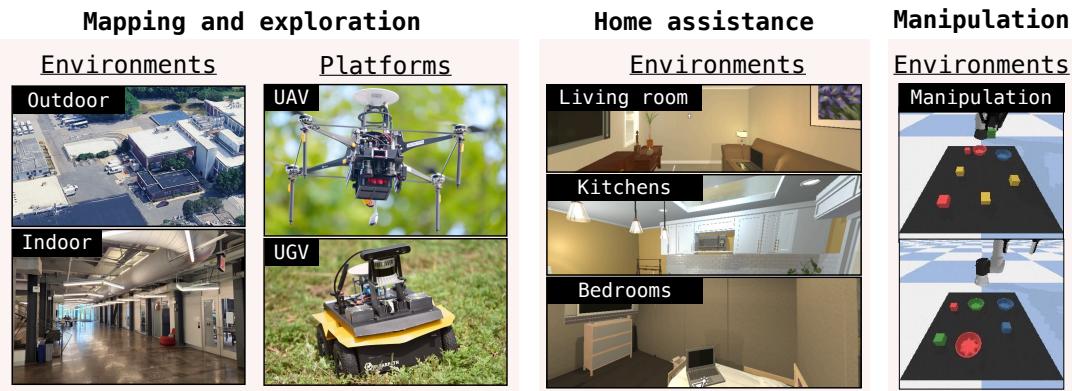
They compared three setups:
- LLM (The Teacher): GPT-4o running the planner (The Gold Standard).
- SLM (The Novice): Llama-3.2-3B without PRISM training (The Baseline).
- PRISM (The Graduate): Llama-3.2-3B distilled via PRISM.
The Results
The performance jump provided by PRISM is startling.
In the original experiments, the un-tuned SLM failed spectacularly. It achieved success rates between 1.76% and 13.5% depending on the task. It simply wasn’t smart enough to handle the logic.
After PRISM training, the exact same model achieved success rates of over 90% on the SPINE tasks, reaching near-parity with GPT-4o.
Let’s look at the breakdown of difficulty in the SPINE experiments:
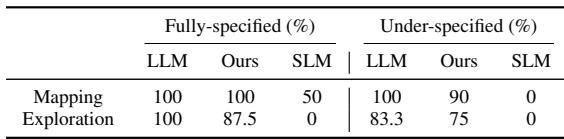
As Table 2 shows:
- Standard SLM (Right column): Crumbles immediately. It gets 0% on almost all complex tasks.
- GPT-4o (Left column): Scores 100% on most tasks, dropping slightly on “Under-specified Exploration.”
- PRISM (Middle column): Holds its own. It matches the LLM on mapping tasks and stays within striking distance (87.5% vs 100%) on exploration.
Why does the standard SLM fail?
The researchers analyzed why the un-tuned small models were so bad. It wasn’t just that they gave wrong answers; they fundamentally misunderstood how to be a robot.
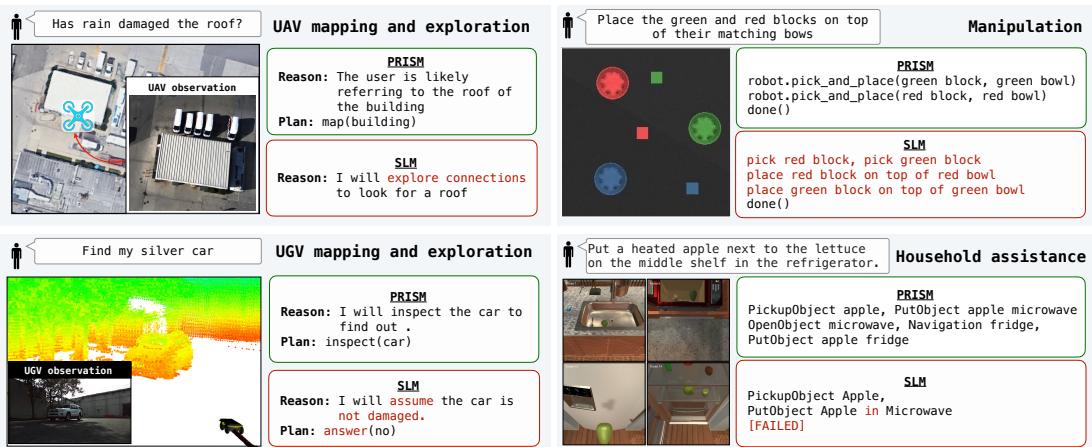
As illustrated in Figure 4:
- Hallucination: The SLM would assume things about the world that it hadn’t verified yet (e.g., claiming a car is undamaged without looking at it).
- Syntax Errors: It would try to call functions that didn’t exist or use them in the wrong order (e.g., trying to pick up two blocks at once when it only has one gripper).
- PRISM’s fix: Because the distilled model was trained on valid execution traces, it learned the “rules of the road.” It learned that you must
gotoa location before you caninspectit.
Speed and Latency
Performance isn’t just about being right; it’s about being fast.
One of the biggest arguments for on-device models is latency. When a robot uses GPT-4, it sends data to a server. This creates a delay that varies wildly depending on network congestion.
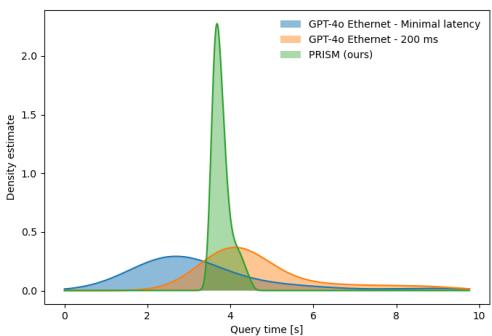
The graph above shows the distribution of query times:
- Blue/Orange (GPT-4o): The latency is spread out. Sometimes it’s fast, sometimes it lags. This unpredictability (jitter) makes smooth control difficult.
- Green (PRISM): The spike is sharp and narrow. The on-device model takes roughly the same amount of time every single step.
This determinism is a massive advantage for control engineers who need to guarantee that the robot’s “thinking loop” fits within a specific time budget.
Conclusion and Implications
The PRISM framework represents a significant step forward for autonomous robotics. It demonstrates that we don’t necessarily need “bigger” brains on robots; we need specialized brains.
By using the massive general knowledge of cloud LLMs to synthesize training data, we can create compact, specialized models that run locally. This breaks the tether to the cloud.
Key Takeaways:
- Synthetic Data Works: You don’t need expensive human-labeled datasets to train robot planners. You can use an LLM to generate the data for you.
- Closed-Loop Training is Key: Simply asking an LLM for the answer isn’t enough. You must simulate the process of discovery (masking environments, iterative updates) to teach a student model how to plan.
- On-Device is Viable: We can now deploy robots in mines, forests, or space—places with no internet—without sacrificing the high-level reasoning capabilities we’ve come to expect from modern AI.
The future of robotics might not be a single super-computer in the cloud controlling everything, but millions of small, distilled experts running on the edge, navigating our world independently.