](https://deep-paper.org/en/paper/2506.17811/images/cover.png)
Imagine you are trying to solve a complex math problem. Do you simply blurt out the first number that comes to your head? Probably not. You likely scribble down a few potential approaches, double-check your logic, and verify your answer before committing to it. Humans naturally allocate more “compute” (thinking time) to harder problems.
In the world of Large Language Models (LLMs), we have seen this principle formalized as “inference-time scaling.” Techniques like Chain-of-Thought reasoning or generating multiple code snippets and verifying them have revolutionized how AI solves complex logical tasks.
However, robotics has largely lagged behind in this paradigm. Most modern robot brains—specifically Vision-Language-Action (VLA) models—operate on a “System 1” basis: they look at an image and immediately output a single action chunk. If that first guess is wrong (due to an occlusion, a distractor, or novel lighting), the robot fails.
In a recent paper, researchers from Stanford, UC Berkeley, and NVIDIA Research ask a pivotal question: Can we improve robot performance by scaling compute at test time?
Their answer is RoboMonkey, a framework that introduces a “generate-then-verify” loop to robotic manipulation. The results are striking: by sampling multiple actions and using a learned verifier to pick the best one, RoboMonkey achieves a 25% improvement in success rates on challenging, real-world tasks.
In this post, we will dissect the RoboMonkey paper, exploring the discovery of robotic scaling laws, the architecture of the verification system, and how this approach bridges the gap between simulation and the messy real world.
The Motivation: From Generation to Verification
State-of-the-art robot policies, such as OpenVLA or Octo, are typically trained via imitation learning. They ingest large datasets of expert demonstrations and learn to clone the expert’s behavior. While effective, this approach treats robot control purely as a generation problem.
The researchers argue that we should view control through the lens of verification. Complexity theory suggests that verifying a solution is often easier than generating one from scratch. If a robot can generate a diverse set of “proposals” and robustly verify which one is correct, it can overcome the fragility of single-shot predictions.
Discovery: Inference-Time Scaling Laws
Before building a system, the authors first had to prove that scaling actually helps. They conducted a study using the Bridge V2 dataset to analyze the relationship between the number of sampled actions and the error rate (measured against a ground-truth expert action).
They tested three sampling methods:
- Policy Sampling: Repeatedly querying the VLA (e.g., OpenVLA) to generate actions.
- Gaussian Perturbation: Sampling a few actions from the VLA, fitting a Gaussian distribution to them, and sampling heavily from that distribution.
- Random Sampling: Uniformly sampling actions (as a baseline).

As shown in Figure 1 above, the results reveal a consistent Inference-Time Scaling Law.
On the left, we see that as the number of samples (\(k\)) increases, the Oracle Action Error (the error of the best sample in the batch) decreases following a power law. This relationship holds true across different underlying models (CogACT, Octo, OpenVLA, SpatialVLA), as seen in the right plot.
Key Insight: Simply generating more options significantly increases the probability that a high-quality action exists within the batch. Notably, the “Gaussian Perturbation” method (orange line, left plot) performs nearly as well as full Policy Sampling but is computationally much cheaper—a finding that becomes the backbone of the RoboMonkey architecture.
The RoboMonkey Framework
Based on these scaling laws, the authors propose RoboMonkey. The framework operates in two distinct stages: training an Action Verifier (to act as the judge) and a generate-then-verify pipeline for deployment.
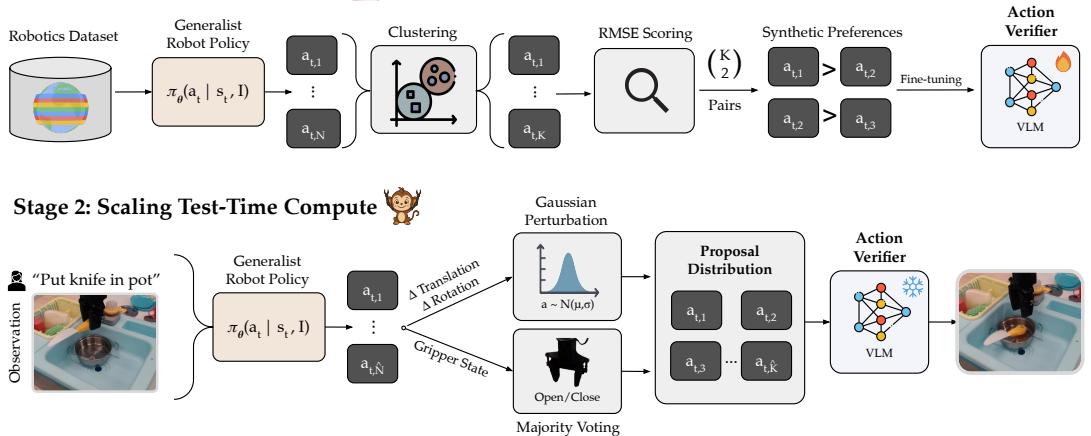
Stage 1: Training the Action Verifier
The core of RoboMonkey is a Vision-Language Model (VLM) fine-tuned to act as a critic. It takes an image, an instruction, and a proposed action, and outputs a scalar score representing the quality of that action.
But how do you train such a verifier? Manually labeling millions of robot actions as “good” or “bad” is prohibitively expensive. The authors introduce a clever Synthetic Data Generation Pipeline:
- Sample & Cluster: For a given state and instruction in a training dataset, they generate \(N\) actions using a standard robot policy. To ensure diversity, they cluster these down to \(K\) representative actions.
- Score: They calculate the Root Mean Squared Error (RMSE) between each generated action and the actual ground-truth action taken by the human expert in the dataset.
- Create Pairs: They create pairs of actions. If Action A has a lower RMSE (closer to expert) than Action B, the pair is labeled “A > B”.
This creates a massive dataset of synthetic preferences without any human intervention.
The Reward Modeling Objective
The verifier is trained using a modified Bradley-Terry model. This is similar to how RLHF (Reinforcement Learning from Human Feedback) models are trained, but with a specific tweak for continuous robotic actions.
The standard objective encourages the model to score the winning action (\(a^W\)) higher than the losing action (\(a^L\)). However, not all wins are equal. Sometimes action A is slightly better than B; other times, A is perfect and B is a disaster. To capture this, the authors add a margin term based on the actual difference in RMSE.
The loss function is defined as:

Here, \(\Delta_t^*\) represents the ground truth difference in quality (RMSE) between the two actions. The term \(\alpha\) is a hyperparameter that scales this margin. The authors found that setting \(\alpha=0.1\) significantly improves the verifier’s ability to distinguish between actions, enhancing precision and recall compared to a standard preference loss.
Stage 2: Scaling Test-Time Compute (Deployment)
Once the verifier is trained, RoboMonkey is ready for the real world. During deployment, the system follows the process illustrated in the bottom half of Figure 2.
- Initial Sampling: The system samples a small number (\(\hat{N}\)) of actions from the base VLA (e.g., OpenVLA).
- Proposal Distribution: Instead of querying the large VLA hundreds of times (which would be slow), the system fits a Gaussian distribution (\(\mathcal{N}(\mu, \Sigma)\)) to the translation and rotation components of the initial samples.
- Massive Sampling: It then draws a large number (\(\hat{K}\)) of cheap samples from this Gaussian distribution.
- Verification: The fine-tuned Action Verifier scores all \(\hat{K}\) candidates.
- Selection: The action with the highest score is executed.
This hybrid approach balances diversity with speed. The VLA provides the general “direction” (the Gaussian mean), while the perturbation explores the local space to find the precise movement needed, which the Verifier then identifies.
Experiments and Results
The researchers evaluated RoboMonkey on both simulated environments (SIMPLER) and physical hardware (WidowX robot).
In-Distribution Performance (Simulation)
In the SIMPLER environment, which replicates real-world setups, RoboMonkey was compared against the base OpenVLA model and V-GPS (another verification baseline).
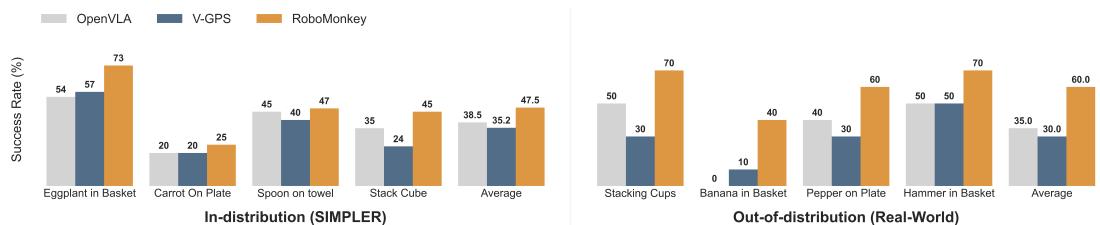
As shown in the left chart of Figure 3, RoboMonkey achieves an average success rate of 47.5%, a 9% improvement over the base OpenVLA policy. The improvements are most notable in tasks requiring high precision, such as “Stack Cube” (+10%) and “Eggplant in Basket” (+19%), where the base policy often failed due to minor collisions or imprecise grasping.
Out-of-Distribution Robustness (Real World)
The true test of a robot is how it handles things it hasn’t seen before. The authors set up four challenging real-world tasks involving novel objects (a hammer, a specific color of cup) and distractors.
The results (Right chart, Figure 3) were dramatic. RoboMonkey achieved a 60% success rate compared to just 35% for OpenVLA.
Take the “Banana in Basket” task. The scene contains a yellow banana and a yellow basket. The base OpenVLA model often got confused, achieving a 0% success rate because it couldn’t visually distinguish the target effectively. RoboMonkey, by generating diverse options and verifying them, was able to select actions that correctly targeted the banana, jumping to a 60% success rate.
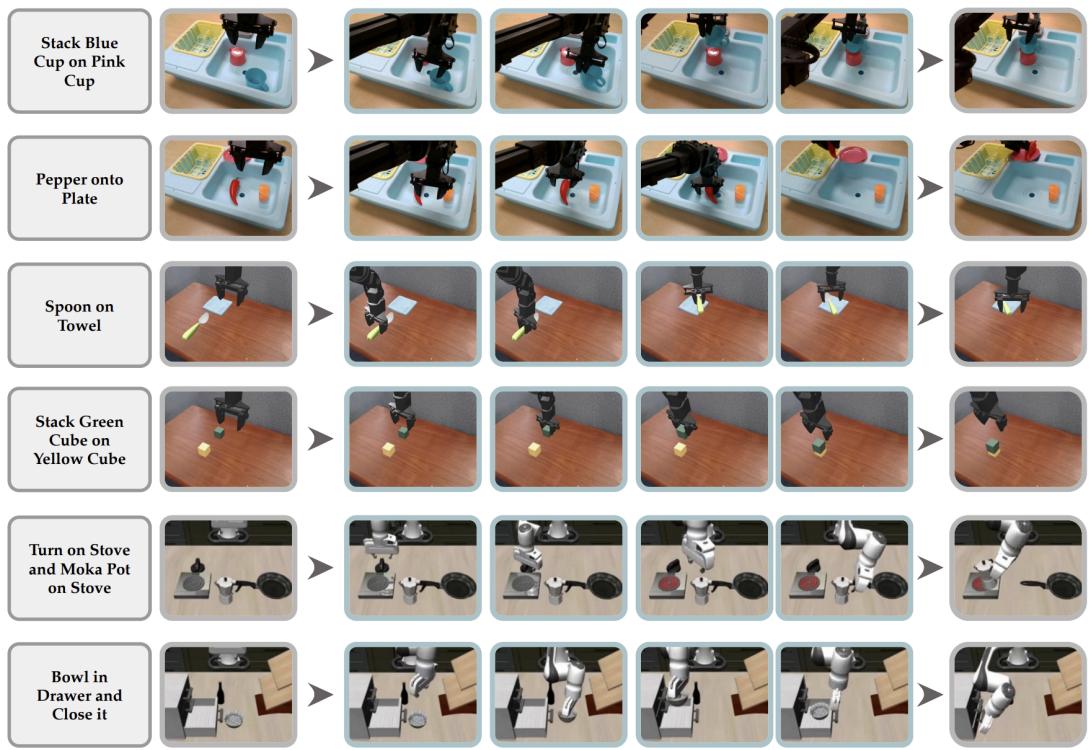
Figure 7 shows examples of these execution traces. Whether it is stacking cups or carefully placing a pepper on a plate, the verification step filters out the “hallucinated” or imprecise actions that plague standard VLAs.
Is it too slow? (Latency Analysis)
A common criticism of “test-time compute” is latency. If a robot takes 10 seconds to decide how to move 1 centimeter, it is useless.
The authors addressed this by implementing a custom serving engine using SGLang, optimized for batch processing.
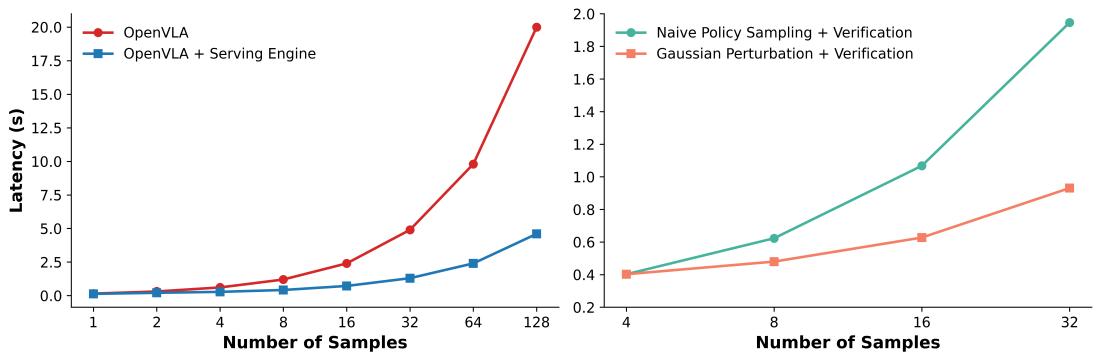
Figure 5 (Right) demonstrates why the Gaussian perturbation method is so vital. The orange line shows that as you scale the number of samples, the latency grows very slowly compared to naively querying the policy (teal line). By combining the custom serving engine with the Gaussian proposal strategy, RoboMonkey can sample and verify 16 candidates in approximately 650 ms (1.5 Hz). This is fast enough for smooth, real-time control.
The Power of Synthetic Data
Finally, the authors investigated if more data leads to better verifiers. Since the data is synthetic (generated from existing datasets), it is theoretically infinite.
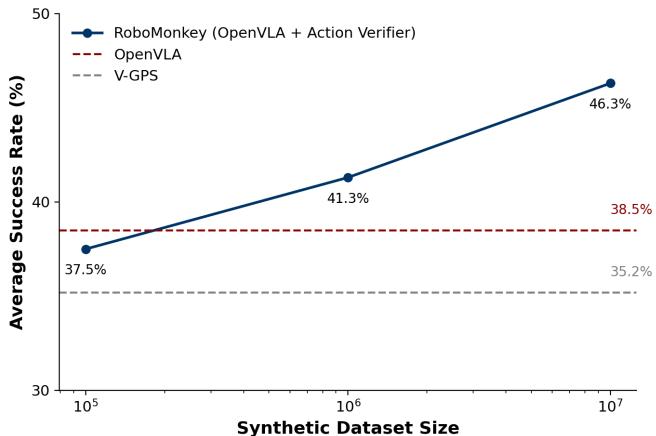
Figure 6 confirms that the “Scaling Law” applies to the verifier’s training data as well. Increasing the synthetic dataset size from \(10^5\) to \(10^7\) pairs resulted in a steady climb in downstream success rates. This suggests that simply processing more of our existing data into comparison pairs can yield better robots without needing new physical demonstrations.
Conclusion
RoboMonkey represents a shift in how we approach general-purpose robotics. Instead of asking models to be perfect on the first try, we are learning that it is more effective to let them “brainstorm” and then critique their own ideas.
The key takeaways from this work are:
- Inference-Time Scaling Laws exist for robots: Action error drops reliably as you generate more samples.
- Verification is easier than Generation: A VLM can be trained on synthetic data to robustly identify good actions, even in out-of-distribution scenarios.
- Efficiency matters: By using Gaussian perturbation and optimized serving, this “System 2” thinking can happen in real-time.
As robot foundation models continue to grow, frameworks like RoboMonkey suggest that the path to robustness isn’t just bigger models—it’s smarter inference. By allowing robots to “think” before they act, we move one step closer to deploying them in the unstructured chaos of the real world.