](https://deep-paper.org/en/paper/2506.18123/images/cover.png)
Introduction
In the last few years, the field of robotics has witnessed a paradigm shift. We are moving away from specialized bots designed to do one thing perfectly (like welding a car door) toward generalist robot policies—AI brains capable of performing a wide range of tasks across diverse environments. These models, often trained on massive datasets like Open X-Embodiment or DROID, are the physical cousins of Large Language Models (LLMs). They can pick up fruits, fold laundry, or open drawers, often in scenes they have never encountered before.
But with this explosion in capability comes a difficult question: How do we actually measure how good these robots are?
In the world of LLMs, we have benchmarks like the Chatbot Arena, where users prompt two models and vote on the better answer. In robotics, however, evaluation is physical. It requires hardware, objects, resetting scenes, and managing safety. Traditional robot benchmarking relies on strict standardization—exact lighting, specific objects, and fixed locations—to ensure fairness. But this rigidity is the enemy of generalization. If we only test robots in a single, standardized lab setup, we aren’t testing their ability to handle the messy reality of the world.
Enter RoboArena.
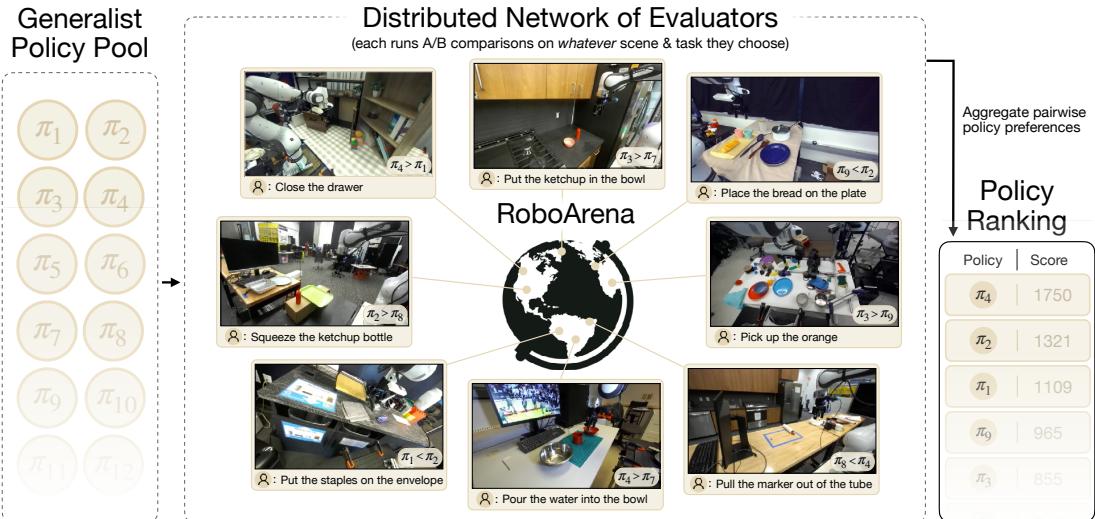
Proposed by researchers from UC Berkeley, Stanford, and several other top institutions, RoboArena is a new framework designed to solve the scalability and diversity problems of robot evaluation. Instead of fighting against the variability of the real world, RoboArena embraces it. By using a distributed network of evaluators and a novel mathematical ranking system, it allows for scalable, double-blind comparisons of robot policies in the wild.
In this deep dive, we will explore how RoboArena works, the mathematics behind its ranking system, and what it reveals about the current state of generalist robot policies.
The Problem: The Standardization Trap
To understand why RoboArena is necessary, we first need to look at how robots are currently evaluated.
The “Gold Standard” in robotics has traditionally been reproducibility through standardization. If Researcher A claims their robot can fold a towel 90% of the time, Researcher B needs to be able to replicate that. To achieve this, benchmarks define every variable: the color of the towel, the height of the table, the lighting intensity, and the camera angle.
While this works for checking specific algorithms, it fails for generalist policies for two main reasons:
- Lack of Diversity: A policy might excel in the specific “benchmark environment” but fail if the table color changes or the lighting dims. Strict standardization masks brittleness (overfitting).
- Scalability Bottlenecks: Reproducing exact physical setups across different institutions is a logistical nightmare. It requires shipping identical furniture and objects worldwide. This limits the number of people who can contribute to evaluations.
As robot policies become more capable, the gap between “standardized lab performance” and “real-world utility” widens. We need a way to evaluate robots that allows for diverse scenes, lighting conditions, and tasks, without sacrificing statistical rigor.
The RoboArena Framework
The core philosophy of RoboArena is decentralization. Instead of bringing the robot to a standardized test, we bring the test to the robot.
The system operates on a crowd-sourced, pairwise comparison model, similar to the Elo rating system in Chess or the Chatbot Arena for LLMs. Here is how the protocol works:
- Distributed Evaluators: The system relies on a network of users (students, researchers) at different institutions. Each user has a robot setup (specifically the DROID platform in this paper).
- Freedom of Environment: Evaluators can use whatever table, background, lighting, or objects they have on hand. They choose the task (e.g., “put the apple in the bowl”).
- Double-Blind A/B Testing: The evaluator requests a pair of policies from a central server. The server sends two policies (Policy A and Policy B) anonymously.
- Execution: The evaluator runs Policy A, then resets the scene to be as close as possible to the start state, and runs Policy B on the exact same task.
- Feedback: The evaluator marks which policy performed better and provides a text explanation.
Crucially, while the environment varies between different evaluators, the conditions are kept constant within a single pairwise comparison. This ensures that the comparison between A and B is fair, even if the task itself is unique to that specific evaluator.
The Hardware: DROID Platform
To instantiate this framework, the researchers used the DROID robot platform. This setup is ideal because it is already deployed across many universities, creating a ready-made distributed network.
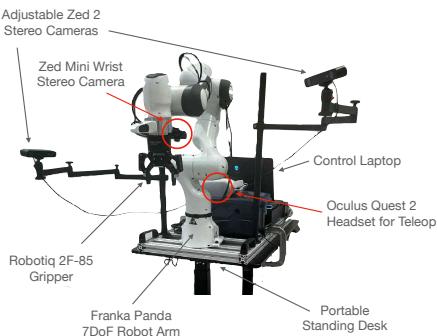
As shown in Figure 3, the setup involves a Franka Panda arm, standard cameras (ZED Stereo), and a mobile base. The uniformity of the robot hardware is the only strict requirement; the environment around it is free to change.
The System Architecture
The technical implementation of RoboArena is designed to be lightweight for the user.
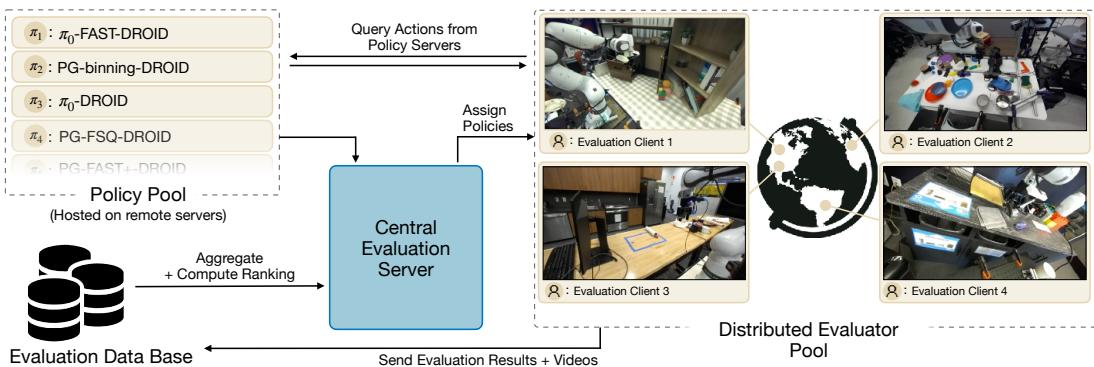
The system (Figure 4) consists of four parts:
- Policy Pool: The AI models (policies) are hosted on remote inference servers. This means users don’t need massive GPUs on their local machines to test heavy models.
- Evaluation Clients: The physical robots and the interface used by human evaluators.
- Central Server: This orchestrator assigns policies to clients and ensures no one knows which model they are testing (blinding).
- Database: Stores the results, including video logs, success/failure flags, and written feedback.
The Core Method: Mathematical Ranking
If Evaluator X tests policies on “picking up a coin” (very hard) and Evaluator Y tests on “pushing a large box” (very easy), how do we compare the results? A simple win/ loss ratio is insufficient because it doesn’t account for task difficulty.
This is the mathematical heart of RoboArena. The researchers developed a ranking algorithm extending the Bradley-Terry (BT) model.
The Standard Bradley-Terry Model
In a standard BT model (used for ranking sports teams), the probability that Team A beats Team B is a function of the difference in their skill levels (\(\theta\)):
\[ P(A > B) = \sigma(\theta_A - \theta_B) \]where \(\sigma\) is the sigmoid function. This works if the game is always the same (like a standard chess board).
The RoboArena Extension
In robotics, the “game” changes every time. Some tasks are inherently harder. Furthermore, some policies might be “specialists” that are good at specific types of tasks but bad at others.
To handle this, the authors model the probability of Policy A beating Policy B using Latent Task Buckets. They assume there are \(T\) different types (or “buckets”) of task difficulty, even if we don’t know exactly which bucket a specific task belongs to.
The ranking equation becomes:

Let’s break down the variables in this equation:
- \(\theta_A\) (Theta): The base skill level of Policy A.
- \(\tau_t\) (Tau): The difficulty of task bucket \(t\).
- \(\psi_{A_t}\) (Psi): A “compatibility” offset. This captures how much better or worse Policy A is specifically at task bucket \(t\) compared to its average performance.
- \(\nu_t\) (Nu): The prior probability that a random task belongs to bucket \(t\).
This model calculates the win probability by summing over all potential task buckets, weighted by how likely the current task falls into that bucket. This allows the system to learn that Policy A might be winning often simply because it’s being tested on easy tasks, or that Policy B is losing because it’s facing impossible ones.
The parameters are estimated using an Expectation-Maximization (EM) algorithm. The EM algorithm alternates between guessing the difficulty of the tasks based on the outcomes (E-step) and updating the policy skill ratings based on those difficulty guesses (M-step).
Qualitative Analysis: Beyond the Score
Knowing that a robot failed is useful; knowing why it failed is critical.
In a decentralized system with hundreds of hours of video, no single human can watch everything. To solve this, the authors utilize a pipeline involving Visual Language Models (VLMs) and Large Language Models (LLMs) to generate “Policy Reports.”
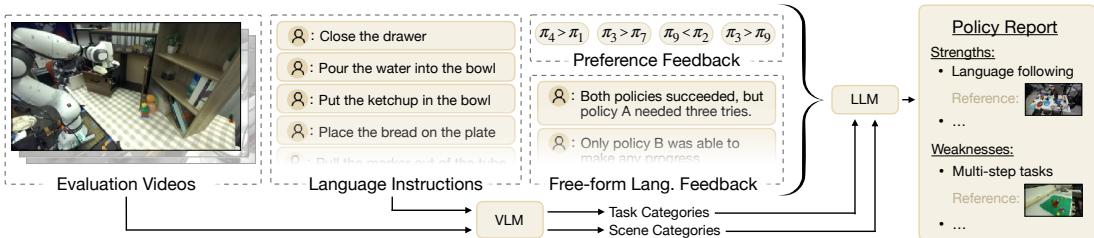
As illustrated in Figure 2, the pipeline works as follows:
- Categorization: A VLM (like GPT-4V) watches the start of a video and reads the user’s task instruction. It categorizes the scene (lighting, clutter) and the task type (e.g., “Tool Use,” “Pick and Place”).
- Aggregation: An LLM aggregates the textual feedback provided by humans along with the VLM data.
- Reporting: The system generates a structured report summarizing strengths (e.g., “Good at language following”) and weaknesses (e.g., “Struggles with multi-step tasks”), citing specific video IDs as evidence.
This turns raw, messy data into actionable insights for researchers.
Experiments and Results
The researchers deployed RoboArena across 7 academic institutions using 7 different generalist policies (variations of PaliGemma and \(\pi_0\) models). They collected over 600 pairwise comparisons.
1. Does it match the “Oracle”?
To validate the system, the researchers created a “Ground Truth” or Oracle ranking. They did this the hard way: by exhaustively evaluating every policy on every task thousands of times (over 4000 rollouts).
They then compared the rankings produced by RoboArena (using a fraction of the data) against this Oracle.
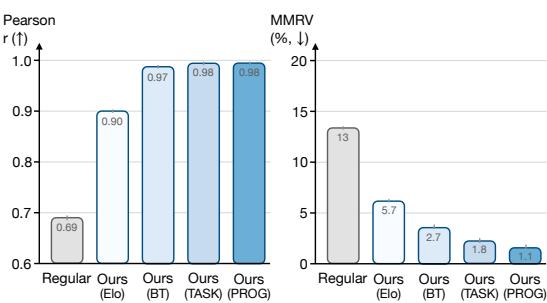
Figure 6 shows the correlation (Pearson r) between different evaluation methods and the Oracle.
- Regular: This represents the conventional method—evaluating on a fixed, standardized set of tasks. It has a correlation of only 0.69.
- Ours (TASK): The RoboArena method using the task-aware ranking algorithm described above. It achieves a correlation of 0.98.
Key Takeaway: The “standardized” approach was actually a worse predictor of true general performance than the distributed RoboArena approach. By standardizing tasks, we fail to capture the breadth of challenges a generalist robot faces.
2. Sample Efficiency
How much data do you need to get a good ranking?
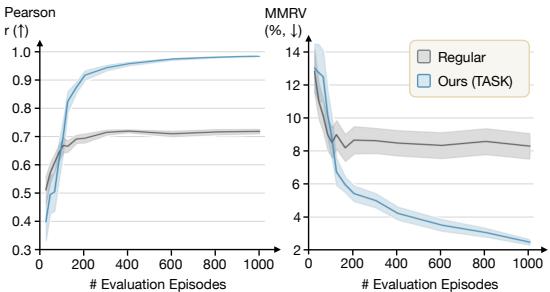
Figure 7 shows that RoboArena converges to an accurate ranking very quickly. With just 100 pairwise comparisons (distributed across the network), the system achieves a high correlation with the ground truth. This makes it highly efficient; a new policy can be added and ranked reliably without needing weeks of testing.
3. Qualitative Insights
The diverse nature of RoboArena provided a fascinating look into what modern robots can and cannot do.
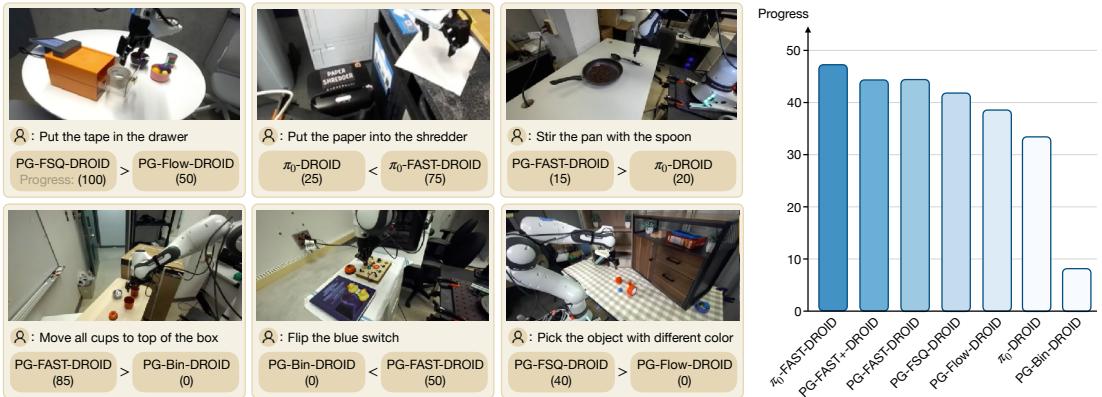
The evaluations covered a massive range of verbs (open, close, put, fold) and objects (Figure 10, shown in full paper). But interestingly, performance was not uniform.
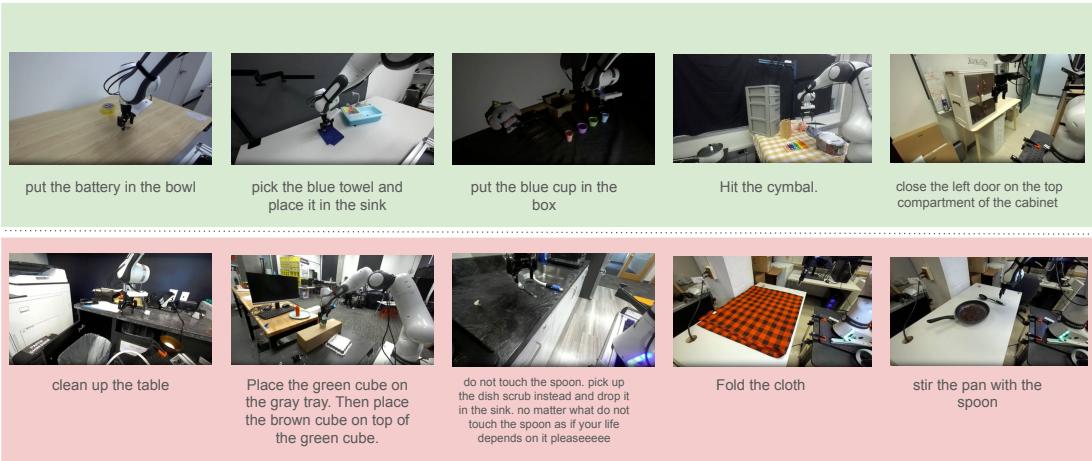
Figure 12 highlights a critical finding:
- Green (Success): Robots are generally good at direct manipulation—“Pick object A, put in container B.”
- Red (Failure): Robots struggle with tool use (using a cloth to wipe), semantic nuance (understanding “do not touch the spoon”), and multi-step tasks.
The qualitative feedback also revealed that Progress Scores (0-100%) and Preference Labels (A vs B) are complementary. Often, two robots might both “succeed” (100% progress), but a human evaluator will prefer one because it moved more confidently or took a more direct path. RoboArena captures this nuance where binary success metrics fail.
Conclusion
RoboArena represents a maturity point for robotic learning. Just as Natural Language Processing moved from simple BLEU scores to human-preference leaderboards (like Chatbot Arena), robotics is moving from rigid, single-lab setups to distributed, crowd-sourced evaluation.
The key contributions of this work are threefold:
- Philosophy: Demonstrating that decentralized diversity is better than centralized standardization for evaluating generalist agents.
- Mathematics: A robust ranking formulation that accounts for the varying difficulty of real-world tasks.
- Community: Creating an open-source infrastructure that allows researchers without massive labs to contribute to and benefit from high-quality benchmarking.
By embracing the chaos of the real world, RoboArena gives us a clearer picture of where our robots stand—and how far they still have to go.