](https://deep-paper.org/en/paper/2506.19325/images/cover.png)
Imagine a classroom where every student has a personal tutor—one that is infinitely patient, available 24/7, and knows exactly how to guide a student from a wrong answer to the right one without just giving it away. This has been the “North Star” of educational technology for decades.
With the rise of Large Language Models (LLMs), this dream seems closer than ever. However, there is a catch. While LLMs are great at chatting, they aren’t naturally perfect teachers. To make them effective, they need to be trained on high-quality pedagogical data. specifically, they need to know what good feedback looks like compared to bad feedback.
Traditionally, gathering this data requires human experts to write and rank thousands of feedback examples—a process that is notoriously slow and expensive.
In this post, we’re diving into a new framework called FEAT (Feedback Dataset Generation Framework for English AI Tutoring). This research proposes a clever way to use LLMs to generate their own training data, drastically reducing the reliance on human labor while actually improving performance.
The Bottleneck: The Cost of Quality
To understand why FEAT is necessary, we first need to look at how we currently train AI to be helpful. The standard approach is Reinforcement Learning from Human Feedback (RLHF). This involves a three-step pipeline:
- Generation: An AI proposes several answers.
- Annotation: A human expert ranks these answers from best to worst.
- Optimization: The AI learns to predict these rankings and optimize its output.
In the context of English tutoring, this is difficult. As shown in the figure below, the “Gold Standard” (Method a) involves humans generating feedback manually. This ensures quality but doesn’t scale. Method (b) uses AI to generate options, but still requires humans to rank them.
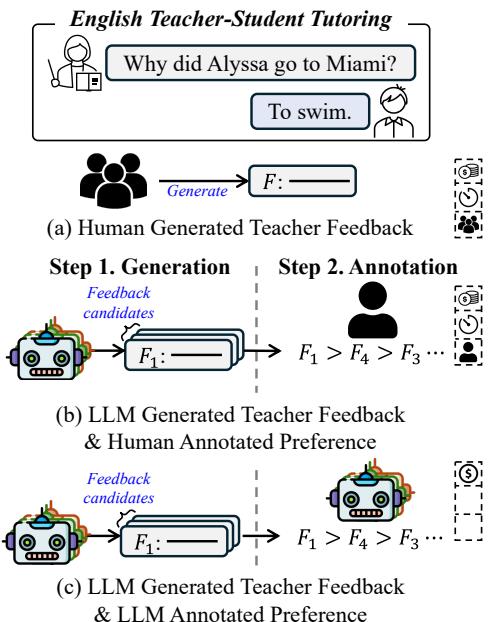
The researchers behind FEAT asked a critical question: Can we move to Method (c)? Can we have an AI generate the feedback and another AI rank the quality, removing the human bottleneck entirely?
Enter FEAT: A Cost-Effective Framework
FEAT stands for Feedback Dataset Generation Framework for English AI Tutoring. It is a systematic approach to constructing preference datasets—data that tells a model “Option A is better than Option B.”
The core innovation of FEAT is how it constructs three distinct types of datasets to test the trade-off between cost and quality.
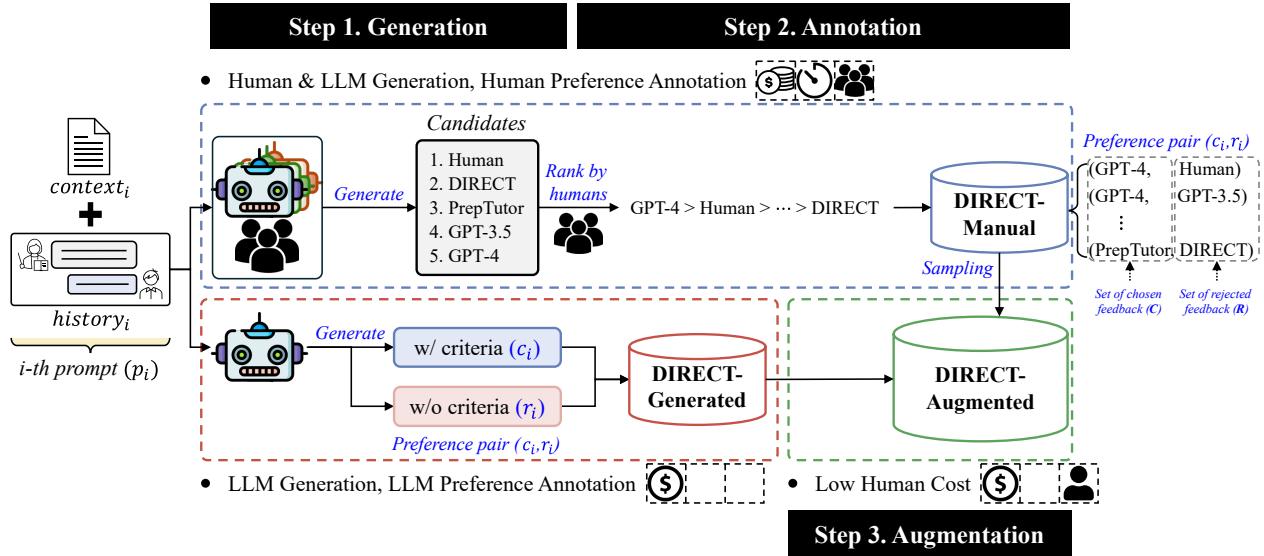
As illustrated in the architecture diagram above, the framework operates in three main stages to create three datasets: DIRECT-Manual (DM), DIRECT-Generated (DG), and DIRECT-Augmented (DA). Let’s break these down.
1. DIRECT-Manual (DM): The High-Quality Baseline
This dataset represents the traditional, expensive approach. It serves as the ground truth for high-quality tutoring.
- Generation: Feedback candidates were collected from diverse sources, including human teachers and various AI models (GPT-3.5, GPT-4, and specialized tutoring models).
- Ranking: Human annotators manually ranked these candidates. They didn’t just pick the one that sounded nicest; they looked for specific pedagogical traits:
- Correct: Is the information accurate?
- Revealing: Does it guide the student without giving away the answer?
The result is a set of “chosen” (better) and “rejected” (worse) pairs. Figure 3 below shows what a sample from this manual dataset looks like. Notice how the “Human” and “GPT-4” feedback attempts to guide the student, while the “Reference” just gives the answer.

2. DIRECT-Generated (DG): The Synthetic Solution
This is where FEAT introduces automation to cut costs. Instead of relying on existing dialogues, the researchers used the MCTest dataset (a reading comprehension test for students) to simulate tutoring scenarios.

Using the story and questions from MCTest (as seen in Figure 4), they tasked an LLM to generate feedback. But here is the clever part: they generated two types of feedback to create a training pair automatically.
- Feedback w/ Criteria: The LLM is prompted to generate feedback using five specific educational criteria (Correct, Revealing, Guidance, Diagnostic, Encouragement). This is labeled as Chosen.
- Feedback w/o Criteria: The LLM is prompted to generate feedback without these specific instructions. This is labeled as Rejected.
The assumption is that feedback generated with specific pedagogical instructions will be superior to generic feedback. This allows the system to auto-label the data without a human ever looking at it.
3. DIRECT-Augmented (DA): The Hybrid Approach
The third dataset, DA, combines the two. It takes the massive, cheap DG dataset and sprinkles in a small percentage of the high-quality, human-annotated DM dataset. The goal is to see if a small amount of human effort can “supercharge” a large amount of synthetic data.
The Five Pillars of Educational Feedback
A major contribution of this work is defining what “good” feedback actually means for an AI tutor. The FEAT framework emphasizes five criteria during the generation process:
- Correct: Factual accuracy regarding the text and the student’s error.
- Revealing: Scaffolding the learning rather than spoon-feeding the answer.
- Guidance: Providing a clear direction for the student’s next thought.
- Diagnostic: Identifying why the student might have been wrong.
- Encouragement: Keeping the student motivated.
The researchers hypothesized that training models to prefer feedback that satisfies these five pillars would result in a superior tutor.
Experiments: Does Synthetic Data Work?
To validate FEAT, the researchers trained several “Ranking Models.” These are models designed to look at two pieces of feedback and predict which one is better. They used various architectures (Binary Classifiers, Reward Models, DPO, and RankNet) and backbone models (Llama and Qwen).
They used a metric called Rank-Biased Overlap (RBO). In simple terms, RBO measures how similar the AI’s ranking is to a human expert’s ranking. An RBO of 1.0 means the AI and the human agree perfectly.
Result 1: Synthetic Data is Competitive
The first major finding was that models trained only on the synthetic, auto-generated data (DG) performed surprisingly well when tested against human judgments.

In Figure 5, the lines represent the performance of models trained on human data (DM -> DM), while the bars represent models trained on synthetic data (DG -> DM). While the human-trained models generally perform better (which is expected), the synthetic models are competitive, particularly when using ensemble methods. This proves that we can get “reasonably good” AI tutors without any human labeling.
Result 2: The Power of Hybrid Data
The most significant discovery came from the DIRECT-Augmented (DA) experiments. The researchers asked: How much human data do we actually need?
They started with the synthetic dataset and slowly added chunks of human-labeled data (from 5% to 100%).
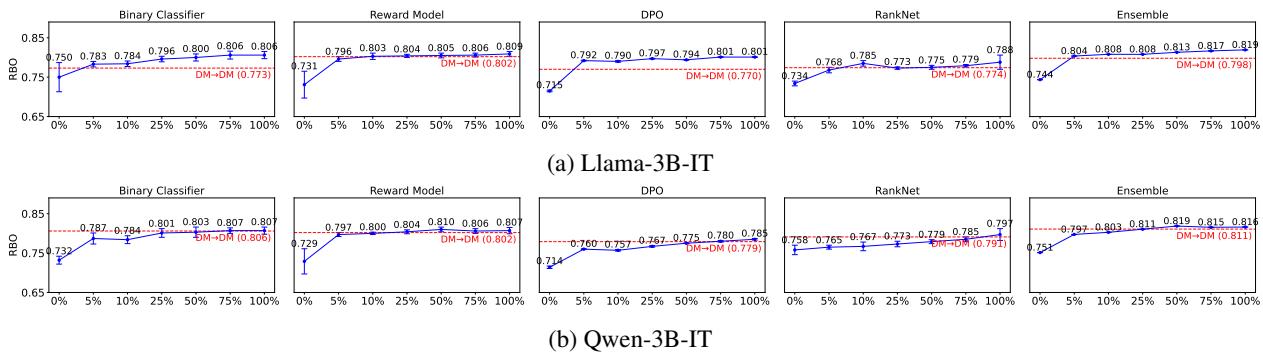
Figure 6 reveals a counter-intuitive and powerful result. Look at the blue lines (the hybrid DA models). In many cases, specifically with the Llama-3B-IT model, the performance crosses the red dashed line (the 100% human data baseline) very early on.
Key Finding: Incorporating just 5–10% of human-annotated data into the synthetic dataset led to performance that was superior to using 100% human-annotated data alone.
This suggests that the diversity and scale of the synthetic data, when grounded by a small set of high-quality human examples, creates a more robust learning environment for the AI than human data alone.
Result 3: More Criteria = Better AI
Finally, the researchers tested whether those five pedagogical criteria (Correct, Revealing, Guidance, Diagnostic, Encouragement) were actually necessary. They compared models trained on feedback generated with all 5 criteria versus models trained on feedback using only the basic 2 (Correct and Revealing).
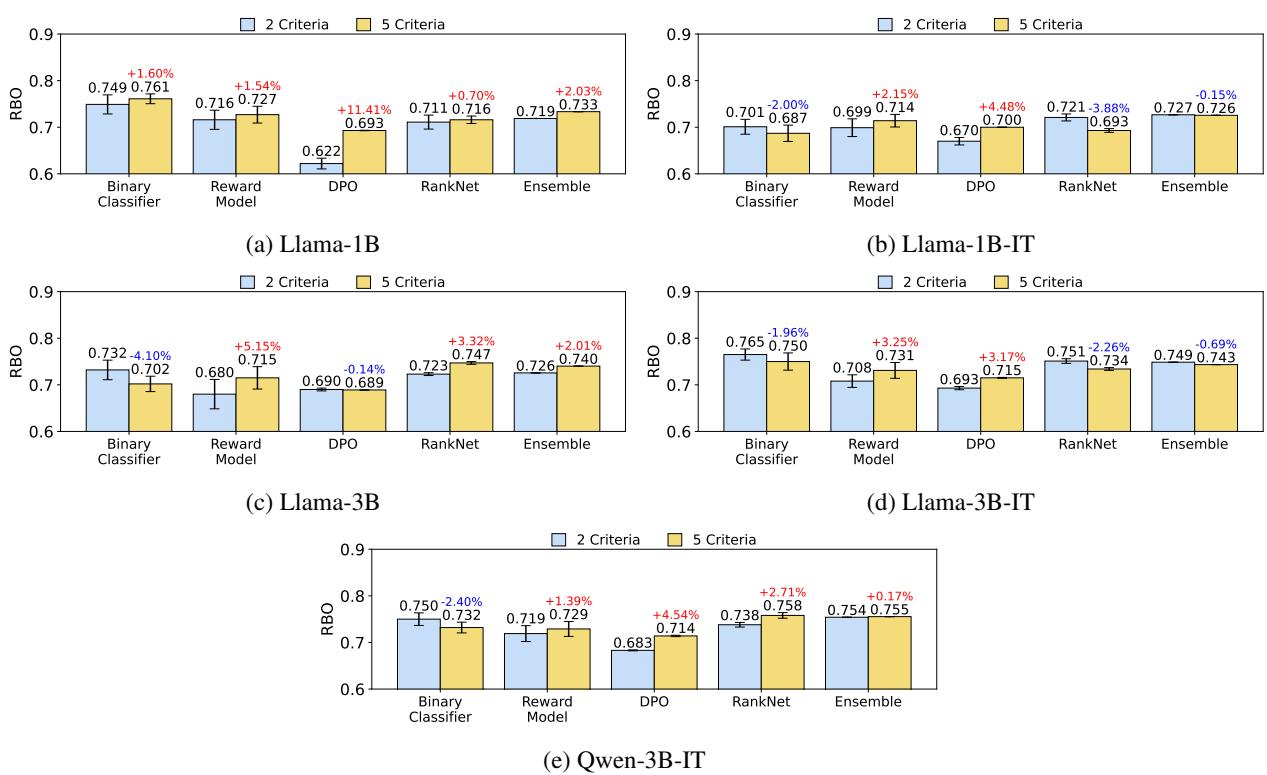
Figure 7 shows the percentage improvement when using 5 criteria. Across almost all models and methods, adding the extra criteria improved the model’s ability to rank feedback correctly. The DPO (Direct Preference Optimization) method, a popular technique in modern LLM training, saw improvements of over 11% for the Llama-1B model.
Conclusion and Future Implications
The FEAT framework addresses one of the most significant barriers in EdTech: the high cost of creating quality data. By demonstrating that LLMs can effectively generate their own training data—and that mixing this with a tiny fraction of human data yields state-of-the-art results—this paper offers a blueprint for scaling AI tutors.
Key Takeaways for Students:
- Data Scarcity is Solvable: You don’t always need massive budgets for human annotators. Clever prompting and synthetic data generation can bridge the gap.
- Hybrid is Best: Purely synthetic data is good; purely human data is better; but a hybrid of both (Augmented) appears to be the best.
- Pedagogy Matters: Simply asking an AI to “give feedback” isn’t enough. Defining specific criteria (like being “Diagnostic” or “Revealing”) drastically improves the quality of the generated data.
As we move forward, frameworks like FEAT will likely expand beyond English tutoring into math, science, and coding, eventually leading to personalized AI tutors that are not just knowledgeable, but pedagogically skilled.