](https://deep-paper.org/en/paper/2506.19571/images/cover.png)
Introduction
In the field of Artificial Intelligence, specifically Natural Language Processing (NLP), we often view human performance as the ultimate “ceiling” to reach. Whether it is playing Chess, Go, or translating text, “Human Parity” is the holy grail. Once an AI system performs as well as a human, we consider the problem largely solved.
But there is a paradox emerging in the sub-field of Machine Translation (MT) Evaluation. We use automated metrics (algorithms that grade translations) to speed up research because human evaluation is slow and expensive. To know if these metrics work, we compare them against a “Gold Standard”—human judgment.
But what happens when the automated metrics start agreeing with the “ground truth” more consistently than human annotators agree with each other?
This is the central question posed by a recent research paper titled “Has Machine Translation Evaluation Achieved Human Parity?” by researchers from the Sapienza University of Rome. The paper explores a fascinating and slightly unsettling possibility: that our automated evaluation tools might have become so sophisticated that we can no longer reliably measure their progress using individual human baselines.
In this deep dive, we will unpack how the researchers turned the tables on standard evaluation by treating humans as “just another system” to be ranked. We will explore the mathematics of “Meta-Evaluation,” analyze the startling results where algorithms outrank people, and discuss the existential crisis this creates for the future of MT research.
Background: The Problem of Grading the Graders
To understand this paper, we first need to understand the ecosystem of Machine Translation Evaluation.
When a researcher builds a new translation model (like the systems behind Google Translate or DeepL), they need to know if it’s any good. They have two options:
- Human Evaluation: Give the translations to professional bilingual linguists. This is the Gold Standard. It is accurate but extremely expensive and slow.
- Automatic Metrics: Use an algorithm to compare the machine’s output to a reference translation. This is fast and free.
Historically, metrics were simple. BLEU (BiLingual Evaluation Understudy), introduced in 2002, simply counted matching words between the output and the reference. It was crude but useful. However, in the Deep Learning era, metrics have evolved. We now use Neural Metrics (like COMET or BLEURT) and Large Language Model (LLM) based evaluators (like GEMBA). These systems don’t just count words; they understand semantic meaning.
The Meta-Evaluation Gap
How do we know if a metric like COMET is good? We perform a Meta-Evaluation. We take a dataset where we have human scores for translations, and we check how well the metric’s scores correlate with those human scores.
Usually, this process assumes that the human score is the absolute truth. However, humans are subjective. Two professional translators might disagree on whether a translation is “perfect” or just “good.” In other NLP tasks, like the HellaSwag or MMLU benchmarks, researchers calculate a “human baseline”—the score a human achieves—and check if the AI beats it.
Surprisingly, Machine Translation Evaluation has lacked a robust human performance reference. We usually compare metrics to humans, but we rarely compare humans to humans in the context of metric ranking. This paper fills that gap. By estimating the agreement among human annotators, the researchers establish an “upper bound” for performance.
Methodology: Turning Humans into Baselines
The core innovation of this paper is the inclusion of Human Baselines in the “Metrics Shared Task” rankings. The researchers took historical data from the Conference on Machine Translation (WMT) from 2020 to 2024 and re-analyzed it.
Instead of just ranking metrics (like BLEURT, COMET, MetricX) against the ground truth, they took groups of human annotators, treated them as an “evaluator,” and put them on the scoreboard alongside the AI metrics.
The Data and Annotators
The study utilizes test sets from English to German (EN\(\to\)DE), Chinese to English (ZH\(\to\)EN), and others. The critical component here is the type of human evaluation protocols used. Not all human scoring is equal:
- MQM (Multidimensional Quality Metrics): The platinum standard. Expert linguists identify specific error spans (e.g., “wrong word order,” “mistranslation”) and assign severity penalties. This is usually used as the Ground Truth.
- SQM (Scalar Quality Metrics): Raters give a single score (0-6 or 0-100) based on overall impression.
- ESA (Error Span Annotation): A hybrid approach where raters highlight errors and then give a score.
The Disjoint Rater Problem
A major methodological challenge the authors faced was “fairness.” If you are trying to measure how well Human Group A agrees with the Ground Truth, you must ensure that no individual person belongs to both groups.
If Rater Steve contributes to the Ground Truth score and the Human Baseline score, the agreement will be artificially inflated. To solve this, the researchers had to filter the datasets. They identified segments where they could strictly partition the raters into disjoint groups.
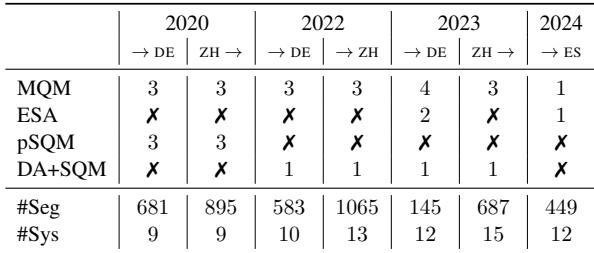
As shown in the table above (Table 1 from the paper), this strict filtering reduced the number of segments (sentences) available for analysis, but it ensured mathematical integrity. For example, in the “2020 EN\(\to\)DE” set, they extracted 3 distinct human evaluators from the pool of raters.
The Mathematical Rulers: SPA and Acc-Eq
How exactly do you score a metric (or a human evaluator)? The authors employed two advanced meta-evaluation formulas used in WMT 2024.
1. Pairwise Accuracy (PA) and Soft Pairwise Accuracy (SPA)
The traditional way to judge an evaluator is Pairwise Accuracy (PA). You take two translation systems, System A and System B.
- The Ground Truth says: System A is better than System B.
- The Metric says: System A is better than System B.
- Result: Success.
The formula for standard PA is:

However, PA is binary. It doesn’t care if System A was much better or only slightly better. The authors prefer Soft Pairwise Accuracy (SPA). SPA incorporates statistical significance (p-values). It rewards an evaluator not just for getting the order right, but for having similar confidence levels as the ground truth.
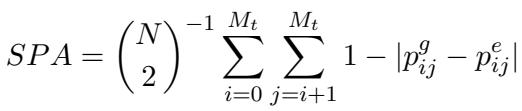
If the Ground Truth is 99% sure A > B, and the metric is only 55% sure, SPA penalizes the metric more than PA would.
2. Pairwise Accuracy with Tie Calibration (\(acc_{eq}^*\))
SPA evaluates how well metrics rank systems (aggregates). But we also want to know how well they rank individual translations. This is where \(acc_{eq}^*\) comes in.
This metric is tricky because of Ties. Humans often give the same score to two different translations (e.g., both are “Perfect”). Continuous neural metrics (which output floats like 0.98234) almost never produce exact ties.
To make the comparison fair, the metric uses a “Tie Calibration” step. It calculates a threshold \(\epsilon\). If the difference between two metric scores is smaller than \(\epsilon\), they are considered tied.
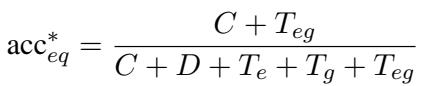
In this equation:
- \(C\): Concordant pairs (Evaluator and Ground Truth agree on order).
- \(D\): Discordant pairs (They disagree).
- \(T\): Tied pairs.
This measure is essentially asking: “Can this evaluator distinguish between a better and worse translation as well as the Ground Truth can?”
The Competitors
The researchers pitted human cohorts against a wide array of automatic metrics.
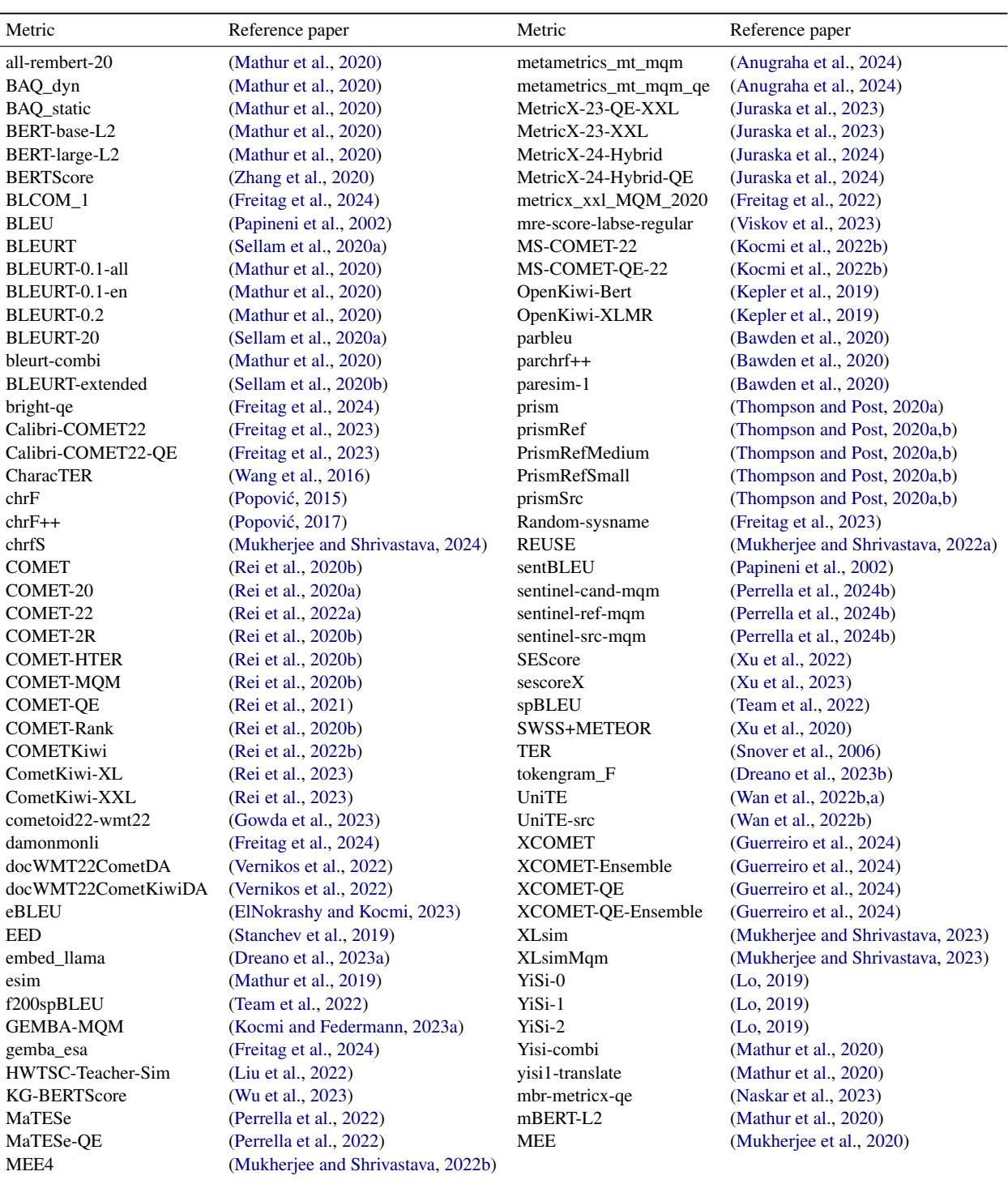
The list includes:
- MQM-based metrics: Metrics trained specifically to predict MQM scores (e.g., COMET-MQM).
- LLM-based metrics: Using GPT-4 prompts to grade translations (e.g., GEMBA-MQM).
- Reference-less metrics (Quality Estimation): Metrics that judge quality without needing a human reference translation (e.g., COMET-QE, MetricX-QE).
Experimental Results: The Parity Moment
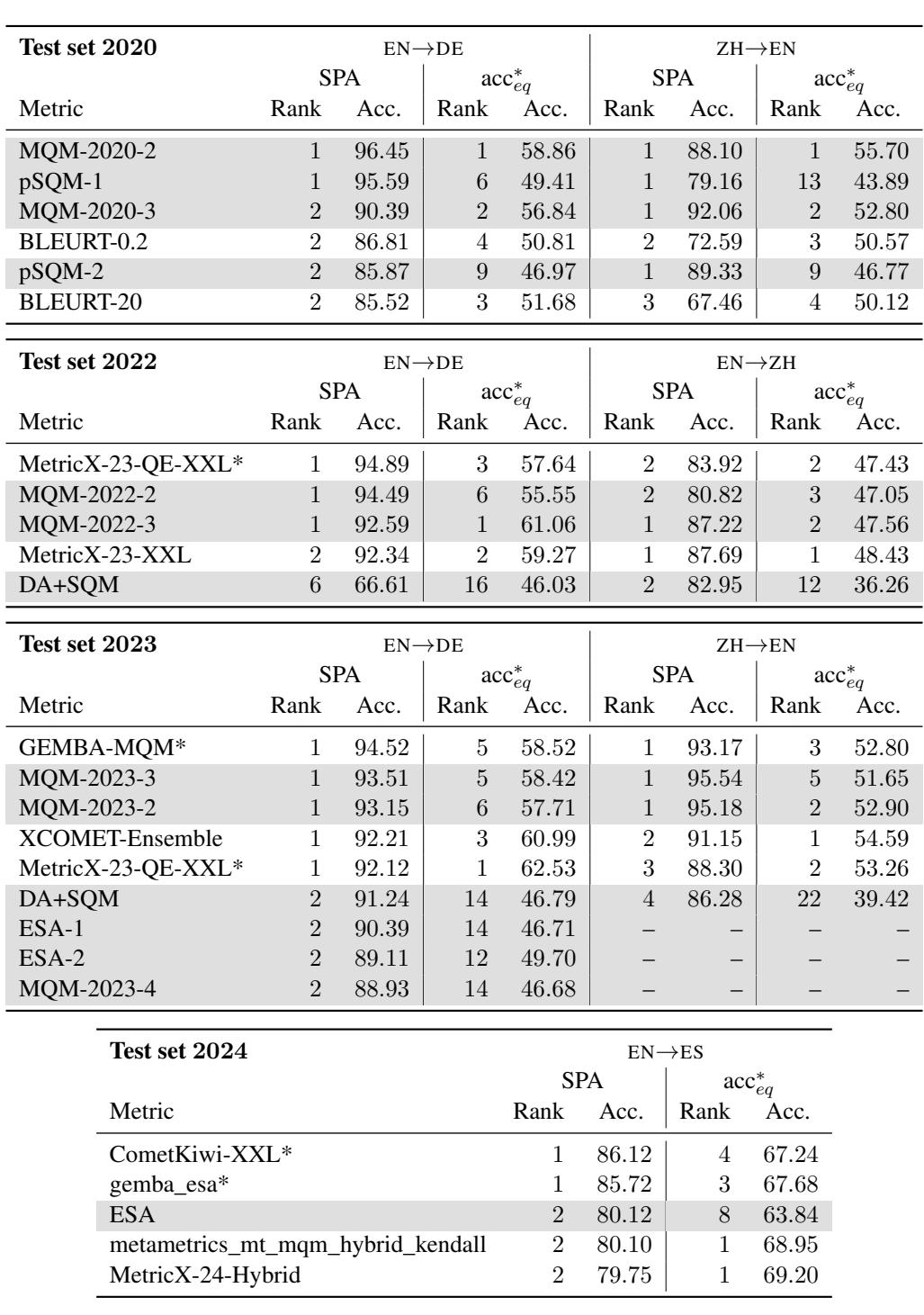
The results of this study are striking. When the researchers integrated human baselines into the rankings, they found that humans were not consistently at the top.
Let’s look at the overview of the rankings. In the table below, rows highlighted in gray are Human Evaluators.
Breakdown by Year
The progression from 2020 to 2024 tells a story of rapid AI improvement.
2020: Humans still rule
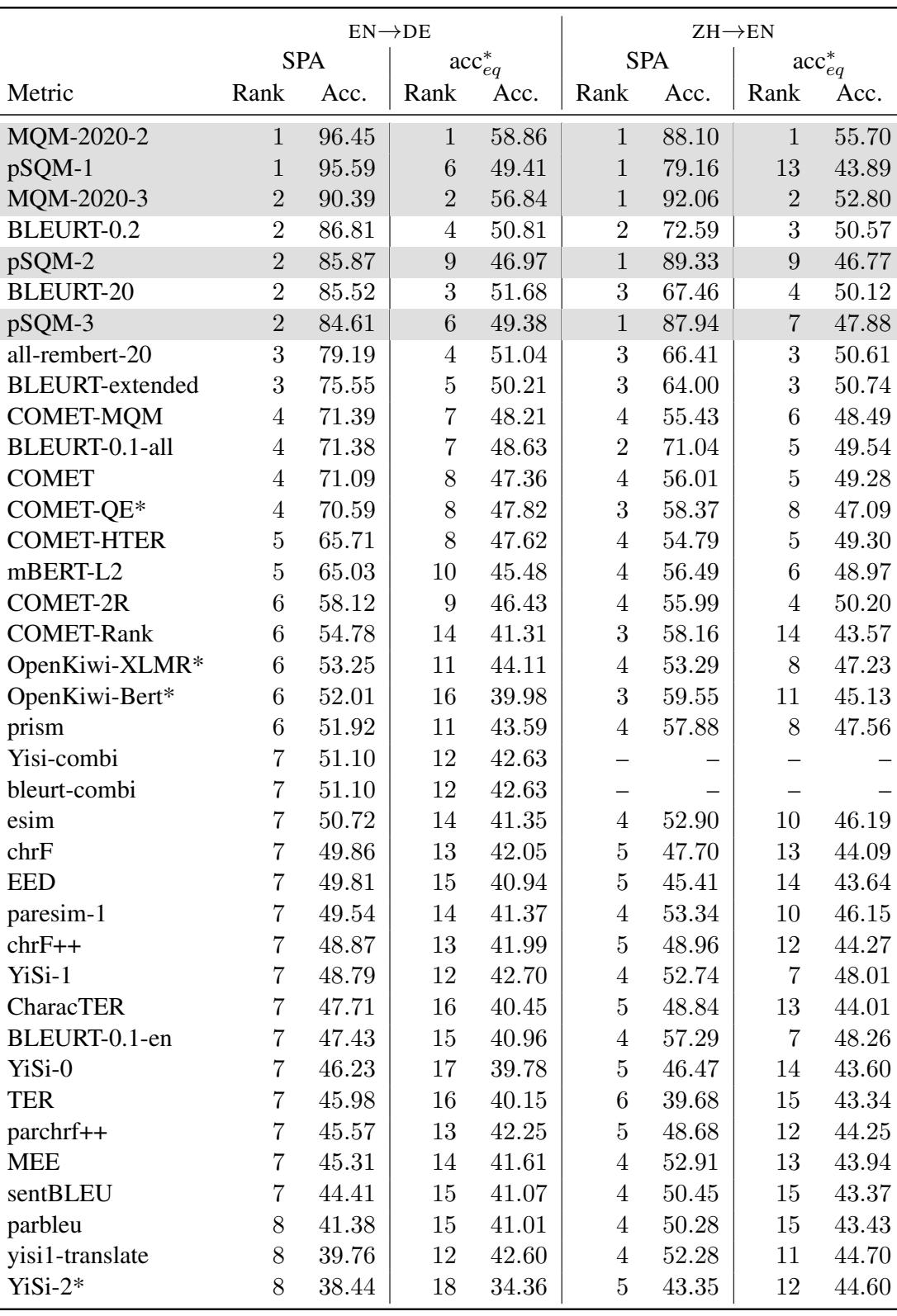
In the 2020 dataset (Table 4 below), human evaluators (MQM, pSQM) largely dominated the rankings.
- For EN\(\to\)DE, the human evaluator “MQM-2020-2” was Rank 1.
- However, notice that
BLEURT-20andMetricXwere already creeping up, sharing the second rank cluster.
2022: The Gap Closes
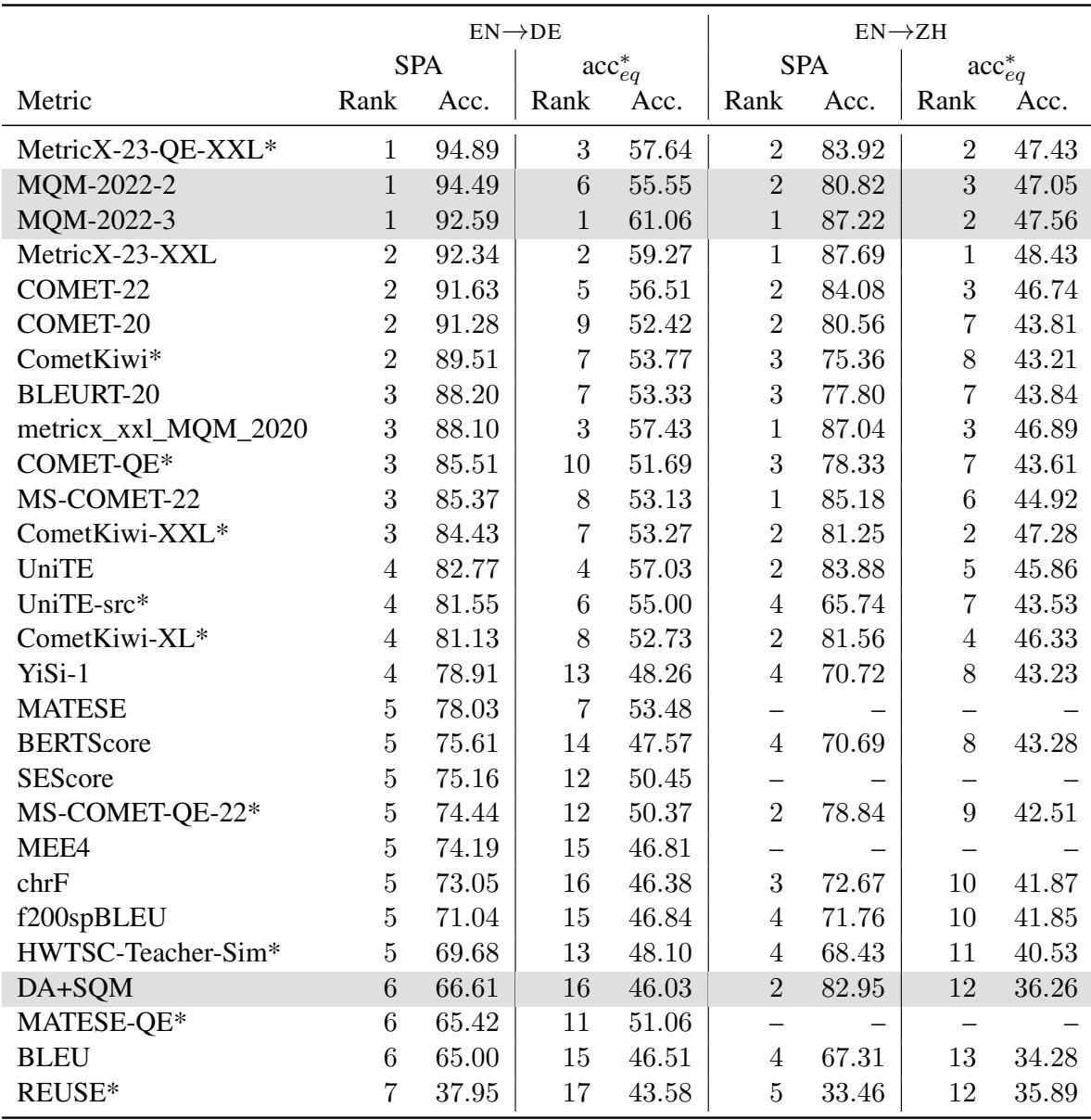
By 2022 (Table 5 below), the landscape shifted.
- MetricX-23-QE (a quality estimation metric) took Rank 1 in SPA for EN\(\to\)DE, effectively tying with the MQM human baselines.
- In the \(acc_{eq}^*\) metric (ranking individual sentences), the metric
MetricX-23-XXLactually outperformed several human configurations.
2023 & 2024: The Flipping Point
The 2023 and 2024 results (Tables 6 and 7 below) show the most dramatic shift.
- In 2023 EN\(\to\)DE (Table 6), the metric GEMBA-MQM (based on GPT-4) achieves the top rank.
- Crucially, under the \(acc_{eq}^*\) measurement, the human evaluators often drop significantly in rank. For example, the human evaluator
DA+SQMfalls to Rank 14, while neural metrics fill the top spots.
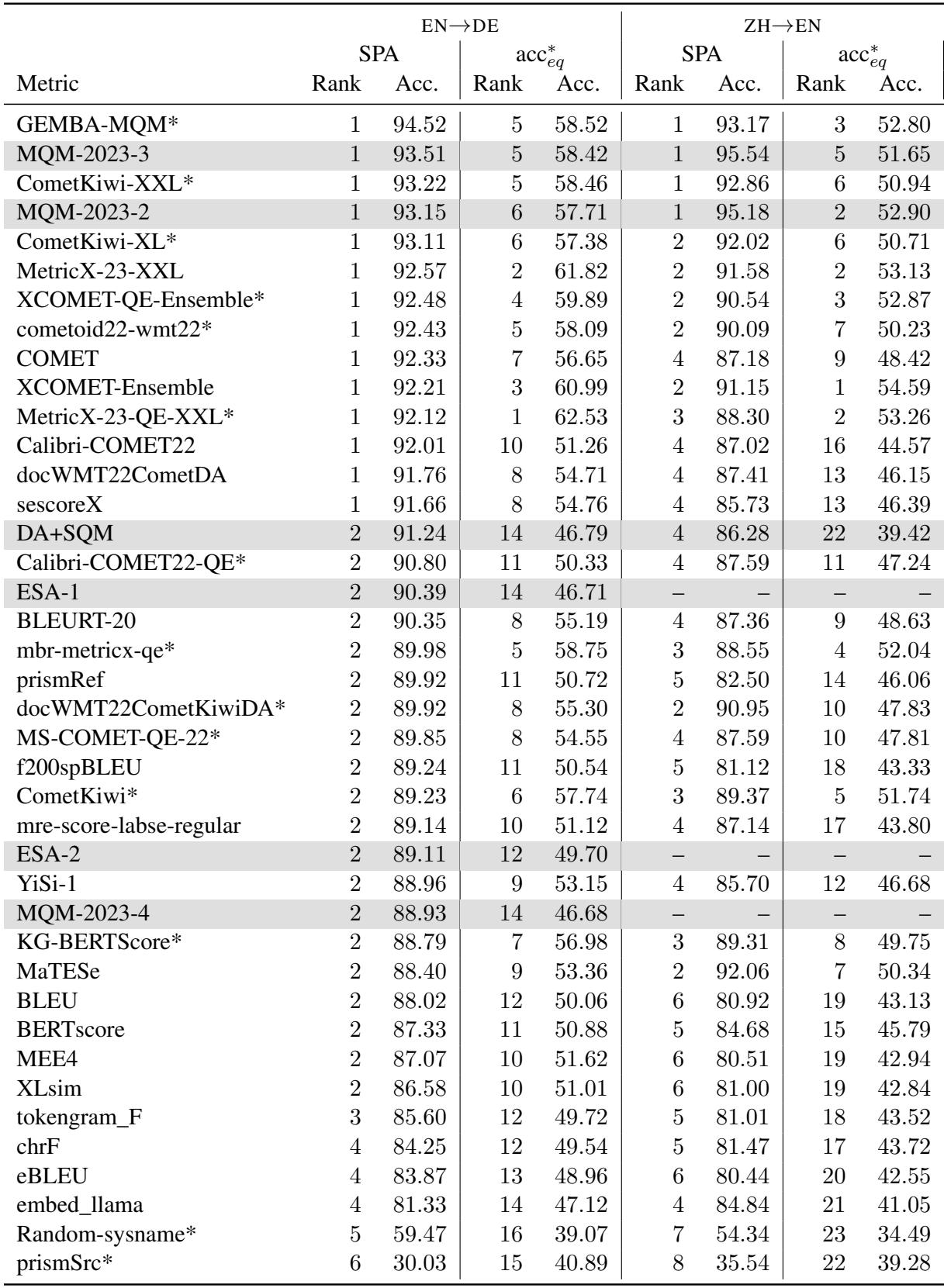
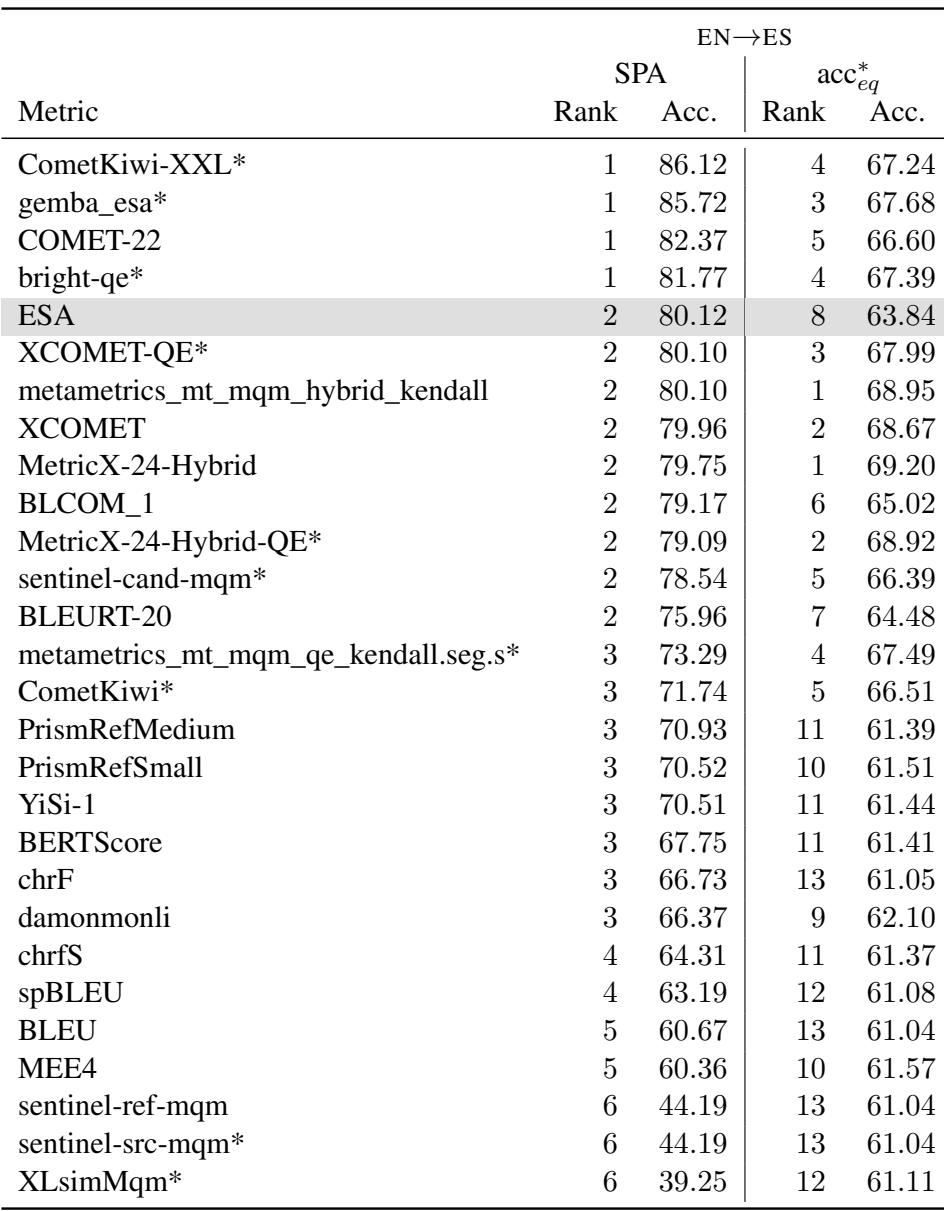
In 2024 (Table 7), for English to Spanish, CometKiwi-XXL and GEMBA rank #1, while the human baseline ESA (Error Span Annotation) drops to Rank 2 in SPA and Rank 8 in segment-level accuracy.
Summary of Results
The data suggests that automatic metrics have achieved, and in some cases surpassed, the reliability of human baselines. Specifically:
- SPA (System Level): Metrics like GEMBA and MetricX are statistically indistinguishable from, or better than, human groups.
- Segment Level (\(acc_{eq}^*\)): Metrics often perform strictly better than human baselines.
Discussion: Is “Superhuman” Quality Real?
If we take these numbers at face value, the conclusion is explosive: AI is better at judging translation quality than humans are.
However, the authors devote a significant portion of the paper to “pumping the brakes” on this conclusion. They argue that statistical parity does not necessarily mean true cognitive parity. They identify three major reasons for caution.
1. The Meta-Evaluation Trap (Tie Calibration)
The researchers noticed a discrepancy: Human evaluators rank much lower on \(acc_{eq}^*\) (segment-level) than on SPA (system-level).
Why? It comes down to how humans score. Humans use discrete scales (e.g., 0, 1, 2… 100). They produce many perfect ties. Metrics produce continuous numbers. The “Tie Calibration” algorithm tries to fix this, but previous research suggests this mathematical fix inherently favors continuous metrics over discrete ones. The metric might “win” simply because its score distribution is mathematically smoother, not because it understands the text better.
2. Annotation Quality
Not all “human” scores are equal. In the 2023 dataset, the human evaluator protocol DA+SQM performed very poorly. The authors suggest this might be due to low annotation quality—perhaps the raters were tired, the guidelines were unclear, or the task was too subjective.
If the “Human Baseline” is composed of distracted or non-expert raters, beating them isn’t a sign of superhuman AI; it’s just a sign that the humans did a poor job.
3. The “Easy Benchmark” Problem
This is perhaps the most critical point. The authors observe that in some test sets, surface-level metrics (which only check for fluency, not meaning) ranked as high as human evaluators.
This implies that the test sets might be too easy. If the translations are all very good, the only errors are minor fluency hiccups. AI metrics are great at spotting missing commas or awkward grammar. But does the metric understand a subtle mistranslation of a cultural idiom? We don’t know, because the datasets might not contain enough difficult, “adversarial” examples to separate the humans from the machines.
The Broader Implication: The Limits of Measuring Progress
The paper concludes with a somewhat philosophical problem facing the field of MT Evaluation.
If our automatic metrics are now ranking higher than our human baselines, we are losing our ability to measure progress.
Imagine a ruler used to measure a table. If the ruler is warped, you can’t measure the table accurately. In MT Evaluation, the “Ground Truth” (MQM annotations) is the ruler.
- If a new metric (Metric A) ranks higher than a human, does it mean Metric A is better?
- Or does it simply mean Metric A has “overfitted” to the specific idiosyncrasies of the specific linguists who created the Ground Truth?
The authors warn that we might be reaching a point where higher rankings don’t reflect better evaluation quality, but merely closer alignment with a specific annotation protocol. We are hitting the ceiling of what the current “Gold Standard” can teach us.
Conclusion
The paper “Has Machine Translation Evaluation Achieved Human Parity?” provides a rigorous, data-driven reality check for the NLP community. By integrating human baselines into the evaluation loop, the authors demonstrated that state-of-the-art metrics like GEMBA and MetricX effectively rival human performance on current benchmarks.
However, “Parity” is a dangerous word. The study highlights that while the numbers look superhuman, the reality is nuanced by mathematical biases and dataset limitations.
The takeaway for students and future researchers is clear: We cannot blindly trust the leaderboard. As AI systems improve, our evaluation methods must become more rigorous. We need harder test sets, better human annotation protocols, and a deeper understanding of what it means for a machine to “understand” quality. Until then, we are navigating a world where the students (AI) are rapidly outsmarting the tests we designed for them.